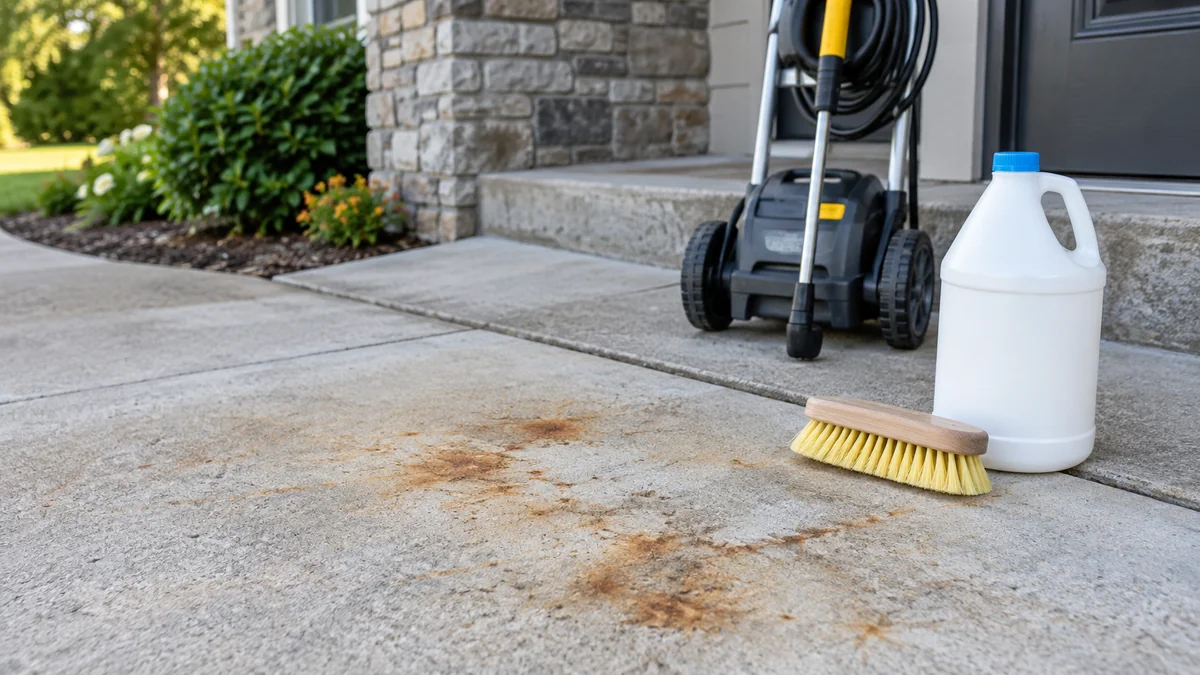
Household bleach generally will not remove a rust stain from concrete. Bleach, or sodium hypochlorite, oxidizes and lightens many organic stains, while rust consists mainly of already oxidized iron compounds that bleach does not dissolve; an acidic or chelating rust remover is usually required.
Key Facts at a Glance
- Bleach is alkaline, typically around pH 11-13, and is designed primarily for organic staining, disinfection, and whitening.
- Rust stains contain iron oxides and hydroxides, which require dissolution or chemical binding rather than ordinary bleaching.
- Oxalic-acid and phosphoric-acid cleaners are usually more effective than vinegar on established concrete rust.
- Never mix bleach with vinegar, muriatic acid, phosphoric acid, or another acidic cleaner because the reaction can release chlorine gas.
- A typical spot treatment takes 1-2 hours, including preparation, dwell time, scrubbing, and rinsing.
- Reappearing rust usually indicates an untreated source such as well water, fertilizer, corroding metal, or reinforcing steel.
Can Bleach Remove Rust From Concrete?
Bleach cannot reliably remove rust from concrete because sodium hypochlorite does not dissolve iron oxide deposits. Bleach may clean algae, mildew, food residue, and some organic discoloration around a rust mark, making the remaining orange stain look more pronounced, but that is not rust removal.
Concrete contains calcium silicate hydrate paste, aggregate, capillaries, and surface pores. Iron particles can lodge in those pores after contact with rusty furniture, metal tools, fertilizer, irrigation water, or corroding hardware. A chlorine solution may disinfect the surface, yet it does not provide the chemistry needed to convert the insoluble iron deposit into a rinseable material.
Bleach can also create an uneven appearance when surrounding organic dirt is removed while the iron stain remains. The result may look darker or brighter by contrast. Whether bleach permanently “sets” every rust stain is less certain than the practical warning: bleach is the wrong first-line product and can make later chemical treatment unsafe if residue remains.
Why Does Bleach Fail Chemically?
Bleach fails because rust is an inorganic iron-oxide deposit, whereas bleach primarily attacks microorganisms and organic molecules. Sodium hypochlorite is an oxidizer in an alkaline solution; iron in common rust is already in an oxidized state, so additional oxidation does not normally make the stain water-soluble.
Acidic cleaners work differently. Hydrogen ions react with iron oxides and can produce soluble iron salts, while chelating ingredients bind iron so it can be removed during rinsing. The concrete itself is also alkaline, so stronger acids can react with the cement paste as well as the rust.
The useful distinction is not “bleach versus a stronger bleach.” It is oxidation versus dissolution. Rust removal requires a product formulated to dissolve or bind iron, followed by agitation and removal of the contaminated liquid.
What Happens if Bleach Was Already Used?
If bleach was used, rinse the concrete thoroughly with large amounts of clean water and allow the surface to dry completely before applying an acidic cleaner. Do not pour vinegar, lemon juice, CLR-type products, oxalic acid, phosphoric acid, or muriatic acid onto wet bleach residue.
Bleach and acid can generate chlorine gas, which can injure the lungs and cause life-threatening breathing difficulty. Outdoor use reduces accumulation risk but does not make intentional mixing safe. If a strong chemical odor, coughing, chest tightness, or breathing difficulty occurs, leave the area and contact emergency services or poison-control authorities.
What Actually Removes Rust From Concrete?
Acidic rust removers and iron-binding products remove concrete rust more effectively than bleach because they change the iron compound into a form that can be rinsed away. The correct choice depends on stain age, depth, concrete finish, nearby vegetation, and the cleaner’s label instructions.
| Cleaner type | Typical use | Typical dwell time | Main limitation |
|---|---|---|---|
| Lemon juice or white vinegar | Fresh, pale surface marks | 10-20 minutes | Often too weak for old or deep stains |
| Oxalic-acid remover | Moderate or severe iron stains | 15-60 minutes | Requires gloves, eye protection, and thorough rinsing |
| Phosphoric-acid cleaner | Rust mixed with mineral scale | 10-30 minutes | May dull decorative finishes |
| Iron chelator or fallout remover | Colored, sealed, or sensitive surfaces | 2-15 minutes | Product-specific and often more expensive |
| Muriatic acid | Heavy industrial deposits only | Up to 5-10 minutes | Highly corrosive and can etch concrete permanently |
Are Vinegar and Lemon Juice Strong Enough?
White vinegar and lemon juice can help with a fresh, light rust mark, but they are unreliable for established stains. Their acetic or citric acid content is relatively mild, and concrete’s alkaline cement paste quickly consumes some of the available acidity.
Apply a small amount to a test area, keep the surface wet for 10-20 minutes, scrub with nylon, and rinse. If the orange color does not noticeably fade after one or two applications, further household-acid treatment usually adds labor rather than meaningful cleaning power.
Vinegar is also unsafe to combine with bleach. A natural label does not make a chemical mixture harmless.
Is Oxalic Acid the Best General Option?
Oxalic acid is often the most practical choice for plain gray concrete with moderate rust staining because it reacts with iron compounds without being as aggressive as muriatic acid when used according to the product label. Products such as Bar Keepers Friend and dedicated masonry rust removers may use oxalic acid, but formulations and concentrations differ.
Never assume that a kitchen or metal-cleaning product is automatically suitable for a concrete slab. Check the label for masonry compatibility, dilution instructions, dwell limits, and required rinsing. Dry oxalic-acid powder should not be inhaled, and concentrated solutions should not contact skin or eyes.
A typical practitioner range for a powdered product is about 1 pound per gallon of hot water, but the manufacturer’s stated ratio takes priority. Stronger is not automatically better because excess acid can attack the cement paste after the rust is gone.
Can Phosphoric Acid or CLR Remove Concrete Rust?
Phosphoric-acid products and some CLR-type cleaners can remove medium rust stains, especially when iron is mixed with calcium scale or hard-water deposits. These products convert or dissolve iron compounds and are often easier to obtain than specialized masonry chemicals.
Compatibility varies widely. A product designed for toilets, stainless steel, or bathroom fixtures may have instructions that exclude concrete, natural stone, sealers, or colored surfaces. Read the label before use, and test a hidden section for color change, whitening, gloss loss, or surface roughness.
Should You Use Muriatic Acid?
Muriatic acid, or hydrochloric acid, should be treated as a professional or last-resort chemical for severe deposits, not as a normal driveway cleaner. It reacts rapidly with cement paste and can etch the surface, expose aggregate, damage nearby metal, injure vegetation, and produce hazardous fumes.
Never improvise a dilution, and never add water to concentrated acid. Where a professional label permits dilution, acid is added slowly to water, not water to acid, while following the product’s safety data sheet. Many residential rust stains can be treated with a safer product, making muriatic acid an unjustified risk.
How to Remove Rust From Concrete Safely
Remove concrete rust with five controlled stages: identify the source, prepare the surface, apply a compatible iron remover, scrub without damaging the slab, and flush the dissolved residue completely. A typical isolated stain requires 1-2 hours, although deep rust may need several applications.
Before You Start
| Requirement | Typical specification |
|---|---|
| Project time | 1-2 hours for one spot |
| Cleaner quantity | 0.25-1 gallon for a small patch |
| Water supply | Garden hose with unrestricted flow |
| Brush | Stiff nylon brush, 6-10 inches wide |
| PPE | Chemical-resistant gloves, goggles, closed shoes |
| Working temperature | Approximately 10-27°C |
| Test area | Hidden patch of at least 6 by 6 inches |
Work outdoors when possible. Keep children and pets away, protect metal drains and fixtures, and check where the runoff will travel. Acidic runoff can injure grass and aquatic life.
Step 1: Identify and Stop the Rust Source
Remove the rusty object, redirect an iron-rich sprinkler, clean fertilizer residue, or repair a leaking metal component before treating the stain. If reinforcement steel is corroding inside a crack or slab, surface cleaning alone will not provide a lasting result.
Photograph the stain before treatment. Record its size, color, and location so you can distinguish genuine removal from temporary wetting or contrast changes.
You will know this step worked when: the source no longer deposits orange material during a clean-water test.
Common mistake: treating a recurring sprinkler mark every month without testing the irrigation water for iron.
Step 2: Remove Dirt and Oil
Sweep loose grit from the concrete. Wash oily or greasy areas with a small amount of dish detergent and warm water, then rinse and allow the slab to dry.
Oil blocks contact between the rust remover and the pore structure. A rust cleaner applied over a greasy film may leave an irregular ring because only the exposed sections react.
You will know this step worked when: water wets the area evenly rather than forming oily beads.
Common mistake: pressure washing immediately and assuming the stain has been chemically treated.
Step 3: Protect Surrounding Materials
Pre-wet nearby grass, soil, masonry, and plants with clean water. Cover sensitive metal, painted surfaces, and vulnerable drains where the product label allows; otherwise divert runoff rather than trapping chemicals against another material.
Pre-wetting plants reduces rapid absorption of diluted runoff, but it does not make careless discharge acceptable. Collect or redirect the rinse water when local rules or site conditions require it.
Step 4: Apply the Compatible Rust Remover
Apply the selected product to the dry stain at the label dilution. Cover the entire orange area without flooding the surrounding concrete, and keep the solution wet during the specified dwell period.
| Stain condition | Starting product | Typical first dwell | Expected action |
|---|---|---|---|
| Pale mark under 24 hours old | Vinegar or mild citric cleaner | 10 minutes | Light scrub and inspect |
| Orange patch under 1 square foot | Oxalic-acid masonry cleaner | 15-30 minutes | Keep wet and agitate |
| Dark stain with mineral scale | Phosphoric-acid cleaner | 10-30 minutes | Rinse and repeat if compatible |
| Decorative sealed concrete | Chelating or pH-balanced product | 2-15 minutes | Test for finish change |
| Thick industrial crust | Professional assessment | Label-specific | Avoid casual muriatic-acid use |
Do not let the product dry. Drying can leave salts, create a visible edge, and increase contact time with the cement paste. Do not extend the dwell period merely because the first few minutes show little change.
You will know this step worked when: the orange color weakens or the liquid becomes yellow, orange, or brown as iron is mobilized.
Step 5: Scrub With Nylon
Scrub in overlapping circles and then across the stain with a stiff nylon brush. Use moderate pressure; the chemical reaction should do most of the work.
Avoid wire brushes on smooth, colored, or decorative concrete. Steel fragments can lodge in pores and produce new rust marks, while aggressive abrasion can permanently alter the surface texture.
You will know this step worked when: the stain lightens evenly without scratch lines or exposed aggregate.
Step 6: Rinse Until Residue Is Gone
Flush the area with a garden hose and plenty of water. A pressure washer can assist with final rinsing on sound, plain concrete, but keep the nozzle moving and avoid forcing contaminated slurry into cracks or adjacent surfaces.
Continue rinsing until runoff is clear and the surface no longer feels slippery or leaves powder after drying. A second application may be safer than one prolonged application.
You will know this step worked when: the dried concrete has no orange halo, white chemical residue, or sticky film.
Why Does Pressure Washing Alone Often Fail?
Pressure washing alone usually removes loose dirt but does not dissolve iron oxide embedded in concrete pores. High pressure may spread orange slurry, strip a weak surface, expose aggregate, or drive contaminated water into cracks without addressing the chemical bond.
Use chemical treatment first and pressure only as a controlled rinsing tool. Surface pressure also varies with nozzle size, distance, pump output, and concrete condition, so a quoted pressure value alone does not predict safety.
A practitioner rule is to start farther from the stain, use a wider fan, and approach only if the concrete remains intact. Decorative or old concrete may need low-pressure rinsing instead.
Which Cleaner Should You Choose?
Choose an oxalic-acid masonry cleaner for established rust on plain gray concrete, a mild household acid only for a very fresh mark, and a pH-balanced chelator for sealed or colored concrete. Muriatic acid belongs in the professional category because its speed comes with a high risk of etching and injury.
| Surface or problem | Preferred first option | Avoid first | Reason |
|---|---|---|---|
| Plain gray driveway | Oxalic-acid concrete product | Household bleach | Rust-specific chemistry with manageable application |
| Fresh pale spot | Vinegar or citric cleaner | Muriatic acid | Mild treatment may be sufficient |
| Well-water orange film | Oxalic or phosphoric cleaner | Pressure alone | Dissolves iron deposited in repeated layers |
| Colored or stamped slab | Compatible chelator | Strong acid | Protects pigment, sealer, and texture |
| Heavy industrial crust | Professional treatment | DIY concentrated acid | Chemical and surface risk exceed routine benefit |
What Is the Typical Cost and Time?
A household-acid attempt may cost under $5, while a commercial rust remover commonly costs about $15-$40 per container or gallon. Professional concrete cleaning and restoration often costs approximately $200-$450 for a localized residential job, depending on access, square footage, surface condition, and repeat treatments.
| Approach | Typical material cost | Typical labor time | Typical result |
|---|---|---|---|
| Vinegar or lemon juice | Under $5 | 30-60 minutes | Partial fading of fresh marks |
| Oxalic-acid product | $15-$40 | 1-2 hours | Strong removal on plain concrete |
| Phosphoric or mixed mineral cleaner | $20-$50 | 1-2 hours | Rust and scale reduction |
| Professional service | $200-$450 | 2-4 hours onsite | Diagnosis, treatment, and controlled rinse |
These are typical planning ranges, not guaranteed prices. Deep penetration, large patios, access problems, and active structural corrosion increase cost.
What Causes Returning Rust Stains?
Returning rust stains indicate an active iron source or untreated contamination beneath the surface. Common sources include well water, rusty sprinkler heads, fertilizer containing iron, metal furniture feet, HVAC condensate contacting steel, and reinforcing steel that is expanding inside cracked concrete.
Well water can leave a broad orange band where sprinklers repeatedly evaporate. Fertilizer may create small dark-orange tracks near garage entrances or garden paths. A concentrated rust outline beside a crack can indicate embedded metal rather than surface fallout.
Can Sealer Prevent Rust From Returning?
A compatible penetrating or topical concrete sealer can reduce future water and iron penetration after the stain and source are controlled. Sealer cannot stop active rust emerging from reinforcing steel, repair a structural crack, or hide a poorly rinsed chemical halo.
Allow the concrete to dry fully before sealing. Follow the sealer manufacturer’s moisture, temperature, and cure requirements, and test for color or gloss changes first.
Special Cases for Decorative Concrete
Colored, stamped, polished, and sealed concrete require a test patch before any acid treatment. Acid can remove cement paste, dull gloss, lighten pigment, expose aggregate, or soften some sealers even when the rust itself disappears.
Use a product explicitly compatible with the surface, often a chelating or pH-balanced iron remover. Keep dwell times short, inspect continuously, and stop at the first sign of finish damage. A restoration contractor is usually more economical than replacing a decorative coating.
Vertical concrete creates an additional problem because liquid cleaner can run downward. Apply smaller amounts, protect the base, work in short sections, and prevent concentrated runoff from drying on lower areas.
Common Mistakes and How to Fix Them
- Applying bleach first: Rinse thoroughly, dry the area, and switch to a compatible rust remover.
- Mixing bleach and acid: Leave the area immediately if fumes occur, ventilate from a safe position, and seek medical or poison-control guidance for symptoms.
- Letting acid dry: Re-wet only if the product label permits it; otherwise rinse and restart with a shorter dwell.
- Using a wire brush: Stop abrasion, vacuum loose metal fragments, and inspect for scratches before repeating chemical treatment.
- Overusing pressure: Move to a wider nozzle and greater distance; deep etching may require surface restoration.
- Ignoring the source: Remove the object, correct irrigation, or investigate cracks before paying for repeated cleaning.
FAQ
Will bleach remove rust from a concrete driveway?
Bleach usually will not remove rust from a concrete driveway because sodium hypochlorite does not dissolve iron oxide. Bleach can remove algae and organic grime around the stain, making the orange mark appear more visible. Use a compatible acid or iron chelator instead, and rinse away any bleach residue before treatment.
How long should rust remover stay on concrete?
Most concrete rust removers require about 10-60 minutes, depending on the active ingredient and stain depth. Vinegar may need 10-20 minutes, while oxalic-acid products often need 15-30 minutes. Keep the solution wet, follow the product label, and never extend dwell time after the stain has stopped improving.
Can rust damage the concrete itself?
Surface rust usually causes discoloration rather than immediate structural damage. Rust from reinforcing steel can be more serious because expanding steel creates internal pressure, cracks, spalling, and loose concrete. A recurring stain beside a crack or broken edge requires diagnosis rather than repeated surface cleaner.
Is Iron Out safe for concrete?
Iron Out and similar products may remove iron staining, but safety depends on the specific formulation and label directions. Some products are intended for water systems, laundry, or household surfaces rather than masonry. Confirm concrete compatibility, use PPE, test a hidden patch, and rinse thoroughly.
Can baking soda neutralize acid on concrete?
Baking soda can neutralize small amounts of acidic residue, but it should not replace thorough rinsing or the product’s stated neutralization procedure. Applying powder to a heavily contaminated area can create residue and obscure whether the cleaner remains active. Flush first, then follow the safety data sheet.
How do you prevent rust stains from patio furniture?
Use nonrusting aluminum, stainless steel, coated, or plastic feet; install protective pads that do not trap water; and keep fertilizer and iron-rich irrigation spray away from the slab. Inspect metal furniture after rain, because a small corrosion source can create a larger porous-concrete stain over time.
The Bottom Line
Will bleach remove rust from concrete? Usually no. Bleach targets organic contamination and does not dissolve iron oxide, so the dependable approach is to identify the source, rinse away any bleach residue, test a compatible oxalic, phosphoric, or chelating cleaner, scrub with nylon, and flush the concrete thoroughly. Use extra caution on colored concrete, sealed surfaces, and any slab showing cracks or reinforcing-steel corrosion.