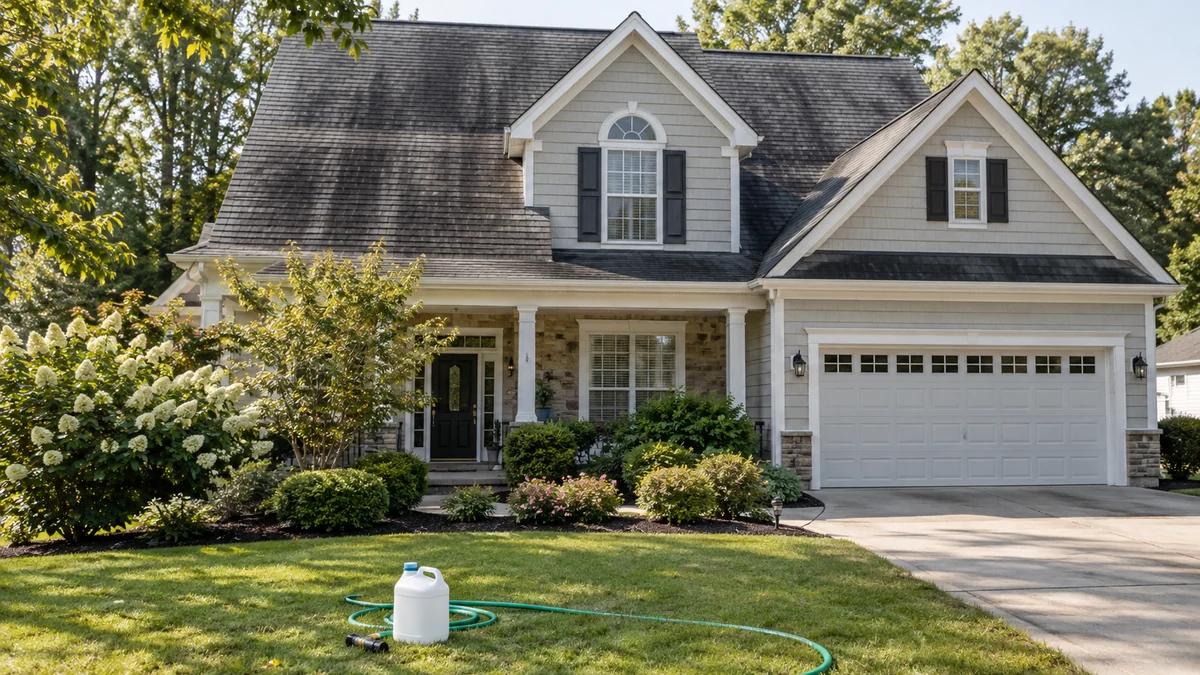
A soft wash mix for removing black streaks usually contains diluted sodium hypochlorite, water, and a bleach-stable surfactant. For typical asphalt shingles, professionals often begin around 1%-3% available sodium hypochlorite at the surface, while siding commonly needs about 0.5%-1.5%; the correct strength depends on the material, stain severity, product concentration, temperature, and runoff controls.
Key Facts
Black roof streaks are commonly associated with the cyanobacterium Gloeocapsa magma, although dirt, lichen, moss, and shingle damage can look similar.
A 12.5% sodium hypochlorite product diluted one part chemical to three parts water produces approximately 3.1% sodium hypochlorite before accounting for product aging and system dilution.
Vinyl siding often needs a weaker solution than asphalt shingles, typically about 0.5%-1.5% at the surface.
Sodium hypochlorite can damage plants, metals, fabrics, coatings, and some painted surfaces through overspray or runoff.
Never mix sodium hypochlorite with acids, ammonia, vinegar, toilet cleaner, or other unapproved chemicals.
Soft washing does not repair granule loss, brittle shingles, failed paint, cracked stucco, or deteriorated siding.
What Are the Black Streaks on a Roof or Siding?
Black streaks on asphalt shingles are commonly colonies of Gloeocapsa magma, a photosynthetic cyanobacterium that produces dark protective pigments. Similar marks can also come from roof runoff, chimney soot, lichen, moss, oxidized paint, or deteriorated roofing granules, so a test patch should precede full treatment.
The distinction matters because sodium hypochlorite can kill biological growth but cannot restore missing granules or reverse oxidation. A streak that remains after a correctly applied biological cleaner may be material discoloration rather than living growth.
The Asphalt Roofing Manufacturers Association recommends cleaning asphalt roofing with methods that avoid damaging the shingle surface. ARMA guidance commonly favors chemical treatment and gentle rinsing over aggressive pressure washing. Always check the roofing manufacturer’s instructions first, because warranty requirements differ.
How can you identify biological staining?
Biological streaks usually follow the roof plane and appear as irregular gray, green, brown, or black bands. Moss forms raised cushions, while lichen creates crusty, attached patches. Dirt and soot often collect below roof penetrations, vents, chimneys, or heavily trafficked areas.
A simple visual diagnosis is not conclusive. Apply the weakest appropriate cleaner to a small, hidden area and observe the result after rinsing and drying. If the color does not change, stop increasing chemical strength until the material has been identified.
Which Soft Wash Mix Should You Use?
The best soft wash mix depends on the substrate and the final sodium hypochlorite concentration at the surface. A practical starting point is approximately 0.5%-1.5% for most siding and 1%-3% for many asphalt-shingle algae stains, with stronger roof treatment reserved for persistent growth and trained operators.
| Surface or condition | Typical starting SH at surface | Typical dwell time | Main limitation |
|---|---|---|---|
| Vinyl siding, light algae | 0.5%-1.0% | 5-10 minutes | Avoid drying and oxidation |
| Painted siding, moderate staining | 0.5%-1.0% | 5-10 minutes | Test paint first |
| Asphalt shingles, light streaks | 1%-2% | 10-15 minutes | Follow roof manufacturer guidance |
| Asphalt shingles, heavy growth | 2%-3% | 10-20 minutes | Professional treatment is safer |
| Concrete or masonry | 1%-3% | 10-20 minutes | Porosity and runoff increase demand |
| Moss or thick lichen | Variable | Multiple treatments | Chemical killing does not remove all residue |
These figures are typical field starting points, not universal instructions. Product age reduces available chlorine, hot surfaces accelerate drying, and downstream proportioners may dilute the mixture before it reaches the nozzle.
What does a 12.5% sodium hypochlorite mix produce?
A simple dilution estimate uses:
C₁V₁ = C₂V₂
For a final batch, the starting concentration multiplied by its volume equals the target concentration multiplied by the total batch volume.
| Desired final concentration | 12.5% SH | Water | Approximate final volume |
|---|---|---|---|
| 1% | 0.8 gallon | 9.2 gallons | 10 gallons |
| 1.5% | 1.2 gallons | 8.8 gallons | 10 gallons |
| 2% | 1.6 gallons | 8.4 gallons | 10 gallons |
| 3% | 2.4 gallons | 7.6 gallons | 10 gallons |
| 4% | 3.2 gallons | 6.8 gallons | 10 gallons |
The table assumes fresh 12.5% sodium hypochlorite and no equipment dilution. Commercial liquid chlorine loses strength during storage, particularly in heat and sunlight, so the label concentration may overstate the actual strength after prolonged storage.
Household bleach labeled around 5%-6% can be used for small jobs only when the label contains no fragrance, thickener, detergent, or other additive that conflicts with the surface or sprayer. It requires substantially more product to reach the same final concentration.
How much surfactant should a mix contain?
Use only a product labeled or specifically formulated for bleach compatibility, and follow that product’s label rate. Typical professional rates range from about 0.5-2 fluid ounces per finished gallon, but surfactant choice affects cling, rinsing, plant exposure, and residue.
Dish soap is not an automatic substitute. Some dishwashing products contain fragrances, solvents, ammonia compounds, or other additives that can increase residue and create compatibility problems. More surfactant does not compensate for weak chemistry or poor surface preparation.
How Do You Mix a Roof Cleaner for Black Streaks?
For a typical asphalt-shingle roof, begin with the lowest concentration that passes a controlled test patch, commonly 1%-2% sodium hypochlorite at the surface. Increase only when the roof manufacturer permits chemical cleaning and the first treatment does not adequately change the biological stain.
A 10-gallon batch using fresh 12.5% sodium hypochlorite would contain approximately 1.6 gallons of chemical and 8.4 gallons of water for a nominal 2% solution. Add compatible surfactant only after confirming the label rate, and mix in a chemical-resistant container.
Avoid a routine 5%-6% roof mix. That strength may be used by experienced contractors for selected severe conditions, but it increases the chance of plant injury, metal corrosion, fabric bleaching, coating damage, and rapid drying. Clay tile, concrete tile, and older roofs require separate material-specific decisions.
Why should you avoid pressure washing asphalt shingles?
Pressure washing can remove or loosen protective granules, force water under laps, damage flashing, and shorten shingle life. The Asphalt Roofing Manufacturers Association’s cleaning guidance is consistent with the principle that biological stains should be treated chemically and rinsed gently rather than blasted away.
A soft wash should not be confused with zero pressure. The pump still moves liquid, but the cleaning action comes primarily from dwell chemistry rather than a narrow, high-energy water jet. If a roof requires climbing, use fall protection and consider a qualified contractor instead of treating the roof as a ground-level cleaning project.
How Do You Mix a Siding Cleaner?
For vinyl, aluminum, and many painted surfaces, use approximately 0.5%-1% sodium hypochlorite at the surface and test an inconspicuous area first. A 10-gallon batch at 1% nominal strength requires about 0.8 gallon of fresh 12.5% SH and 9.2 gallons of water.
Apply the solution to a cool, pre-wet section no larger than can be kept wet during the dwell period. Surfactant may improve cling, but excessive dwell time and direct sunlight create more risk than a slightly weak first application.
Painted wood, EIFS, stucco, and oxidized aluminum need extra caution. A cleaner can expose chalking, lift failing paint, or alter the appearance of an existing finish. Soft washing removes biological contamination; it does not make a failing coating sound.
| Material | Starting approach | Rinse requirement | Test-patch concern |
|---|---|---|---|
| Vinyl siding | 0.5%-1% SH | Thorough low-pressure rinse | Oxidation and streaking |
| Aluminum siding | 0.5%-1% SH | Immediate metal rinse | Chalky paint and corrosion |
| Painted wood | 0.5%-1% SH | Controlled, gentle rinse | Paint failure and grain damage |
| Stucco | 0.5%-1.5% SH | Prevent concentrated runoff | Color variation and cracks |
| EIFS | Weakest approved solution | Keep joints and openings controlled | Water intrusion and coating damage |
| Brick or concrete | 1%-3% SH | Flush porous areas | Efflorescence and nearby metals |
What Do You Need Before Applying the Mix?
A small siding project typically requires a garden hose, chemical-resistant pump sprayer, measuring container, compatible cleaner, protective eyewear, chemical-resistant gloves, footwear, drop cloths, and clean water for rinsing. Roof work adds fall-protection equipment, a long-reach application method, and a runoff-control plan.
Before You Start
- Typical time: 2-6 hours for a small exterior, excluding setup and drying.
- Typical DIY material cost: $40-$150 for a sprayer, chemical, protective equipment, and plant protection.
- Typical contractor cost: $250-$900 for many residential services, with roof access and regional labor causing large variation.
- Minimum prerequisite: Confirm the surface material, chemical label, weather, drainage path, and manufacturer cleaning instructions.
- Do not start: During high wind, extreme heat, freezing conditions, or imminent heavy rain.
- Keep available: At least one dedicated hose for continuous plant and surface rinsing.
Do not use a household pump sprayer that has previously contained herbicide, acid, solvent, or an unknown cleaner. Chemical residue can react with sodium hypochlorite or contaminate a surface.
How Do You Apply a Soft Wash Mix?
Apply a soft wash mix in controlled sections, keep the chemical from drying, and rinse surrounding surfaces and vegetation before and after treatment. The most important success factor is uniform wetting at the correct concentration, not maximum pressure or maximum chemical strength.
Step 1: Inspect and prepare the property
Remove furniture, toys, fabrics, and portable metal items. Close windows and doors, identify outdoor electrical equipment, and protect delicate fixtures according to their manufacturer’s instructions.
Check gutters and downspouts. A roof treatment can carry concentrated solution into a garden bed, storm drain, pond, or neighboring property if the discharge path is not controlled.
Success checkpoint: The application area, runoff route, water supply, and emergency rinse path are identified.
Common mistake: Starting before locating a downspout that drains directly onto sensitive plants.
Step 2: Pre-wet plants and adjacent materials
Thoroughly wet leaves, grass, shrubs, siding below the work area, and nearby masonry with clean water. Pre-wetting reduces initial absorption, but it does not make bleach runoff safe; continued rinsing and runoff control remain necessary.
Covering plants with plastic can trap heat and chemical vapor. Use breathable protection only when appropriate, remove it promptly, and never leave vegetation covered in direct sun.
Success checkpoint: Leaves and exposed soil are visibly saturated before chemical application.
Common mistake: Wetting plants once, then allowing contaminated runoff to remain in the root zone.
Step 3: Mix and test the solution
Measure chemical and water accurately. Add water to the mixing container first when the product label permits, then add sodium hypochlorite carefully and add compatible surfactant last.
Never add acid, ammonia, vinegar, toilet cleaner, or an unknown detergent. Chemical reactions can release toxic gases. Keep the original labels available and avoid mixing concentrates in a closed container.
Apply a small test patch and observe the surface during the dwell period. Stop if paint lifts, color changes unevenly, metal darkens, or the substrate reacts unexpectedly.
Success checkpoint: The test patch changes the biological stain without harming the substrate.
Common mistake: Increasing concentration before confirming that the stain is biological.
Step 4: Apply the surface cleaner
For siding, work in manageable sections and apply from the bottom upward when the purpose is to reduce visible cleaner runs through dry dirt. For roofs, use a controlled application from the ridge toward the eave without walking on fragile or steep shingles.
Keep the nozzle broad and the pressure low. Do not aim into soffit vents, window seals, siding joints, roof penetrations, or electrical components.
Success checkpoint: The surface is evenly wet, with no dry islands or concentrated drip lines.
Common mistake: Applying too much solution to create runoff instead of uniform coverage.
Step 5: Control dwell time
Allow approximately 5-15 minutes for many siding applications and 10-20 minutes for many roof treatments, checking continuously. The solution should remain wet, and the operator should shorten the dwell period in heat, direct sun, or on absorbent materials.
Black biological staining may fade quickly, but a slower visual response does not automatically justify stronger chemistry. Reapply a weaker solution after rinsing if the manufacturer and surface condition allow it.
Success checkpoint: The stain lightens or changes color without the solution drying.
Common mistake: Leaving the chemical on until the entire surface looks perfect, then discovering dried spots or damaged paint.
Step 6: Rinse and neutralize exposure
Rinse from top to bottom with a broad, low-pressure fan pattern while preventing concentrated runoff. Continue flushing windows, plants, gutters, metal fixtures, and surrounding hardscape with clean water.
Do not rely on sodium thiosulfate as permission to ignore runoff controls. A neutralizer may reduce residual oxidizer in a controlled spill, but the product label and local environmental requirements determine its appropriate use.
Success checkpoint: No visible residue remains, plants receive a final clean-water rinse, and runoff is not entering a sensitive waterway.
Common mistake: Rinsing the wall while ignoring the gutter, downspout, or soil receiving the chemical.
What Is Better, Sodium Hypochlorite or Oxygen-Based Cleaner?
Sodium hypochlorite works faster against many algae and organic stains, while sodium percarbonate and other oxygen-based products usually provide a slower, lower-corrosion alternative. Neither option is universally safe, and oxygen-based cleaners may still harm plants, metals, coatings, or aquatic environments at excessive concentration.
| Cleaning option | Typical visible response | Surface action | Main advantage | Main limitation |
|---|---|---|---|---|
| 0.5%-1% SH siding mix | 5-15 minutes | Oxidizes biological staining | Fast treatment | Plant and coating risk |
| 1%-3% SH roof mix | 10-20 minutes | Kills algae and organic growth | Effective on dark streaks | Runoff and roof-access hazards |
| Sodium percarbonate | Hours to days | Oxygen-based oxidation | Lower chlorine exposure | Slower, often needs agitation |
| Detergent-only wash | Minutes | Loosens dirt and oils | Useful for nonbiological soil | Does not reliably kill algae |
| Mechanical brushing | Immediate removal | Physical abrasion | No oxidizer required | Can damage coatings and shingles |
Claims that oxygen-based cleaners are “totally safe” are too broad. Safety depends on concentration, contact time, runoff, plant species, aquatic exposure, and the product’s safety data sheet.
Use an oxygen-based cleaner when chlorine exposure is unacceptable and the owner accepts slower results, more agitation, and possible repeat treatments. It is not automatically the best choice for a large roof or thick lichen.
Why Do Black Streaks Return?
Black streaks return when surviving biological contamination, shade, moisture, airborne particles, or roof geometry recreates favorable growth conditions. A cleaning treatment removes or kills existing growth, but it does not permanently sterilize the roof or prevent new spores from arriving.
Typical recurrence can range from one to several years, depending on climate, tree cover, roof orientation, humidity, and treatment completeness. North-facing slopes and shaded areas usually need earlier inspection than sunny, well-ventilated slopes.
For prevention, keep gutters clear, trim branches that shade the roof, correct persistent moisture, and consider manufacturer-approved algae-resistant shingles during replacement. Copper or zinc strips are sometimes used near roof ridges, but installation must follow roofing and metal compatibility requirements.
What if the black marks do not disappear?
If a test patch fails to change the stain, stop escalating the chemical strength. The mark may be soot, roof wear, lichen residue, asphalt bleed, oxidation, or a stain embedded below a damaged coating.
A second gentle treatment may be reasonable for confirmed biological growth. Mechanical scraping, aggressive brushing, and pressure washing are poor substitutes for diagnosis on asphalt shingles.
What Are the Main Safety Risks?
The main risks are toxic gas from incompatible mixing, chemical burns, eye injury, plant damage, metal corrosion, fabric bleaching, slippery surfaces, falls, and uncontrolled discharge into drains or waterways. Sodium hypochlorite also attacks some sprayer components, especially metals and seals not rated for bleach service.
Use chemical-resistant gloves, splash goggles, protective clothing, and footwear appropriate to the label and task. A respirator is not a substitute for ventilation, label compliance, and avoiding hazardous mixtures; do not enter a contaminated vapor area or improvise respiratory protection.
Keep residents, children, and pets away until application, rinsing, and ventilation are complete. Store sodium hypochlorite cool, upright, labeled, and separated from acids, ammonia products, fuels, and organic materials.
When Should You Hire a Professional?
Hire a professional when the roof is steep, fragile, high, heavily moss-covered, difficult to rinse, close to a pond, or connected to sensitive landscaping. Professional service is also preferable when the roof manufacturer requires a specific method or the substrate cannot be identified confidently.
Typical residential soft-wash pricing ranges from about $250-$900, while large, steep, or multi-story properties may cost more. Ask for the planned surface concentration, plant-protection procedure, runoff controls, insurance, roof-access method, and post-treatment rinse process.
A contractor who promises permanent removal, uses one strength for every material, or relies on high pressure for shingles is giving an incomplete specification. Request a test patch and written exclusions for pre-existing paint, roof, stucco, or siding damage.
Common Mistakes and How to Fix Them
| Mistake | Likely result | Corrective action |
|---|---|---|
| Using one ratio for every surface | Paint damage or weak cleaning | Identify substrate and test first |
| Letting SH dry | Bleached spots and residue | Rinse immediately and work smaller sections |
| Mixing with acid or ammonia | Toxic gas | Evacuate, ventilate from a safe location, seek emergency help if exposed |
| Ignoring downspout discharge | Plant or aquatic damage | Redirect flow and flush with clean water |
| Using pressure on shingles | Granule loss and leaks | Stop mechanical washing; use approved chemical treatment |
| Treating dirt as algae | Unnecessary chemical exposure | Test a small area and inspect the stain source |
| Storing diluted mix overnight | Unpredictable strength and degradation | Mix only the amount needed that day |
FAQ
Can household bleach remove black roof streaks?
Household bleach can remove some biological roof staining when its label permits the use and the formula contains no incompatible additives. Because household bleach is commonly 5%-6%, a larger volume is needed than with 10%-12.5% commercial sodium hypochlorite. Test the surface first and control runoff.
How long should a soft wash mix remain on shingles?
A typical starting dwell time for an asphalt-shingle treatment is 10-15 minutes, but the solution must remain wet and the roof must tolerate the method. Hot sun, wind, old shingles, and dark surfaces shorten the safe dwell period. Rinse before drying rather than extending contact indefinitely.
Can rain remove the dead algae after treatment?
Light remaining residue may weather away after treatment, and some roof-cleaning methods rely partly on rainfall. Rain is not a substitute for rinsing contaminated gutters, plants, windows, and hardscape, especially when concentrated solution has run into those areas.
Does soft washing remove moss permanently?
Soft washing can kill or weaken moss, but it does not permanently prevent regrowth. Thick moss may leave attached residue after treatment, and scraping can damage shingles. Correct moisture, shade, drainage, and roof-condition problems before selecting a follow-up method.
Is sodium percarbonate safe for plants?
Sodium percarbonate is not automatically plant-safe. The compound releases hydrogen peroxide and sodium carbonate, and concentrated or repeated exposure can injure foliage and alter soil conditions. Follow the product label, prevent runoff, and rinse vegetation thoroughly.
Can I soft wash a roof from a ladder?
A ladder may provide access, but it does not make roof cleaning safe. Wet shingles become slippery, chemical exposure can impair footing, and many roofs require fall protection. Ground-based application or a qualified roofing-cleaning contractor is safer for steep, tall, brittle, or complicated roofs.
The Bottom Line
A reliable soft wash mix for removing black streaks starts with diagnosis, a surface-specific sodium hypochlorite concentration, a small test patch, controlled dwell time, and complete runoff management. Use approximately 0.5%-1.5% for many siding applications and 1%-3% for many asphalt-shingle treatments, but follow the manufacturer’s instructions instead of treating those ranges as universal recipes. The safest successful cleaning is the weakest mixture that removes confirmed biological staining without drying, damaging the substrate, or exposing plants and waterways.