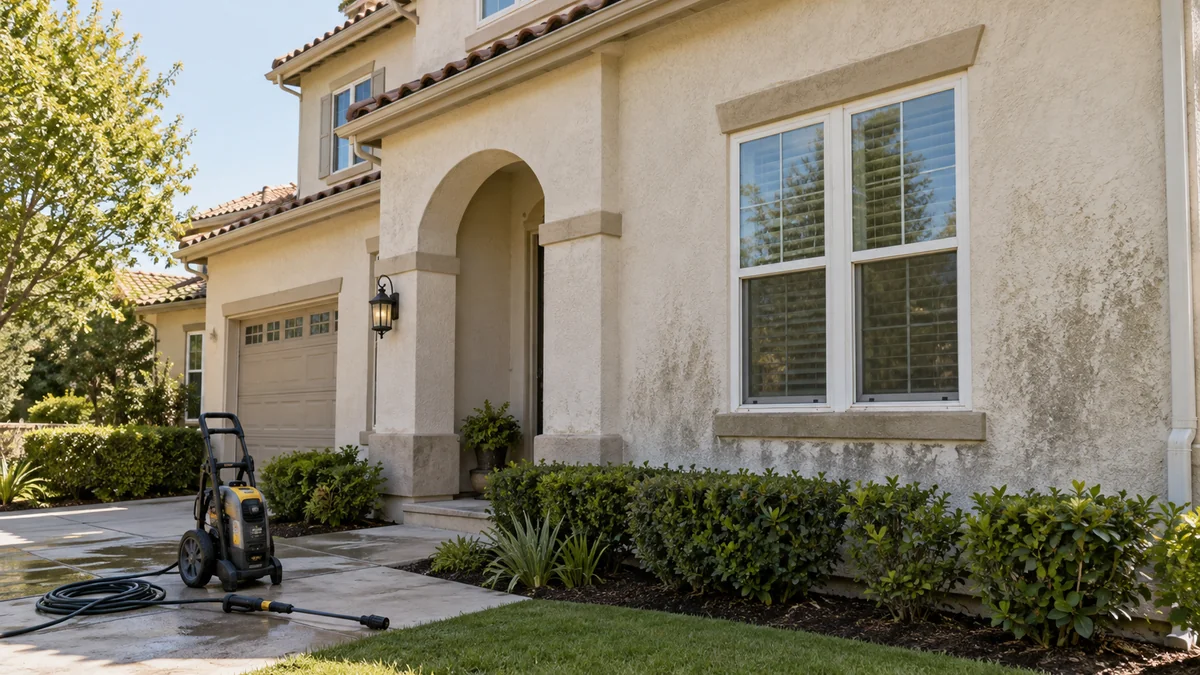
You can pressure wash a stucco house only with low pressure, wide spray patterns, and careful water control. Conventional high-pressure washing is unsafe for most stucco because it can erode the finish, enlarge cracks, drive water behind the cladding, and damage synthetic EIFS. Soft washing is usually the safer cleaning method.
Key Facts
Traditional cement stucco can tolerate limited low-pressure rinsing, but high-pressure washing can remove the surface matrix and expose the substrate.
Synthetic stucco, including EIFS, generally requires more conservative pressure and more careful water management than hardcoat stucco.
Organic stains respond to a properly diluted exterior cleaning solution, dwell time, and a gentle rinse rather than concentrated mechanical force.
Never wash over open cracks, holes, failed sealant, loose patches, or suspected drainage problems.
Typical professional stucco cleaning costs about $400-$900 for an accessible 2,000-square-foot home, before repairs.
Rust, efflorescence, and mineral deposits need different treatment from algae, mildew, and mold.
Should You Pressure Wash a Stucco House?
Yes, but “pressure wash” should mean controlled low-pressure cleaning, not blasting stucco with a standard 1,500-4,000 PSI setting. A professional may use a pressure-washer pump to deliver water or cleaning solution, yet the pressure at the wall should remain low enough to avoid cutting the finish and forcing water into the assembly.
The safest general approach is soft washing: apply a suitable detergent or sanitizer at low pressure, allow adequate dwell time, then rinse with a broad fan pattern. A garden hose may be sufficient for light dust, while established algae or mildew usually requires a controlled cleaning solution.
The answer changes with the cladding. A sound three-coat cement stucco wall is more impact-resistant than an acrylic EIFS finish, but neither system benefits from a narrow, high-energy spray. Cleaning cannot correct failed flashing, missing sealant, rotten sheathing, or a defective drainage plane.
What Is Stucco, and Why Is It Vulnerable?
Stucco is a textured exterior cladding made from cementitious material or acrylic finish material over a supporting wall assembly. Traditional stucco commonly uses Portland cement, lime, sand, and water over metal lath, while synthetic stucco uses an acrylic finish over insulation, reinforcing mesh, and other EIFS components.
The texture creates many small recesses that collect dust, pollen, soot, algae, and mildew. The surface also contains pores and joints, so water can enter through cracks, unsealed penetrations, window perimeters, and poorly maintained control joints.
A pressure stream removes contaminants by impact. That mechanism is useful on durable concrete or some masonry, but stucco is a finish system rather than a single solid slab. Repeated aggressive washing can remove the fine binder at the surface, expose aggregate, enlarge defects, and damage paint or acrylic coatings.
Water intrusion is the more serious risk. A wall can look intact after cleaning while moisture remains behind the finish, where wet framing, corrosion, insulation damage, or mold may develop.
Which Stucco Type Is on Your House?
Identify the stucco system before selecting pressure, chemicals, or repair materials. Traditional hardcoat stucco and synthetic EIFS can look similar from the ground, but their surface hardness, drainage design, and tolerance for water differ substantially.
| Cladding type | Typical construction | Cleaning concern | Conservative approach |
|---|---|---|---|
| Three-coat cement stucco | Cement, lime, sand, lath, scratch and brown coats | Cracks can reach the wall assembly | Low-pressure detergent wash and broad rinse |
| One-coat stucco | Factory-blended cementitious coat, often over foam | Thin finish can erode at defects | Test an inconspicuous area first |
| EIFS | Acrylic finish, mesh, base coat, insulation board | Water can enter at seams and openings | Lowest practical pressure and limited saturation |
| Painted stucco | Cement or acrylic stucco with exterior coating | Paint can chalk, streak, or peel | Confirm coating compatibility before chemicals |
| Historic stucco | Lime-rich or older cement formulation | Brittle areas may spall or detach | Consult a preservation-oriented contractor |
How Can You Recognize EIFS?
EIFS often feels slightly softer than cement stucco and may have foam-like trim, decorative bands, or a consistent acrylic texture. Visual identification is unreliable, especially after painting or repairs. Construction records, an installer’s documentation, a small inspection opening, or an experienced building-envelope professional can provide better confirmation.
EIFS is not automatically defective. Its risk comes from water entering through discontinuities and failing to drain as designed. A contractor who treats every wall as ordinary cement stucco can create damage by oversaturating joints, window edges, vents, and trim.
Why Is Soft Washing Safer?
Soft washing separates stain removal from impact removal. The cleaning solution loosens or kills organic growth, and a low-pressure rinse carries the residue away without concentrating force on the stucco surface.
A typical exterior wash may use water, a compatible surfactant, and diluted sodium hypochlorite for biological growth. Exact concentration depends on the product, temperature, porosity, stain severity, and application method. A labeled product should control the final dilution; stronger is not automatically better.
| Cleaning method | Typical wall pressure | Best use | Main risk |
|---|---|---|---|
| Garden hose rinse | 40-80 PSI | Loose dust and pollen | Inadequate for rooted algae |
| Low-pressure soft wash | 50-300 PSI | Algae, mildew, and light grime | Chemical runoff or uneven dwell |
| Controlled hardcoat rinse | 300-800 PSI | Limited professional use on sound cement stucco | Erosion and water entry |
| Conventional power wash | 1,500-4,000 PSI | Concrete and some hard masonry | Gouging, paint loss, and intrusion |
The pressure ranges are practical operating ranges, not universal engineering limits. Pump pressure, nozzle size, hose length, spray distance, wall condition, and operator technique all affect force at the surface.
What Pressure and Nozzle Should You Use?
Use the lowest pressure that removes the softened residue, usually below 300 PSI for synthetic systems and often below 500 PSI for sound traditional stucco. A professional may use somewhat higher pressure on robust, intact hardcoat stucco, but the surface should be tested first and never treated as pressure-proof.
Choose a wide fan nozzle, commonly 40 degrees or wider, and keep the wand moving. Avoid zero-degree and narrow 15-degree tips because they concentrate energy into a small area. A practical starting distance is 18-24 inches, adjusted only after testing.
| Equipment variable | Safer starting point | Avoid |
|---|---|---|
| Nozzle angle | 40-65 degrees | 0-15 degrees |
| Starting distance | 18-24 inches | Contact spraying |
| EIFS pressure | 50-200 PSI | High-pressure blasting |
| Hardcoat pressure | 100-500 PSI | Assuming 800 PSI is universally safe |
| Spray motion | Continuous, overlapping passes | Holding the jet in one spot |
A downstream chemical injector can reduce chemical concentration at the pump and permit broad application, but equipment configuration does not make excessive pressure safe. The nozzle, unloader setting, distance, and operator still determine the result.
Which Cleaning Solution Works on Stucco?
Sodium hypochlorite is commonly used for biological growth, while a compatible surfactant helps the solution cling to vertical stucco. Rust and efflorescence require separate diagnosis because chlorine-based cleaners do not dissolve every mineral stain.
Organic growth
Green algae, black mildew, and many dark biological stains typically respond to a diluted exterior solution with a controlled dwell period. Apply from the bottom upward to reduce streaking, keep the wall wet, and rinse from the top downward.
Rust and iron staining
Rust streaks may come from metal fixtures, irrigation water, fasteners, or nearby soil. A stucco-safe oxalic or phosphoric acid product may help, but acid can damage metals, plants, coatings, and masonry. Follow the label and perform a spot test.
Efflorescence
Efflorescence is a white, powdery deposit caused by soluble salts moving through masonry or cementitious materials. Washing alone may not solve it. Repeated efflorescence can indicate moisture movement, so inspect drainage, cracks, flashing, and irrigation before applying an acid cleaner.
Never mix bleach with acids, ammonia, or other household cleaners. That can release dangerous gases or create hazardous reactions.
How Do You Soft Wash a Stucco House?
A careful soft wash has five phases: inspect, protect, apply, rinse, and verify. A typical 2,000-square-foot house takes a professional crew 2-4 hours when access is simple, while a cautious DIY project may take 6-12 hours.
Step 1: Inspect the wall
Walk the entire perimeter and mark cracks, holes, loose areas, failed caulk, damaged vents, open control joints, and staining around windows. Check whether downspouts discharge against the wall and whether sprinklers wet the stucco repeatedly.
Do not wash areas with active defects until they are evaluated and repaired. Water entering a crack can create damage that remains hidden behind the finish.
Success checkpoint: The wall has no unaddressed openings in the planned wash zone.
Common mistake: Treating hairline cracks as cosmetic without checking whether they are active or recurring.
Step 2: Protect the property
Close windows and doors. Cover outdoor outlets, low-voltage fixtures, delicate metal, cameras, and equipment that the product label identifies as vulnerable. Keep cleaning solution away from air intakes and do not spray directly into vents.
Pre-wet vegetation with clean water, move portable furniture, and identify where runoff will travel. Plants are most vulnerable when leaves remain dry and absorb concentrated solution.
Success checkpoint: Plants, fixtures, windows, and runoff paths have a protection plan.
Common mistake: Covering plants with plastic during heat, which can trap chemical solution and heat against the leaves.
Step 3: Test the cleaning solution
Apply the selected product to a small hidden area. Wait through the intended dwell period, rinse, and inspect for color change, chalking, streaks, texture loss, or coating failure.
Use the weakest labeled concentration that produces the desired result. Do not increase strength simply because a wall looks heavily stained; dwell time, temperature, porosity, and repeated applications may be safer adjustments.
Success checkpoint: The test area has no discoloration or surface damage after drying.
Common mistake: Testing only while the wall is wet, when streaks and coating changes can be difficult to see.
Step 4: Apply from bottom to top
Apply the cleaning solution in manageable sections, beginning low on the wall and working upward. This reduces dirty runs across dry areas. Keep the surface wet for the labeled dwell time, often about 5-15 minutes, without allowing the solution to dry.
Do not let the solution pool at window sills, trim, or the base of the wall. Reapply a light mist if evaporation begins, provided the product directions allow it.
Success checkpoint: Organic staining visibly loosens before rinsing.
Common mistake: Applying too much solution at once and losing control of runoff.
Step 5: Rinse from top to bottom
Rinse with clean water using a wide fan, moderate flow, and a moving wand. Keep the spray away from cracks, vents, window seals, and trim until those areas have been checked.
Rinse until runoff is clear and no cleaner remains in recesses. Use a lower-pressure rinse on EIFS and painted surfaces than on sound cement stucco.
Success checkpoint: No foam, residue, streaking, or loose biological material remains.
Common mistake: Moving too close to the wall to remove a stubborn spot, which can etch the finish.
Step 6: Rinse plants and inspect the result
Rinse vegetation, soil near the foundation, windows, metal fixtures, and hardscape. After the wall dries, inspect for missed staining, exposed aggregate, chalking, new cracks, or areas where water entered.
A dry-wall inspection matters. Wet stucco can temporarily hide color variation and make a damaged coating look uniform.
When Should You Not Wash Stucco?
Do not wash stucco when the wall has open cracks, detached sections, soft spots, exposed mesh, failed window flashing, active leaks, or uncertain historic finishes. Cleaning should follow envelope repairs, not substitute for them.
Pause the project in direct hot sun, strong wind, freezing weather, or rain that prevents controlled dwell and rinsing. Wind can carry sanitizer onto plants and neighboring property, while rapid evaporation can leave uneven marks.
Do not use a ladder while holding a pressurized wand. Use a ground-operated extension pole or hire a professional for upper levels. A fall risk and an uncontrolled spray are separate hazards that can occur together.
Old homes deserve special caution. Lime-rich stucco, weak repairs, and vapor-sensitive wall assemblies may require a conservator or building-envelope specialist rather than a routine wash company.
DIY or Professional Cleaning?
DIY cleaning can work for a small, accessible, sound wall with light staining and a homeowner who can control chemicals and runoff. Professional service is preferable for two-story homes, EIFS, extensive biological growth, fragile paint, unknown repairs, or any wall with suspected moisture damage.
| Situation | DIY suitability | Typical time | Better decision |
|---|---|---|---|
| One-story cement stucco, light dust | High | 2-4 hours | Garden hose or low-pressure wash |
| One-story wall, moderate algae | Moderate | 4-8 hours | Soft-wash equipment and test area |
| Two-story cement stucco | Low | 6-12 hours | Insured professional |
| EIFS with heavy staining | Low | 4-8 professional hours | EIFS-experienced contractor |
| Cracks, leaks, or loose stucco | None until repaired | Varies | Building-envelope assessment |
Ask a contractor what pressure will reach the wall, which chemical will be used, how plants will be protected, and how the company will handle runoff. “We use a pressure washer” is not enough information. The written proposal should identify low-pressure or soft-wash methods and exclude concealed repairs unless separately authorized.
A responsible contractor should carry liability insurance and workers’ compensation where required. Request references involving the same stucco type, not only concrete driveways or vinyl siding.
What Does Professional Stucco Cleaning Cost?
Professional stucco cleaning typically costs $400-$900 for an accessible 2,000-square-foot home, while difficult access, heavy growth, regional labor rates, and repairs can push the total higher. DIY costs commonly range from $75-$300 for solution, sprayer equipment, protective materials, and safety gear.
| Cost component | Typical range | Main price variable |
|---|---|---|
| Basic one-story wash | $300-$600 | Wall area and stain severity |
| Two-story professional wash | $500-$1,200 | Access and extension equipment |
| DIY cleaning supplies | $75-$300 | Sprayer, PPE, solution, plant protection |
| Minor sealant repair | $150-$600 | Number of joints and access |
| Stucco remediation | $1,000-$15,000+ | Hidden sheathing or framing damage |
These are typical planning ranges, not fixed market prices. A quote should state whether windows, trim, decks, detached garages, chemical protection, and post-rinse cleanup are included.
The least expensive cleaning method can become the most expensive decision if it damages paint, exposes aggregate, or drives water into a defective wall. Price should be compared with the contractor’s method and insurance, not alone.
What Are the Most Common Cleaning Failures?
The most damaging mistake is using high pressure to compensate for an unsuitable chemical process. Mechanical force can remove a stain’s visible layer while leaving biological material in the texture, so the stain returns and the wall becomes thinner.
Other frequent failures include:
- Washing over open cracks: Water enters behind the finish. Repair and cure defects first.
- Using a zero-degree tip: The concentrated jet cuts grooves and removes texture.
- Letting cleaner dry: Dried solution can streak, discolor, or damage nearby materials.
- Ignoring irrigation: Sprinklers repeatedly wet stucco and can carry iron or soil onto the wall.
- Treating rust like mildew: Chlorine does not dissolve iron oxide. Use a compatible rust treatment.
- Skipping the dry inspection: Damage and uneven coating may appear only after evaporation.
- Using household bleach without dilution control: Concentration, surfactant compatibility, runoff, and plant exposure become unpredictable.
A useful practitioner rule is to improve chemistry and dwell before increasing pressure. If a broad fan and proper solution cannot clean the area, identify the stain rather than escalating force.
How Can You Prevent Stains From Returning?
Prevent recurrence by correcting the moisture source, not merely repeating the wash. Trim vegetation away from the wall, redirect downspouts, repair leaking hose bibs, reduce sprinkler overspray, and keep roof drainage from discharging onto stucco.
| Maintenance task | Suggested interval | Prevents |
|---|---|---|
| Inspect cracks and sealant | Every spring and fall | Water entry |
| Check sprinklers and downspouts | Quarterly | Algae and rust streaks |
| Remove vegetation touching stucco | Every 1-2 months in growing season | Trapped moisture |
| Light visual wash inspection | Every 6-12 months | Early biological growth |
| Professional cleaning | Often every 2-5 years | Heavy buildup |
Homes in humid, shaded, coastal, or heavily wooded locations may need shorter intervals. A dry, sunny wall may remain clean longer, especially when drainage and ventilation are sound.
FAQ
Can a garden hose clean stucco?
A garden hose can remove loose dust, pollen, and some fresh surface dirt without the risk of high-pressure impact. It usually will not remove established algae, mildew, rust, or deep organic staining. Use a broad spray and avoid directing water into cracks, vents, window joints, and damaged sealant.
Is bleach safe for acrylic stucco?
Diluted sodium hypochlorite can be compatible with many exterior acrylic finishes when the product label permits it, but concentrated or dried solution can discolor coatings and damage plants or metals. Test a hidden area, control dwell time, pre-wet vegetation, and rinse thoroughly. EIFS still requires careful water control.
Can pressure washing cause stucco leaks?
Pressure washing can contribute to leaks when water is forced through cracks, failed sealant, window perimeters, vents, or damaged trim. A sound wall may tolerate a controlled low-pressure rinse, but cleaning cannot make a defective drainage plane watertight. Inspect and repair openings before washing.
How often should stucco be cleaned?
Most stucco homes need cleaning about every 2-5 years, although shaded, humid, coastal, and wooded properties may need more frequent attention. Correcting irrigation overspray, poor drainage, vegetation contact, and roof runoff usually extends the interval more effectively than using stronger chemicals.
How do you remove black streaks from stucco?
First determine whether black streaks are mildew, algae, soot, rust, or efflorescence. Organic growth generally responds to a labeled exterior sanitizer and low-pressure rinse, while rust needs a compatible mineral-stain product. Test every cleaner because painted, acrylic, historic, and cementitious stucco can react differently.
The Bottom Line
You should not pressure wash a stucco house with conventional high pressure. Use a controlled soft-washing process, broad spray pattern, suitable cleaning solution, careful pre-inspection, and thorough plant and runoff protection. Traditional stucco may tolerate limited professional pressure, while EIFS and painted finishes require greater restraint.
The decisive question is not whether a pressure washer is present. It is whether the operator can identify the stucco system, repair openings, control pressure at the wall, manage dwell time, and distinguish organic stains from mineral deposits. Done correctly, low-pressure cleaning removes growth while preserving the stucco finish and the wall assembly behind it.