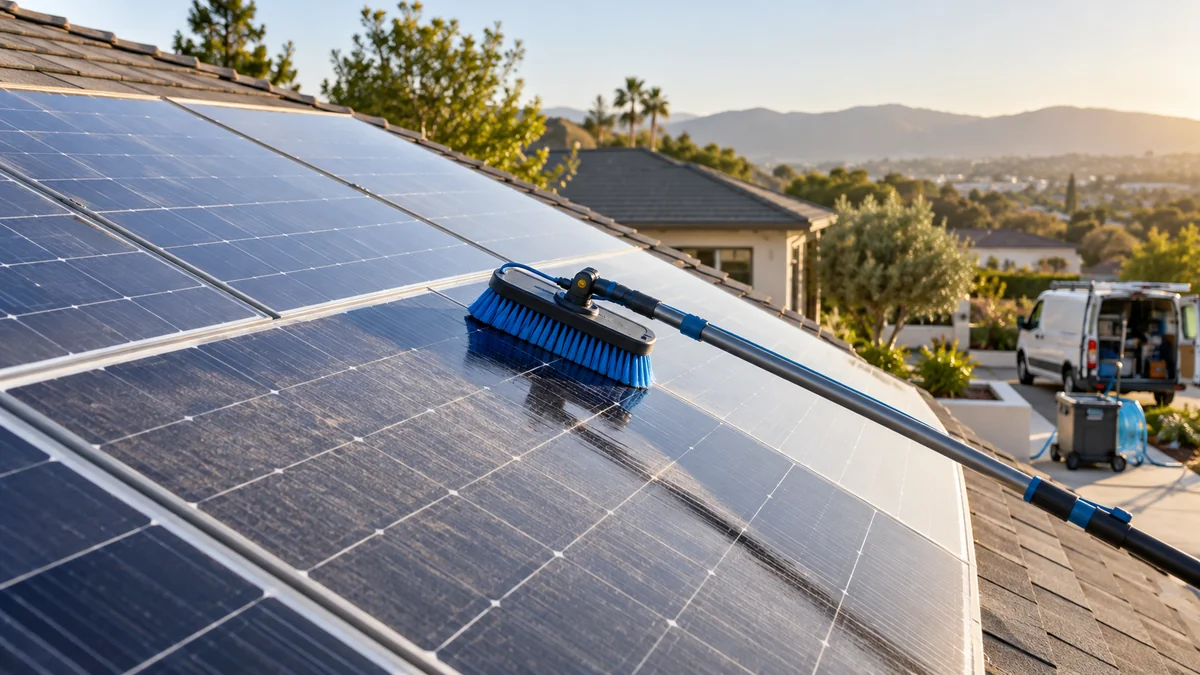
A professional solar panel cleaning service safely removes dust, pollen, bird droppings, salt, soot, and other deposits from photovoltaic modules using trained technicians, non-abrasive tools, and purified water. A proper visit also includes a visual condition check, careful scheduling around module temperature, documented results, and escalation of electrical or structural defects that cleaning cannot repair.
Key Facts at a Glance
- A typical residential solar cleaning visit costs about $150-$350 for a 15-25-panel system in the United States.
- Professional crews usually use reverse-osmosis or deionized water with soft nylon, microfiber, or equivalent non-abrasive brushes.
- Solar panels should not be pressure-washed, scrubbed with household detergents, or walked on.
- A common maintenance interval is 6-12 months, but agricultural, desert, coastal, and high-bird sites may need service every 3-6 months.
- Cleaning can recover meaningful production when deposits materially block sunlight, but it will not fix inverter faults, failed optimizers, shading, cracked modules, or degraded cells.
- A credible provider supplies insurance details, explains its water and access method, documents pre-existing damage, and reports findings after the visit.
What Does a Professional Solar Panel Cleaning Service Include?
A professional solar panel cleaning service combines module washing with basic visual inspection and performance context. The technician should examine the array before applying water, remove loose debris without dragging grit across the glass, wash with suitable equipment, rinse without mineral residue, and record conditions that require an electrician or solar contractor.
The service is not identical to residential window cleaning. Photovoltaic modules have frames, seals, junction boxes, cabling, connectors, racking, and electrical conductors that make access and water control more consequential. The cleaning company should follow the module manufacturer’s care instructions and the system owner’s shutdown procedure rather than assuming every array has the same design.
A complete residential visit commonly takes 45-90 minutes, depending on roof access, panel count, debris, hose routing, and inspection requirements. Commercial work may require a site-specific method statement, fall-protection plan, traffic controls, water logistics, and production scheduling.
What the technician should inspect
The inspection should identify:
- Cracked or chipped glass
- Loose frames, clamps, and racking
- Exposed, chewed, or sagging cables
- Damaged conduit and connectors
- Bird nests and heavy droppings
- Pooled dirt along lower panel edges
- Tree growth and new shade
- Hard-water scale from earlier cleaning
- Inverter alerts or abnormal production
- Access hazards, fragile roof coverings, and skylights
Cleaning technicians can identify visible warning signs, but they should not diagnose energized electrical faults unless they hold the appropriate qualifications. A ground fault, damaged connector, or suspected arc fault requires a qualified solar electrician or service technician.
How Does Professional Solar Panel Cleaning Work?
Professional solar panel cleaning generally follows six stages: system coordination, temperature and access checks, inspection, dry debris removal, purified-water washing, and verification. The most important controls are avoiding unsafe electrical contact, avoiding thermal shock, and preventing abrasive particles or minerals from remaining on the module surface.
Step 1: Coordinate shutdown and access
The technician confirms how the system is isolated before work begins. Some systems have inverter and AC disconnect controls, while module-level electronics, batteries, trackers, and commercial switchgear can change the procedure.
The cleaning crew should not improvise electrical isolation. If the shutdown sequence is unclear, the owner should contact the original installer, manufacturer, or a qualified solar professional. A cleaning company that says it can safely wash any active array without discussing the system design deserves caution.
Step 2: Choose a safe temperature and weather window
Technicians typically work in the early morning, late afternoon, or on an overcast day, when module surfaces are cooler. Applying cool water to very hot glass can create uneven thermal stress, particularly where one part of a module cools faster than another.
Wind, lightning, rain intensity, and frost also affect scheduling. Strong wind can move poles, hoses, and roof debris, while rain can make roof access unsafe. Light rain may reduce dust but does not remove baked-on bird deposits, salt film, tree sap, or oily agricultural residue.
Step 3: Perform the pre-wash inspection
The technician photographs visible damage and checks panel edges, racking, wiring, and debris concentration. This step protects both parties because a crack or hotspot that existed before cleaning should not later be attributed to the service.
The inspection should also compare the monitoring portal with recent production. A sudden output decline can result from soiling, but shading, inverter clipping, failed optimizers, network errors, degradation, and electrical faults can produce similar symptoms.
Step 4: Remove loose debris while dry
Leaves, twigs, sand piles, and thick dust should be removed with a soft brush or another manufacturer-compatible method before wet scrubbing. Wetting a heavy layer of grit can create an abrasive slurry that increases the chance of fine scratches.
Technicians should never drag metal tools, hard-edged squeegees, roof gravel, or stiff household brushes across module glass. A soft brush is not automatically safe if it contains trapped sand or is used with excessive pressure.
Step 5: Wash with purified water
Reverse-osmosis and deionized-water systems reduce dissolved minerals that otherwise dry as spots or chalky deposits. Water-fed poles allow technicians to work from the ground or roof perimeter in many residential installations, reducing the need to step near modules.
The brush should loosen deposits with controlled agitation rather than force. Heavy bird droppings or sap may require a dwell period and repeated gentle passes. The provider should follow the module maker’s instructions before using any cleaning agent, because detergents can leave films and some formulations may affect coatings, seals, or warranty conditions.
Step 6: Rinse, verify, and document
A proper rinse removes loosened material from module corners, frame channels, and the lower edge. The technician then checks for remaining streaks, restarts equipment according to the agreed procedure, and records after-photos.
Cleaning alone cannot prove a system is electrically healthy. A useful report distinguishes visible cleanliness from production performance and lists defects that need another trade. Where monitoring data is available, the owner can compare generation under similar irradiance and temperature conditions rather than expecting an immediate, fixed percentage increase.
Which Equipment and Cleaning Methods Are Best?
Manual water-fed poles are the most practical option for many residential and small commercial arrays. Robotic equipment becomes more attractive as panel counts, roof size, repetition, and labor costs increase, while drones and fixed sprinkler systems fit narrower situations and require more specialized controls.
| Method | Typical application | Water or tool requirement | Main limitation |
|---|---|---|---|
| Water-fed pole | 6-100 residential or light-commercial panels | RO/DI water, soft brush, telescopic carbon-fiber pole | Reach and operator productivity |
| Robotic cleaner | 500-100,000+ panels on accessible surfaces | Tracked unit, microfiber rollers, controlled water supply | Capital cost, edges, obstacles, uneven layouts |
| Drone-assisted washing | Restricted-access or elevated commercial areas | Specialized aircraft, spray system, trained pilot | Wind, regulation, overspray, limited scrubbing |
| Fixed sprinkler array | Repetitive desert or industrial installations | Installed nozzles, filtration, control system | Water consumption and poor removal of bonded deposits |
Manual water-fed poles
Manual poles provide close control over pressure and residue. They work well on pitched residential roofs when the operator can remain safely at the eaves, on suitable roof access points, or on the ground.
The method is less efficient when arrays are very large, separated across multiple roofs, or covered by thick bonded contamination. A provider should explain how it will manage hose weight, roof edges, skylights, and fall protection.
Robotic solar cleaners
Robots can reduce repetitive labor on large, relatively uniform arrays. Their usefulness depends on panel spacing, clamps, slopes, trackers, frame height, roof parapets, and the machine’s ability to turn without contacting sensitive components.
Robotic cleaning is not automatically superior. A tracked unit can miss corners, leave deposits along frames, or spread contaminated water if brushes and tanks are not maintained. A commercial proposal should specify inspection sampling and manual follow-up.
Why drones and sprinkler systems are niche options
Drones can reduce access work in selected industrial environments, but they do not eliminate the need for airspace compliance, overspray control, weather limits, and a method for removing bonded dirt. In many cases, a drone can rinse but cannot match the controlled agitation of a brush.
Fixed sprinklers are useful where a system is designed around frequent, predictable dust loading. They consume water, may leave minerals if filtration is poor, and cannot replace periodic inspection of wiring, racking, glass, and connectors.
How Much Does Solar Panel Cleaning Cost?
Typical residential solar panel cleaning costs range from $150-$350 per visit for a 15-25-panel array, with common per-panel pricing around $10-$25 and minimum call-out charges near $125-$150. Commercial pricing often combines mobilization with a per-panel rate, while large automated projects can cost less per panel but require specialized site conditions.
| Project type | Typical panel count | Typical price range | Typical duration |
|---|---|---|---|
| Small residential | 6-14 panels | $125-$250 | 30-60 minutes |
| Standard residential | 15-25 panels | $150-$350 | 45-90 minutes |
| Large residential | 26-50 panels | $250-$700 | 1-2.5 hours |
| Small commercial | 50-250 panels | $500-$2,000 | 2-8 hours |
| Large commercial | 250-5,000 panels | Quote-based, often $4-$7 per panel before volume adjustments | 1-5 days |
| Utility-scale robotic work | 5,000+ panels | Often $0.40-$1.50 per panel in suitable layouts | Scheduled by block |
These are typical planning ranges, not universal rates. Roof pitch, access distance, travel, water production, fall protection, bird waste, hard-water scale, insurance requirements, and minimum labor charges can move a quote substantially.
A low per-panel price may exclude setup, roof access, inspection, tax, travel, or difficult debris. A higher quote may include purified-water production, two technicians, documented reporting, safety equipment, and minor debris removal. Compare the scope, not only the unit price.
What changes the price?
The main cost variables are:
- Panel count and array fragmentation
- Roof height and pitch
- Ground-mounted or rooftop access
- Distance from the provider’s service area
- Heavy bird droppings, sap, or cement dust
- Need for water tanks or on-site purification
- Fall-protection and commercial safety requirements
- Robotic equipment mobilization
- Required photographs, reports, or performance testing
- Frequency discounts under a maintenance contract
How Often Should Panels Be Cleaned?
Most residential arrays need inspection at least annually and cleaning every 6-12 months when soiling is moderate. Sites exposed to desert dust, agricultural pollen, sea spray, bird activity, wildfire smoke, or nearby construction may justify cleaning every 3-6 months.
| Site condition | Suggested review interval | Suggested cleaning trigger |
|---|---|---|
| Temperate suburban roof | Every 12 months | Visible deposits or measurable production decline |
| Dry, dusty inland site | Every 3-6 months | Dust film after storms or repeated output loss |
| Agricultural property | Every 3-6 months | Pollen, fertilizer dust, or harvest-season residue |
| Coastal installation | Every 6-12 months | Salt film, windblown debris, or corrosion inspection |
| High-bird activity | Every 1-3 months | Droppings covering cells or repeated nesting |
| Commercial flat roof | Monthly visual checks | Performance threshold or scheduled service |
| Ground-mounted array | Every 6-12 months | Accessible soiling, weeds, and animal damage |
Rain is not a complete cleaning strategy. It can move loose dust but may leave concentrated dirt at the lower frame, and it does not reliably remove hardened droppings, salt, sap, soot, or oily films.
A practical trigger is a sustained production difference against comparable weather data, not a single cloudy day. Owners should compare irradiance, temperature, shading, inverter status, and seasonal solar position before attributing a loss to dirt.
Is Professional Cleaning Worth the Cost?
Professional cleaning is usually worth considering when soiling is visible, access is hazardous, production losses exceed the cleaning price, or the array sits in a high-deposit environment. Cleaning is usually poor value when panels are lightly soiled, safely accessible, frequently washed by natural rainfall, or experiencing a fault unrelated to surface contamination.
The return calculation is straightforward:
Estimated recovered value = expected additional kilowatt-hours × electricity value.
For example, if cleaning is expected to recover 150 kilowatt-hours over the relevant period and electricity is valued at $0.25 per kilowatt-hour, the gross energy value is $37.50. A $200 cleaning would not pay back from that recovery alone. Export credits, demand charges, battery charging, avoided peak purchases, and longer service intervals can change the result.
Published guidance varies because soiling depends heavily on local conditions. EnergySage has noted that many homeowners may not need frequent professional cleaning, especially where rainfall removes ordinary dust. Nexamp also frames cleaning as site-dependent maintenance rather than a universal annual requirement. Those positions are compatible: the correct frequency follows the deposit rate and the financial value of recovered generation.
Do not accept a guaranteed 10%, 15%, or 20% production increase without a measurement method. An increase after washing may reflect changing sunlight, temperature, cloud cover, inverter behavior, or a simultaneous repair.
Professional Cleaning Versus DIY
Professional cleaning is safer and more defensible for pitched roofs, high arrays, fragile roofing, heavy contamination, and systems with unclear shutdown procedures. DIY cleaning can be reasonable for an accessible ground-mounted array when the owner can avoid walking on modules, use purified water, follow manufacturer guidance, and work without electrical or fall hazards.
| Decision factor | Professional service | DIY ground-mount cleaning |
|---|---|---|
| Typical labor cost | $150-$350 residential visit | $0 labor, equipment often $50-$300 |
| Roof-fall exposure | Reduced through trained access controls | High on pitched or elevated roofs |
| Water quality | RO/DI system supplied | Requires filter or deionization cartridge |
| Condition inspection | Photos and defect escalation | Usually limited to owner observation |
| Warranty risk | Lower when documented and compliant | Depends on method and manufacturer rules |
| Best setting | Elevated, complex, commercial, heavily soiled | Low, accessible, uncomplicated array |
Never walk, kneel, sit, or place concentrated weight on a module. The glass may not visibly break, yet pressure can damage cells, create microcracks, or weaken connections.
Safe DIY boundaries
DIY owners should limit work to arrays that are safely reachable without climbing onto a hazardous roof. Use a soft, clean brush and purified water, avoid high pressure, avoid household glass cleaner, and stop if the system shows an inverter warning, exposed conductor, cracked glass, or damaged connector.
Ground-mounted does not mean risk-free. Wet paths, unstable soil, sharp rack edges, wildlife, energized conductors, and battery equipment still require attention.
What Should You Look for in a Cleaning Company?
Choose a provider that explains its process before quoting, carries appropriate liability and workers’ compensation insurance, uses equipment suitable for photovoltaic glass, and separates cleaning from electrical diagnosis. The strongest providers also give pre-service and post-service photographs, written exclusions, and a clear plan for damaged modules or unsafe access.
Ask these questions before booking:
- What water purification method do you use, and do you test total dissolved solids?
- What brush material and pressure-control method do you use?
- How do you handle system shutdown and inverter restart?
- Will you walk on modules or place equipment against them?
- What insurance covers roof damage and technician injury?
- Do you photograph pre-existing cracks, cable damage, and racking problems?
- What happens if you find a ground fault or exposed conductor?
- Is roof access, heavy bird waste, travel, and hard-water scale included?
- How will you measure whether cleaning improved production?
- Do you follow the module manufacturer’s maintenance instructions?
A professional provider should not promise that cleaning will restore a fixed percentage of output. The provider should also refuse unsafe work rather than solve access problems with improvised ladders, unprotected roof travel, or pressure washing.
Common Problems and Failure Modes
Why can cleaning damage solar panels?
Cleaning can damage solar panels when technicians use high pressure, abrasive tools, contaminated brushes, harsh chemicals, or cold water on overheated modules. Pressure can stress seals and connectors, while grit trapped in a brush can scratch glass or coatings.
A pressure washer is especially inappropriate for routine photovoltaic cleaning. It can drive water toward seals, cable entries, junction boxes, and connectors, while its force offers little benefit over controlled low-pressure washing.
What causes white marks after cleaning?
White marks usually indicate dissolved minerals left by hard water or a residue that was not fully rinsed. Repeated tap-water washing can build calcium or magnesium deposits, particularly along the lower frame.
Scale removal should be approached cautiously. Aggressive acids, abrasive powders, and scraping can damage surfaces. A specialist should identify the residue, check manufacturer guidance, and use the least aggressive compatible treatment.
Why is production still low after cleaning?
Low production after cleaning usually indicates that soiling was not the primary fault. Possible causes include inverter errors, failed optimizers, shading, snow, damaged wiring, module degradation, incorrect monitoring, grid outages, or a mismatch between the comparison dates.
Compare production with irradiance and temperature, inspect the inverter status, and consult a qualified solar technician when the decline is sudden or localized. Cleaning cannot repair a failed string or restore a cracked cell.
What does a ground-fault warning mean?
A ground-fault or insulation-fault warning requires immediate caution and professional diagnosis. The cause may include damaged cable insulation, moisture intrusion, a cracked module, connector failure, or inverter equipment trouble.
Do not wash, disconnect, or handle suspected faulted equipment as a cleaning task. Solar modules can produce DC electricity whenever illuminated, even when an inverter is switched off.
Maintenance Plans for Different Properties
Pitched residential roof
Schedule an annual inspection and use professional cleaning when panels cannot be reached from a safe position. Spring cleaning may remove winter deposits before a high-generation period, while autumn service can address leaves and bird debris.
Ground-mounted residential system
Ground-mounted owners have more cleaning flexibility, but should still use purified water and avoid module contact. Inspect weeds, animal damage, rack bolts, cable protection, and shading at the same visit.
Agricultural or dusty property
Plan reviews around planting, harvest, and major dust events. Pollen and soil particles can form a film that rainfall does not remove, while tractors and processing equipment may add concentrated residue.
Coastal property
Inspect for salt film and corrosion at the same time. Cleaning removes deposits from the glass, but it does not stop corrosion in racking, fasteners, connectors, or cable supports.
Commercial or industrial array
Use a written operations and maintenance scope with response times, production reporting, access controls, and defect escalation. Robots can reduce repetitive labor on uniform arrays, but periodic manual inspection remains necessary for edges, wiring, racking, and module damage.
Frequently Asked Questions
Can rain clean solar panels sufficiently?
Rain can remove loose dust but often leaves bird droppings, pollen, salt, sap, soot, and concentrated dirt at panel edges. A rainy climate may reduce cleaning frequency, but owners should still inspect production and module surfaces annually, especially near trees, roads, farms, or bird roosts.
Should solar panels be cleaned in direct sunlight?
Technicians generally avoid cleaning very hot panels in direct sunlight because rapid, uneven cooling can stress glass and make water evaporate before contaminants rinse away. Early morning, late afternoon, and overcast conditions usually provide safer and more consistent working temperatures.
Can window cleaners clean photovoltaic modules?
A window cleaner may have useful access and brush skills, but ordinary window-cleaning methods do not automatically meet solar requirements. Confirm that the provider understands module surfaces, purified water, electrical hazards, roof safety, manufacturer instructions, and defect reporting before hiring.
Do solar panels need soap?
Solar panels usually do not need soap for ordinary dust, pollen, or light deposits when purified water and a clean soft brush are used. A manufacturer-approved cleaning agent may be appropriate for unusual contamination, but household detergents can leave films or affect coatings.
How long does a residential cleaning appointment take?
A typical 15-25-panel residential visit takes about 45-90 minutes, including setup, inspection, washing, rinse, photographs, and system checks. Steep roofs, multiple arrays, heavy deposits, long hose runs, and required safety equipment can extend the appointment.
Does cleaning improve panel efficiency?
Cleaning can improve delivered energy when surface deposits block a meaningful amount of sunlight, but the gain varies by climate, deposit thickness, panel angle, and weather. A provider should compare similar operating conditions rather than guarantee a fixed percentage increase.
The Bottom Line
A professional solar panel cleaning service is most valuable when panels have visible, performance-relevant contamination or cannot be accessed safely. Expect a typical residential price of $150-$350, purified water, non-abrasive tools, a pre-clean inspection, documented results, and clear escalation of electrical defects. For a safe roof, reliable provider, and correct cleaning interval, match the service to the site rather than paying for a universal schedule.