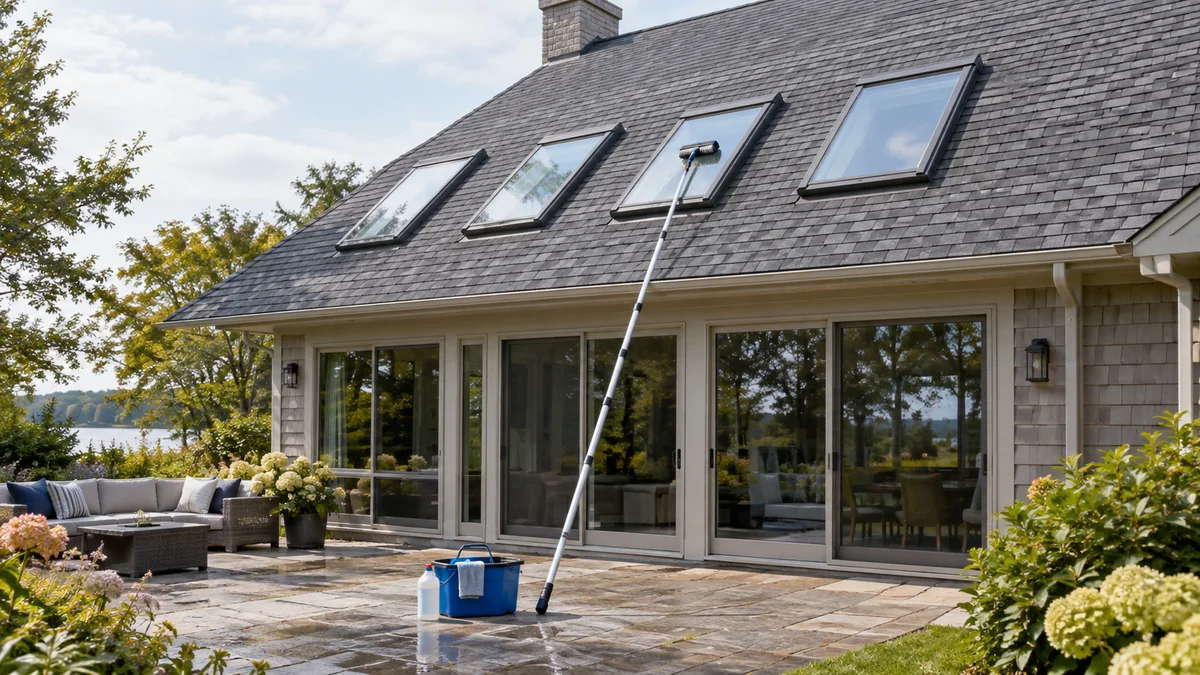
To clean exterior skylights safely without slipping, keep your feet on the ground or another stable, protected surface and use a telescopic pole, soft brush, and squeegee. Clean on a cool, shaded day, remove dry grit first, avoid pressure washing, and stop when the skylight requires roof access, unstable ladder work, or excessive pole force.
Key facts
A ground-based water-fed pole is usually the safest method for fixed skylights within practical reach.
A typical residential skylight takes 15-30 minutes to clean after equipment is assembled.
Mild dish soap and water are safer for unknown glazing than ammonia, alcohol, solvents, or abrasive powders.
Acrylic and polycarbonate can scratch or craze more easily than glass.
Never walk on a skylight pane, roof window, roofing membrane, or wet roof surface.
A professional is the safer choice for steep roofs, heights above practical pole reach, fragile roofing, and damaged flashing.
What Is the Safest Cleaning Method?
The safest exterior skylight cleaning method is a ground-based telescopic pole system that lets you wash, rinse, and squeegee without placing weight on the roof. A water-fed pole is usually the easiest option for tall or broad glazing, while a microfiber pad and squeegee provide a lower-cost solution for accessible one-story homes.
The word “safe” has two parts here: fall prevention and property protection. A person can remain on level ground and still damage a skylight by applying too much pressure, dragging grit across plastic, forcing a pole against flashing, or directing water beneath seals.
Do not treat a skylight as a walking surface. Even glazing designed for roof installation is not automatically designed to support a person. A roof ladder, fall-arrest system, guardrail, or scaffold may be necessary for professional access, but an ordinary household ladder does not make roof work safe.
Can You Clean a Skylight From the Ground?
You can clean many skylights from the ground if the pane is visible, the pole reaches without excessive bending, and the operator can control the tool at the required angle. Ground cleaning becomes impractical when roof geometry blocks the glass, the roofline exceeds safe pole reach, or the pole must be pushed sideways with substantial force.
Measure before buying equipment. A pole’s advertised length is not the same as useful cleaning reach because the operator needs several feet of handling room and must maintain a workable angle. A 20-foot pole may provide roughly 16-18 feet of effective reach in a real yard, depending on the skylight position and approach.
| Situation | Typical equipment | Practical limit | Recommended decision |
|---|---|---|---|
| One-story skylight over lawn | 12-20 ft pole, pad, squeegee | 10-16 ft working height | DIY ground cleaning |
| Two-story skylight with clear access | 18-30 ft carbon-fiber pole | 16-25 ft working height | Water-fed pole or trained operator |
| Skylight above a narrow roof valley | Pole with angled head | Control may be poor | Assess professionally |
| Steep roof above a garage | Ladder or roof access required | Fall exposure increases | Do not improvise |
| Glazing above 30 ft | Commercial water-fed or access system | Home equipment is often inadequate | Hire an insured professional |
Which Equipment Should You Choose?
Choose a telescopic microfiber-and-squeegee kit for occasional, low-cost cleaning and a water-fed pole for higher skylights, repeated maintenance, or large panes. Magnetic and robotic cleaners are niche alternatives that require compatible glass, reliable attachment, and a safe indoor operating position.
Extension pole with pad and squeegee
A rigid aluminum or carbon-fiber pole with a pivoting head is the basic manual setup. Use a soft microfiber sleeve or flagged nylon brush, not a stiff household broom. A swivel head helps the tool sit flat against an angled skylight.
The main limitation is leverage. A wet pad at the end of a long pole becomes heavy, and pushing hard against glass can flex the pole, disturb seals, or make the operator step toward an unsafe position. If the tool cannot remain controlled with light pressure, stop.
Water-fed pole
A water-fed pole sends purified water through a hollow pole to a soft brush. Reverse osmosis and deionization remove minerals that would otherwise remain as spots when water dries. The operator agitates the surface, rinses thoroughly, and allows the purified water to evaporate.
Water-fed systems are efficient on glass and frames, especially at two-story heights. They are less suitable for some acrylic and polycarbonate surfaces because brush pressure and trapped grit can create fine scratches. Follow the skylight manufacturer’s cleaning instructions first.
Magnetic or robotic cleaner
A magnetic cleaner or robot can work on compatible flat glass when one part operates inside and the outside unit remains tethered. These devices are not universal exterior-skylight solutions: domed glazing, thick laminated glass, textured surfaces, plastic panes, and heavy contamination can defeat the magnetic connection or cleaning path.
Never rely on a magnet alone above a hard-to-access area. Attach the manufacturer’s safety cord, confirm the glass thickness range, and keep the inside half supported until the outside unit is secure.
| Method | Typical cost | Best reach | Surface suitability | Main limitation |
|---|---|---|---|---|
| Manual pole kit | $25-$60 | 10-16 ft | Glass, compatible plastic with soft pad | High leverage and streak risk |
| Water-fed pole | $400-$900 | 16-30 ft | Most exterior glass | Equipment cost and plastic caution |
| Magnetic cleaner | $50-$400 | Indoor operation | Compatible flat glass | Thickness and attachment limits |
| Professional service | $75-$150 per visit, typical | Site-dependent | Manufacturer-compatible method | Recurring service cost |
Before You Start
Allow 30-45 minutes for setup and cleaning one accessible skylight, with an additional 15 minutes if the glass has bird droppings or mineral deposits. The difficulty is moderate because the cleaning itself is simple, but controlling a long pole and protecting the glazing require care.
Tools and materials
- Telescopic pole, usually 12-25 feet
- Soft microfiber pad or flagged brush
- Clean rubber squeegee, if using manual cleaning
- Two buckets, one for washing and one for rinsing tools
- Mild dish soap, approximately 1 teaspoon per gallon of water
- Garden hose with a gentle spray pattern
- Several clean microfiber towels
- Non-slip footwear for ground work
- Safety glasses if debris may fall
- Manufacturer’s cleaning instructions, if available
Inspect the ground first. Remove toys, hoses, stones, and other trip hazards, then place the bucket where the pole cannot catch it. Do not stand on wet decking, loose soil, a roof edge, a retaining wall, or a makeshift platform.
Step 1: Confirm the Skylight and Weather Conditions
Identify the glazing, inspect visible damage, and choose a cool, dry, low-wind period before extending any pole. Glass, acrylic, and polycarbonate require different pressure limits, while strong wind can turn a long pole into an unstable lever.
Do not clean cracked glazing, loose frames, lifted flashing, or visibly failed seals. Water may enter the roof assembly, and cleaning can worsen the defect. Photograph existing damage so a later leak is not confused with the cleaning process.
A shaded morning or overcast day usually gives better results than direct afternoon sun. Water and soap dry quickly on hot glazing, leaving mineral marks before the operator can rinse or squeegee.
You will know this step worked when: the surface is cool enough to remain wet during washing and the surrounding ground is clear.
Common mistake: starting because the weather is dry while ignoring high wind. Wind affects pole control even when no rain is present.
Step 2: Remove Loose Dry Debris
Attach a dry microfiber duster or soft brush and sweep leaves, needles, cobwebs, and loose dust from the pane and frame. Use light strokes from the upper area downward, keeping the tool face flat rather than grinding debris into the surface.
Dry grit is the main scratch hazard during the first wet pass. The risk is higher on acrylic and polycarbonate, whose softer surfaces can develop visible micro-scratches from sand, roof granules, or dried bird residue.
Do not use a dry towel to polish a dusty skylight. A towel can drag particles across the pane, and a circular motion can distribute grit over a larger area.
You will know this step worked when: loose debris has fallen away and no visible particles remain under the pad.
Common mistake: brushing aggressively around the perimeter. The brush can catch on raised flashing or a deteriorated seal.
Step 3: Pre-Rinse With Low Pressure
Rinse the skylight with a gentle hose spray or a water-fed brush to soften dried droppings, pollen, and mud. Begin at the upper edge and work downward, but keep the spray directed across the surface rather than under the frame or flashing.
A garden hose is acceptable when the spray is gentle and controlled. A pressure washer is not a safe substitute. High-pressure water can force moisture beneath gaskets, dislodge sealant, damage flashing interfaces, and spread contaminated runoff onto roof materials.
For hardened bird droppings, hold a wet microfiber pad against the area for 30-60 seconds before wiping. Repeated soaking is safer than scraping with a blade or abrasive sponge.
You will know this step worked when: contamination softens and water flows down without carrying loose grit across untouched areas.
Common mistake: using a concentrated jet because the pane appears far away. Distance reduces control and does not eliminate pressure-related damage.
Step 4: Apply a Compatible Cleaning Solution
Mix approximately 1 teaspoon of mild, non-abrasive dish soap into 1 gallon of clean water. Saturate the microfiber sleeve or soft brush, then clean in overlapping vertical strokes, followed by a light horizontal pass on heavily soiled areas.
Use less soap than seems necessary. Excess detergent leaves a film that creates streaks and attracts dust. Do not combine household chemicals, and avoid ammonia, alcohol, acetone, abrasive powders, razor blades, and solvent-based cleaners unless the skylight manufacturer specifically approves them.
White vinegar is sometimes used for mineral deposits, but it is not a universal skylight cleaner. Acidic solutions can affect some coatings, sealants, metals, or plastic surfaces. Test an inconspicuous area only when the manufacturer’s instructions permit it.
You will know this step worked when: the surface has an even wet film and dirt lifts without firm pressure.
Common mistake: scrubbing harder when contamination remains. Soak the area longer instead of increasing pressure.
Step 5: Rinse the Glass and Frame Thoroughly
Rinse from the top down until no soap remains on the pane, frame, or brush. Soap left in the upper frame can run onto clean glass later, producing streaks that appear after the surface has dried.
A second rinse is worthwhile where the water is hard or the skylight has textured edges. If you use a water-fed pole, purified water can provide the final rinse. With ordinary tap water, squeegee promptly before minerals dry.
Keep the hose stream away from roof joints and visible flashing overlaps. The objective is to rinse the glazing, not flood the roof assembly.
You will know this step worked when: runoff is clear, with no foamy trails or dirty lines emerging from the frame.
Common mistake: rinsing only the center of the pane. Dirt from the frame and corners can flow back over the glass.
Step 6: Squeegee Without Losing Control
Fit a clean, undamaged rubber blade and pull from the upper edge downward in straight overlapping passes. Wipe the blade after every pass, and keep the pole angle shallow enough that the blade remains in full contact with the glass.
A squeegee performs poorly when its rubber is nicked, dirty, hardened, or twisted. Replace a damaged blade rather than compensating with more pressure. At long reach, a microfiber finishing pad may be safer than a squeegee if maintaining blade contact requires force.
Never reach farther by stepping onto a sill, roof edge, ladder top, chair, or wet surface. Move the operator’s position on stable ground instead, even if that means making another pass.
You will know this step worked when: each pass leaves a continuous dry track without curved water tails.
Common mistake: pulling the blade diagonally across a sloped pane. Diagonal leverage can rotate the head and leave water trapped along the lower edge.
Step 7: Inspect the Result From Ground Level
Inspect the skylight from several angles while it is still damp, then check again after drying. Look for soap film, mineral spots, missed corners, loose debris, and water collecting at the lower frame.
Use a clean microfiber towel on the pole head for isolated edge marks. Do not lean a ladder against the skylight, and do not climb onto the roof to correct a small streak after the main job.
A professional inspection is appropriate if cleaning reveals cracked glazing, failed gaskets, damaged flashing, interior condensation between panes, or water stains around the ceiling opening. Cleaning cannot repair those conditions.
You will know this step worked when: the pane dries evenly and no new water enters the frame or surrounding roof area.
Common mistake: judging the result only from directly below. Reflected light from a side angle reveals streaks more reliably.
How Does Material Change the Method?
Glass tolerates more cleaning pressure than acrylic and polycarbonate, but every skylight should still be cleaned with a soft tool and manufacturer-approved solution. Plastic glazing can scratch, haze, craze, or react with chemicals that are acceptable on ordinary window glass.
Do not identify material solely by tapping. Sound can vary with thickness, frame construction, mounting, and coatings. Check labels, installation records, manufacturer documentation, or the product model when possible.
| Surface | Safer default | Avoid | Special concern |
|---|---|---|---|
| Tempered or laminated glass | Mild soap, soft microfiber, clean squeegee | Abrasive pads and metal blades | Coatings may scratch |
| Acrylic | Water, mild soap, soft microfiber | Ammonia, alcohol, solvents | Fine scratches and crazing |
| Polycarbonate | Manufacturer-approved cleaner, soft brush | Harsh chemicals and dry rubbing | Surface coating damage |
| Low-E coated glass | Approved mild cleaner, light pressure | Abrasive polishing | Coating can be damaged |
| Domed plastic | Gentle rinse and soft pad | Rigid scraping tools | Curvature complicates contact |
Expert rule: when the material is unknown, use water and a clean microfiber pad first. Material uncertainty is a reason to reduce chemical exposure, not to select a stronger cleaner.
Which Method Is Best for Your Situation?
The best method depends on height, surface material, cleaning frequency, and whether the operator can maintain control from stable ground. A manual pole is economical for one or two accessible skylights, while purified water reduces squeegee work on tall glass.
| User situation | Best option | Typical setup time | Reason |
|---|---|---|---|
| One-story homeowner | Manual microfiber pole | 10-15 minutes | Low cost and adequate reach |
| Two-story glass skylight | Water-fed pole | 20-40 minutes | Better reach and frame rinsing |
| Fixed skylight behind roof obstruction | Professional equipment | Site-specific | Ground line-of-sight is blocked |
| Opening flat-glass skylight | Compatible magnetic tool | 10-20 minutes | Indoor control may be possible |
| Acrylic dome | Soft manual pad | 10-20 minutes | Minimizes chemical and brush risk |
A magnetic tool is not automatically safer than a pole. If the outside unit detaches, it can fall, scratch the pane, damage roofing, or become impossible to retrieve. The tool must match the glass thickness and surface shape.
How Much Does Skylight Cleaning Cost?
Typical DIY equipment costs range from $25-$60 for a manual pole kit and $400-$900 for a residential water-fed system. Professional cleaning commonly costs about $75-$150 per visit for accessible residential work, although height, roof complexity, quantity, travel, and required access equipment can increase the quote.
Prices vary substantially by region. A quote should specify whether it includes exterior glass, frames, screens, interior cleaning, debris removal, leak inspection, and access equipment.
| Cost item | Typical range | Usually includes | May increase when |
|---|---|---|---|
| Manual pole kit | $25-$60 | Pole, pad, basic squeegee | Carbon fiber or longer reach |
| Water-fed setup | $400-$900 | Pole, brush, filtration components | Commercial filtration capacity |
| Magnetic cleaner | $50-$400 | Indoor and outdoor units | Thick glass or robotic control |
| Professional cleaning | $75-$150 per visit | Exterior cleaning of accessible units | Steep roof or special access |
| Replacement squeegee blade | $8-$25 | One compatible blade | Unusual head size |
Do not compare a low DIY price with a professional quote without comparing fall exposure, insurance, access equipment, and the cost of damaged flashing or glazing. The cheapest method is not the cheapest outcome if the task requires roof travel.
How Often Should You Clean Skylights?
Clean exterior skylights about twice a year in ordinary conditions, typically after spring pollen and before autumn leaves or winter weather. Homes beneath trees, near dusty roads, in coastal areas, or in regions with frequent bird activity may need quarterly inspection or cleaning.
Inspect after severe storms even if the pane looks clean. Hail, branches, windblown grit, and displaced flashing can create problems that ordinary washing will not reveal. A clean skylight also makes cracks and seal failures easier to see.
Avoid cleaning during freezing conditions. Water can create slippery ground, freeze around frames, and make a minor task harder to control.
Can You Use a Pressure Washer?
You should not use a pressure washer on an exterior skylight unless the skylight manufacturer and a qualified professional specifically approve the method. Pressure can drive water beneath seals, damage coatings, strip sealant, and force debris into frame channels.
A gentle garden hose is sufficient for pre-rinsing most residential skylights. The cleaning brush should provide agitation, while water removes loosened contamination. Pressure should not compensate for inadequate soaking or an unsuitable tool.
How Do You Fix Streaks and Mineral Deposits?
Fix streaks by rinsing away soap, cleaning or replacing the squeegee blade, and making overlapping passes while the glass remains wet. Hard-water deposits require identification and manufacturer-approved treatment; aggressive scraping can permanently damage plastic and coated glass.
Common causes include a dirty blade, excess detergent, direct sun, mineral-rich tap water, and runoff from a contaminated frame. A final purified-water rinse can reduce spotting on compatible glass.
For persistent white deposits, photograph the area and check the glazing instructions before using vinegar or a commercial descaler. Acid may remove minerals while damaging a coating or seal, so a seemingly successful spot treatment can create a larger repair problem.
When Should You Hire a Professional?
Hire an insured window-cleaning or roof-access professional when the skylight requires roof travel, sits above practical pole reach, is over a steep or fragile roof, or shows damaged glazing, flashing, or seals. Professional service is also appropriate when wind, snow, ice, poor footing, or nearby electrical hazards prevent stable ground work.
Ask the contractor how the crew will access the skylight, whether workers carry liability insurance, and whether the method protects the roof and glazing. A legitimate provider should be able to explain the equipment and stop conditions rather than simply promise a clean pane.
The following conditions are firm stop signs:
- You must place a foot on the roof to reach the glass.
- The ladder would stand on uneven, wet, or unstable ground.
- The pole requires force that pulls you toward a roof edge.
- The skylight is cracked, loose, or leaking.
- Wind prevents controlled pole movement.
- The glazing material and cleaner compatibility are unknown.
- A power line is within the equipment’s possible movement area.
FAQ
Can I use a ladder to clean an exterior skylight?
A ladder can provide access to a professional work system, but a household ladder does not make roof cleaning safe. Never stand on the top rungs, lean sideways over a roof edge, or transition from a ladder onto a roof without proper fall protection and training. A ground-based pole is safer when it provides adequate control.
Is vinegar safe for every skylight?
Vinegar is not safe for every skylight. Some glass surfaces, coatings, metals, sealants, acrylics, and polycarbonates can react poorly to acidic cleaners. Use the manufacturer’s instructions first; when documentation is unavailable, begin with clean water and a small amount of mild dish soap.
How do I clean a skylight that opens?
An opening skylight may permit indoor access to a compatible magnetic cleaner, but the exterior unit must match the glass thickness and remain tethered. Do not lean through the opening, sit on the frame, or place weight on the glazing. A pole remains preferable when it can reach from stable ground.
What removes bird droppings from skylight glass?
Soak bird droppings with clean water for 30-60 seconds, then lift them with a soft microfiber pad. Repeat the soaking process instead of scraping. Dried droppings can contain abrasive particles, so dry wiping and metal blades increase scratch risk.
Can I clean skylights in direct sunlight?
Direct sunlight makes cleaning harder because water and detergent evaporate before rinsing or squeegeeing. Choose shade, early morning, or an overcast period when the surface stays wet. If direct sun is unavoidable, work in small sections and rinse immediately.
How do I clean a skylight above a conservatory or extension?
Use a telescopic pole only if the operator can stand on stable ground with clear line-of-sight and no need to lean over the extension roof. Do not stand on conservatory glazing or a lightweight roof. If the structure blocks pole control, hire a professional with suitable access equipment.
The Bottom Line
The safest way to clean exterior skylights safely without slipping is to keep both feet on stable ground and use a soft telescopic pole, controlled rinse, and compatible cleaner. Choose a water-fed system for tall glass, use extra caution with acrylic and polycarbonate, and hire an insured professional whenever safe ground-based reach cannot complete the job.