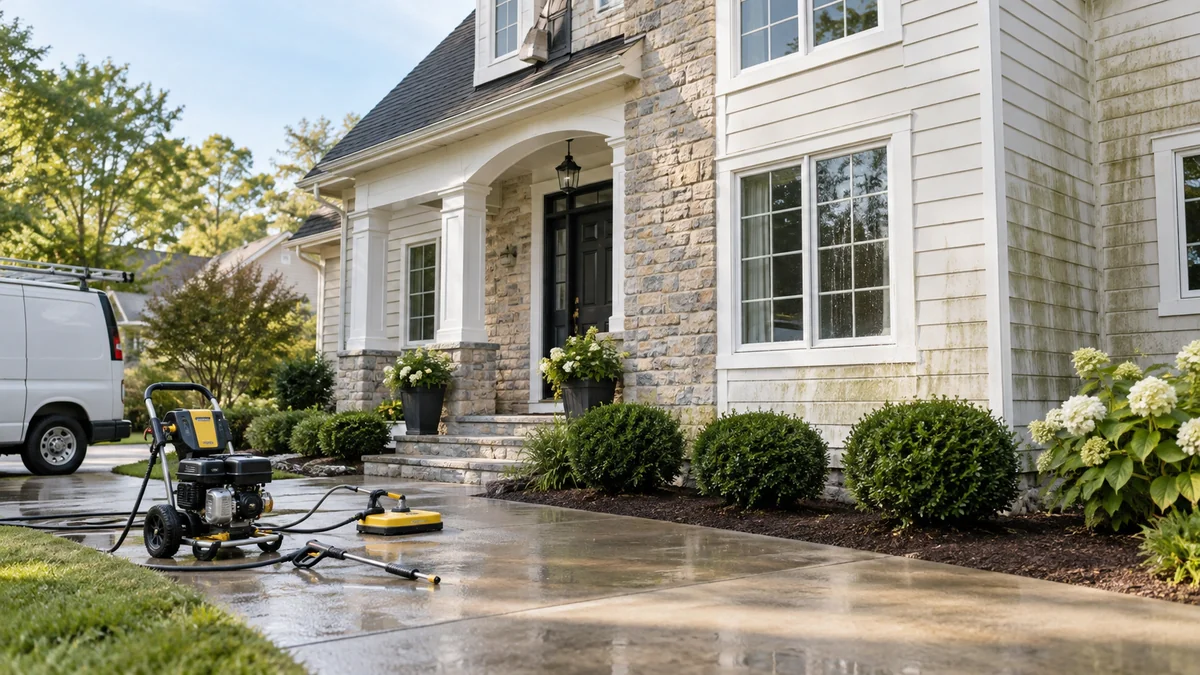
Exterior building cleaning services remove dirt, biological growth, pollutants, oil, mineral deposits, and other staining from facades, roofs, windows, walkways, and site structures. Professional work matches the cleaning chemistry, water pressure, temperature, access equipment, and runoff controls to the substrate, because the wrong combination can damage masonry, coatings, sealants, landscaping, or occupied interiors.
Key Facts
Commercial facade cleaning commonly costs about $0.08-$0.35 per square foot for straightforward low-rise work and $0.15-$0.80 per square foot for complex high-rise access.
Soft washing uses chemical treatment and low-pressure rinsing, making it generally preferable for stucco, EIFS, painted wood, vinyl, and asphalt shingles.
Pressure washing is better suited to sound, unpainted concrete and selected masonry than to fragile coatings, old mortar, or sealed joints.
A competent project includes pre-inspection, a test area, protection of openings and landscaping, controlled application, rinsing, runoff management, and closeout documentation.
Pure-water pole systems clean exterior glass without mineral spotting when the water has been properly deionized and the surface is suitable.
Cleaning cannot reverse etched pollution, corrosion, failed sealants, cracked masonry, or permanent discoloration without restoration or repair.
What Are Exterior Building Cleaning Services?
Exterior building cleaning services are commercial maintenance and facade-care operations that remove deposited contamination from a building envelope and its surrounding hardscape. Typical targets include airborne dust, vehicle soot, algae, mold, mildew, moss, bird deposits, grease, graffiti, efflorescence, and mineral spotting.
The service may cover brick, concrete, natural stone, stucco, EIFS, painted wood, vinyl siding, metal panels, curtain wall glass, windows, roofs, loading docks, parking structures, sidewalks, and entry canopies. Scope must be written by surface and elevation. “Clean the building” is too vague for a safe contract.
Cleaning is different from restoration. Washing removes contamination that remains on or near the surface; restoration may require poulticing, abrasive cleaning, grinding, polishing, repointing, coating removal, corrosion treatment, or replacement. A contractor should identify that boundary before promising a result.
What does a complete service include?
A complete commercial cleaning scope normally includes inspection, access planning, surface testing, protection, chemical selection, controlled cleaning, rinsing, waste controls, final inspection, and a written record of exceptions. Window washing, graffiti removal, sealant replacement, painting, and masonry repair may be separate line items.
The strongest specifications identify the elevation, substrate, stain type, acceptable appearance, cleaning method, water source, working hours, traffic controls, and warranty terms. Photographs before and after treatment reduce disputes about pre-existing damage and stains that cleaning cannot remove.
How Does the Cleaning Process Work?
A professional exterior building cleaning project follows five operating stages: inspect, protect, treat, rinse, and verify. The sequence matters because chemical contact without substrate testing can cause discoloration, while rinsing without runoff controls can move contaminants into soil or storm drains.
1. Inspect the building and test representative surfaces
Technicians should record substrate type, coating condition, cracks, open joints, failed window seals, electrical fixtures, vents, roof anchors, fragile ornament, and interior water-sensitive areas. They should classify deposits as organic, particulate, oily, mineral, metallic, or chemically etched.
A small test panel should establish the lowest effective pressure, chemical concentration, dwell time, nozzle pattern, and rinsing volume. Test panels belong in shaded and exposed conditions when the facade has different orientations. A successful test removes the target soil without changing gloss, color, texture, mortar, sealants, or coating adhesion.
2. Isolate work zones and protect property
Protection includes covering or pre-wetting vegetation, closing windows, shielding doors and electrical equipment, isolating air intakes, posting pedestrian controls, and establishing a drop zone beneath elevated work. Occupied buildings may need tenant notices, temporary HVAC adjustments, and interior leak monitoring.
Water can enter through failed gaskets, louver openings, weep holes, roof penetrations, and cracked render. Protection is not optional decoration. It is a control against interior moisture, electrical faults, chemical exposure, and slip incidents.
3. Apply the selected detergent or biocide
Cleaning agents loosen the bond between soil and substrate. Surfactants improve wetting, alkaline detergents help with greasy contamination, and appropriately controlled biocides address algae, mold, and other biological growth.
Dwell time is commonly 10-30 minutes for biological treatment, but temperature, sunlight, wind, porosity, and product instructions change the working interval. The surface should remain wet during dwell. A solution that dries on glass, painted metal, or vegetation can leave damage that a second rinse does not correct.
4. Rinse with calibrated pressure and volume
Technicians should work from the cleanest upper area downward while preventing dirty runoff from drying on completed sections. Pressure at the surface depends on pump pressure, nozzle angle, nozzle orifice, distance, and flow, so a machine’s advertised PSI alone does not define risk.
Low-pressure soft washing may use delivery pressure below 500 PSI, while pressure washing commonly operates around 2,000-4,000 PSI at the equipment. Those figures are planning ranges, not universal settings. Historic brick, soft stone, wood, EIFS, and aged coatings may require far less.
5. Verify the result and manage wastewater
Closeout should check missed areas, streaks, chemical residue, damaged joints, window spotting, runoff pathways, and plant condition. Wastewater must be handled according to local sewer, stormwater, and environmental requirements. A contractor should never assume that detergent, oil, paint residue, or biological material may enter a storm drain.
The closeout package should include photographs, areas completed, chemicals used, exceptions, damage observations, and recommendations for the next service. That record improves future maintenance because technicians can repeat successful settings instead of starting from guesswork.
Which Cleaning Method Fits Each Exterior?
The best method depends on the substrate, contaminant, desired finish, access, and runoff restrictions. No single system is safe for every facade, and “more pressure” is not a substitute for diagnosis.
| Method | Typical operating range | Best applications | Main limitations |
|---|---|---|---|
| Pressure washing | 2,000-4,000 PSI equipment rating | Sound concrete, heavy grime, selected unpainted brick | Can erode mortar, drive water behind joints, strip coatings |
| Hot-water power washing | 1,500-4,000 PSI, heated water | Oil, grease, loading docks, industrial concrete | Heat can damage coatings, sealants, plants, and sensitive stone |
| Soft washing | Often below 500 PSI | Stucco, EIFS, painted wood, vinyl, biological growth | Requires chemical control, dwell management, and runoff protection |
| Steam or DOFF cleaning | Up to about 150°C, low pressure | Heritage brick, terra cotta, delicate biological deposits | Slow production, specialist equipment, limited grease removal |
| Pure-water poles | Deionized water, pole reach often up to 60-80 feet | Exterior glass, frames, light facade dust | Poor choice for heavy grease, paint, cement, or etched glass |
When is soft washing safer than pressure washing?
Soft washing is generally safer for porous or coated surfaces because chemical action does most of the cleaning while water provides controlled rinsing. It is commonly selected for stucco, EIFS, painted wood, vinyl, asphalt shingles, and biological growth on facades.
Soft washing is not automatically harmless. Sodium hypochlorite and other treatment agents can bleach plants, corrode unprotected metals, damage fabrics, and irritate occupants. Correct dilution, wetting, dwell, neutralization where required, and thorough rinsing determine the result.
When should a contractor use steam or DOFF cleaning?
Steam or DOFF cleaning suits delicate historic masonry and biological deposits where high pressure could remove a friable surface or erode mortar. Low mechanical force can clean ornament and textured brick while reducing water penetration.
Steam does not solve every masonry problem. Heavy oil, deep corrosion, paint layers, and chemically etched pollution may require a separate conservation method. Historic buildings may also require owner, architect, or conservation approval before testing.
How do pure-water systems clean windows?
Pure-water systems remove dissolved minerals through reverse osmosis and deionization, then deliver the water through a brush on a telescopic pole. When the glass is properly agitated and rinsed, mineral-free water dries without the spotting caused by ordinary tap water.
Pure water does not dissolve every contaminant. Construction debris, silicone, paint, bird deposits, hard-water scale, and greasy films may require scraping, detergent, restoration cleaning, or polishing. Water quality should be checked with a total dissolved solids meter before large-scale work.
How Are High-Rise Facades Reached?
High-rise cleaning requires an engineered access plan, trained workers, equipment inspection, exclusion zones, rescue procedures, and weather monitoring. Rope access, suspended platforms, boom lifts, and scaffolding each solve different geometry and production problems.
| Access system | Typical working context | Strength | Constraint |
|---|---|---|---|
| Rope access | Complex elevations, towers, setbacks | High mobility and limited ground footprint | Requires certified systems, anchors, rescue planning |
| Suspended cradle | Uniform curtain wall and glass towers | Efficient for repeated vertical bays | Needs compatible roof rigging and platform controls |
| Boom lift | Low and mid-rise work, open ground | Fast repositioning from grade | Ground bearing, reach, and overhead clearance limit use |
| Scaffolding | Restoration, long-duration projects | Stable platform for detail work | High mobilization cost and larger site footprint |
| Drone spray equipment | Limited specialist applications | Reduces worker exposure in selected areas | Regulatory, payload, wind, overspray, and rescue limitations |
Rope access is not automatically the cheapest option. A tower with frequent anchor transfers may cost more than a cradle, while a parking structure with clear ground access may favor a lift. Drone-based cleaning remains a specialized approach, not a universal substitute for trained facade workers, inspection, or hand detailing.
Wind, rain, lightning, freezing temperatures, and poor visibility can stop elevated work. Contracts should state who pays for weather delays and how the contractor protects partially completed elevations.
How Much Do Commercial Exterior Cleaning Services Cost?
Typical commercial exterior cleaning prices range from $0.08-$0.35 per square foot for straightforward low-rise facades, $0.15-$0.80 per square foot for complex high-rise work, and $0.03-$0.25 per square foot for parking garages and concrete lots. Commercial window cleaning often ranges from $2-$5 per pane, but access and detailing can change the unit price substantially.
| Project type | Typical planning range | Typical duration | Major price driver |
|---|---|---|---|
| Small retail facade | $0.10-$0.35 per sq. ft. | 4-8 hours | Mobilization and storefront protection |
| Mid-rise facade | $0.15-$0.55 per sq. ft. | 2-4 days | Lift, rope, or cradle access |
| High-rise facade | $0.15-$0.80 per sq. ft. | 1-3 weeks | Wind delays, rigging, and repeated drops |
| Parking garage | $0.03-$0.25 per sq. ft. | 1-5 days | Oil, traffic control, and wastewater |
| Commercial windows | $2-$5 per pane | 1-5 days | Pane size, access, frames, and restoration soil |
These are typical planning ranges, not guaranteed market prices. A small building may receive a minimum mobilization charge even when its square footage suggests a low total. Costs also rise with night work, contaminated wastewater, difficult water access, traffic management, test panels, specialty chemicals, fragile finishes, and separate detailing.
A useful bid separates fixed costs from production costs. Ask for mobilization, access equipment, labor, chemicals, water, protection, wastewater handling, restoration, and repairs as distinct lines. Two bids with identical square-foot prices may have very different exclusions.
How Long Does Building Washing Take?
A small retail or strip-mall project under 5,000 square feet commonly takes 4-8 working hours. A three-to-five-story commercial building often takes 2-4 days, while a high-rise project can require 1-3 weeks when access changes, weather delays, and window detailing are included.
Production slows when the facade has many balconies, recessed bays, fragile finishes, occupied entrances, or separate substrate types. Heavy biological growth also requires dwell time and repeat treatment, while grease may require hot water and multiple passes.
The fastest schedule is not always the lowest-risk schedule. Rushing dwell time, omitting test panels, or moving equipment before runoff is controlled can create rework and damage.
What Can Go Wrong, and How Is It Fixed?
Exterior cleaning failures usually result from a mismatch between contaminant, substrate, chemistry, pressure, or access. Diagnosis should precede retreatment because repeated washing can deepen damage without removing the underlying cause.
| Visible problem | Likely cause | Appropriate response |
|---|---|---|
| Milky white masonry residue | Efflorescence or mineral migration | Confirm salts, use approved low-pressure cleaning, correct moisture source |
| Green growth returns quickly | Surface-only pressure washing | Apply a suitable biological treatment and improve moisture control |
| Dark ghosting remains | Pollutant etching or substrate shadowing | Test restoration, polishing, or coating work instead of repeated washing |
| Stripes after window cleaning | Mineral-rich water or uneven rinsing | Check TDS, brush technique, and final pure-water rinse |
| Interior dampness | Failed seal, open joint, or excessive water volume | Stop work, inspect the envelope, repair the entry path |
| Plant bleaching | Chemical overspray or runoff | Flush vegetation, document exposure, correct protection and dilution |
Efflorescence is a moisture-management symptom as well as a surface stain. Acidic treatments can damage limestone, polished stone, mortar, and metal, so a contractor should identify the masonry before selecting an acid.
Rapid biological regrowth may indicate shade, persistent moisture, clogged gutters, leaking downspouts, or condensation. Cleaning removes the visible growth, but maintenance must address the condition that supports it.
A counterintuitive field rule is that a clean-looking facade can hide damage. High pressure may remove a weak outer glaze or expose aggregate, producing an immediately bright surface that weathers faster afterward.
How Often Should a Building Be Cleaned?
Most commercial facilities benefit from an annual facade inspection and a planned wash interval based on exposure rather than a universal calendar. High-traffic entrances, hospitality properties, coastal buildings, shaded north elevations, and industrial sites may need quarterly spot cleaning or more frequent localized work.
| Building condition | Typical interval | Priority areas |
|---|---|---|
| Low-traffic suburban office | 12-24 months | Entry, signage, visible elevations |
| Urban retail or hospitality | 3-12 months | Doors, sidewalks, canopies, loading areas |
| Shaded or damp facade | 6-12 months | North walls, joints, gutters, low elevations |
| Industrial facility | 3-12 months | Oil zones, docks, exhaust-affected panels |
| Coastal or salt-exposed building | 6-12 months | Metal panels, glass, fasteners, ledges |
Facility managers should record staining after rain, construction, landscaping changes, and nearby roadwork. Scheduled cleaning is usually easier to budget than emergency work before a lease inspection, sale, public event, or insurance review.
What Should a Contractor Proposal Include?
A defensible proposal identifies the exact building areas, cleaning method, test-panel process, access equipment, chemical products, working hours, protection measures, runoff controls, price basis, exclusions, and acceptance standard. It also states whether the contractor will clean frames, sills, ledges, sidewalks, roof edges, and exterior fixtures.
Before awarding work, request:
- General liability and workers’ compensation certificates, with limits appropriate to the project.
- Evidence of training for lifts, rope access, suspended platforms, or other selected systems.
- A written rescue and emergency plan for elevated work.
- References for the same substrate and building height.
- Product safety data sheets and chemical handling procedures.
- A test panel with documented pressure, dilution, dwell, and result.
- Runoff and stormwater controls suited to the site.
- Before-and-after photographs and a report of pre-existing defects.
- A clear remedy for missed areas, plant damage, water intrusion, or unacceptable finish.
- Proof that the contractor will not discharge contaminated water without authorization.
A low bid that omits wastewater control, access, protection, or restoration boundaries is not comparable to a complete bid. Normalize every proposal before choosing the lowest price.
How Should Owners Match Cleaning to Their Situation?
Facility managers
Use an annual baseline wash plan, then add quarterly attention to public entrances, sidewalks, loading docks, and high-visibility hospitality areas. Require work-hour controls, tenant communication, documented runoff management, and service-level dates.
Multifamily and HOA boards
Prioritize test panels and low-pressure methods on stucco, EIFS, painted siding, and aging masonry. Coordinate resident notices, close windows, protect balconies, and document any pre-existing leaks before work begins.
Industrial operators
Use hot-water or detergent systems for hydrocarbon deposits only after confirming substrate tolerance. Isolate catch basins, collect or filter contaminated water as required, and keep cleaning chemicals away from process drains and sensitive equipment.
Historic-property owners
Use the least aggressive proven method, retain test-panel records, and involve a qualified conservator when the facade includes soft brick, terra cotta, carved stone, lime mortar, or historic coatings. Cleaning should not erase patina that has cultural or architectural value.
FAQ
Can exterior building cleaning remove every stain?
No. Washing usually removes deposited dirt, biological growth, grease, and some mineral contamination, but it cannot reliably reverse etched pollution, corrosion, deep dye transfer, failed coatings, cracked masonry, or permanently discolored material. A test panel should determine whether restoration, repair, repainting, or replacement is needed.
Is pressure washing safe for brick?
Pressure washing is safe only when the brick, mortar, coating condition, nozzle, pressure, distance, and water volume are suitable. Sound modern brick may tolerate controlled cleaning, while soft historic brick and deteriorated mortar can suffer erosion, water penetration, and joint loss. Low-pressure chemical cleaning is often safer.
Will building washing damage windows or sealants?
Building washing can damage windows or sealants when water is forced through failed gaskets, open joints, vents, or deteriorated perimeter seals. Contractors should inspect glazing, protect openings, avoid direct spray at vulnerable joints, and stop work if interior moisture appears.
What is the difference between soft washing and power washing?
Soft washing relies primarily on chemical treatment and low-pressure rinsing, while power washing relies on a higher-velocity water stream and may use heated water. Soft washing suits many coated and biological surfaces; power washing suits selected sound concrete, masonry, and heavy grease conditions.
Should cleaning happen before painting or sealing?
Cleaning should normally happen before painting or sealing because coatings require a sound, dry, contaminant-free surface. The substrate may also need repairs, moisture testing, efflorescence treatment, or a specified drying period before a coating is applied.
How can owners compare two cleaning quotes?
Compare the included elevations, square-foot measurement, access system, test-panel method, chemical products, pressure limits, plant protection, wastewater controls, working hours, exclusions, insurance, warranty, and closeout documentation. A lower unit price is meaningful only when both proposals define the same scope and risk controls.
The Bottom Line
Exterior building cleaning services protect appearance and help preserve building materials when the contractor matches chemistry, pressure, temperature, access, and runoff controls to the facade. Soft washing commonly fits coated and biological surfaces, pressure and hot-water cleaning fit selected concrete and heavy soil, steam suits delicate heritage work, and pure-water systems fit routine exterior glass. For a reliable project, require a test panel, a substrate-specific method statement, documented protection, controlled wastewater, and a proposal that distinguishes cleaning from restoration. A planned maintenance interval also costs less than repeated emergency treatment after staining, water intrusion, or surface damage.