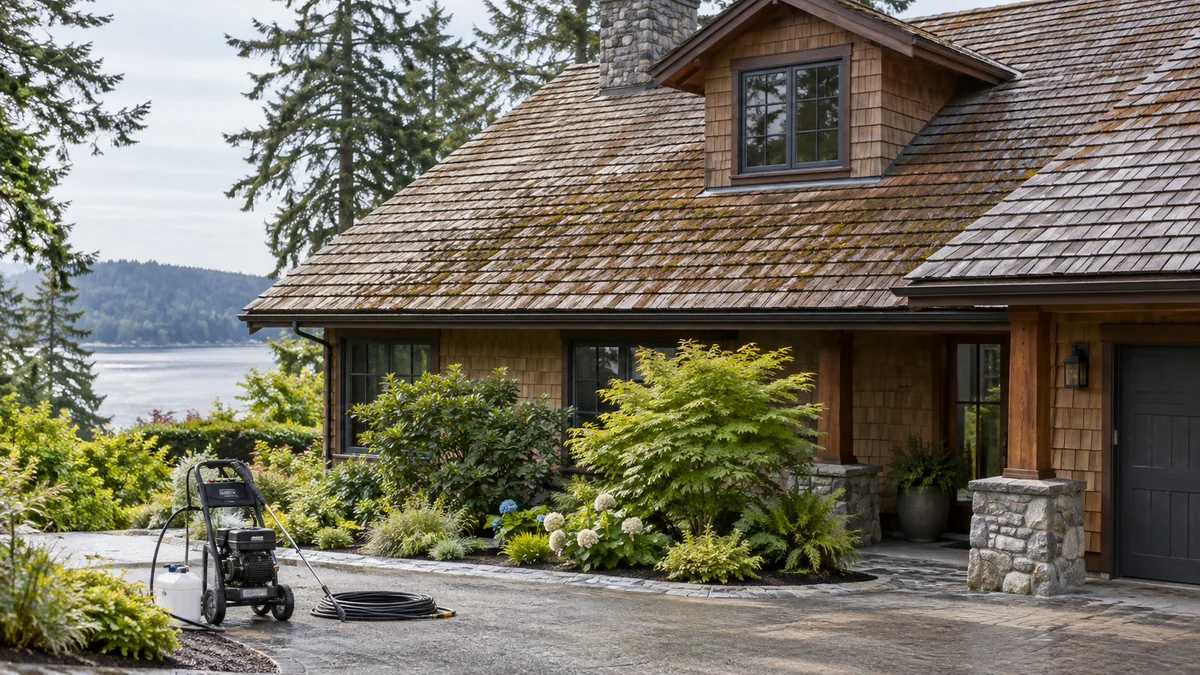
Cedar shake roof cleaning and treatment is a controlled maintenance process that removes organic growth, clears drainage paths, brightens weathered wood, and applies a vapor-permeable preservative when the shakes are structurally sound. The work normally takes 2-3 days because cedar must dry before treatment, and the roof’s age, thickness, moisture content, slope, and local climate determine whether restoration is appropriate.
Key facts
Cedar shakes should be cleaned with low-pressure methods, not aggressive power washing.
A roof should be inspected for splitting, soft wood, exposed fasteners, failed flashing, and leaks before treatment.
Cedar must be fully dry before oil or stain application; a typical target is 15-18% moisture content or the product manufacturer’s limit.
Basic cleaning commonly costs about $0.50-$1.25 per square foot; cleaning plus treatment commonly costs $1.50-$3.50 or more.
Penetrating oil stains can reduce moisture absorption and UV exposure, but they cannot restore structurally rotten shakes.
Moss control is incomplete unless shade, branches, gutters, ventilation, and recurring moisture are addressed.
What Is Cedar Shake Roof Cleaning and Treatment?
Cedar shake roof maintenance combines inspection, dry debris removal, biological cleaning, rinsing, optional brightening, drying, and preservation. The purpose is not to make old cedar look new. The purpose is to remove conditions that retain moisture while slowing UV weathering and fungal decay.
Cedar is a cellular wood product. Repeated wetting and drying cause the material to expand and contract, while ultraviolet radiation breaks down exposed lignin and turns the surface silver-gray. Gray cedar is not automatically failing; softness, deep erosion, splitting, cupping, and persistent dampness are more meaningful warning signs.
Moss and lichen create a separate risk. Growth holds water against the shake surface and can extend into joints and keyways, the drainage gaps between adjacent shakes. Algae and mildew may be mainly cosmetic, although persistent dampness associated with them can contribute to decay.
Which roof conditions make cleaning worthwhile?
Cleaning is usually worthwhile when shakes remain firm, retain adequate thickness, and have localized or widespread surface growth without major leakage. Cleaning is not a substitute for reroofing when the roof has widespread soft wood, exposed underlayment, repeated leaks, severe cupping, or numerous broken shakes.
A practitioner’s rule is simple: cleaning improves the environment around sound wood; it does not rebuild missing wood fibers.
How Does the Cleaning and Treatment Process Work?
The process has seven stages: protect the site, clear dry debris, apply a controlled cleaner, rinse gently, brighten when appropriate, dry completely, and apply a penetrating treatment. The most important control is not a single pressure number. It is preventing fiber erosion, trapped moisture, chemical damage, and runoff contamination.
What should happen before any chemical is applied?
A competent contractor records roof age, identifies shake type, checks attic ventilation, inspects flashing and valleys, and tests representative areas. The contractor should also identify plants, fish ponds, metal surfaces, painted siding, and drainage routes that require protection.
Roof access requires special care. Old shakes can crack under concentrated foot traffic, and wet cedar is highly slippery. Crews should use roof-specific access systems, ladders, staging, or rope techniques rather than treating the roof like an asphalt-shingle surface.
Step-by-Step Cedar Roof Cleaning
Step 1: Protect plants, siding, and drainage
Pre-wet vegetation with clean water and cover vulnerable areas with breathable protection where practical. Control runoff rather than allowing concentrated cleaner to flow into gardens, ponds, storm drains, or neighboring property.
Downspouts may need temporary diversion or collection, depending on the product label and local disposal requirements. Never assume that a product labeled biodegradable is harmless at concentrated strength.
Success checkpoint: runoff is controlled, nearby surfaces are protected, and emergency rinse water is available.
Common mistake: beginning chemical application before wetting plants and identifying where roof water will discharge.
Step 2: Remove dry debris and open keyways
Remove leaves, needles, twigs, and heavy moss deposits with hand tools, a soft brush, or carefully controlled air from a safe position. Keep tools from scraping across the grain.
Open blocked keyways without widening them. Debris in these channels slows drainage and keeps the side edges of shakes wet after rainfall.
Success checkpoint: valleys, gutters, penetrations, and keyways are visibly open without broken shake edges.
Common mistake: using a stiff metal rake or wire brush that removes sound cedar along with debris.
Step 3: Apply a cedar-compatible cleaner
Apply the selected solution uniformly, usually from a low-pressure chemical sprayer. Working from lower areas upward can reduce streaking, but the exact sequence depends on the product and roof geometry. Keep the surface wet during the product’s labeled dwell period, commonly 15-30 minutes.
Sodium percarbonate is often selected for moderate organic growth because it releases peroxide in water and is less aggressive toward wood than strong chlorine solutions. Heavier alkaline cleaners may remove oil residue and embedded dirt but require careful rinsing and, where specified, neutralization.
Success checkpoint: moss, algae, and surface dirt soften without the cedar becoming fuzzy or excessively pale.
Common mistake: allowing cleaner to dry on the wood, which can create uneven color and concentrated chemical exposure.
Step 4: Rinse with controlled pressure
Rinse in the direction of water flow, using the lowest pressure that removes loosened material. The 300-psi ceiling often cited for cedar is not a universal safe setting; nozzle type, distance, flow rate, wood condition, and operator technique also determine damage risk.
A garden-hose flow or purpose-designed soft-wash rinse may be safer than a pressure washer. Never direct water upward beneath shake overlaps, flashing, vents, or ridge details.
Success checkpoint: dead growth and cleaner residue are removed while the wood surface remains intact and non-fibrous.
Common mistake: increasing pressure to obtain instant visual results. Surface fibers may be removed before the operator recognizes the damage.
Step 5: Brighten only when the substrate needs it
A wood brightener based on oxalic or another labeled acid can reduce alkaline residue, tannin staining, and some iron discoloration. Brightening is not mandatory after every cleaning, and acid should never be mixed directly with an alkaline cleaner.
Apply according to the manufacturer’s dilution and contact instructions, then rinse thoroughly. Test a small area first because aged cedar can react unevenly.
Success checkpoint: the roof has an even appearance without chalky residue, dark chemical blotches, or active runoff.
Common mistake: using brightener to conceal rot or expecting acid to restore eroded wood.
Step 6: Allow the shakes to dry
Drying commonly requires 24-48 hours, although shaded roofs, cool weather, high humidity, and thick shakes can require longer. Use a moisture meter at multiple roof elevations rather than relying only on surface appearance.
A typical treatment target is below 15-18% moisture content when the product permits that range. Follow the preservative label if it specifies a different threshold.
Success checkpoint: readings are consistently within the treatment product’s range, and the weather forecast provides sufficient rain-free time.
Common mistake: treating the roof the morning after washing because the top surface feels dry while joints remain damp.
Step 7: Apply a penetrating preservative
Apply a compatible penetrating oil or semitransparent stain by low-pressure spray, brush, or both. Back-brush excess product from puddles, laps, flashing, and keyways. Pooling can produce uneven color and slow drying.
A penetrating product should reduce water uptake while allowing water vapor to escape. Pigmented stains generally provide more UV protection than clear oils because pigment screens ultraviolet radiation.
Success checkpoint: color is uniform, excess product is removed, and keyways remain open.
Common mistake: applying a film-forming coating that traps moisture beneath the surface or bridges drainage gaps.
Which Cleaning Chemicals Are Appropriate?
No cleaner is universally best. Product selection depends on growth severity, roof age, nearby vegetation, metal components, runoff controls, and the preservative that will follow.
| Cleaner | Typical use | Main advantage | Main risk |
|---|---|---|---|
| Sodium percarbonate | Light to moderate moss, algae, and mildew | Peroxide-based action with relatively low wood aggressiveness | Longer dwell time and weaker performance on thick lichen |
| Sodium metasilicate cleaner | Heavy dirt, grease, or old treatment residue | Strong soil and oil removal | Alkaline residue can darken wood without thorough rinsing |
| Diluted sodium hypochlorite | Selected severe biological growth | Fast oxidation and visible kill | Can damage lignin, corrode metals, harm plants, and bleach cedar |
| Oxalic acid brightener | Tannin, iron, or alkaline discoloration | Reduces some dark staining after cleaning | Not a primary moss cleaner; incorrect use can injure wood |
| Citric acid brightener | Mild pH correction and staining work | Lower-odor alternative in some systems | Results vary with stain type and concentration |
Product labels control dilution, dwell time, personal protective equipment, and disposal. Mixing bleach, acids, ammonia, or other cleaners can release dangerous gases or create uncontrolled reactions.
Which Cedar Roof Treatment Is Best?
A penetrating, cedar-compatible stain is usually the most balanced treatment where UV exposure and moisture cycling are the main concerns. Clear oils preserve a weathered appearance but generally provide less UV screening than pigmented products.
| Treatment type | Typical service interval | UV protection | Vapor behavior | Best use |
|---|---|---|---|---|
| Clear penetrating oil | 2-4 years | Low to moderate | High when correctly formulated | Natural gray appearance |
| Semitransparent oil stain | 3-6 years | Moderate to high | High when penetrating | Color retention and weather exposure |
| Copper or zinc preservative oil | 3-6 years | Product-dependent | Usually high if non-film-forming | Moisture-prone roofs with labeled compatibility |
| Acrylic film coating | Product-dependent | Often high initially | Potentially restricted | Generally unsuitable for aged shakes |
| Silicone film sealer | Product-dependent | Variable | May restrict drying | Avoid unless specifically engineered for the roof assembly |
Treatment frequency depends on exposure rather than a fixed calendar. South-facing slopes, open coastal sites, and high-altitude roofs can weather faster, while shaded slopes may remain damp and require biological maintenance sooner.
Pressure Washing Versus Soft Washing
Low-pressure chemical cleaning is generally safer for cedar than high-pressure jet washing because the method removes growth chemically instead of relying on mechanical abrasion. Pressure washing can strip soft earlywood, enlarge surface checks, drive water under overlaps, and damage fragile fasteners or underlayment.
| Method | Typical operating characteristic | Main benefit | Main limitation |
|---|---|---|---|
| Low-pressure soft wash | Chemical application with gentle rinse | Low mechanical wear | Requires dwell control and runoff management |
| Garden-hose rinse | Low mechanical force | Safer for delicate aged wood | May not remove bonded lichen alone |
| Hand scraping | Minimal chemical runoff | Useful for isolated deposits | Can crack shakes and leave roots behind |
| High-pressure washing | Concentrated mechanical water force | Fast visible cleaning | Fiber erosion, leaks, and underlayment damage |
| Zinc or copper strips | Rain-activated metal ions | Ongoing localized growth suppression | Limited reach on long or shaded slopes |
Metal strips can help control recurring moss near ridges, but rainfall distributes their effect unevenly. They do not replace cleaning, ventilation correction, branch trimming, or inspection.
How Much Does Cedar Shake Roof Cleaning Cost?
Typical professional pricing is about $0.50-$1.25 per square foot for cleaning alone and $1.50-$3.50 or more per square foot for cleaning, brightening, drying coordination, and penetrating treatment. A 1,500-2,500-square-foot roof therefore commonly falls near $1,500-$4,500, with steep access, repairs, containment, and difficult disposal increasing the total.
| Scope | Typical price | Typical duration | Common exclusions |
|---|---|---|---|
| Inspection and light debris removal | $150-$500 | 2-4 hours | Repairs and treatment |
| Cleaning only | $0.50-$1.25/sq. ft. | 1 day | Brightener and preservative |
| Cleaning plus treatment | $1.50-$3.50+/sq. ft. | 2-3 days | Shake replacement and flashing |
| Minor shake repairs | $500-$2,500 | 0.5-2 days | Structural sheathing work |
| Extensive restoration | $3,000-$10,000+ | 3-10 days | Full replacement |
These are typical planning ranges, not a bid. Roof measurement, pitch, access, regional labor, containment requirements, and the roof’s condition can change the price substantially.
Should You Clean, Repair, or Replace the Roof?
Clean and treat a cedar roof when the wood is firm and the defects are limited. Repair when individual shakes, flashing, ridge caps, or penetrations have failed. Replace when decay and thinning are widespread enough that isolated repairs cannot restore a reliable water-shedding surface.
Use a decision inspection before accepting a cleaning proposal:
- Probe representative shakes gently with an appropriate inspection tool.
- Check for soft areas, deep erosion, splitting, cupping, and missing corners.
- Inspect valleys, chimneys, skylights, wall transitions, and fasteners.
- Examine the attic for daylight, staining, wet insulation, and poor ventilation.
- Count failed shakes across several roof sections rather than examining only the easiest slope.
- Request a written distinction between cleaning, repairs, and replacement.
A clean-looking roof can still leak. Conversely, gray cedar can remain serviceable when its thickness and strength are intact.
What Problems Occur After Cleaning?
Dark brown or black staining
Dark staining can result from tannin movement, iron contamination, residual growth, or overly alkaline chemistry. A contractor should stop, identify the cause, test a small area, and use a labeled brightener if appropriate rather than immediately applying more cleaner.
Fuzzy wood fibers
Fuzzing usually indicates excessive mechanical action, an aggressive rinse, or weakened surface wood. Allow the roof to dry, document the damage, and avoid sanding or brushing aggressively. A preservative can consolidate sound remaining fibers, but it cannot restore lost thickness.
Persistent moss after treatment
Persistent moss often indicates shade, overhanging branches, clogged gutters, poor drainage, or a damp north-facing slope. Treatment kills or suppresses growth; it does not remove the environmental source.
Leaks after washing
Leaks can expose pre-existing flashing, underlayment, or penetration defects. Water forced beneath overlaps can also reveal weaknesses that were already present. Inspect the attic and roof details immediately, and do not assume that adding surface sealer will solve the leak.
What Can Homeowners Safely Do?
Homeowners can usually remove accessible gutter debris, trim branches from the ground, photograph growth, inspect attic staining, and arrange professional evaluation. Walking on cedar shakes, mixing concentrated chemicals, operating a pressure washer on the roof, and handling steep wet surfaces are poor DIY tasks.
Ask contractors these questions:
- What moisture reading is required before treatment?
- Which product and dilution will you use?
- How will runoff be controlled?
- What pressure, nozzle, and rinse method will be used?
- Which shakes require replacement before cleaning?
- Is brightening included in the written scope?
- What maintenance interval and product warranty apply?
- How will plants, metal gutters, siding, and painted surfaces be protected?
A reliable proposal separates cleaning, repairs, treatment, and exclusions instead of presenting one unexplained lump sum.
How Should Cedar Roofs Be Maintained After Treatment?
Inspect the roof from the ground or with a professional twice yearly, especially after autumn leaf fall and severe storms. Keep gutters and valleys clear, trim branches that shade or abrade the roof, and maintain attic ventilation so interior moisture can escape.
| Maintenance task | Typical frequency | Reason |
|---|---|---|
| Ground-level visual inspection | Every 6 months | Detect growth, displaced shakes, and debris |
| Gutter and valley cleaning | 1-2 times yearly | Preserve drainage and drying |
| Branch trimming | Every 1-3 years | Reduce shade, needles, and abrasion |
| Attic ventilation check | Annually | Limit underside condensation |
| Professional roof inspection | Every 2-5 years | Evaluate thickness, fasteners, and flashing |
| Preservative review | Every 3-6 years | Check color, water uptake, and product condition |
FAQ
Can cedar shakes be cleaned with bleach?
Diluted sodium hypochlorite can remove biological growth, but it carries higher risks for lignin, plants, metal fasteners, siding, and runoff. A cedar-safe product selected for the roof’s condition is preferable, and the contractor must follow the label rather than use a generic household-bleach recipe.
How long should cedar shakes dry before staining?
Cedar shakes commonly need 24-48 hours after washing, but shaded or humid roofs may need longer. Measure moisture in several areas and follow the stain manufacturer’s threshold. Surface dryness alone is unreliable because water can remain in joints and beneath overlapping shakes.
Does cedar roof treatment stop moss permanently?
No. Penetrating treatment can reduce water uptake and some biological risk, but shade, debris, humidity, and roof orientation continue to influence moss growth. Recurring inspections, branch trimming, gutter cleaning, and suitable metal strips may extend the interval between cleanings.
Is gray cedar a sign that the roof needs replacement?
No. Gray color usually indicates UV weathering and lignin oxidation, not automatic structural failure. Replacement becomes more likely when gray wood is also thin, soft, split, cupped, leaking, or extensively eroded. A hands-on inspection and attic review provide better evidence than color alone.
Can cedar shakes be treated in cold weather?
Treatment is generally safest within the product’s labeled temperature range, often approximately 50-90°F, with no rain during application and curing. Cold surfaces, dew, high humidity, and freezing conditions slow penetration and drying, so the label and measured wood moisture should control scheduling.
How often should cedar shake roofs be cleaned?
Many roofs need review every 2-5 years and treatment roughly every 3-6 years, although climate and exposure determine the interval. Cleaning too frequently can remove sound surface fibers, while waiting until moss is thick allows moisture to remain against the wood.
The Bottom Line
Cedar shake roof cleaning and treatment works best as preventive maintenance for structurally sound wood, not as a cosmetic shortcut for a failing roof. Inspect first, clear keyways, use a cedar-compatible low-pressure cleaning system, rinse without forcing water beneath overlaps, dry to the product’s moisture requirement, and choose a penetrating treatment rather than a moisture-trapping film. The roof’s condition, ventilation, drainage, shade, and climate determine whether restoration is sensible or replacement is the safer investment.