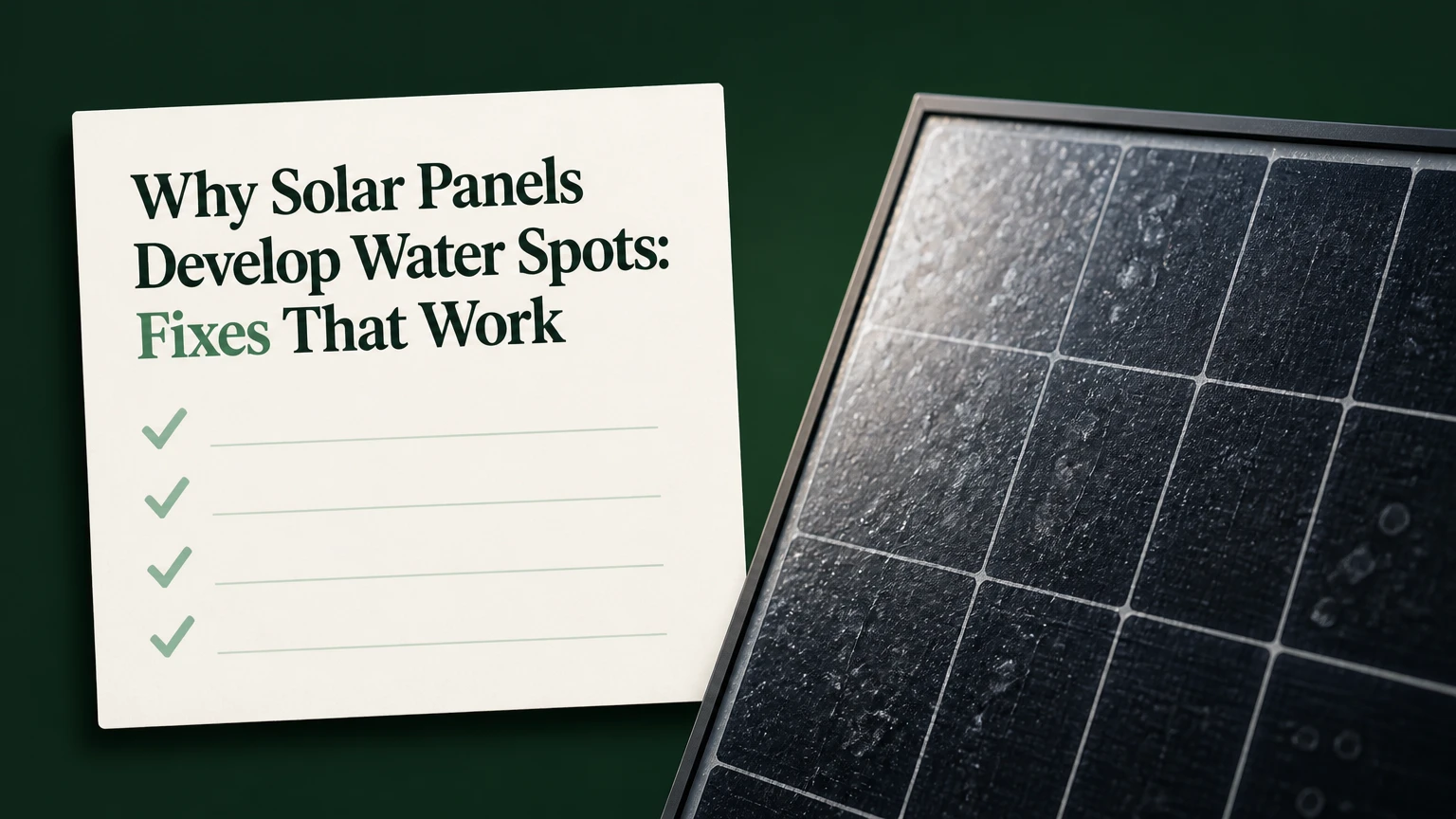
Solar panels develop water spots when rain, dew, irrigation, or cleaning water evaporates from the glass and leaves dissolved minerals, dust, salts, or organic residue behind. Hard-water calcium carbonate creates white rings and scale, while dust, salt spray, pollen, and bird waste create darker films that scatter light and may reduce energy production.
Key Facts at a Glance
- Solar panel water spots are deposits left after contaminated water dries on the module glass.
- Calcium carbonate and magnesium compounds usually create white, chalky hard-water rings.
- Water spots reduce light transmission through optical scattering and partial shading, but the loss varies with coverage, thickness, angle, and irradiance.
- “Reverse greenhouse effect” is not a standard photovoltaic diagnosis; localized soiling, optical loss, and electrical mismatch are more accurate terms.
- Pure-water cleaning with reverse osmosis or deionization prevents new mineral residue when the final rinse dries on the glass.
- Water spots alone do not prove a hot spot or permanent cell damage. Infrared inspection and electrical data are needed for that diagnosis.
What Are Solar Panel Water Spots?
Solar panel water spots are dried deposits on module glass, not defects inside the photovoltaic cells. A droplet carries dissolved calcium, magnesium, silica, sodium, chloride, carbonate, dust, or organic material; evaporation removes the water while the nonvolatile material remains attached to the surface.
A faint circular mark may contain only a small mineral load. Repeated drying cycles build overlapping rings into a continuous film. Low-tilt arrays, sprinkler overspray, and panels cleaned with hard tap water accumulate deposits fastest because water remains on the glass longer.
The glass surface is smooth at human scale but contains microscopic texture and surface contamination. Mineral crystals can lodge in that contamination and become harder to remove after repeated heating and drying. Most deposits are surface-cleaning problems, although scratched glass, delamination, and internal corrosion require a different diagnosis.
Why does evaporation create a visible ring?
Evaporation concentrates dissolved solids inside the shrinking droplet, and the final residue often forms at the droplet perimeter because fluid movement carries particles toward the contact line. This “coffee-ring” behavior explains why calcium stains frequently appear as white outlines rather than evenly distributed circles.
Water hardness is commonly reported as milligrams per liter of calcium carbonate equivalent, while TDS measures the combined concentration of dissolved substances. The two measurements are related but not interchangeable. A TDS meter can identify unusually mineralized rinse water, but it cannot identify whether the deposit is calcium carbonate, silica, salt, or another contaminant.
How Does the Spotting Process Work?
Solar panel spotting follows five linked physical and chemical stages: water lands on the glass, dissolved material concentrates, crystals or films form, residue bonds to contamination, and repeated cycles increase opacity. Panel heat speeds drying, but heat does not manufacture minerals that were absent from the water.
A practical example shows the mechanism. A well-water droplet containing calcium and bicarbonate lands on a panel at 55°C. As the droplet shrinks, carbon dioxide leaves the water and calcium carbonate becomes less soluble, so chalky crystals remain after the liquid disappears. A later droplet spreads those crystals and creates a larger patch.
Which conditions accelerate deposits?
| Condition | Typical effect | Diagnostic clue | Best response |
|---|---|---|---|
| Water hardness above 120 mg/L as CaCO3 | Fast white scaling | Chalky rings after drying | Final-rinse with RO or DI water |
| Panel tilt below 10 degrees | Longer wet time | Broad lower-edge bands | Improve drainage or dry manually |
| Sprinkler overspray | Repeated mineral loading | Spots on nearby modules only | Redirect sprinkler heads |
| Desert dust and light dew | Dark cemented film | Mud-like streaks after sunrise | Pre-rinse before brushing |
| Coastal salt aerosol | Transparent crystalline haze | White edge deposits near the sea | Frequent pure-water rinse |
The 120 mg/L threshold describes “hard” water classification in common water-quality practice, not a universal point at which solar glass immediately scales. Scaling also depends on alkalinity, pH, temperature, droplet volume, drying frequency, and whether water spreads across the panel.
Does panel heat make water spots worse?
Panel heat makes spotting more likely by shortening drying time and concentrating dissolved solids quickly. Crystalline silicon modules commonly operate well above ambient temperature in direct sun; a 25°C day can produce glass temperatures around 45-65°C under strong irradiance, depending on wind, mounting, and module construction.
Fast drying is not automatically more damaging than slow drying. Repeated deposits, not one warm droplet, usually create the visible problem. Thermal shock is a separate risk: applying cold water to very hot glass can create uneven contraction, particularly when the module already has edge damage or manufacturing stress.
Which Residues Appear on Solar Glass?
Solar panel residues differ in appearance, chemistry, removal difficulty, and electrical significance. White carbonate scale, gray silica haze, dark dust films, bird waste, and salt crystals should not receive the same cleaner or scrubbing force.
| Residue type | Appearance | Common source | Removal difficulty |
|---|---|---|---|
| Calcium carbonate scale | White rings or chalky crust | Hard tap or well water | Moderate to high |
| Silica-rich film | Clear-gray haze or smooth band | Dust, groundwater, industrial fallout | High |
| Salt residue | White crystals near edges | Sea spray or saline irrigation | Low to moderate |
| Dust cementing | Brown, gray, or black streaks | Dew, pollution, pollen, desert dust | Low when fresh |
| Bird-dropping residue | Opaque irregular patches | Bird roosting or nesting | Moderate, with hygiene risk |
Silica deserves special caution. Silica deposits can become difficult to dissolve, but they do not literally form a glass matrix identical to the module glass during ordinary weathering. The claim that neglected silica is always permanent is too broad. Some films respond to specialist treatment, while severe deposits may require controlled restoration or glass replacement.
Hard-water scale is also not chemically “bonded to pores” in the way a coating bonds to a substrate. It adheres through crystallization, surface roughness, contamination, and repeated drying. That distinction matters because a compatible descaler may remove it without abrading the glass, while an inappropriate acid can damage frames, seals, coatings, or runoff areas.
How Much Output Can Water Spots Reduce?
Water spots can reduce photovoltaic output by a fraction of a percent to several percent in ordinary cases, while dense opaque deposits over active cell areas can create larger localized losses. A universal 2%-15% loss claim is not reliable without measuring the array before and after cleaning under comparable irradiance and temperature.
Optical loss has three main pathways. Mineral haze scatters incoming light, opaque dirt blocks light, and uneven deposits shade only part of a cell or cell string. Electrical mismatch can amplify the effect when one module or substring performs substantially worse than its peers.
The actual loss depends on deposit coverage, module angle, cell layout, bypass-diode design, inverter MPPT behavior, and weather. A lower-edge stain may have little effect if it covers inactive border glass, whereas a narrow opaque band across several cell rows can matter more than a larger transparent haze.
Can water spots cause hot spots?
Water spots can contribute to localized heating when opaque deposits shade cells unevenly, but water spots alone do not establish a hot-spot failure. A shaded cell may dissipate power as heat, yet the temperature depends on string current, cell mismatch, bypass-diode operation, shading geometry, ambient conditions, and module construction.
The claim that severe water stains routinely produce temperatures above 90°C is not a safe general rule. Temperatures above 90°C are possible in damaged or severely mismatched modules, but infrared thermography should confirm the condition. A thermal image showing a bright cell, junction box, bypass diode, or connector requires professional diagnosis rather than more aggressive washing.
How should output loss be measured?
Use the inverter’s historical production, irradiance data, and peer-module comparison before assuming a cleaning benefit. Compare power normalized for irradiance and temperature on two similarly clear days, then inspect the array after cleaning.
IEC 61724-1 provides terminology and monitoring practices for photovoltaic system performance, including irradiance and energy measurements. A homeowner does not need a full IEC monitoring installation, but the principle is useful: compare like conditions rather than comparing a cloudy day before cleaning with a sunny day afterward.
Which Water Is Safest for Cleaning Panels?
RO or DI water is safest for the final rinse because it leaves fewer dissolved solids when the surface dries. Tap water may be acceptable for a pre-rinse in some locations, but hard municipal water, well water, and softened water can each leave residue.
| Water source | Typical dissolved-solids concern | Suitable use | Main limitation |
|---|---|---|---|
| DI water | Often below 10 ppm after fresh resin | Final rinse and spot-free drying | Resin exhausts quickly in hard water |
| RO permeate | Commonly 10-50 ppm, system-dependent | Pre-rinse and final rinse | Produces reject water |
| Municipal tap water | Often 100-500+ ppm TDS | Loose-debris pre-rinse | Mineral spots after drying |
| Well water | Highly variable, often 200-1,000+ ppm TDS | Testing required before use | Hardness, iron, silica, and bacteria vary |
| Rainwater | Often low mineral content but contaminated by dust | Pre-rinse after clean collection | Roof debris and atmospheric pollutants |
| Water-softener output | Lower calcium, higher sodium | Limited pre-rinse | Still leaves dissolved solids |
A TDS reading below 20 ppm is a useful operational target for a spot-free final rinse, but it is not a universal manufacturer requirement. Test the water at the pole or hose outlet, not only at the filter inlet. Resin exhaustion can produce a sudden rise in TDS.
RO and DI are complementary rather than identical. RO removes much of the dissolved load and reduces DI resin consumption; DI removes remaining ions and can produce very low-conductivity water. A small residential array may need only a portable DI cartridge, while a commercial operator may justify an RO-DI cart.
Is softened water better than tap water?
Softened water is not automatically spot-free because ion-exchange softeners replace calcium and magnesium with sodium or potassium ions. The water may be less likely to form hard carbonate scale, yet dissolved salts remain after evaporation.
Softened water can help with plumbing and soap performance, but it is a poor substitute for RO or DI water when the cleaning method allows the panel to air-dry. If softened water is the only option, use a small test area and dry the glass with a clean, appropriate squeegee.
How Do You Remove Solar Panel Water Spots?
Remove solar panel water spots with a cool-glass, low-abrasion process: isolate the work area, pre-rinse loose grit, use pure water and a manufacturer-compatible cleaner when necessary, agitate gently, rinse thoroughly, and prevent the final rinse from drying. Old silica or carbonate scale may require a trained solar-cleaning specialist.
Before You Start
| Item | Typical specification | Typical quantity or cost |
|---|---|---|
| Work time | Cool morning or evening | 30-90 minutes per 10 panels |
| Pure water | RO or DI, preferably below 20 ppm TDS | 5-15 gallons per 10 panels |
| Brush | Soft, nonabrasive solar brush | 1 brush, $30-$150 |
| Squeegee | Clean rubber blade, no metal edge | 1, $15-$50 |
| Cleaner | Manufacturer-approved, biodegradable product | $20-$60 per container |
| Safety equipment | Roof access, gloves, eye protection | $25-$200, excluding fall protection |
Do not walk on modules. Do not disconnect energized rooftop equipment unless the system manufacturer and a qualified professional specify the isolation procedure. Water and electricity create a shock hazard, and many inverters continue producing voltage whenever sunlight is present.
Step 1: Check the glass and module condition
Inspect for cracked glass, lifted frame edges, burn marks, loose cables, damaged connectors, and delamination. A cracked module should not be scrubbed or sprayed heavily because water can enter damaged areas and increase electrical and safety risk.
You will know the inspection is complete when the module has no obvious physical damage and the cleaning plan excludes unsafe roof sections. The common mistake is treating a damaged module as a dirty module.
Step 2: Choose a cool, low-wind period
Clean when the glass is cool to the touch, usually early morning or late afternoon. Avoid peak sun, freezing conditions, strong wind, and periods when rapid evaporation will leave rinse marks.
The common mistake is using a clock-based rule such as “before 7:00 AM” in every climate. Surface temperature, not a fixed time, controls thermal-shock and drying risk.
Step 3: Pre-rinse from the upper edge
Use low-pressure RO or DI water to loosen dust, sand, pollen, and bird-dropping particles before brushing. Work from the upper edge downward so grit does not drag across already-cleaned glass.
You will know the pre-rinse worked when loose particles flow away without visible scratching during gentle brush contact. The common mistake is dry-brushing, which can create fine scratches and spread abrasive dust.
Step 4: Treat mineral rings sparingly
Apply a solar-compatible cleaner only to deposits that pure water does not remove, following the product label for dilution and dwell time. Many products use acidic chemistry, so protect aluminum frames, roofing membranes, vegetation, and storm drains from runoff.
Patch-test a small edge area first. Never combine cleaners, and never assume household vinegar, glass cleaner, dish detergent, or strong descaler is safe for photovoltaic modules. Vinegar may dissolve some carbonate deposits, but its concentration, runoff, residue, and seal compatibility are not controlled by the word “natural.”
Step 5: Agitate with a soft brush
Use light pressure and overlapping strokes with a clean, soft nylon or microfiber-covered brush. Do not use steel wool, scouring pads, razor blades, abrasive powders, or hard squeegee edges.
You will know the deposit is releasing when the surface feels uniformly smooth and the slurry rinses away without repeated force. The common mistake is increasing pressure when the chemistry is wrong. More force cannot safely remove silica or etched glass.
Step 6: Flush with pure water
Rinse until no cleaner, foam, or visible mineral slurry remains. Use enough flow to carry residue away from the lower frame and adjacent modules.
A final rinse is successful when the water sheets evenly and leaves no drying edge after a small test section evaporates. The common mistake is stopping after the first clear-looking rinse, leaving dissolved minerals to crystallize again.
Step 7: Remove standing water
Use a clean, soft rubber squeegee if the panel design and access conditions permit. Pull water in straight overlapping passes, clean the blade frequently, and avoid trapping grit beneath it.
You will know the job is complete when no beads remain at the lower frame, clamps, or cable-entry areas. The common mistake is allowing a hard-water final rinse to air-dry on the glass.
Which Cleaning Method Fits the Problem?
| Method | Typical operating cost | Best application | Poor application |
|---|---|---|---|
| DI water and soft brush | $0.20-$1.00 per gallon, depending on resin | Light deposits and routine maintenance | Thick, old mineral scale |
| RO-DI cart | $500-$3,000 equipment | Commercial arrays and frequent cleaning | One small array cleaned once |
| Solar-compatible chemical cleaner | $20-$60 per container | Localized carbonate residue | Unidentified residue or cracked glass |
| Professional restoration | $150-$600 residential visit, typical | Severe scale, steep roofs, specialty access | Simple dust removable with water |
| Glass replacement | Hundreds of dollars per module plus labor | Etched, cracked, or irreparably damaged glass | Surface film with no glass damage |
Costs vary by region, roof access, array size, water hardness, and whether fall-protection equipment is required. A chemical cleaner is not a replacement for pure water. It may dissolve scale, but the dissolved material still needs a complete rinse.
Are hydrophobic coatings worth using?
Hydrophobic coatings can reduce droplet retention, but they cannot guarantee spot-free glass or restore lost photovoltaic output. Dust, salt, bird waste, incompatible application, and coating wear can offset the benefit, especially on steep modules that already shed water effectively.
Use a coating only when the product documentation names photovoltaic glass, confirms compatibility with the module manufacturer, and explains warranty implications. Test adhesion and optical appearance on one module first. A coating that leaves haze or changes surface reflectance can create the same optical problem it was intended to prevent.
What Mistakes Make Water Spots Worse?
The most damaging cleaning mistakes are cold-water spraying on hot glass, abrasive scrubbing, uncontrolled chemicals, and contaminated tools. These actions can turn removable residue into scratched glass, frame corrosion, seal damage, or persistent haze.
- Spraying a hot module with cold water: Wait until the glass cools and use moderate flow.
- Dry-brushing desert dust: Pre-rinse first because silica-rich grit can scratch glass.
- Using household glass cleaner: Surfactants can leave residue, and ammonia or solvents may be incompatible with coatings and seals.
- Using a pressure washer: High pressure can drive water into frames, connectors, and junction-box areas.
- Cleaning bird waste without protection: Wear gloves and eye protection, wet the waste before removal, and avoid aerosolizing dried material.
- Cleaning only the visibly worst panel: Compare the entire array because subtle haze across many modules can create the larger production loss.
Rain does not reliably clean solar panels. A heavy, clean downpour may remove loose dust, but light rain often wets the surface, mobilizes contaminants, and leaves a new ring when sunlight dries the remaining droplets.
When Should Panels Be Cleaned or Professionally Inspected?
Clean panels when measured production, visible residue, local contamination, or seasonal conditions justify the work, rather than following a universal monthly schedule. A practical residential interval is often 6-12 months, while agricultural, desert, coastal, and low-tilt systems may need inspection every 1-3 months.
| Situation | Inspection interval | Cleaning trigger | Professional escalation |
|---|---|---|---|
| Steep residential roof, low dust | 6-12 months | Visible film or monitored loss | Roof access is unsafe |
| Desert residential array | 1-3 months | Dust after dew or storms | Persistent output mismatch |
| Agricultural property | Monthly | Pollen, dust, irrigation overspray | Chemical residue or high roof |
| Coastal installation | 2-6 months | Salt haze or bird waste | Corrosion or connector damage |
| Commercial low-tilt roof | Monthly | Soiling alarm or visual coverage | Thermal anomaly or string fault |
Cleaning frequency should follow the economics of recovered energy. If a $250 service is expected to recover only $40 of annual energy value, cleaning for production alone may not make financial sense. Safety, warranty preservation, and corrosion prevention can still justify the service.
What signs indicate a panel problem beyond water spots?
Escalate beyond cleaning when output remains low after residue removal, one module differs sharply from neighboring modules, an inverter reports insulation or arc faults, or an infrared camera shows a persistent hot cell. Cracks, browning backsheets, delamination, junction-box discoloration, and melted connectors also require qualified service.
Photovoltaic module standards such as IEC 61215 address design qualification and environmental stress testing, but standards do not make a damaged module safe to wash or guarantee that a stain is cosmetic. Follow the module and inverter manufacturer’s maintenance instructions and preserve photographs before using chemicals.
How Can You Prevent Future Water Spots?
Prevent future water spots by eliminating contaminated overspray, using RO or DI water for the final rinse, improving drainage, removing standing water, and monitoring residue before it becomes scale. Prevention works best when the water source is corrected, because repeated cleaning cannot compensate for a nearby sprinkler or leaking roof drain.
Use these controls in order:
- Redirect irrigation heads away from the array.
- Test tap and well water with a calibrated or recently checked TDS meter.
- Use a pre-filter for sediment and an RO-DI system when mineral load is high.
- Keep gutters and roof drains from discharging across lower module edges.
- Remove bird attractants and nesting access where lawful and safe.
- Record inverter production before and after major cleaning.
- Inspect coating and seal recommendations before applying any protectant.
Low-tilt arrays need special attention because gravity removes less water. Improving tilt may be impractical after installation, so squeegee drying and pure-water rinsing become more valuable. Automated cleaning systems can reduce labor on large arrays, but brushes, water quality, and maintenance costs still determine whether they outperform scheduled manual service.
FAQ
Can hard water permanently damage solar panels?
Hard water usually causes removable surface scale rather than immediate permanent module damage. Permanent damage becomes more likely when abrasive cleaning scratches the glass, aggressive chemicals attack frames or seals, or deposits hide an existing crack or hotspot. A qualified technician should inspect etched glass, delamination, corrosion, and abnormal electrical output.
Can I clean solar panels with a garden hose?
A garden hose can pre-rinse loose dust, but ordinary hose water may leave mineral spots after drying. Use low pressure, cool glass, and a pure-water final rinse. Do not use a hose on cracked modules, exposed wiring, loose connectors, or any roof area where water can enter electrical equipment.
Is vinegar safe for solar panel water spots?
Vinegar can dissolve some calcium carbonate, but it is not universally approved for photovoltaic modules. Concentration, contact time, runoff, frame compatibility, seal exposure, and residue all matter. Use a product approved by the module or cleaning-equipment manufacturer, patch-test first, and never mix vinegar with bleach or other cleaners.
Do water spots reduce solar panel lifespan?
Water spots alone usually reduce optical performance rather than shorten module life. Lifespan risk increases when residue retains moisture, promotes corrosion, conceals cracks, or leads owners to use abrasive tools and strong acids. Regular visual inspection and gentle, compatible cleaning reduce those secondary risks.
Should I replace panels with severe stains?
Replace a module only when cleaning cannot restore the glass or testing confirms cracked glass, delamination, corrosion, electrical failure, or an uneconomic repair. Severe-looking white scale may still be a surface problem. Obtain an output test and thermal inspection before approving replacement.
Why are spots worse along the bottom edge?
Bottom-edge spotting occurs because gravity carries water, dissolved minerals, dust, and cleaner toward the frame. Low-tilt modules retain a wider wet band, while frame drainage paths can repeatedly deposit solids in the same location. Drying the lower edge and correcting roof runoff often stops recurrence.
The Bottom Line
Solar panels develop water spots because contaminated water evaporates and leaves minerals or mixed debris on the glass. Calcium carbonate creates white hard-water rings, while silica, salt, dust, pollen, and bird waste produce different films that require different treatments. The accurate technical concern is optical soiling and possible mismatch, not a universal “reverse greenhouse effect.”
Start with cool glass, a low-abrasion pre-rinse, RO or DI water, and complete drying. Measure production before claiming a 2%-15% loss, and use infrared or electrical testing before attributing a 90°C hot spot to staining. Correct sprinkler overspray, hard-water rinsing, poor drainage, and low-tilt water retention to prevent the same deposits from returning.