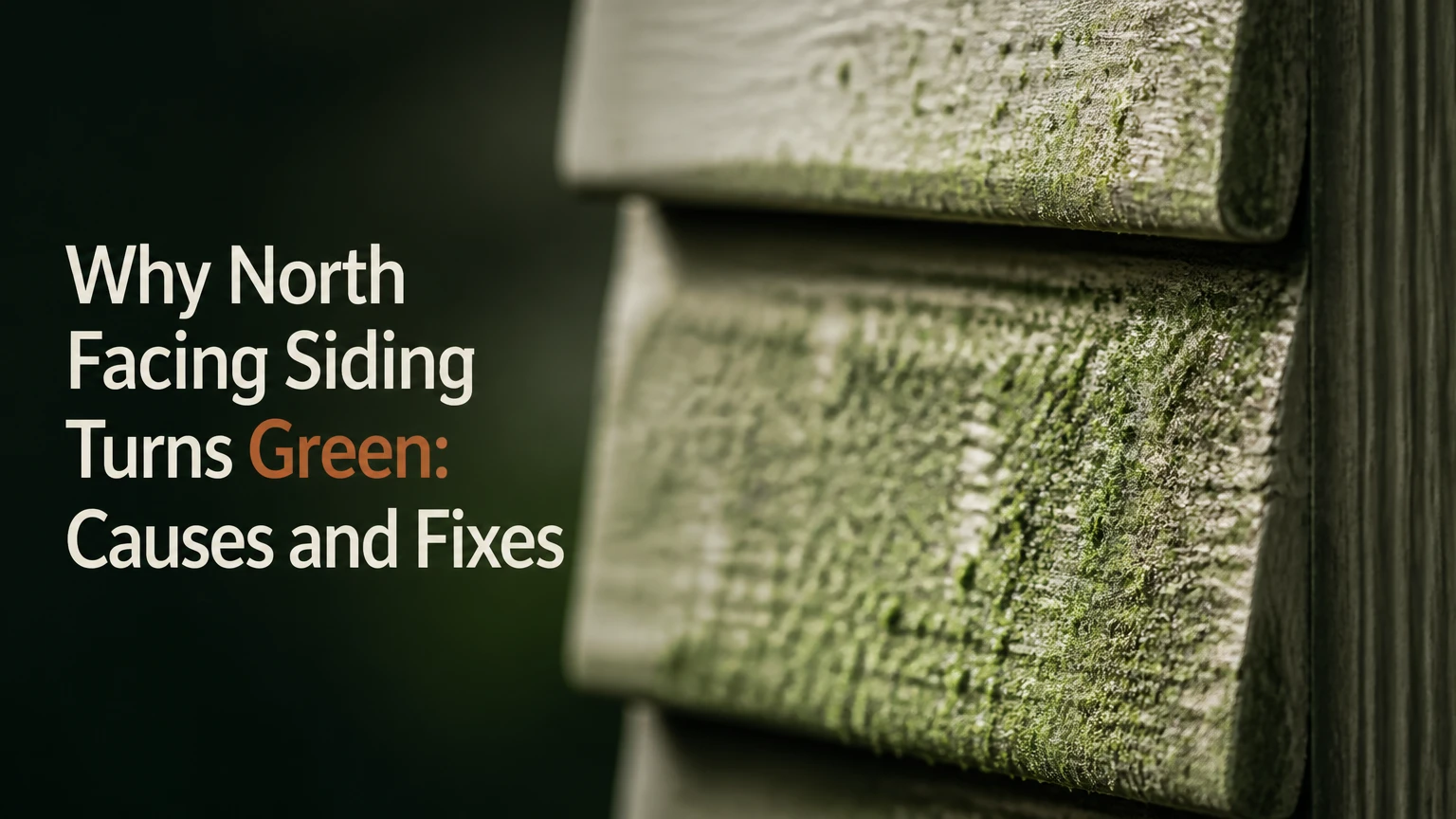
North-facing siding turns green because limited direct sunlight leaves the wall cooler and wet for longer, allowing algae to colonize its surface. Moss, mildew, and some molds can join the growth when moisture persists, but green discoloration can also come from copper runoff, dirt, or mineral staining rather than biology.
Key Facts at a Glance
- Green growth on north-facing siding is usually algae when it forms a thin, evenly distributed green film.
- Shade increases drying time, but leaking gutters, dense vegetation, sprinkler spray, and poor drainage often determine how severe the growth becomes.
- Soft washing uses low-pressure water and a compatible cleaning solution; pressure washing can force water behind siding or damage coatings.
- Wood siding requires faster moisture diagnosis than vinyl because recurring dampness can support decay and paint failure.
- A clean wall that turns green again within a few months usually has an unresolved water or airflow source.
- Bleach, peroxide, and commercial cleaners differ in concentration, dwell time, plant risk, and material compatibility. Product labels control safe use.
Why North Facing Siding Turns Green
North-facing siding turns green when shade, moisture, moderate temperatures, and surface nutrients combine long enough for photosynthetic organisms to grow. The north wall of a Northern Hemisphere building commonly receives less direct solar radiation, while trees, roof overhangs, neighboring structures, and damp climates can extend the wet period further.
Sun direction explains the pattern, not every individual case. In the Northern Hemisphere, the midday sun generally travels across the southern part of the sky, so a north-facing wall often receives little direct heat. In the Southern Hemisphere, the strongest solar exposure generally favors north-facing walls instead, making local latitude and building orientation important.
Algae do not need soil. Airborne spores settle with dust, pollen, and organic debris, then use water and indirect light on the siding surface. Textured vinyl, weathered paint, rough fiber cement, and porous masonry hold more moisture than smooth, intact coatings.
What organisms make siding look green?
Green algae most often creates a flat film, streak, or powdery coating. Moss forms a thicker, raised, plant-like layer, while mildew and mold may appear green, gray, black, or white depending on species and surface conditions.
| Appearance | More likely cause | Surface clue | Recommended response |
|---|---|---|---|
| Thin green film | Surface algae | Even coating on shaded panels | Low-pressure cleaning and moisture control |
| Fuzzy green tufts | Moss | Raised growth in joints or texture | Remove gently, then correct persistent dampness |
| Green-black blotches | Algae, mold, or mixed biofilm | Irregular patches near leaks | Identify the water source before repeated cleaning |
| Orange or blue-green streaks | Metal or mineral runoff | Starts below flashing, gutters, or copper | Test the stain before applying biocide |
| White chalky film with green areas | Aged paint or vinyl plus algae | Powder transfers to a finger | Assess coating failure and clean gently |
Green color alone cannot identify an organism. A laboratory test is rarely necessary for ordinary exterior cleaning, but extensive indoor mold, a persistent musty odor, or suspected water intrusion deserves assessment by a qualified building professional.
How does shade create the growth cycle?
Shade slows evaporation and reduces surface temperature, so rain, dew, and condensation remain available to organisms for longer periods. Algae spores then attach to dust or microscopic surface irregularities, grow into a film, and create a darker, wetter surface that can support later colonization.
The process usually follows five conditions:
- Wetting: rain, dew, condensation, gutter overflow, or irrigation wets the siding.
- Slow drying: shade, low wind, overhangs, and vegetation reduce evaporation.
- Attachment: spores and organic particles lodge in texture, seams, and weathered coatings.
- Growth: algae use moisture, nutrients, and indirect light to expand across the surface.
- Succession: thicker growth retains more water, allowing moss or mixed microbial films to establish.
A visible film can develop in roughly 4-6 weeks during consistently warm, damp weather, but that is a typical field range rather than a universal biological deadline. Cold winters, dry climates, smooth metal, and clean airflow can delay growth substantially.
Does a north wall always stay wet enough for algae?
No. Orientation is only one risk factor. A north-facing wall in a dry, windy climate may remain clean, while an east-, west-, or south-facing wall beneath sprinklers or a leaking gutter may turn green faster than the north wall.
Practitioners usually inspect the wall in the morning and after rain. Darkened seams, wet caulk, overflowing gutters, and soil splash identify active moisture better than compass direction alone. A moisture meter can compare affected and unaffected wood siding, but readings must be interpreted against the material and weather conditions.
How can you tell algae from mold, moss, or staining?
Identify the pattern, texture, location, and behavior before choosing a cleaner. A wipe test can provide a preliminary clue, but it cannot reliably distinguish every organism or chemical stain.
- Algae: usually green, thin, and spread across damp shaded areas.
- Moss: thicker, raised, and concentrated in joints, ledges, or constantly wet zones.
- Mildew: often powdery and gray, white, or green, with a superficial appearance.
- Mold: may be black, green, brown, or gray and can occur in mixed colonies.
- Copper runoff: often blue-green and concentrated below copper flashing, gutters, or roof details.
- Iron or tannin staining: commonly orange, brown, or tea-colored rather than true green.
- Efflorescence: white, crystalline deposits caused by soluble salts moving through masonry or cement-based surfaces.
Do not assume that every dark stain is toxic mold or that every green patch is algae. The cleaning chemistry, protective equipment, and repair decision change when the stain comes from metal runoff, paint failure, or water entering the wall assembly.
What causes green siding to return after cleaning?
Green siding returns when cleaning removes the visible colony but leaves the wetting mechanism unchanged. The most common recurrence sources are gutter overflow, downspout discharge, sprinkler overspray, dense shrubs, roof runoff, and a shaded surface with little air movement.
| Recurrence source | Inspection target | Typical corrective action | Expected benefit |
|---|---|---|---|
| Gutter overflow | Sagging gutter, blocked outlet, wet fascia | Clean, reseal, or re-pitch gutter | Reduces repeated vertical wetting |
| Downspout discharge | Water pooling beside the wall | Extend outlet 4-10 feet where practical | Moves splash away from siding |
| Sprinkler overspray | Wet panels during irrigation cycle | Rotate or lower sprinkler head | Removes daily artificial wetting |
| Dense vegetation | Leaves touching siding or blocking wind | Maintain a visible air gap | Improves drying and inspection access |
| Roof or flashing leak | Streaks below roof intersections | Repair flashing or roofing defect | Stops concentrated water entry |
| Weathered coating | Chalky paint, open joints, rough fibers | Repaint or repair according to material | Reduces water retention and attachment |
A recurring green wall can conceal a building-envelope problem. On wood, fiber cement, or stucco, inspect joints, penetrations, window trim, and the wall base before scheduling another wash.
Which cleaning method is safest for siding?
The safest method matches pressure, chemistry, dwell time, and runoff control to the substrate. Low-pressure application is generally less damaging than aggressive pressure washing, but low pressure does not make an incompatible chemical safe for paint, plants, metal, or waterways.
| Method | Typical equipment or pressure | Best use | Main limitation |
|---|---|---|---|
| Garden-hose cleaning | Household hose, near-zero surface pressure | Light film on intact vinyl or metal | Often weak against established growth |
| Soft washing | Low-pressure sprayer, typically below 500 psi at the surface | Biological growth on suitable exterior materials | Chemical runoff and dwell time require control |
| Pressure washing | Common consumer units, 1,300-3,000 psi | Durable masonry when correctly handled | Can etch, gouge, crack, or drive water behind panels |
| Manual cleaning | Soft brush, bucket, compatible detergent | Small areas and delicate coatings | Requires more labor and may not kill residual growth |
The term “soft wash” describes a low-pressure cleaning approach, not a universal recipe. A professional can still damage siding with excessive chemical concentration, prolonged dwell time, poor rinsing, or spray directed into seams.
Is pressure washing north-facing siding a good idea?
Pressure washing is usually a poor first choice for vinyl, painted wood, and lap siding because the nozzle can lift edges, crack brittle panels, remove coatings, or force water behind the cladding. It can be appropriate for some masonry when the operator uses the correct nozzle, distance, pressure, and surface test.
The U.S. Department of Energy notes that water-resistive barriers and drainage planes depend on properly managed exterior water. Directing high-pressure water into laps and penetrations defeats that drainage strategy. Begin with the lowest effective pressure, keep the spray angled downward, and test an inconspicuous area.
How do you clean green siding without damaging the house?
Clean green siding by protecting runoff areas, pre-wetting nearby plants, applying a label-approved cleaner, allowing the specified dwell time, using gentle agitation where needed, and rinsing before the product dries. The exact dilution must come from the product label because bleach and peroxide products have different concentrations.
Before you start
| Requirement | Typical value | Why it matters |
|---|---|---|
| DIY time | 2-4 hours for one accessible wall | Includes setup, treatment, brushing, and rinsing |
| Cleaner cost | $20-$60 for concentrate or ready-to-use product | Varies by active ingredient and coverage |
| Water source | Garden hose with adjustable nozzle | Provides controlled rinsing |
| Application tool | 1-2 gallon pump sprayer | Applies solution evenly at ground level |
| Brush | Soft-bristle brush on extension pole | Removes bonded film without gouging coating |
| Protection | Gloves, eye protection, suitable clothing | Limits contact with cleaner and contaminated runoff |
Avoid ladders when an extension pole can reach the surface. Stop if wind carries spray toward people, pets, windows, vehicles, or desirable plants.
Step 1: Diagnose the water source
Inspect gutters, downspouts, roof edges, hose bibs, irrigation heads, window trim, and vegetation. Run irrigation briefly and watch whether spray reaches the siding.
You will know this step worked when the wetting pattern has a plausible source and the wall is not being treated as an isolated cosmetic problem. A common mistake is cleaning first and discovering a blocked gutter weeks later.
Step 2: Protect plants and fixtures
Move outdoor furniture, cover delicate electrical components, and pre-wet landscaping with clean water. Divert or collect runoff where local rules, waterways, or sensitive plantings require it.
You will know the area is prepared when plants, metal fixtures, and painted surfaces are shielded from concentrated cleaner. Never combine cleaning products. The Centers for Disease Control and Prevention states, “Never mix bleach with ammonia or any other cleaner.”
Step 3: Apply a compatible cleaner
Use a product specifically labeled for the siding material and biological growth. Apply from the bottom upward when the label permits, which helps reduce uneven streaking, and keep the surface wet during the stated dwell period.
You will know the solution is working when the film softens or loses color without the surface drying. A common mistake is applying cleaner to hot, dry siding, where evaporation shortens contact time and increases spotting.
Step 4: Agitate only when necessary
Use a soft brush on persistent deposits, working in small sections. Do not scrape vinyl with a metal tool or use a stiff abrasive pad on painted wood, fiber cement, or coated metal.
You will know the surface is ready to rinse when attached film releases with light brushing rather than force. Heavy scrubbing can remove the coating that protects the cladding.
Step 5: Rinse from top to bottom
Rinse thoroughly with a garden hose or controlled low-pressure stream, keeping water out of laps, vents, joints, and window openings. Confirm that no cleaner remains on glass, trim, plants, or metal.
You will know rinsing is complete when runoff is clear and the surface has no slippery residue or white drying film. Leaving bleach or detergent to dry can discolor finishes and damage vegetation.
Step 6: Reinspect after drying
Check the wall after 24-48 hours of drying. Look for remaining colonies, coating failure, open joints, swollen wood, soft trim, and stains that did not respond to biological cleaning.
A successful wash removes growth without exposing bare substrate. If green areas remain in joints, the issue may require repair rather than another stronger chemical treatment.
Which cleaner works best on green siding?
A label-approved exterior biocide or detergent is usually more predictable than an improvised mixture because the manufacturer specifies dilution, dwell time, substrate compatibility, and disposal precautions. Bleach can act quickly, while hydrogen peroxide products may reduce some corrosion and plant concerns, but neither eliminates the need for runoff management.
| Cleaner category | Typical action time | Strength | Limitation |
|---|---|---|---|
| Sodium hypochlorite product | 5-15 minutes, label dependent | Fast visual change on algae | Can harm plants, metals, coatings, and skin |
| Hydrogen peroxide product | 10-30 minutes, label dependent | Often lower chlorine odor and residue | May need agitation on heavy growth |
| Surfactant detergent | 5-15 minutes, label dependent | Improves soil and film removal | May clean without fully controlling regrowth |
| Residual treatment | Several weeks to months, product dependent | Can slow recolonization | Requires label compliance and does not repair leaks |
Bleach is not automatically the best option for a house near a pond, edible garden, delicate landscaping, or corrosion-sensitive fixtures. A residual inhibitor is not a substitute for cleaning, drainage repair, or adequate rinsing.
How do siding materials change the cleaning decision?
Siding material determines how much pressure, moisture, and chemical exposure the surface can tolerate. Vinyl generally tolerates gentle exterior cleaning, while wood, stucco, fiber cement, and aging coatings require more careful testing because water can enter pores, joints, or damaged finishes.
| Siding material | Main green-growth risk | Safer starting method | Repair warning |
|---|---|---|---|
| Vinyl | Surface film, brittle aged panels | Label-approved cleaner and hose rinse | Cracks, lifted laps, chalking |
| Painted wood | Algae plus trapped moisture and decay | Low-pressure wash and coating inspection | Soft wood, peeling paint, failed caulk |
| Fiber cement | Surface algae at shaded joints | Low-pressure cleaning and gentle brush | Open joints, edge swelling, coating loss |
| Stucco | Algae in texture and cracks | Low-pressure rinse with compatible cleaner | Cracks, hollow areas, persistent damp patches |
| Metal | Algae film, oxidation, runoff stains | Mild detergent and low-pressure rinse | Corrosion, failed finish, copper staining |
Fiber-cement manufacturers, including James Hardie, publish material-specific cleaning and maintenance guidance. Warranty terms may restrict high-pressure washing, harsh chemicals, or alterations, so check the installation and product documents before treatment.
Can green siding indicate hidden rot?
Green siding does not prove hidden rot, but recurring wet growth on wood siding raises the probability of decay at joints, bottom edges, penetrations, and behind failed trim. Probe questionable wood with an appropriate inspection tool, or hire a building professional when the substrate feels soft or the wall shows swelling.
Algae can live harmlessly on the exterior face of intact vinyl. Wood decay requires sustained moisture and favorable conditions, so the risk is structural and material-specific rather than determined by green color alone.
How much does green siding cleaning cost?
Typical DIY cleaning costs $20-$60 in materials and takes 2-4 hours for one accessible wall. Typical professional soft-washing prices range from about $300-$600 for a standard two-story home, although height, access, contamination, landscaping protection, region, and total exterior area can move the price substantially.
| Project scope | Typical price | Typical duration | Main price driver |
|---|---|---|---|
| Small DIY wall | $20-$60 | 2-4 hours | Cleaner quantity and brushing |
| Single-story professional wash | $150-$350 | 1-3 hours | Wall size and setup |
| Standard two-story exterior | $300-$600 | 2-5 hours | Height, access, and protection |
| Heavy growth with repairs | $600-$1,500+ | 1-2 days | Cleaning plus gutter, trim, or coating work |
These are planning ranges, not fixed market rates. A quote should state the cleaning method, chemical type, pressure approach, plant protection, window treatment, runoff handling, and whether gutter or siding repairs are excluded.
How often should north-facing siding be cleaned?
North-facing siding commonly needs cleaning every 12-24 months in damp, shaded environments, but the correct interval follows the wall’s drying conditions rather than a calendar. A dry, open site may need less frequent treatment, while a wall beneath trees or faulty gutters may require correction before the next cleaning cycle.
Autumn treatment can reduce winter and spring buildup where the product label allows seasonal use. Inspect after leaf fall, before the wet season, and after major storms. Recleaning every few months signals an unresolved moisture source, not a need for increasingly aggressive pressure.
How can you prevent green growth permanently?
No exterior treatment permanently prevents biological growth on a shaded wall because spores remain airborne and weather conditions change. Prevention works by shortening wet time, reducing organic debris, maintaining coatings, and stopping concentrated water from reaching the siding.
Use this maintenance sequence:
- Clean gutters before the wet season and check for overflow marks.
- Extend downspouts so discharge does not splash against the foundation or siding.
- Keep branches and shrubs away from the wall to improve airflow.
- Redirect irrigation heads that wet the siding.
- Remove leaves and organic debris from ledges, roofs, and window trim.
- Maintain paint, caulk, flashing, and siding joints according to manufacturer guidance.
- Apply a residual product only when its label permits the material and location.
A sealant cannot correct wet sheathing, a leaking window, or failed flashing. Sealing a damp assembly can trap moisture and delay detection of rot.
What should you do if growth returns within months?
If green siding returns within three to six months, inspect water delivery and drying conditions before repeating treatment. Start with gutters and irrigation, then examine roof edges, window penetrations, vegetation, wall texture, and the base of the cladding.
Expert troubleshooting rules
- Follow the wet edge: The darkest growth often traces the water path from a gutter, roof intersection, or failed window detail.
- Compare shaded and exposed walls: Different growth on similar materials indicates a drying and solar-exposure problem, while identical stains may indicate the product or substrate.
- Do not escalate pressure first: Recurrence after aggressive washing usually means the moisture source remains active.
- Test suspected staining: A small, hidden-area test distinguishes biological film from copper, iron, tannin, or coating discoloration.
- Inspect the wall base: Soil splash and poor grading can wet lower siding even when the upper wall dries normally.
Call a professional when siding is loose, wood is soft, runoff threatens a pond, the wall is several stories high, or suspected mold extends into the building interior.
FAQ
Is green siding dangerous?
Green exterior siding is usually a cosmetic algae or moss issue, but persistent moisture can damage wood, coatings, trim, and wall joints. Avoid touching or disturbing heavy growth without gloves and eye protection, and investigate musty odors, interior staining, soft wood, or recurring dampness rather than treating color alone.
Does vinegar remove algae from house siding?
Vinegar may loosen light surface deposits, but household vinegar is not a dependable treatment for established exterior algae across all siding materials. Its acidity can affect sensitive finishes, plants, and nearby metals, so use only a product labeled for the substrate and biological growth.
Can rain clean green siding?
Rain can remove loose dust but rarely removes attached algae, moss, or biofilm. Rain may also spread spores and keep a shaded wall wet, so natural rainfall does not replace controlled cleaning, rinsing, gutter maintenance, or correction of sprinkler overspray.
Should green siding be cleaned before painting?
Yes. Remove biological growth, allow the siding to dry fully, repair damaged areas, and follow the coating manufacturer’s preparation requirements before painting. Painting over algae can trap contamination, cause adhesion failure, and conceal moisture damage that will continue beneath the new coating.
Does north-facing siding turn green in every climate?
No. Humidity, rainfall, wind, vegetation, building spacing, wall material, and irrigation determine whether a north wall supports growth. A shaded wall in an arid, windy climate may remain clean, while a sprinkler-wet wall on another orientation can develop algae first.
The Bottom Line
Why north facing siding turns green is primarily a moisture-and-drying question, with shade acting as the accelerator. Clean the growth with a material-compatible, low-pressure method, then correct gutters, irrigation, vegetation, drainage, or coating defects. If the green film returns within months, investigate the wall’s water path instead of using stronger pressure or more concentrated chemicals.