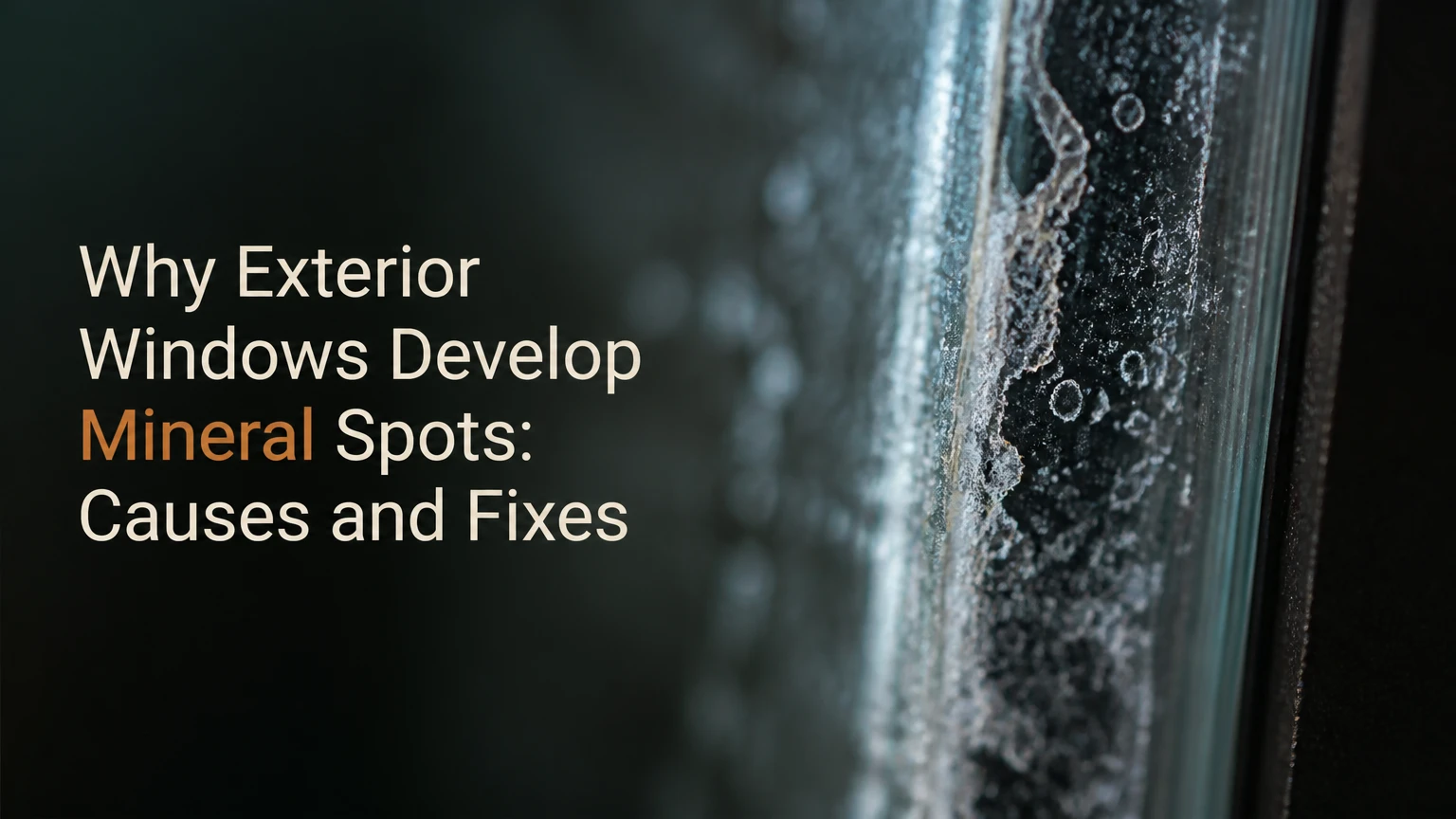
Exterior windows develop mineral spots when water containing dissolved calcium, magnesium, silica, or other salts dries on the glass and leaves those solids behind. Sprinklers, hose water, rainwater running over masonry, and poorly rinsed window-washing water are common sources. Fresh deposits sit on the surface, while repeated exposure can create rough, hazy glass etching.
Key Facts at a Glance
Mineral spots form when dissolved solids remain after exterior water evaporates.
USGS classifies water above 120 mg/L as calcium carbonate as hard water, but spotting depends on the complete water chemistry and drying conditions.
Irrigation overspray is often the fastest way to create recurring spots on residential windows.
Vinegar can help dissolve carbonate residue, but it cannot restore glass that has already been etched.
Spots that look clear when wet but cloudy when dry may indicate microscopic surface damage.
Hydrofluoric acid can attack glass and presents a severe health hazard; homeowners should not use it.
Why Do Exterior Windows Develop Mineral Spots?
Exterior windows develop mineral spots because mineral-bearing water remains on the glass long enough to evaporate. Pure water leaves as vapor, while dissolved solids such as calcium carbonate, magnesium salts, and silica remain as rings, droplets, or cloudy films.
The water does not need to be visibly dirty. Clear irrigation water can contain enough dissolved material to leave a residue after repeated drying. A sprinkler that reaches the same lower sash each afternoon can create more spotting than occasional rainfall because the same mineral load is delivered repeatedly to one location.
Glass is primarily a silica-based material with a polished surface, but the surface is not perfectly featureless at microscopic scale. Deposits can lodge in tiny irregularities, and prolonged exposure to alkaline or chemically aggressive residues can alter the surface enough to create permanent haze. The common claim that ultraviolet light chemically bonds every mineral deposit to silica is inaccurate. Heat and sunlight accelerate drying, but glass damage depends mainly on deposit chemistry, contact time, concentration, and mechanical treatment.
Where Does the Mineral-Laden Water Come From?
The source of the water usually determines both the appearance and the best prevention method. Irrigation water commonly leaves chalky circular marks, while masonry runoff can leave a more diffuse white film containing cement dust and silica-rich particles.
Common sources include:
- Lawn sprinklers: Repeated overspray creates concentrated rings on lower windows.
- Tap-water washing: Water left to air-dry after cleaning deposits the local mineral load.
- Rainwater runoff: Rain collects dust, cement residue, and soluble salts from stucco, concrete, brick, and metal flashing.
- Construction activity: Cutting concrete or masonry can spread alkaline dust onto nearby glazing.
- Cooling systems: Commercial evaporative-cooling discharge can carry concentrated salts.
- Coastal exposure: Salt aerosols leave sodium chloride and other residues, although salt film differs from classic calcium carbonate spotting.
The U.S. Geological Survey states, “Hardness is a measure of the amount of calcium and magnesium salts in water.” That definition matters because hardness is only one part of spotting risk. Water with moderate hardness can still spot heavily if it dries slowly on hot glass or carries silica and suspended construction residue.
How Do Mineral Spots Form on Glass?
Mineral spotting follows a predictable concentration process: water reaches the pane, collects in droplets, evaporates, and leaves dissolved solids concentrated at the droplet edge. Repeated cycles build thicker deposits and can increase the chance of surface etching.
A typical formation sequence is:
- Contact: Sprinkler spray, rain, or wash water lands on exterior glass.
- Retention: Surface tension holds droplets, especially around seals, frames, and lower edges.
- Concentration: Evaporation removes water while calcium, magnesium, silica, and salts remain.
- Deposition: The concentrated material dries as a ring, crust, haze, or scattered spot.
- Rewetting: Later water partially dissolves or redistributes soluble components.
- Surface damage: Alkaline residue, abrasive particles, and repeated scrubbing can roughen the glass.
Sunlight can make the process faster by warming the pane and increasing evaporation. Sunlight does not, by itself, guarantee permanent chemical bonding. A shaded window can become etched if deposits remain wet, concentrated, and undisturbed for long periods.
Does Water Hardness Predict Window Spotting?
Water hardness provides a useful warning, not a precise spotting forecast. USGS commonly groups water below 60 mg/L as calcium carbonate as soft, 61-120 mg/L as moderately hard, 121-180 mg/L as hard, and above 180 mg/L as very hard.
| Water condition | Hardness as CaCO3 | Likely exterior-glass effect |
|---|---|---|
| Soft | 0-60 mg/L | Low carbonate residue under normal washing |
| Moderately hard | 61-120 mg/L | Visible spots after air-drying or repeated spray |
| Hard | 121-180 mg/L | Frequent white rings and crust formation |
| Very hard | More than 180 mg/L | Rapid buildup when irrigation reaches glass |
| High silica or alkalinity | Variable | Persistent haze that vinegar may not remove |
The 120 mg/L figure is a water-classification boundary, not a scientifically fixed point at which windows suddenly begin spotting. Total dissolved solids, pH, alkalinity, silica, temperature, droplet size, and drying time also affect the result.
Which Minerals Usually Create the Spots?
Calcium carbonate is the most familiar source of chalky white spots, but exterior glass deposits can contain several substances. The deposit may also include dust, cement fines, sodium salts, iron, or organic material from the surrounding environment.
| Deposit component | Common source | Typical appearance | Removal implication |
|---|---|---|---|
| Calcium carbonate | Groundwater, irrigation, hard tap water | White, chalky rings | Mild acid may dissolve fresh residue |
| Magnesium carbonate or salts | Hard groundwater | White to translucent film | Often responds to acidic cleaners |
| Silica or silicate residue | Concrete, stucco, masonry runoff | Gray-white haze or ghost marks | Often needs mechanical polishing |
| Sodium chloride | Coastal air, salt spray | Fine crystalline film | Water rinsing may remove fresh salt |
| Iron oxide | Well water, rusty runoff | Orange, brown, or yellow spots | Requires a compatible iron-stain treatment |
| Cement dust | Construction and concrete cutting | Powdery alkaline film | Remove gently before particles scratch glass |
Silica is especially important because acid cleaners that dissolve carbonate deposits may have little effect on silica-rich contamination. Abrasive polishing can sometimes improve the appearance, but deep damage may make replacement more economical.
Are All White Spots Mineral Deposits?
No. White exterior marks can also be dried soap, bird-dropping residue, paint overspray, silicone, adhesive, oxidation from frames, or scratches filled with dirt. A spot diagnosis should include source, texture, distribution, and response to a controlled cleaning test.
Paint overspray often appears as discrete raised specks rather than flat rings. Metal runoff may produce orange or black discoloration. A failed insulated glass unit creates fogging between panes, which cannot be cleaned from the exterior because the moisture is inside the sealed cavity.
How Can You Diagnose the Spot Type?
You can distinguish surface residue from etching by examining texture under wet and dry conditions, then testing a small area with a safe cleaner. Surface deposits feel raised or powdery and usually change substantially after controlled cleaning; etched glass feels smooth or finely rough and remains visibly hazy after residue removal.
Use this diagnosis sequence:
- Wash a small test area with clean water and a soft microfiber cloth.
- Dry it with a fresh, lint-free towel.
- View the pane from several angles in reflected daylight.
- Place a clean fingertip or plastic scraper edge over the dry surface, without force.
- Test diluted white vinegar on a small inconspicuous section for several minutes.
- Rinse completely and compare the test area with untreated glass.
| Observation | More likely cause | Appropriate next action |
|---|---|---|
| Powder wipes away while wet | Loose mineral residue | Rinse, gently clean, and dry |
| White crust feels raised | Carbonate or salt deposit | Use a glass-safe mineral cleaner |
| Haze remains after acid-safe test | Silica residue or etching | Consider professional polishing |
| Clear when wet, cloudy when dry | Micro-pits or fine scratches | Stop aggressive cleaning and assess polishing |
| Marks occur only between panes | Failed insulating-glass seal | Contact the glazing contractor |
| Orange or brown specks | Iron-bearing runoff | Use a compatible iron remover |
| Random raised dots | Paint, sap, or construction debris | Use glass-safe contaminant removal |
The wet-versus-dry test is useful but not conclusive. Water fills microscopic surface irregularities and temporarily reduces light scattering, so etched glass can look clearer when wet even though the underlying damage remains.
When Do Deposits Become Glass Etching?
Mineral deposits become glass etching when the glass surface has been physically or chemically altered, rather than merely covered by removable residue. The transition has no universal time limit because mineral composition, concentration, heat, alkalinity, abrasion, and exposure determine the rate.
The often-repeated claim that glass reaches a “point of no return” after 6-12 months is too definite. Some sprinkler deposits become difficult within weeks, while older carbonate residue can remain removable after months if it has not damaged the pane. Conversely, silica-rich construction residue can create lasting haze quickly.
Etching risk increases when:
- Hard deposits remain on the pane through repeated wet-dry cycles.
- Alkaline concrete or stucco runoff contacts the glass.
- Fine sand or cement particles are rubbed across a dry surface.
- A razor, coarse pad, or abrasive powder creates scratches.
- Chemical cleaner is allowed to dry on hot glass.
- A protective coating is attacked by an incompatible product.
A 40°C, or 104°F, glass temperature is not a validated universal “baking” threshold. Hot glass dries faster, but the relevant exposure conditions vary widely. Treat high temperatures as a reason to work in shade and shorten dwell time, not as proof that damage occurs within minutes.
Which Removal Method Fits Each Condition?
Fresh surface residue usually responds to controlled washing and a mild acid or manufacturer-approved mineral remover. Etched glass requires polishing, and deeply distorted or damaged glazing may require replacement.
| Condition | First-line method | Typical labor | Main risk |
|---|---|---|---|
| Fresh carbonate film | Diluted vinegar or glass-safe acidic cleaner | 10-20 minutes per pane | Leaving cleaner to dry |
| Moderate crust | Commercial mineral remover and nonabrasive pad | 20-45 minutes per pane | Incompatible product or streaking |
| Silica-rich haze | Professional cerium oxide polishing | 1-3 hours per pane | Optical distortion from uneven polishing |
| Fine scratches | Professional glass polishing assessment | 1-4 hours per pane | Removing too much glass locally |
| Failed insulated unit | Glass-unit replacement | 1-3 weeks typical ordering | Incorrect dimensions |
| Heavy construction residue | Professional contaminant removal | 30-120 minutes per pane | Dragging grit across the surface |
Is Vinegar Safe and Effective?
Diluted white vinegar can help dissolve fresh calcium carbonate residue, but vinegar is not a universal glass-restoration product. Use a small test area, keep the solution off sensitive stone, metal finishes, seals, and coatings, and rinse the pane thoroughly.
A practical homeowner method is:
- Work in shade when the glass is cool.
- Remove loose dust with clean water.
- Apply a roughly 1:1 mixture of white vinegar and water to a small area.
- Allow 3-5 minutes of contact time without letting it dry.
- Agitate lightly with a soft microfiber cloth.
- Rinse with clean water and dry immediately.
Do not mix vinegar with bleach, ammonia, or other cleaners. If the surface remains cloudy after residue removal, repeated vinegar applications are unlikely to reverse etching.
Is CLR or Hydrofluoric Acid Safe for Glass?
CLR and similar descaling products are not automatically safe for every window, coating, frame, or seal. Follow the product label and the glass manufacturer’s instructions, and never assume a bathroom or plumbing descaler is suitable for architectural glazing.
Hydrofluoric acid is particularly dangerous because it can penetrate tissue, cause delayed injury, and attack glass. Professional glass restorers may use specialized acid systems under strict controls, but homeowners should not handle hydrofluoric acid or improvised acid blends.
Can Etched Glass Be Polished or Must It Be Replaced?
Etched glass can sometimes be improved with cerium oxide polishing, but polishing is practical only when the damage is shallow and the operator can maintain uniform pressure and movement. Replacement is usually preferable when the pane has deep distortion, extensive scratches, coating damage, or a failed insulated-glass seal.
| Decision | Typical 2025 residential range | Typical duration | Best situation |
|---|---|---|---|
| DIY mineral treatment | $5-$25 per project | 30-90 minutes | Small, fresh deposits |
| Professional spot removal | $15-$60 per pane | 30-120 minutes | Localized residue or light etching |
| Professional polishing | $75-$250 per pane | 1-4 hours | Repairable surface haze |
| Replacement insulated glass unit | $200-$800+ per opening | 1-3 weeks lead time | Severe damage or failed seal |
| Full window replacement | $500-$2,000+ per opening | 1-3 days installation | Frame, seal, and glass problems |
These are typical planning ranges, not fixed prices. Height, access, pane size, local labor rates, coating type, and whether scaffolding is needed can change the estimate substantially.
An honest limitation matters here: polishing can remove a shallow layer of glass, but it cannot restore a heavily distorted pane without risk. Uneven polishing can create a visible lens effect that looks worse from inside the room.
How Can You Prevent New Mineral Spots?
Prevention works best when it removes the water source before the water reaches the glass. Redirect sprinklers, control masonry runoff, use purified rinse water, and dry exterior panes before mineral-bearing droplets evaporate.
Use this prevention plan:
- Adjust sprinkler heads so spray stops at least several inches before the window plane.
- Check irrigation while operating, because wind can carry spray beyond the intended arc.
- Rinse new concrete, stucco, and masonry carefully while protecting adjacent glass.
- Wash windows in shade and squeegee immediately.
- Use deionized or reverse-osmosis water for commercial water-fed-pole cleaning.
- Dry the lower edge, corners, and frame channels where water commonly remains.
- Test a glass sealant or water-repellent only if the product is approved for that glass.
- Inspect windows monthly during irrigation season and after construction work.
Hydrophobic coatings can reduce droplet retention, but they do not make mineral-bearing water harmless. A coating may also complicate later restoration or violate a manufacturer’s warranty if applied to low-emissivity, tinted, or factory-treated glass.
Which Prevention Method Fits Each Property?
| Property situation | Main exposure | Recommended control | Inspection interval |
|---|---|---|---|
| Single-family home | Lawn sprinkler overspray | Redirect heads and dry lower panes | Monthly in summer |
| Home beside new masonry | Cement and alkaline runoff | Cover glass and rinse residue promptly | After each workday |
| Commercial storefront | Frequent public washing | Use purified final-rinse water | Weekly |
| Coastal building | Salt aerosol and windblown dust | Fresh-water rinse and scheduled cleaning | Every 2-4 weeks |
| High-rise property | Access and repeated weathering | Contract water-fed pure-water cleaning | Quarterly or semiannually |
A polymer or ceramic coating may reduce maintenance, but source control usually produces the largest benefit per dollar. Coating a pane that continues to receive sprinkler spray treats the symptom while leaving the mineral delivery system unchanged.
What Mistakes Make Mineral Spots Worse?
The most damaging mistakes combine heat, chemicals, and abrasion. Dry scrubbing, coarse pads, untested acids, and contaminated squeegees can convert removable residue into permanent scratches.
Avoid these failure modes:
- Cleaning hot glass in direct sun: Cleaner dries before rinsing and leaves concentrated residue.
- Using steel wool without testing: Even fine abrasive material can scratch some coated or contaminated surfaces.
- Scrubbing dry deposits: Crystals and grit act like abrasive particles under pressure.
- Using kitchen scouring powder: Aluminum oxide and other abrasives can create directional scratches.
- Applying hydrofluoric acid: The health hazard is severe, and glass damage can be immediate.
- Reusing a dirty squeegee: Trapped grit drags across the pane during every pass.
Professional rule of thumb: lubrication is not optional when removing bonded contamination. Keep the pane wet, use clean tools, and replace the microfiber cloth as soon as it collects visible grit.
Another counterintuitive point is that a stronger cleaner is not always a better cleaner. A mild acid may remove calcium carbonate safely, while a stronger product damages metal frames, seals, coatings, or nearby stone without improving silica haze.
Why Do Some Spots Return After Cleaning?
Spots return when the mineral source remains active or when etching was mistaken for residue. A cleaned pane can look clear for a short time, then develop fresh rings after the next irrigation cycle; an etched pane can remain hazy immediately because the damage is part of the glass surface.
Trace the pattern before repeating treatment. Circular marks aligned with sprinkler arcs indicate irrigation. A vertical or diagonal film beneath a stucco ledge suggests masonry runoff. Uniform haze on the entire pane may indicate wash-water drying, salt exposure, or a coating problem.
If only one section returns, inspect nearby:
- Sprinkler heads and drip lines
- Gutter discharge and downspouts
- Stucco, concrete, and stone ledges
- Window screens that hold wet dust
- Exterior hose bibs and washing practices
- Failed sealants around flashing
Source tracing often costs less than repeated restoration. A professional cleaning cannot provide a durable result while the same hard-water spray continues to hit the pane.
Should You Polish, Replace, or Leave the Glass?
Choose polishing when the haze is localized, shallow, and visually disruptive but the pane remains structurally sound. Choose replacement when polishing would require removing substantial glass, the insulating seal has failed, or the expected repair cost approaches the price of a new unit.
Leave minor cosmetic spotting alone when removal would create more risk than benefit, particularly on old, coated, laminated, or specialty glass. Ask a professional to identify the glass construction before polishing, because low-emissivity coatings, films, and tempered panes require different handling.
For commercial properties, compare restoration against recurring cleaning costs. For example, a $150 polishing job may be sensible on a large storefront, while a $300 restoration estimate for a small older insulated unit may justify replacement if the seal is already failing.
Frequently Asked Questions
Can rainwater alone create mineral spots on exterior windows?
Rainwater can create spots after it washes dust, concrete particles, salts, and roof or wall residue onto the glass. Clean rainfall usually contains fewer minerals than hard tap water, but runoff from masonry, stucco, gutters, and dusty surfaces can leave a persistent film when it dries.
Why are window spots worse near the bottom of the glass?
Lower glass receives concentrated water from frames, sills, sprinklers, and runoff paths. Droplets also remain longer along horizontal edges, allowing more evaporation and mineral accumulation. A recurring lower-band pattern usually points to irrigation or drainage rather than a defect inside the glass.
Can a water softener stop exterior window spots?
A water softener can reduce calcium and magnesium hardness in treated household water, but it may not remove silica, sodium, dust, or minerals in irrigation water. Softened water can still spot if it dries on the pane, so source control and immediate drying remain necessary.
Does distilled water remove existing hard-water stains?
Distilled or deionized water can rinse away loose, water-soluble residue more effectively than mineral-rich tap water, but it does not dissolve every hardened deposit or repair etching. Purified water works best as a final rinse after cleaning and as part of a prevention routine.
Are mineral spots covered by a window warranty?
Most window warranties cover manufacturing defects, failed insulating seals, or material problems, not deposits caused by irrigation, cleaning, construction runoff, or improper maintenance. Review the specific manufacturer terms before applying a coating or abrasive treatment, because unauthorized restoration may affect coverage.
Why do mineral spots appear after professional window washing?
Spots can appear after professional washing when the final rinse contains dissolved minerals, the pane dries before squeegeeing, or dirty equipment redistributes residue. Ask the cleaner whether the final rinse uses deionized water, whether the work occurs in shade, and how the lower frame channels are dried.
Conclusion
Exterior windows develop mineral spots because mineral-bearing water dries on the pane and leaves concentrated solids behind. Prevent the water from reaching the glass, remove fresh carbonate residue with a tested glass-safe method, and treat persistent wet-versus-dry haze as possible etching rather than endlessly applying stronger chemicals.