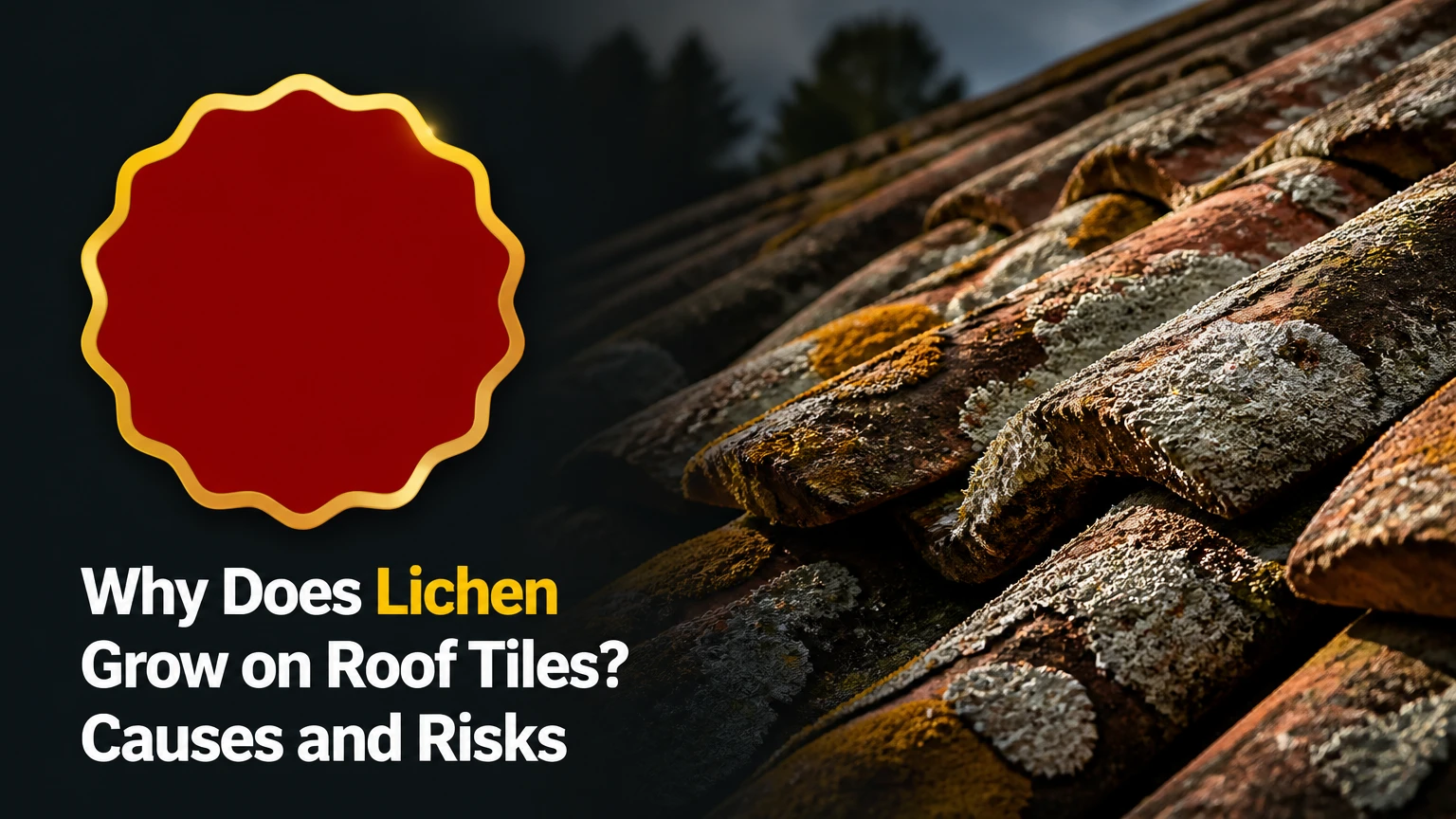
Lichen grows on roof tiles because the tile surface provides a stable, rough anchor that collects moisture, airborne minerals, dust, and organic particles. Lichen is a partnership between a fungus and a photosynthetic alga or cyanobacterium, so it can colonise concrete, clay, slate, and other mineral surfaces without ordinary garden soil.
Key Facts at a Glance
- Roof lichen needs a damp surface, light, and airborne nutrients, but it does not require a soil layer.
- Rough, weathered, shaded tiles usually support lichen better than smooth, regularly dried tiles.
- Lichen grows slowly, with visible coverage often developing over several years rather than weeks.
- Lichen is not automatically evidence of a leaking roof, although thick growth can conceal cracked tiles, blocked channels, or failed flashings.
- Rhizines anchor lichen to a surface; they are not true roots and do not normally penetrate roof tiles like plant roots.
- Pressure washing can remove visible growth while shortening tile life, driving water beneath laps, or stripping a surface finish.
What Is Lichen on a Roof?
Roof lichen is a composite organism formed by a fungus living with a photosynthetic partner. The fungal component creates the external body, called a thallus, while an alga or cyanobacterium produces carbohydrates through photosynthesis and exchanges some of that energy within the partnership.
The British Lichen Society explains that lichens occupy surfaces ranging from rock and bark to soil and built structures. A roof therefore provides a usable habitat even when no visible earth is present. Dust, bird residue, pollen, and mineral particles supply small quantities of nutrients, while rain and dew supply water.
Lichen is different from moss. Moss is a small plant-like organism with leaf-like structures and rhizoids, whereas lichen is a fungus-based symbiosis. Roof algae generally form slimy or powdery green, black, or brown films. The three organisms can occur together, but they respond differently to cleaning and moisture.
How Does Lichen Attach to Tile?
Lichen attaches through fungal filaments and specialised anchoring structures called rhizines. Rhizines resemble tiny roots, but they mainly grip irregularities and do not function as vascular roots that draw water from deep inside a tile.
Crustose species can bond so tightly to the mineral surface that removing the visible patch also removes some surface material. Foliose species have leaf-like lobes and may attach at several points. Fruticose species are usually upright or hair-like and are less common on ordinary pitched roofs than crustose and foliose forms.
That distinction matters during cleaning. A pressure washer may remove a loose foliose patch quickly, while the same force can scar a clay tile or leave a crustose species partly attached.
Why Do Roof Tiles Suit Lichen Growth?
Roof tiles suit lichen because they combine rough mineral texture, repeated wetting, sunlight, and long periods without disturbance. Roof orientation, shading, local rainfall, tile age, and airborne pollution determine whether a particular roof becomes heavily colonised.
A new glazed clay tile may remain comparatively inhospitable because its surface is smooth and sheds water quickly. An old concrete tile develops microscopic roughness as its surface weathers, and that roughness traps dust and water. North-facing or tree-shaded roof planes often dry more slowly in the Northern Hemisphere, but dense lichen can also grow on east- or west-facing slopes when rainfall and shade compensate for stronger afternoon drying.
Which Roof Conditions Encourage Growth?
| Roof condition | Typical effect on lichen | Practical reason |
|---|---|---|
| North-facing pitch in the UK | High growth potential | Lower direct drying and frequent dampness |
| Overhanging tree canopy | High growth potential | Shade, leaf dust, and longer surface wetness |
| Smooth glazed clay tile | Low to moderate growth potential | Reduced grip and faster runoff |
| Weathered concrete tile | Moderate to high growth potential | Rough pores retain dust and moisture |
| Coastal or industrial air | Variable, often moderate | Airborne salts, minerals, soot, and particles alter the surface |
| Roof pitch below 25 degrees | Higher retention risk | Water and debris remain longer than on steep slopes |
| Roof pitch above 45 degrees | Lower retention risk | Faster drainage and reduced debris accumulation |
Lichen does not need permanent shade. The algal partner needs light for photosynthesis, and many species tolerate direct sun when periodic rain or dew prevents prolonged dehydration. Moisture is usually the limiting factor, not darkness alone.
Why Does Lichen Grow on One Side of a Roof?
Lichen grows more heavily on one roof side when that plane stays wet longer or receives more airborne debris. In the Northern Hemisphere, north-facing slopes often show stronger growth because they receive less direct midday sunlight, although nearby trees, buildings, prevailing rain, and roof geometry can reverse that pattern.
A valley between roof planes, a section below a chimney, and the area beneath an overhanging branch can each create a local moisture pocket. Compare tiles at the same age and material before blaming orientation. A blocked gutter or failed flashing can also create a wet strip that resembles a simple shade pattern.
How Does Lichen Survive Without Soil?
Lichen survives without soil because the fungus absorbs water and dissolved substances from rain, dew, and humid air, while the photosynthetic partner manufactures energy from light. Airborne dust and small organic deposits provide supplemental minerals, so a lichen thallus can live directly on a roof tile.
The partnership is efficient but slow. Lichen can dry almost completely and resume activity after rewetting, which helps it survive exposed roofs where ordinary plants would wilt. The fungal body also protects the photobiont from rapid environmental changes.
Lichen acids, including compounds based on oxalic acid in some species, can contribute to chemical weathering of mineral surfaces. That process is real on rock, but roof damage should not be attributed automatically to acid attack. On manufactured tiles, freeze-thaw cycles, thermal movement, foot traffic, manufacturing defects, and water penetration often matter more than lichen chemistry.
How Does Roof Lichen Colonisation Develop?
Roof lichen colonisation generally follows spore or fragment deposition, moisture-assisted establishment, formation of a fungal network, acquisition or activation of a photosynthetic partner, and gradual thallus expansion. The sequence is biologically variable, so fixed timelines should be treated as typical rather than guaranteed.
- Deposition: Wind, rain, birds, and nearby vegetation deposit spores or fragments.
- Germination: A compatible fungal spore begins producing hyphae when moisture and temperature permit.
- Partnership formation: The fungus associates with a suitable alga or cyanobacterium.
- Thallus development: The lichen forms a recognisable crust, lobe, or tuft.
- Surface expansion: The organism spreads across suitable roughness and damp microhabitats.
Visible patches may appear two to five years after installation in favourable climates, while poor conditions can delay obvious growth for much longer. A reported growth range of roughly 0.5-2 millimetres per year may describe some slow-growing lichens, but it is not a universal roof-living rate. Species, climate, surface exposure, and measurement method produce substantial variation.
How Fast Does Roof Lichen Spread?
Roof lichen usually expands slowly, with visible coverage commonly taking several years and established thalli persisting for decades when they are not disturbed. Rapidly increasing green or black coverage over a few months more often indicates algae, moss, or accumulated debris than a newly mature lichen colony.
| Roof observation | Likely interpretation | Recommended check |
|---|---|---|
| Pale grey crust fixed to tile | Crustose lichen | Inspect tile surface before scraping |
| Yellow, orange, or grey leaf-like lobes | Foliose lichen | Check whether lobes lift without force |
| Green cushion with stems | Moss | Check damp laps and blocked channels |
| Black or green film | Algae or biofilm | Check shade, runoff, and surface moisture |
| Hair-like upright tufts | Fruticose lichen | Confirm attachment point and roof stability |
Is Lichen Harmful to Roof Tiles?
Lichen is usually a maintenance concern before it becomes a direct structural threat. Established growth can retain moisture, obscure defects, trap debris, and increase surface weathering, but the presence of lichen alone does not prove that tiles are failing or that a roof will leak.
The risk depends on tile material and condition. A sound, glazed tile may tolerate superficial colonisation for years. A porous, frost-damaged concrete tile with open cracks has less remaining resilience, and removing firmly attached lichen can cause more damage than leaving a thin patch temporarily in place.
Can Roof Lichen Cause Leaks?
Roof lichen can contribute indirectly to leaks by hiding cracked tiles, obstructing water channels, lifting fragile surface fragments, and retaining damp debris around laps. Lichen itself is rarely a single, sufficient explanation for water entering a building.
Look for evidence rather than relying on appearance. Warning signs include staining on loft timbers, damp insulation, daylight through broken tiles, displaced slates, overflowing gutters, and moisture that appears after specific wind directions. A roof inspection should check flashings, valleys, ridge bedding, underlay, battens, and tile alignment.
An important practitioner rule is simple: clean only after documenting the roof’s condition. Photographs taken from the ground and loft can distinguish a cosmetic growth problem from a roof-maintenance problem.
Does Lichen Damage Clay, Concrete, and Slate Equally?
Lichen does not affect every roofing material equally. Concrete tiles are often porous and mechanically robust, clay tiles can have vulnerable weathered surfaces and brittle edges, and slate can split along natural cleavage planes when mishandled.
| Tile material | Main lichen-related concern | Cleaning sensitivity | Inspection priority |
|---|---|---|---|
| Concrete | Moisture retention and surface roughening | Moderate | Cracks, granular loss, porous coating |
| Plain clay | Surface loss and brittle edges | High | Spalling, flaking, slipped tiles |
| Glazed clay | Growth at joints or damaged glaze | High | Glaze chips and hairline cracks |
| Natural slate | Delamination and breakage | Very high | Splits, nail sickness, fragile laps |
| Fibre-cement slate | Surface coating loss | Moderate to high | Asbestos risk in older products |
Older fibre-cement slates may contain asbestos. Do not drill, wire-brush, cut, or pressure-wash them without identifying the product and following local asbestos controls.
Should You Remove Lichen From Roof Tiles?
Remove roof lichen when it conceals defects, blocks drainage, retains persistent moisture, or threatens a fragile tile surface; leave minor, harmless colonisation temporarily when cleaning would damage historic or already-brittle material. The correct decision depends on inspection findings, not on colour alone.
Before treatment, record tile type, roof pitch, access height, fragile features, gutters, nearby ponds, and the condition of mortar and flashings. Roof work introduces fall, breakage, chemical runoff, and electrical risks that a ground-level visual inspection cannot eliminate.
Which Removal Method Is Safest?
| Method | Typical cost per 100 m² | Typical result duration | Main limitation |
|---|---|---|---|
| Manual removal with soft tools | £30-£150 DIY materials | 1-3 years | Slow and hazardous at height |
| Professional low-pressure biocide | £400-£800 | 2-5 years | Runoff and plant protection required |
| Steam cleaning by specialist | £600-£1,200 | 1-3 years | Requires trained operator and access |
| Pressure washing | £300-£700 | 1-3 years | Can damage surfaces and tile laps |
| Zinc or copper strip installation | £300-£600 | 5-10+ years | Prevents growth gradually, not instantly |
These are typical UK planning ranges, not fixed quotations. Roof size, access, scaffolding, pitch, tile fragility, waste handling, and chemical containment can change the price substantially.
Biocide and Soft Washing
A roof-approved biocide can kill or weaken biological growth while using less abrasive force than scraping. Application usually works best during a dry period when the product can remain on the surface for the manufacturer’s stated dwell time, followed by natural weathering or controlled rinsing.
Protect ponds, soil, edible crops, gutters, painted surfaces, and downpipes. Never mix products. Sodium hypochlorite can corrode metals, damage plants, and affect mortar, so a dedicated product and label-based dilution are safer than improvised bleach.
Manual Scraping and Steam
Manual removal with a suitable scraper, followed by low-pressure steam where appropriate, gives a specialist more control over historic clay, slate, and delicate surfaces. Pre-wetting can soften dry crusts, but force must remain low enough to avoid removing the tile’s weathered face.
Historic England guidance for traditional buildings generally favours compatible, minimally aggressive maintenance over abrasive interventions. A period roof should be assessed by a contractor familiar with its tile type and construction, not treated like a modern concrete-tile roof.
Pressure Washing
Pressure washing gives fast visual improvement but carries a high risk of surface and installation damage. Upward spray can drive water beneath overlapping tiles, while excessive pressure can remove coatings, loosen pointing, and open roughness that later holds more moisture.
Pressure washing is particularly unsuitable for fragile slate, old plain clay, fibre-cement products, and roofs with uncertain underlay condition. A clean-looking roof is not proof that the treatment preserved its service life.
How Can You Prevent Lichen Regrowth?
Prevent regrowth by reducing persistent shade and debris, keeping gutters functional, correcting water traps, and using an appropriately installed copper or zinc strip where the roof design allows it. Prevention works gradually because rainfall must carry small quantities of metal ions across the roof surface.
Metal strips are not a substitute for repairs or a treatment for established colonies. They work poorly on roof sections that do not receive runoff, beneath wide obstructions, or where leaves bridge the metal and tile surface. Copper can stain some light-coloured materials, and zinc runoff may affect sensitive planting or aquatic environments.
Prevention Measures Ranked by Usefulness
| Measure | Typical effort | Expected benefit | Best application |
|---|---|---|---|
| Remove overhanging branches | 1-4 hours | High where shade is dense | Tree-covered roof planes |
| Clear gutters twice yearly | 30-90 minutes | Moderate to high | Roofs with leaf accumulation |
| Repair leaking valleys or flashings | £150-£1,500 typical | High | Wet strips and internal staining |
| Install zinc or copper strip | £300-£600 typical | Moderate over 5-10 years | Ridge or upper roof runoff |
| Apply clear coating | £800-£1,800 typical | Variable, 5-8 years claimed | Sound compatible tiles only |
A coating should never be used to hide failing tiles. Some coatings trap moisture, alter breathability, change appearance, or void manufacturer recommendations. Confirm compatibility with the tile maker or a conservation specialist.
What Should Different Roof Owners Do?
Homeowners with sound modern concrete tiles can usually prioritise inspection, gentle treatment, and gutter control. Owners of historic clay, natural slate, or suspected asbestos-containing products should prioritise material identification and specialist advice before any cleaning.
For a Modern Concrete-Tile Roof
Check for cracks, loose tiles, blocked gutters, and roof-space dampness before choosing treatment. A professional soft wash may be reasonable when access and runoff can be controlled, while a zinc strip can reduce future colonisation after the roof is clean and sound.
For a Historic or Fragile Roof
Avoid pressure washing, aggressive dry scraping, and untested coatings. A conservation roofer can test a small area, identify the tile, and choose hand tools or controlled steam that preserve patina and the weathered surface.
For a DIY Homeowner
Ground-based inspection and gutter cleaning are sensible tasks; roof walking is not safe on many pitches and materials without proper access equipment. Do not use a ladder as a substitute for a stable work platform, and never spray chemicals where runoff can enter ponds, drains, or neighbouring property.
Common Mistakes When Treating Roof Lichen
- Blaming lichen for every leak: Inspect flashings, valleys, underlay, and cracked tiles before cleaning.
- Using strong household bleach: Bleach can harm plants, metals, mortar, and tile colour without providing lasting prevention.
- Dry-scraping crustose growth: Firm scraping can remove the tile surface along with the lichen.
- Pressure-washing upward: Water can enter beneath tile overlaps and wet the roof structure.
- Ignoring gutters: Dead material can form sludge that blocks outlets after treatment.
- Treating all dark growth as lichen: Algae, moss, soot, and lichen require different diagnosis and handling.
One counterintuitive truth matters here: removing lichen can expose pre-existing damage rather than create it. If a tile flakes during careful cleaning, the colony may have been masking a surface already weakened by frost, age, or manufacturing defects.
FAQ
Is roof lichen a sign of damp inside the house?
Roof lichen is not, by itself, evidence of interior damp. Lichen indicates that the external surface periodically remains wet, while indoor damp requires a pathway such as a failed flashing, broken tile, defective underlay, condensation, or blocked drainage. Inspect the loft after rain before deciding that cleaning will solve the problem.
Can rain wash lichen spores away?
Rain can move spores and fragments across a roof, but established lichen usually remains attached through fungal anchoring structures. Heavy rain may remove loose debris while leaving crustose patches intact. Wind, birds, nearby trees, and roof drainage distribute biological material more effectively than a single rainfall event.
Does roof paint stop lichen growth?
Roof paint may reduce growth temporarily when the coating is compatible, intact, and correctly applied, but paint is not a universal lichen control. A coating can fail through peeling, trap moisture, alter breathability, or conceal tile defects. Repairing water traps and improving debris control usually provides a sounder first step.
Is lichen worse than moss on roof tiles?
Moss often creates a more obvious drainage and lifting problem because it forms a thick, water-holding mat around laps and channels. Lichen adheres more tightly and may weather the surface, making removal riskier. A roof can contain both, so the appropriate response depends on tile condition and blocked drainage.
Will replacing roof tiles permanently stop lichen?
Replacing tiles does not permanently stop lichen because airborne spores and fragments can recolonise any suitable mineral surface. New smooth or glazed tiles may delay establishment, but shade, rainfall, debris, and roof orientation remain influential. Correcting persistent moisture and installing suitable runoff-based prevention offers a longer-term result.
The Bottom Line
Why does lichen grow on roof tiles? Lichen grows because weathered roofing provides a rough, stable mineral surface with intermittent moisture, light, and airborne nutrients. Lichen is not automatically dangerous, but thick or firmly attached growth can conceal defects and complicate maintenance.
Identify the organism and tile material first. Inspect for leaks, cracks, blocked channels, fragile surfaces, and asbestos before choosing between gentle manual work, specialist soft washing, steam, or preventive metal strips. The safest roof treatment removes the biological problem without creating a larger mechanical or water-ingress problem.