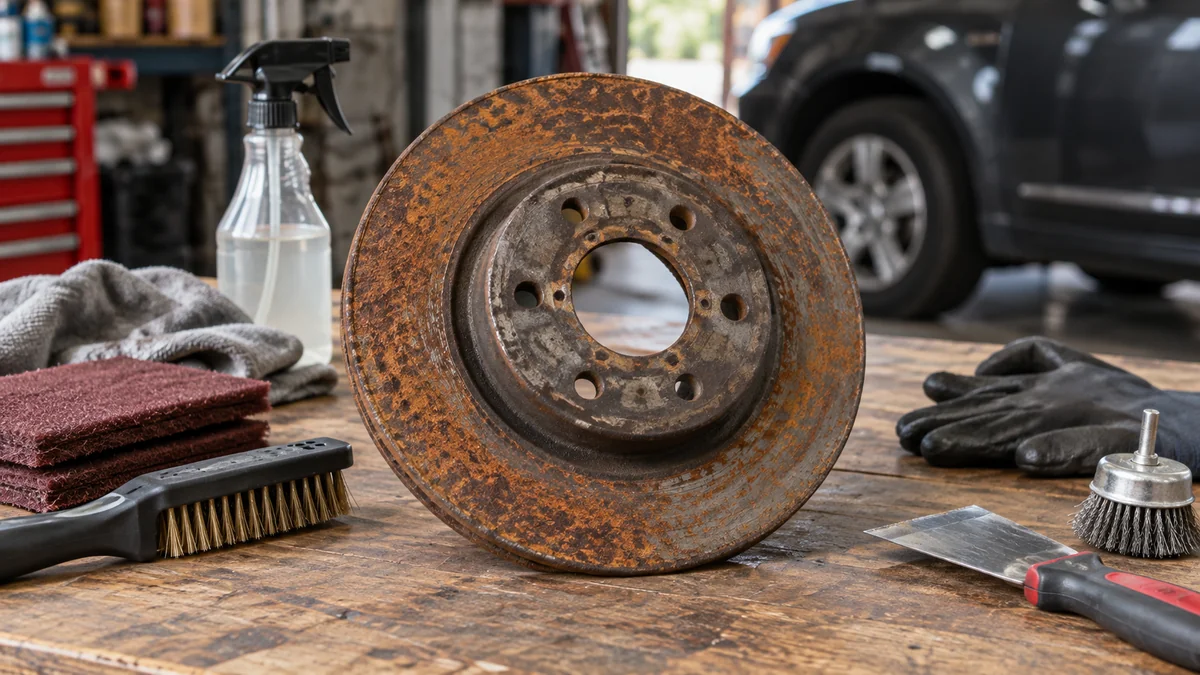
The fastest way to remove rust from metal is laser cleaning for professional work, while an angle grinder with a wire cup or flap disc is usually fastest for heavy rust in a home workshop. For delicate parts, a chelating remover is safer; for light surface rust, phosphoric acid or abrasive paper can finish the job without significant metal loss.
Key Facts at a Glance
- A 300- to 1,000-watt pulsed laser can remove surface rust in seconds to minutes, but requires trained operation and controlled laser safety equipment.
- A wire cup on an angle grinder commonly removes heavy scale from accessible steel in 5-30 minutes, depending on area and thickness.
- Muriatic acid acts quickly, but can attack sound steel, release hazardous fumes, cause flash rust, and create hydrogen-embrittlement concerns.
- Chelating products such as Evapo-Rust typically take 30 minutes to 24 hours and preserve dimensions better than grinding.
- Rust removal is incomplete until the clean metal is dried immediately and protected with oil, primer, paint, or another corrosion barrier.
- Critical fasteners, springs, pressure parts, firearms, and load-bearing components should not receive improvised acid or electrolysis treatments.
Which Rust Removal Method Is Fastest?
Laser ablation is the fastest rust-removal method overall, but mechanical abrasion is the fastest method most homeowners can realistically use. A professional laser can clean exposed rust in seconds or minutes, whereas a wire wheel or flap disc usually completes a small steel part in 5-30 minutes.
Rust removal speed depends on four variables: rust thickness, surface area, access, and whether the original dimensions must remain unchanged. A grinder wins on thick, loose scale because it combines impact and abrasion. A chelator wins on precision because it dissolves corrosion without cutting deeply into the substrate, although the soak takes longer.
The fastest apparent method is not always the fastest complete process. Grinding may remove scale quickly but leave rust in pits, while acid may clean recesses and then require neutralization, rinsing, drying, inspection, and immediate coating. A professional laser also requires extraction, enclosure controls, setup, and an operator trained for the specific material.
Comparison of Rust Removal Methods
| Method | Typical working time | Typical DIY or service cost | Best use |
|---|---|---|---|
| Pulsed laser cleaning | 10 seconds-10 minutes per small part | $80-$350 per service hour | Valuable parts, fabrication, large exposed surfaces |
| Angle grinder with wire cup | 5-30 minutes per small-to-medium area | $40-$180 for tool and consumables | Heavy scale on thick steel |
| Flap disc and sanding | 15-90 minutes | $10-$35 per disc and abrasive set | Rust removal plus surface smoothing |
| Phosphoric acid gel | 15 minutes-2 hours | $10-$30 per container | Light-to-medium rust and paint preparation |
| Chelating bath | 30 minutes-24 hours | $15-$40 per container | Precision parts and reusable immersion work |
| Electrolysis | 4-24 hours | $5-$20 excluding power supply | Ornate, recessed, or historically important iron |
| White vinegar soak | 6-48 hours | $3-$10 | Small household parts and low-cost restoration |
What Is the Fastest DIY Way to Remove Heavy Rust?
The fastest DIY method for heavy rust on thick, accessible steel is an angle grinder fitted with a wire cup or flap disc. Remove loose scale first, keep the abrasive moving, inspect the surface under good light, then use a finer abrasive or rust converter before applying immediate corrosion protection.
A twisted-wire cup removes flaky scale while preserving more shape than an aggressive grinding wheel. An 80-grit flap disc cuts faster and produces a smoother surface, but it removes sound metal more readily. Neither tool should be used on thin sheet metal without careful pressure control.
Step 1: Inspect and Prepare the Metal
Identify the base metal, rust depth, coatings, and structural role before selecting an abrasive. Do not grind a load-bearing component merely to improve its appearance if corrosion has reduced its thickness.
Remove oil and dirt with a suitable degreaser. Clamp the work securely, clear combustible materials, and determine where sparks and abrasive fragments will travel. For painted items, test a small hidden area because old coatings may contain hazardous lead or other contaminants.
Step 2: Select the Abrasive
Choose a wire cup for flaky rust and an 80-grit flap disc for bonded scale that must also be smoothed. Use a drill-mounted wire brush only for light rust or small areas because drills generally remove heavy scale more slowly than grinders.
| Surface condition | Recommended tool | Typical setting or grade | Expected result |
|---|---|---|---|
| Orange surface haze | Hand brush or drill brush | 80-120 grit equivalent | Cleaned surface with low metal loss |
| Thin bonded rust | Wire wheel or flap disc | 80 grit | Rust removal and moderate scratch pattern |
| Heavy flaky scale | Twisted wire cup | Grinder rated for attachment | Rapid scale breakdown |
| Deep pits after scale removal | Flap disc, then abrasive paper | 80, 120, and 220 grit | Smoother profile, pits remain visible |
| Thin sheet steel | Hand abrasive or chemical gel | 180-320 grit | Lower risk of warping or thinning |
Step 3: Remove Scale Without Gouging
Wear safety glasses under a face shield, hearing protection, suitable gloves, long sleeves, and a properly selected respirator. Hold the grinder firmly, keep the disc moving, and avoid pressing hard enough to stall the motor or overheat the work.
A shallow working angle, typically around 10-15 degrees for a flap disc, reduces gouging. A wire cup should contact the surface squarely enough to work efficiently without allowing the edge to catch. Do not use a damaged disc, remove a grinder guard, or exceed the accessory’s rated revolutions per minute.
You will know the first pass worked when loose scale is gone and the remaining surface shows a consistent dark-gray or metallic pattern rather than raised orange flakes. A common mistake is stopping when the orange color disappears from the high points while leaving corrosion inside pits and seams.
Step 4: Refine, Clean, and Inspect
Use 120- to 220-grit abrasive paper to reduce sharp wire-wheel marks where appearance or paint adhesion matters. Blow or vacuum dust with equipment rated for fine particulate; compressed air can spread hazardous dust into the breathing zone.
Wipe the metal with a compatible solvent or manufacturer-approved cleaner. Inspect pits, weld toes, bolt holes, and folded edges with angled lighting. Surface rust that remains in a pit may require a gel or chelating treatment rather than more grinding, especially when continued abrasion would reduce the part’s dimensions.
Step 5: Protect the Clean Steel Immediately
Dry bare steel completely, including threaded holes and seams, then apply protection immediately. A temporary oil film is suitable for tools and indoor parts; epoxy primer, zinc-rich primer, or a complete paint system is better for outdoor steel.
Flash rust can appear within minutes when clean steel is wet and exposed to humid air. Warm, dry air and compressed air help, but compressed air alone is not a coating. The successful checkpoint is a uniformly dry surface with no orange bloom before the protective product is applied.
Is Muriatic Acid the Fastest Chemical Rust Remover?
Muriatic acid is among the fastest chemical rust removers, but it is rarely the best general-purpose choice because hydrochloric acid attacks sound steel, produces hazardous fumes, and can create severe flash rust after rinsing. Commercial chelators or phosphoric-acid products are slower but usually safer and easier to control.
Hydrochloric acid dissolves iron oxides rapidly, especially on heavily scaled steel. It also removes or damages galvanizing, attacks many adjacent metals, and can generate hydrogen during contact with metal. Mixing it with bleach or other cleaners can release toxic gases.
For household work, use a product whose label specifies rust removal and follow that label exactly. Do not improvise dilution, immersion time, neutralization, ventilation, or disposal procedures. Chemical-resistant gloves, eye and face protection, compatible containers, outdoor or engineered ventilation, and an emergency rinsing plan are minimum requirements, not optional upgrades.
Chemical Options Compared
| Chemical method | Typical contact time | Metal-preservation profile | Main limitation |
|---|---|---|---|
| Hydrochloric acid | 5-15 minutes | Low if poorly controlled | Attacks sound steel and creates fumes |
| Phosphoric acid gel | 15 minutes-2 hours | Moderate to high | May leave dark phosphate residue |
| Chelating remover | 30 minutes-24 hours | High | Slow on thick, tightly bonded scale |
| White vinegar, acetic acid | 6-48 hours | Moderate | Requires scrubbing and long soaking |
| Baking soda paste | Usually ineffective alone | High | Neutralizes acids but does not rapidly dissolve rust |
Phosphoric acid converts some iron oxide into an adherent iron-phosphate residue while removing loose corrosion. That residue can improve short-term passivation, but the surface still needs cleaning and a compatible primer. A converter is not equivalent to complete rust removal when deep corrosion remains.
Which Method Preserves the Most Metal?
Chelation and electrolysis generally preserve the most original metal because they target corrosion more selectively than grinding. Electrolysis is useful for iron and steel objects that can be immersed, while a chelating bath is simpler when the object fits the product’s container and the manufacturer permits the treatment.
Electrolysis requires a nonconductive container, a sacrificial iron or steel anode, an alkaline electrolyte such as washing soda, a low-voltage direct-current power source, and correct polarity. The rusty workpiece is connected to the negative terminal, while the sacrificial anode connects to the positive terminal. Reversing those connections can damage the object.
Hydrogen gas is produced during electrolysis, so the setup requires strong ventilation and no flames, sparks, cigarettes, or enclosed ignition sources. Remove paint, grease, and dissimilar metals where the process could damage them. Brass, aluminum, zinc, and mixed-metal assemblies should not be placed into an improvised electrolysis bath.
Precision Methods by Object Type
| Object or situation | Preferred method | Typical duration | Reason |
|---|---|---|---|
| Antique cast-iron tool | Electrolysis or chelator | 4-24 hours | Preserves markings and geometry |
| Rusted machined shaft | Chelating bath | 1-12 hours | Avoids abrasive dimensional loss |
| Small steel bolt, noncritical | Chelator or wire brush | 30 minutes-2 hours | Easy inspection and low setup |
| Spring or high-strength fastener | Mechanical cleaning | 10-45 minutes | Avoids hydrogen-embrittlement risk |
| Thin automotive panel | Hand abrasion or controlled blasting | 15-60 minutes | Limits heat and thinning |
| Large structural beam | Professional abrasive blasting | 1-8 hours | Handles scale and creates coating profile |
What Is the Fastest Rust Removal Method for Different Situations?
The best fast method changes with the object’s thickness, value, geometry, and intended finish. Thick structural steel favors mechanical abrasion or professional blasting, precision parts favor chelation, and valuable or complex surfaces may justify a laser or specialist restoration service.
For Automotive Panels
Use a DA sander, hand abrasive, or controlled media blasting rather than a heavy wire cup. Thin panels can warp from heat and lose their original thickness under aggressive grinding. After rust removal, treat pits, use an automotive epoxy primer, and inspect the reverse side because visible rust often begins between seams.
For Tools and Hardware
A wire brush is fastest for light surface corrosion. A chelating bath is better for hinges, threads, stamped markings, and parts where abrasive bristles cannot reach. Remove the treatment residue, dry all joints, and apply a light rust-preventive oil before storage.
For Structural Steel
Mechanical abrasion or abrasive blasting is normally faster than chemical soaking. Blasting also creates a surface profile that helps a specified coating system bond, but the abrasive, containment, respiratory protection, and waste handling must match the coating and project requirements.
For Valuable or Historic Objects
Avoid removing stable patina automatically. A conservator may choose electrolysis, chelation, or localized hand tools to retain tool marks and historical evidence. Laser cleaning can be precise, but the operator must control pulse energy and avoid overheating thin sections, plated details, or mixed materials.
What Are the Most Common Rust-Removal Mistakes?
The most damaging rust-removal mistakes are using excessive abrasion, leaving acid residue, sealing active rust under paint, and delaying protection after rinsing. These failures either remove sound metal, restart corrosion, or hide deterioration until the part becomes unsafe.
- Grinding until every pit is shiny: Deep pits may require more material removal than the component can safely tolerate. Remove loose corrosion, measure critical thickness, and use a compatible converter or coating where the remaining pits are structurally acceptable.
- Using a wire wheel on thin metal: Wire wheels can heat, gouge, and smear corrosion across a panel. Reduce pressure, use a finer abrasive, or switch to a gel and hand finishing.
- Treating baking soda as the rust remover: Baking soda is primarily a mild alkaline neutralizer and cleaning aid. It is useful after a compatible acid treatment, not as a rapid substitute for a rust-removal chemical.
- Painting over orange residue: Paint can trap moisture and conceal active corrosion. Remove loose scale, clean the surface, allow it to dry, and use a primer compatible with the remaining surface chemistry.
- Leaving acid-treated steel wet: Rinsed steel can flash-rust almost immediately in humid conditions. Dry seams and holes with clean forced air, then coat the surface without delay.
- Treating critical hardened steel with acid: Hydrogen absorbed during acid exposure can contribute to delayed cracking in high-strength components. Replace or professionally evaluate safety-critical fasteners, springs, suspension parts, and pressure components.
How Much Does Fast Rust Removal Cost?
Typical DIY rust removal costs range from $10 for hand abrasives or vinegar to $180 for an angle grinder and consumables. Professional laser cleaning commonly costs about $80-$350 per service hour, while blasting services often cost $50-$150 per hour before transport, containment, and coating.
The cheapest method is not necessarily the lowest total cost. A $15 acid product can become expensive if it damages threads, creates disposal problems, or forces replacement of a part. A $30 chelating product may be cheaper overall when preserving a machined surface avoids rework.
| Project scale | Fastest practical choice | Typical elapsed time | Typical total cost |
|---|---|---|---|
| One small hand tool | Wire brush or chelator | 30 minutes-12 hours | $5-$25 |
| Several rusty hardware pieces | Chelating bath | 2-24 hours | $20-$60 |
| Large thick steel section | Grinder or blasting | 30 minutes-8 hours | $40-$250 DIY or service |
| Valuable precision component | Specialist chelation or laser | 1-8 hours | $100-$700 |
| Automotive panel | DA sanding or controlled blasting | 1-6 hours | $75-$500 before refinishing |
How Do You Prevent Rust From Returning?
Prevent recurring rust by removing contamination, drying every crevice, and applying a barrier matched to the environment. Indoor tools need a thin oil or wax film, while outdoor steel generally needs a prepared surface, compatible primer, and weather-resistant topcoat.
Rust returns when water, oxygen, salts, or trapped residue remain on the surface. Coastal air, road salt, condensation, and unsealed seams accelerate recurrence. Galvanic contact can also corrode steel when wet steel touches a dissimilar metal such as copper or stainless steel under the wrong conditions.
Use these practitioner rules:
- Coat bare steel within minutes of final drying in humid conditions.
- Prime porous pits rather than relying on a decorative topcoat alone.
- Seal seams and bolt interfaces where water can remain trapped.
- Store tools below the local dew point when possible, or use vapor-corrosion protection.
- Inspect repaired outdoor steel after the first wet season instead of waiting for visible bubbling.
FAQ
Can WD-40 remove heavy rust?
WD-40 and similar penetrating oils can loosen rusted fasteners and displace moisture, but they do not rapidly remove thick iron oxide. Use a wire brush, chelator, or labeled rust-removal product for corrosion removal, then apply an appropriate protective oil after the surface is clean and dry.
Does vinegar remove rust faster than commercial remover?
White vinegar can dissolve light rust because acetic acid reacts with iron oxides, but a soak commonly takes 6-48 hours and still requires scrubbing. A commercial chelator or phosphoric-acid gel usually gives more predictable results, especially on pitted steel or repeated projects.
Can I remove rust without sanding?
Yes. Chelating baths, phosphoric-acid gels, electrolysis, and professional laser cleaning can reduce or remove rust without conventional sanding. Each has limits: immersion methods need disassembly, chemicals need residue control, electrolysis creates hydrogen, and laser cleaning requires specialized equipment and trained operation.
Is sandblasting faster than grinding?
Sandblasting can be faster across large, heavily scaled surfaces because it cleans broad areas and recesses simultaneously. Grinding is usually faster for a small accessible patch because setup is minimal. Blasting can thin delicate metal, embed unsuitable media, create dust, and require containment.
Should I remove all rust before painting?
Remove loose and active corrosion before painting, but do not grind deep pits away automatically. For sound steel with shallow residual staining, a compatible rust treatment and primer may be appropriate. Structural loss, perforation, cracking, or severe pitting requires repair or replacement rather than cosmetic coating.
What is the safest method for a rusty high-strength bolt?
Use careful mechanical cleaning for inspection, then replace the bolt if corrosion has reduced its cross-section, damaged threads, or created pitting in a stressed area. Avoid improvised acid baths and electrolysis on safety-critical high-strength fasteners because hydrogen exposure can increase delayed-fracture risk.
The Bottom Line
The answer to what is the fastest way to remove rust from metal depends on the object and the acceptable risk. Choose a professional laser for maximum speed on valuable or extensive work, an angle grinder for heavy rust on thick accessible steel, and a chelating remover for precision parts where preserving original dimensions matters. Finish every method by drying the metal immediately and applying corrosion protection.