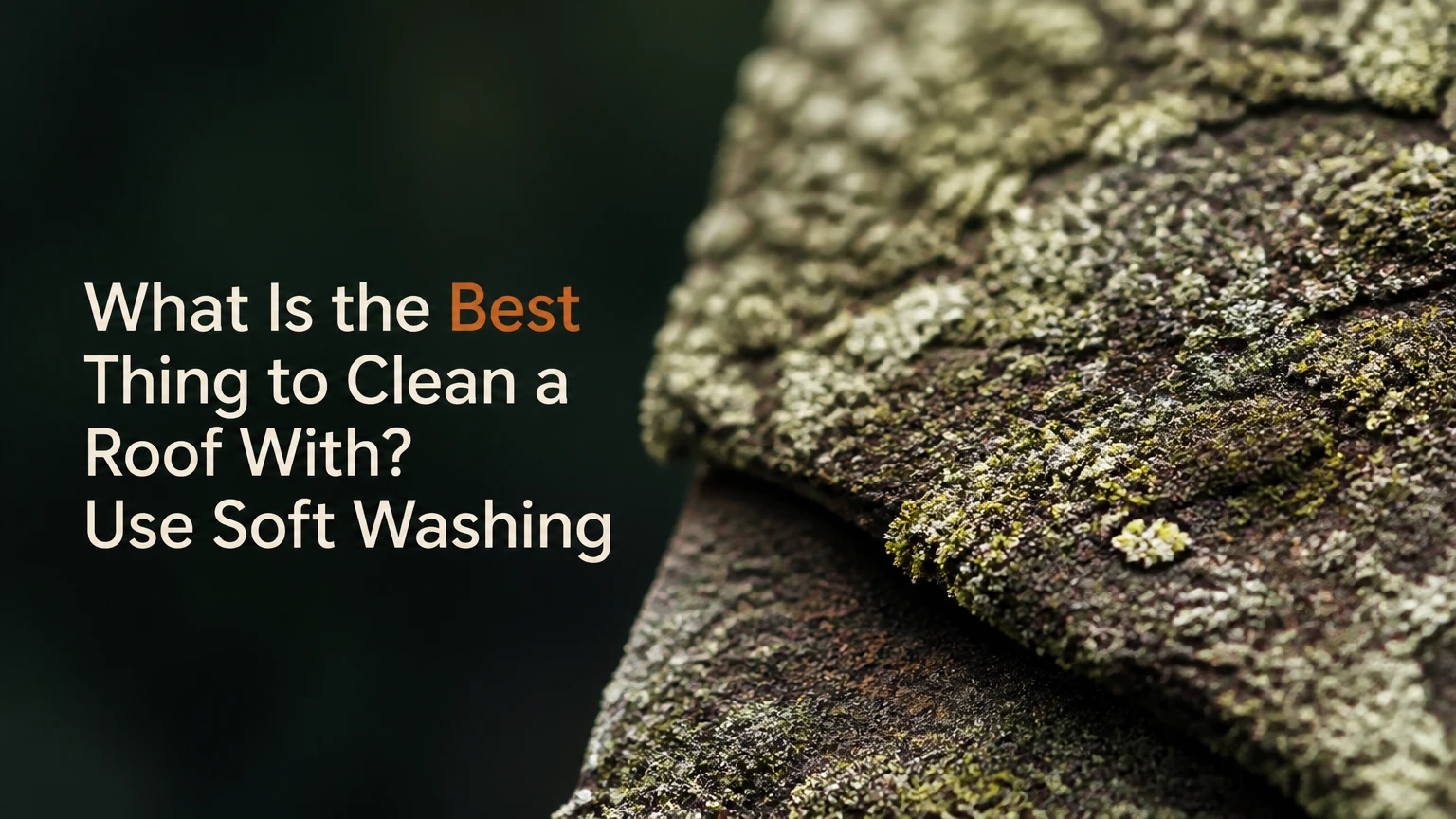
For most asphalt shingle and concrete tile roofs, the best cleaner is a diluted sodium hypochlorite solution, often called chlorine bleach, applied as a low-pressure soft wash. A 3%-4% active solution can kill algae, mold, and moss without the granule damage associated with pressure washing, provided the roof manufacturer permits chemical cleaning.
At a Glance
- Diluted sodium hypochlorite is usually the most effective cleaner for algae on asphalt shingles and concrete tiles.
- A typical target strength is 3%-4% active sodium hypochlorite, not undiluted household bleach.
- Low-pressure application and rinsing protect asphalt shingle granules better than pressure washing.
- Sodium hypochlorite is unsuitable for untreated wood and can corrode unprotected metal.
- Plants, siding, windows, pets, and rainwater systems require protection before chemical application.
- Thick moss and lichen may need physical removal and a second treatment.
Why Does Sodium Hypochlorite Work on Roof Growth?
Sodium hypochlorite works because its oxidizing action breaks down the organisms and pigments that create roof stains. The chemical is particularly effective against black algae streaks associated with Gloeocapsa magma, as well as surface mold and many forms of moss.
The roof-cleaning industry uses sodium hypochlorite in a soft-wash process rather than blasting the surface with water. The solution does the biological work while low pressure limits mechanical damage. Roof Coatings Manufacturers Association guidance and published recommendations from manufacturers such as GAF support nonabrasive cleaning methods for compatible roofing products.
The important distinction is concentration. Stronger is not automatically safer or better. A solution that dries on a hot shingle can damage nearby materials, scorch plants, and create hazardous runoff. The U.S. Environmental Protection Agency’s concise rule is, “The label is the law.” Product labels, roof warranties, and local discharge rules therefore take priority over a generic recipe.
Sodium hypochlorite does not repair deteriorated shingles or remove every mineral stain. It treats organic growth.
Which Roof-Cleaning Chemical Fits Each Roofing Material?
The correct cleaner depends on the roof material, coating, and type of stain. Sodium hypochlorite is a strong default for asphalt shingles and some concrete tiles, but wood, bare metal, slate, clay, and membrane roofs need separate confirmation.
| Roof material | Typical cleaner | Pressure guidance | Main caution |
|---|---|---|---|
| Asphalt shingles | 3%-4% sodium hypochlorite solution | Low pressure, under 300 PSI | Protect granules and plants |
| Concrete tile | Diluted sodium hypochlorite if manufacturer permits | Low pressure | Avoid forcing water beneath tiles |
| Cedar shakes | Sodium percarbonate solution | Gentle rinse | Avoid chlorine bleach |
| Bare aluminum or steel | Non-corrosive detergent | Low pressure | Rinse promptly and completely |
| Painted metal | Manufacturer-approved detergent | Low pressure | Test coating compatibility |
| Clay tile | Neutral cleaner or approved biocide | Gentle rinse | Prevent cracking and erosion |
| Slate | Slate-safe cleaner after inspection | Minimal pressure | Do not walk on fragile slate |
| Rubber or membrane roof | Manufacturer-approved detergent | Low pressure | Avoid solvent and incompatible chemicals |
Sodium percarbonate is a common alternative for cedar because it releases oxygen-based cleaning agents rather than aggressively bleaching wood fibers. A typical field mixture is about 1 cup of sodium percarbonate powder per gallon of warm water, although the product label controls the final ratio.
Roof coatings, sealants, paint, and previous repairs can change the answer. A small test area is sensible, especially when the roof material is older or unidentified.
What Strength Should a Roof-Cleaning Solution Be?
A typical active strength for algae on compatible asphalt shingles is 3%-4% sodium hypochlorite. The final concentration depends on the starting product, because household bleach, commercial bleach, and pool shock contain different percentages of active sodium hypochlorite.
| Starting product | Example starting strength | Approximate mixture for 3%-4% active solution |
|---|---|---|
| Household bleach | 6% | 1 part bleach plus 1 part water gives about 3% |
| Strong household bleach | 8.25% | 1 part bleach plus 1.25 parts water gives about 3.7% |
| Pool shock | 12.5% | 1 part pool shock plus 3 parts water gives about 3.1% |
| Commercial sodium hypochlorite | 10% | 1 part product plus 2 parts water gives about 3.3% |
These are approximate calculations, not universal instructions. Sodium hypochlorite loses strength during storage, especially in heat and sunlight. Never combine sodium hypochlorite with ammonia, acids, vinegar, or other cleaners because toxic gases can form.
A bleach-compatible surfactant can improve cling. Some professionals use approximately 1 ounce per gallon of finished solution, but ordinary dish soap may contain additives that harm plants or create excess foam. The label and the roof manufacturer’s instructions should decide the product.
How Do You Apply a Soft-Wash Roof Cleaner?
Apply a roof cleaner from the ground or a stable access point with low pressure, keeping the solution wet during the dwell period. Do not climb a wet, chemically treated roof unless a trained professional has assessed the fall risk.
- Inspect the roof, gutters, flashing, vents, siding, and nearby vegetation.
- Confirm the roofing material and read the manufacturer’s cleaning instructions.
- Remove loose debris without scraping or tearing shingle surfaces.
- Pre-wet plants, soil, siding, windows, and masonry with clean water.
- Apply the correctly diluted solution from the lower edge upward or according to the equipment manufacturer’s method.
- Keep the surface wet for about 15-20 minutes, but do not allow the chemical to dry.
- Rinse with a garden hose or low-pressure system, generally below 300 PSI.
- Flush gutters and downspouts, then rinse surrounding surfaces and plants again.
- Inspect the roof after drying and repeat only where growth remains.
The solution should kill much of the visible growth during the dwell period, but dead moss may remain attached. Pulling it off aggressively can remove granules or damage flashing. Letting dead growth release naturally is often safer.
How Much Roof-Cleaning Solution Do You Need?
A typical soft-wash application uses about 0.5-1.5 gallons of finished solution per 100 square feet, depending on roof pitch, porosity, growth density, and application equipment. A 2,000-square-foot roof therefore may require approximately 10-30 gallons for one complete application.
| Roof area | Light growth | Heavy or porous growth | Typical finished solution |
|---|---|---|---|
| 1,000 square feet | 5 gallons | 15 gallons | 5-15 gallons |
| 1,500 square feet | 8 gallons | 23 gallons | 8-23 gallons |
| 2,000 square feet | 10 gallons | 30 gallons | 10-30 gallons |
| 2,500 square feet | 13 gallons | 38 gallons | 13-38 gallons |
Roof area is not the same as the home’s floor area. A steep roof, multiple dormers, and attached garages increase the actual surface area. Professional estimators usually measure roof squares, with one roofing square equal to 100 square feet.
Excess solution is not a sign of better cleaning. Overspraying increases runoff, chemical use, plant exposure, and cleanup requirements. Apply enough to wet the growth uniformly, then stop.
What Equipment and Weather Conditions Are Safest?
The safest setup uses a low-pressure pump or garden hose attachment, chemical-resistant gloves, eye protection, protective clothing, and controlled runoff. A roof should be cleaned on a cool, overcast day with little wind and no rain expected during the dwell period.
Avoid application when roof temperatures exceed approximately 85°F, when wind can carry spray, or when direct sun will dry the solution in minutes. Early morning or shaded sections are usually easier to manage. Rain immediately after application can dilute the treatment and move chemical runoff across plants or into drains.
Useful equipment includes:
- Low-pressure sprayer with chemical-resistant components
- Garden hose with an adjustable spray nozzle
- Nonslip ground footwear
- Chemical-resistant gloves and splash goggles
- Plastic sheeting for sensitive surfaces
- Clean-water hose for continuous rinsing
- Temporary downspout diversion or collection containers
A ladder does not make roof access safe by itself. Wet algae, steep pitches, brittle shingles, and chemical overspray create serious fall hazards. Professionals often use ground-based telescoping systems instead of walking the roof.
How Do You Protect Plants, Gutters, and Siding?
Protect plants by saturating leaves and soil with clean water before, during, and after applying sodium hypochlorite. Wet foliage absorbs less of the concentrated solution, while immediate rinsing reduces the time available for injury.
Covering plants with plastic can trap heat and worsen damage in sunlight, so breathable protection or repeated water rinsing is often preferable. Move outdoor furniture, toys, pet dishes, and sensitive metal objects away from the runoff path.
Use these controls:
| Surface or item | Protection method | Follow-up |
|---|---|---|
| Grass | Pre-wet and rinse repeatedly | Flush runoff with clean water |
| Shrubs and flowers | Pre-wet foliage and shield sensitive beds | Rinse leaves from both sides |
| Painted siding | Keep wet and rinse immediately | Inspect for streaking |
| Windows | Cover or continuously rinse | Clean glass after roof work |
| Gutters | Control discharge where possible | Flush gutters and downspouts |
| Fish ponds | Prevent all chemical entry | Hire a professional if runoff cannot be isolated |
Do not assume dilution makes uncontrolled runoff harmless. A 3% solution can scorch vegetation and harm aquatic life. Local stormwater rules may also prohibit sending chemical wash water into public drains.
What Is Best for Moss, Lichen, and Black Streaks?
Black algae streaks usually respond best to a properly diluted sodium hypochlorite soft wash, while thick moss and crusted lichen need physical treatment in addition to chemical application. The visible growth type determines whether one application is enough.
| Growth type | Appearance | Recommended approach | Expected result |
|---|---|---|---|
| Black algae | Dark vertical streaks | 3%-4% soft wash | Color fades quickly |
| Thin moss | Small green tufts | Soft wash, then gentle rinse | Growth dies and loosens |
| Thick moss | Cushioned green mats | Remove loose bulk gently, then treat | Detachment may take weeks |
| Lichen | Hard gray or pale crust | Treat, wait, gently loosen, retreat | Ghost rings may remain temporarily |
| Dirt only | Brown or gray film | Manufacturer-approved detergent | Bleach may be unnecessary |
Thick moss can conceal roots beneath its surface. Spraying the top layer may kill visible foliage while leaving attached material behind. Scraping with a stiff tool can damage shingles, so a soft brush and minimal force are safer.
Lichen often requires patience. A second application after the first treatment has softened the growth may produce a better result than increasing concentration. A stronger solution is not a substitute for controlled technique.
Can You Clean a Roof With a Pressure Washer?
You generally should not pressure-wash asphalt shingles because concentrated water can strip ceramic granules, lift shingle edges, and force water beneath the roofing system. Standing farther away reduces pressure at the surface but does not eliminate the risk.
Manufacturers commonly direct homeowners toward low-pressure, nonabrasive cleaning instead. GAF’s maintenance guidance warns against power washing asphalt shingles because the process can damage the roofing surface. The Asphalt Roofing Manufacturers Association also emphasizes gentle cleaning methods for asphalt shingles.
Pressure washing may be acceptable for some hard surfaces, such as certain concrete areas, but roof suitability depends on the material and equipment. Even concrete tiles can crack, shift, or admit water when handled aggressively.
The damage may not be obvious immediately. Missing granules expose asphalt to ultraviolet radiation and can accelerate aging, while damaged seal strips may reduce wind resistance. Pressure washing can also void warranty coverage when the manufacturer prohibits it.
Use low pressure for the rinse. Let the chemical loosen organic growth instead of trying to remove the growth through force.
What Should You Use on a Metal or Wood Roof?
Use sodium percarbonate or another wood-safe cleaner on cedar shakes, and use a non-corrosive detergent approved for the coating on metal roofs. Chlorine bleach is a poor default for both materials because untreated wood can dry and discolor, while bare metal can corrode.
For cedar shakes, dissolve sodium percarbonate in warm water according to the product label, apply it evenly, allow controlled dwell time, and rinse gently. Avoid aggressive brushing because raised wood fibers can create a rough, damaged surface.
For unpainted aluminum, copper, and steel, use a neutral or manufacturer-approved detergent. Rust stains require a separate compatible treatment, and oxalic acid is sometimes used for rust removal, but oxalic acid is not a quaternary ammonium compound and should not be treated as a universal roof disinfectant.
Painted metal needs a coating test first. A cleaner that is safe for bare steel may dull a factory finish. Rinse metal promptly because chemical residue can remain active in seams, fasteners, and gutters.
When the roof type is uncertain, stop before mixing chemicals. A roofing contractor or manufacturer can identify the surface.
How Should You Clean a Roof With Rainwater Collection?
Disconnect or bypass every roof drain that feeds a rainwater cistern before applying any chemical cleaner. Reconnect the system only after the roof, gutters, and downspouts have been flushed thoroughly with clean water.
A single rinse may not remove all residual sodium hypochlorite, surfactant, or loosened biological material. The practical approach is to divert the first runoff, rinse the roof and collection surfaces, and test stored water before using the system again.
For drinking-water collection, chemical roof cleaning is often a poor do-it-yourself project. Even biodegradable products can introduce contaminants or alter water quality. A professional should evaluate the roof coating, storage tank, first-flush diverter, and local water regulations.
For gardens, avoid assuming that diluted bleach is acceptable irrigation water. Chlorine demand varies with organic material, and concentrated runoff can harm soil organisms and plants. Keep the collection system isolated until testing confirms that the water is suitable for its intended use.
Is Bleach Better Than Wet & Forget?
Bleach is usually faster, while Wet & Forget and similar quaternary ammonium products are slower and may require less active rinsing. Neither option is universally better because roof material, runoff sensitivity, growth type, and product labeling change the decision.
| Factor | Sodium hypochlorite soft wash | Wet & Forget-type product | Sodium percarbonate |
|---|---|---|---|
| Visible speed | Minutes to hours | Weeks to months | Hours to days |
| Typical use | Asphalt shingles and tile | Compatible exterior surfaces | Wood and sensitive materials |
| Rinsing | Usually required | Often unnecessary | Usually required |
| Plant risk | High without rinsing | Product-dependent | Lower than chlorine, not zero |
| Moss removal | Kills growth, may leave bulk | Gradual decline | Gradual lifting |
| Main limitation | Runoff and corrosion | Slow results | Less aggressive on heavy algae |
Wet & Forget’s label controls application, waiting time, and compatible surfaces. A no-rinse product is not automatically harmless around ponds, edible gardens, or rainwater systems.
Bleach suits a homeowner who needs rapid biological treatment and can control runoff. A slower product may suit a shaded home with sensitive landscaping where immediate visual results matter less.
How Much Does Professional Roof Cleaning Cost?
Professional roof cleaning commonly costs about $0.15-$0.50 per square foot, or approximately $300-$1,000 for a 2,000-square-foot roof, before unusually steep access, heavy moss, repairs, or difficult runoff controls.
| Project condition | Typical price range | Why the price changes |
|---|---|---|
| Small, accessible roof | $250-$500 | Less labor and setup |
| Average asphalt roof | $300-$1,000 | Area and growth level |
| Steep or multi-level roof | $700-$1,500 | Greater fall protection |
| Heavy moss or lichen | $600-$1,500 | Additional treatment and labor |
| Metal, slate, or specialty roof | $500-$2,000 | Material-specific methods |
| Rainwater or pond protection | Add $100-$500 | Diversion and water control |
These are typical practitioner ranges, not a national price survey. Regional labor rates, roof pitch, access, insurance requirements, and the cleaning company’s process can change the quote substantially.
A credible estimate should identify the chemical, pressure method, plant protection, runoff handling, and any warranty limitations. The lowest quote may omit cleanup or use damaging pressure.
How Long Does a Clean Roof Stay Clean?
A professionally cleaned roof commonly remains visibly clean for 12-24 months, although heavy shade, humidity, tree cover, and slow-drying surfaces can shorten that period. Preventive maintenance may extend the interval.
Zinc or copper strips near the ridge can reduce algae and moss regrowth because rain carries small amounts of metal ions down the roof. The strips do not remove existing growth, and their effectiveness depends on roof layout, rainfall, oxidation, and whether debris blocks the metal surface.
A practical maintenance schedule is:
- Inspect the roof twice yearly.
- Clear leaves from valleys and gutters each season.
- Trim branches that shade or scrape the roof.
- Treat early algae before moss becomes a thick mat.
- Reclean when growth returns, not solely on a fixed calendar.
Claims of five to 10 years between cleanings are possible in favorable conditions but should not be treated as a guarantee. A north-facing roof beneath dense trees can regrow much sooner than a sunny, well-ventilated roof.
Why Are Streaks Still Visible After Roof Cleaning?
Streaks can remain because dead algae pigment, lichen crust, embedded dirt, or uneven chemical coverage is still on the roof. A roof can be biologically clean before it looks uniformly new.
Black algae stains may fade gradually after treatment as weather removes residual pigment. Lichen can leave pale rings because the organism protected the surface beneath its crust. Thick moss may die while remaining physically attached for several weeks or months.
Do not immediately increase the chemical strength or pressure. First inspect a small area after the roof dries. If live growth remains green, soft washing may need a controlled second application. If only discoloration remains, additional dwell time may not improve the appearance.
Pressure washing is especially poor troubleshooting. It can make a roof look cleaner quickly while removing protective granules. A better response is targeted retreatment, gentle loosening of dead material, or acceptance of residual staining when removing it would risk the roof surface.
When Should You Hire a Professional Roof Cleaner?
Hire a professional when the roof is steep, fragile, difficult to access, close to sensitive landscaping, connected to a rainwater system, or affected by extensive moss or lichen. Professional help is also appropriate when the roofing material is unknown.
A homeowner should avoid the project when safe ground-based application is impossible or when climbing would require walking on wet shingles. Chemical exposure, ladder falls, electrical hazards, and uncontrolled runoff create more serious risks than the staining itself.
Ask the contractor these questions:
- What roofing material and manufacturer guidance did you identify?
- What active chemical and final concentration will you use?
- Will the process use low pressure rather than surface blasting?
- How will plants, siding, gutters, ponds, and pets be protected?
- How will chemical runoff be diverted and disposed of?
- Is proof of liability insurance available?
A professional should explain the method before quoting the price. Vague promises of “high-pressure roof washing” are a warning sign for asphalt shingles.
The Bottom Line
For compatible asphalt shingle and concrete tile roofs, diluted sodium hypochlorite applied as a low-pressure soft wash is usually the best roof cleaner. Use approximately 3%-4% active strength, control the 15-20 minute dwell time, and rinse without pressure washing. Match the chemical to the material: sodium percarbonate for cedar, non-corrosive detergent for metal, and professional assessment for specialty roofs or rainwater systems.