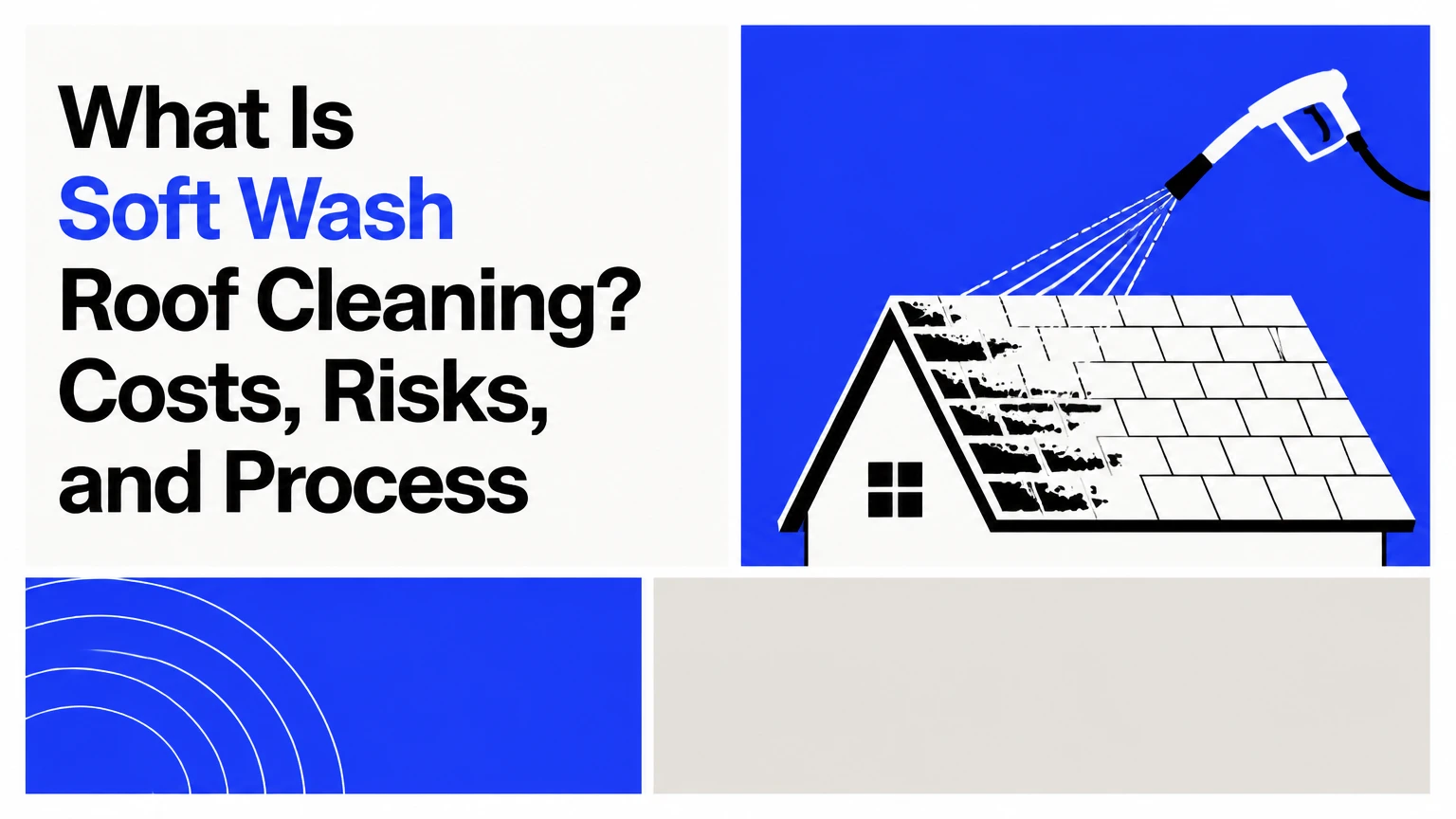
Soft wash roof cleaning is a roof-maintenance method that uses a cleaning solution to kill algae, moss, lichen, and other organic growth, followed by gentle rinsing or natural weathering. Unlike pressure washing, soft washing relies primarily on chemical action rather than force, reducing the risk of shingle granule loss when the method and solution suit the roof.
Key Facts
- Soft wash roof cleaning uses low-pressure solution application, commonly around 40-100 PSI, rather than 1,500-4,000 PSI pressure washing.
- Sodium hypochlorite is a common active ingredient, but the correct concentration depends on the roof material, growth, temperature, and product label.
- Asphalt shingles should not be aggressively pressure washed because high pressure can remove granules and damage seals.
- A typical 2,000-square-foot residential roof takes about 2-4 hours, including setup, protection, treatment, and cleanup.
- Typical professional pricing ranges from $300-$650 for a straightforward roof, with steep access, heavy growth, tile, and containment increasing the price.
- Soft washing removes biological contamination, but it cannot repair leaks, replace failed flashing, or restore shingles that have already lost substantial granules.
What Is Soft Wash Roof Cleaning?
Soft wash roof cleaning is the controlled application of a biocidal or detergent-based solution at low pressure to remove and kill roof-surface growth. The process targets contamination chemically, then removes dead material through a low-pressure rinse or several rainfall cycles, depending on the roof system and the amount of attached growth.
The method is different from simply spraying bleach from the ground. A competent roof cleaner first identifies the roofing material, checks for loose components, protects vegetation, manages runoff, and selects a solution that will not create avoidable damage. Low pressure reduces mechanical abrasion, but the chemicals still require professional handling.
Dark streaks on asphalt shingles often contain cyanobacteria, commonly associated with Gloeocapsa species. Moss and lichen create a different problem because their structures attach more firmly and can lift shingle edges or retain moisture. A roof may therefore need a different dwell period and post-treatment approach for streaks than for thick moss.
Soft washing is a cleaning and sanitation process, not a roof repair or roof replacement process. It cannot correct a leak, restore brittle shingles, repair rotten decking, or reverse ultraviolet damage.
How Does Soft Washing Clean a Roof?
Soft washing cleans a roof through chemical contact, dwell time, and controlled removal of dead growth. The solution wets the contaminated surface, disrupts biological cells, and loosens organic residue; the operator then rinses only as aggressively as the roof manufacturer and material permit.
The biological contamination
Roof algae, moss, and lichen are not interchangeable. Algae usually appears as dark streaks or broad discoloration, moss forms raised green or brown mats, and lichen can create hard, crusted growth attached to the surface. Dirt may look similar but will not respond to a biocide in the same way.
The familiar black streak organism is often described as Gloeocapsa magma, although visual identification from the ground is uncertain. A cleaner should not promise a precise species diagnosis without appropriate testing. The practical treatment decision is usually based on visible growth, roof material, and the product label.
The chemical action
Sodium hypochlorite, an active chlorine compound, is widely used by professional exterior cleaners. Surfactants can improve wetting and cling, while water carries the solution across the roof. Oxygen-based products, such as sodium percarbonate formulations, may be selected for particular materials or customer requirements, though they may act more slowly or less aggressively on established growth.
The active concentration should not be copied from an internet recipe. Commercial bleach strength varies, roof materials respond differently, and heat or sunlight changes evaporation and dwell behavior. A professional should follow the product label, local regulations, and manufacturer cleaning instructions.
The physical action
Low-pressure application distributes the solution without the impact of a pressure-washer jet. Some dead moss may rinse away immediately, while firmly attached material is often left to dry and release gradually during subsequent rain. Scraping or brushing thick growth can disturb granules, coatings, laps, or waterproofing details.
The practical rule is simple: use enough chemical action to kill the growth, then use no more mechanical force than necessary.
What Happens During a Professional Cleaning?
A professional soft wash normally follows seven stages: inspection, preparation, vegetation protection, solution application, dwell, controlled rinsing, and final cleanup. A standard residential project commonly takes 2-4 hours, although roof pitch, access, weather, growth density, and runoff controls can extend the visit.
1. Inspect the roof and property
The technician should identify shingles, clay or concrete tile, slate, coated metal, wood shakes, or another system before mixing or applying chemicals. The inspection should also record loose shingles, exposed underlayment, damaged flashing, open seams, fragile tiles, skylights, gutters, and nearby electrical equipment.
A roof with active leaks or unsafe access may need repair before cleaning. Cleaning a failing surface can expose defects that were previously hidden by moss or debris.
2. Protect plants and building components
Vegetation should be thoroughly pre-wetted with clean water before chemical application. Sensitive plants may require temporary covering, relocation, repeated rinsing, or a different cleaning plan. Plastic coverings should not remain over plants in hot sun because trapped heat can cause damage even without chemical exposure.
Technicians should protect painted surfaces, windows, doors, outdoor furniture, vehicles, air-conditioning equipment, and fish ponds. Downspout discharge must be directed away from concentrated plant beds and managed according to local stormwater requirements.
3. Remove loose debris without abrasion
Leaves, twigs, and loose debris can be removed with a blower or soft tool when roof access is safe. Heavy moss should not be ripped from shingles simply to create an immediately bare appearance. Pulling attached growth can remove granules or lift the edge of a shingle.
4. Apply the roof-cleaning solution
The solution is generally applied in manageable sections, often from the ridge toward the eaves, so the operator can control runoff. Wind speed, wind direction, roof temperature, and nearby vegetation determine whether spraying should proceed.
The operator should keep the spray pattern controlled and avoid unnecessary drift. Application equipment may include a dedicated low-pressure pump, proportioner, hose reel, or manufacturer-approved sprayer.
5. Allow appropriate dwell time
Typical dwell time is about 10-20 minutes, but the correct period depends on the product, temperature, sunlight, growth, and roof material. The surface should remain wet long enough for the solution to work; allowing it to dry rapidly can produce uneven results and increase chemical residue.
A second light application may be safer than one excessively strong application, but only when the product instructions permit it.
6. Rinse or leave dead growth to weather away
Asphalt shingles often need a gentle rinse or gradual weathering rather than aggressive blasting. The goal is to remove residue without stripping protective granules. Tile and metal can tolerate different approaches, but neither should be treated as automatically damage-proof.
7. Rinse the property and verify drainage
The final stage includes rinsing walls, windows, gutters, downspouts, plants, and hardscape surfaces. The technician should inspect for missed streaks, chemical residue, displaced tiles, and runoff impacts before leaving.
What Chemicals Are Used?
Sodium hypochlorite is the most common active cleaner for many professional roof-washing applications, while surfactants improve coverage and alternative oxygen-based products may suit selected situations. No single mixture is safe for every roof, and household cleaning products should never be combined without confirming chemical compatibility.
| Component | Typical role | Main control |
|---|---|---|
| Sodium hypochlorite | Kills algae, moss, and lichen | Product label, roof material, temperature |
| Water | Dilutes and carries the solution | Clean supply and controlled volume |
| Exterior surfactant | Improves wetting and cling | Roof pitch, runoff, manufacturer guidance |
| Sodium percarbonate | Oxygen-based alternative | Growth severity and product instructions |
| Plant rinse or neutralizer | Reduces chemical exposure after treatment | Vegetation type and runoff conditions |
Household dish soap is not automatically a suitable surfactant. Products containing ammonia or incompatible additives can create hazardous gases when mixed with chlorine products. A technician should provide the product name or safety data sheet when a customer asks what will be applied.
Chemical strength also affects corrosion risk. Concentrated chlorine contacting copper, galvanized steel, aluminum, painted surfaces, or certain fasteners can stain or corrode components, particularly when residue dries in hot conditions.
Which Roof Materials Can Be Soft Washed?
Asphalt shingles, tile, metal, slate, and wood roofing can require different cleaning methods, pressures, and chemical restrictions. Soft washing is often appropriate for asphalt shingles, but the phrase does not guarantee safety for every material or roof condition.
| Roof material | Typical cleaning concern | Suitable approach |
|---|---|---|
| Asphalt shingles | Granule loss and brittle seal strips | Low-pressure treatment, gentle rinse or weathering |
| Clay tile | Cracked or displaced tiles | Low-impact application, careful foot-traffic avoidance |
| Concrete tile | Porosity and surface erosion | Material-specific solution and controlled rinsing |
| Painted metal | Coating damage and oxidation | Mild compatible cleaner, low-pressure rinse |
| Slate | Chipping, delamination, fragile laps | Specialist inspection and minimal access |
| Wood shakes | Moisture retention and surface fiber damage | Manufacturer-approved treatment, limited pressure |
Roof manufacturers may publish cleaning instructions that differ by product line. The Asphalt Roofing Manufacturers Association recommends non-abrasive methods for asphalt roofing and warns against practices that can damage shingles. A contractor should check the shingle manufacturer’s guidance rather than claim that every soft wash is automatically warranty-compliant.
Slate roofs deserve special caution. A low-pressure sprayer does not make walking on fragile slate safe, and chemical runoff can affect nearby metalwork. Wood shakes may also require ventilation and moisture considerations that do not apply to asphalt shingles.
What Pressure Is Safe?
There is no universal pressure number that makes roof cleaning safe, but professional soft washing commonly uses approximately 40-100 PSI at the surface, while asphalt shingles should not be subjected to ordinary pressure-washing levels. The nozzle, distance, flow rate, operator technique, roof condition, and rinse direction matter as much as the gauge reading.
| Method | Typical pressure range | Primary action | Main roof risk |
|---|---|---|---|
| Soft wash application | 40-100 PSI | Chemical wetting | Drift, runoff, chemical damage |
| Garden hose | 40-80 PSI supply-dependent | Light rinsing | Inadequate removal or splash |
| Pressure washing | 1,500-4,000 PSI | Mechanical impact | Granule loss, lifted shingles, leaks |
| Manual scraping | 0 PSI | Physical abrasion | Scratches, torn edges, surface loss |
Pressure alone cannot prove that a contractor uses a safe method. A low-pressure pump can still deliver an unsuitable chemical, and a pressure washer with a wide fan can still damage an old roof. Ask how the company controls spray distance, runoff, dwell, and access.
How Much Does Soft Wash Roof Cleaning Cost?
Typical professional soft wash roof cleaning costs about $300-$650 for a straightforward residential roof, or approximately $0.15-$0.60 per square foot where contractors price by roof area. Steep pitches, multiple stories, heavy moss, complex geometry, tile, slate, containment, and difficult water access can push a project toward $700-$1,200 or more.
| Project condition | Typical price range | Typical time |
|---|---|---|
| One-story, light algae, simple asphalt roof | $300-$450 | 1.5-2.5 hours |
| Two-story, moderate staining, asphalt shingles | $450-$750 | 2-4 hours |
| Steep roof or heavy moss | $700-$1,200 | 3-6 hours |
| Tile or fragile specialty roof | $600-$1,500+ | 3-8 hours |
| Add-on gutter cleaning | $100-$300 | 30-90 minutes |
These are typical planning ranges, not a national fixed price schedule. A roof measurement from satellite imagery may differ from the roof’s actual surface area, and contractors may include setup, plant protection, insurance, chemical handling, and cleanup in a minimum service charge.
A low quote can indicate that the company excludes vegetation protection, does not manage downspouts, uses unsuitable pressure, or intends to rinse aggressively to shorten the visit. Compare the written scope, not only the dollar amount.
How Long Do Results Last?
Soft-washed roof results commonly remain visibly improved for 2-5 years, but regrowth depends on shade, humidity, tree cover, roof orientation, rainfall, and the presence of nearby biological spores. North-facing slopes under dense trees often darken sooner than sunny, well-ventilated slopes.
A maintenance rinse or inspection every 12-24 months can identify returning growth before moss becomes deeply attached. Zinc or copper strips may reduce regrowth in some installations when rainwater carries metal ions over the roof, but they do not correct shade, trapped debris, or poor drainage and should be installed without compromising flashing.
Soft washing does not create a permanent biological barrier. A contractor promising a fixed lifetime result should explain the roof’s exposure conditions and the limits of the treatment.
Soft Washing Compared With Other Methods
Soft washing is usually the better choice for biological staining on asphalt shingles because it reduces impact, while pressure washing can be appropriate for some robust, compatible surfaces when the manufacturer allows it. Manual removal may help with isolated debris but can damage attached growth areas when used forcefully.
| Decision factor | Soft washing | Pressure washing | Manual brushing or scraping |
|---|---|---|---|
| Asphalt shingle pressure | About 40-100 PSI | Commonly 1,500-4,000 PSI | 0 PSI |
| Algae control | Chemical kill | Surface removal, incomplete kill possible | Surface removal, incomplete kill possible |
| Moss treatment | Kills growth, gradual release possible | Fast removal, root remnants possible | Direct removal, attachment damage possible |
| Granule risk | Low when correctly controlled | Moderate to high | Moderate to high |
| Chemical exposure | Requires runoff management | Lower chemical use possible | Usually low chemical use |
| Best surface examples | Asphalt shingles, selected tile | Compatible metal or concrete surfaces | Small isolated debris areas |
Pressure washing is not automatically wrong for every roof. A coated metal roof, concrete surface, or certain commercial systems may tolerate a carefully specified wash, but the decision belongs to the roof manufacturer and an experienced operator.
Soft washing is also not the best answer when the roof has widespread blistering, severe granule loss, exposed underlayment, structural sagging, or active leaks. Cleaning cannot substitute for replacement.
Can You Soft Wash a Roof Yourself?
A homeowner can apply some labeled roof-treatment products from the ground, but climbing onto a chemically wet roof creates a severe slip hazard and is not an appropriate DIY activity for most people. Professional work is safer when it requires roof access, concentrated chemicals, long hoses, runoff control, or treatment near sensitive landscaping.
Before attempting any ground-based application, verify the product label, roof compatibility, weather forecast, wind conditions, ladder placement, nearby plants, runoff path, and local disposal requirements. Do not mix chlorine products with ammonia, acids, or unlisted cleaners. Use eye, skin, and respiratory protection specified by the safety data sheet.
A telescoping sprayer can create overspray that reaches windows, neighboring property, vehicles, or vegetation. Ground application also makes it harder to inspect loose shingles and flashing. The apparent equipment savings may not offset plant replacement, siding damage, or a fall injury.
How to Vet a Roof Cleaning Company
Choose a contractor who explains roof compatibility, chemical handling, plant protection, runoff control, and post-cleaning inspection before discussing price. A responsible company should provide proof of liability insurance, describe its pressure range, and identify what happens if the roof contains pre-existing damage.
Ask these questions:
- Which roof material and manufacturer instructions did you use to select the method?
- What active chemical will you apply, and which product label governs its use?
- How will you protect plants, ponds, painted surfaces, and air-conditioning equipment?
- Where will gutter and downspout runoff go during treatment?
- Will you rinse dead moss, or allow it to weather away?
- How will you avoid walking on fragile shingles, slate, or tile?
- What roof defects will cause you to stop and recommend repair?
- Does the written estimate include setup, containment, neutralization, and cleanup?
- What insurance covers chemical overspray and roof access?
- What result and regrowth expectations are actually stated in writing?
A contractor who promises that every roof is safe at the same pressure has not assessed the material carefully enough.
What Can Go Wrong?
The most common soft-washing failures involve chemical drift, inadequate rinsing, excessive concentration, poor weather selection, and treating a damaged roof as though cleaning will solve its defects. Each failure has a recognizable cause and a different remedy.
| Visible problem | Likely cause | Corrective action |
|---|---|---|
| Brown or scorched plants | Chemical drift, runoff, or dry vegetation | Flood foliage and soil with clean water; consult an arborist for severe injury |
| White residue on siding | Dried chemical deposits | Rinse promptly with clean water and inspect painted surfaces |
| Orange or rust-colored stains | Existing oxidation or metal runoff | Identify the metal source; use a material-specific treatment |
| Streaks remain after cleaning | Uneven coverage, short dwell, or staining below surface | Reinspect after drying; use a permitted second treatment |
| Moss returns quickly | Dense shade, moisture, or nearby untreated growth | Improve debris control and schedule earlier maintenance |
| Shingles lose granules | Excessive pressure, scraping, or aged material | Stop mechanical cleaning; document damage and obtain roofing advice |
| Metal components corrode | Concentrated chemical left to dry | Flush affected components and correct application controls |
One practitioner rule matters above the others: never allow a chlorine-based solution to dry on windows, painted siding, metal flashing, or sensitive plants. Shade, smaller sections, pre-wetting, and continuous rinsing reduce that risk.
A second rule is equally important: dead moss does not need to be forcibly removed from every shingle. If the growth is attached, waiting for natural release can preserve more granules than trying to make the roof look bare in one visit.
When Should You Delay Roof Cleaning?
Delay soft washing during strong wind, freezing conditions, extreme heat, active rain, or when the roof surface is unsafe to access. Wind increases chemical drift, freezing weather can create ice, and intense heat accelerates evaporation before the solution has adequate contact time.
| Condition | Recommended decision | Reason |
|---|---|---|
| Wind above the operator’s control limit | Delay | Increased drift and uneven application |
| Roof surface above approximately 90°F | Prefer cooler hours | Faster evaporation and plant stress |
| Forecast rain within the product’s required dwell period | Delay | Reduced contact time and uncontrolled runoff |
| Freezing temperatures within 24 hours | Delay | Ice formation and poor rinsing |
| Saturated soil near sensitive plant beds | Delay or add containment | Greater runoff and root exposure |
| Active roof leak or exposed underlayment | Repair first | Cleaning can worsen or reveal damage |
The product label and local weather conditions override generic timing advice. Morning or late afternoon can be preferable in warm climates, but a damp roof can also increase slip risk.
What Does Soft Washing Not Fix?
Soft washing does not fix roof leaks, rotten decking, failed flashing, missing shingles, cracked tiles, open metal seams, structural movement, or ventilation defects. It also cannot restore granules already lost through age, hail, foot traffic, or previous pressure washing.
A roof inspection should precede cleaning when the owner notices interior stains, sagging, loose materials, persistent dampness, or granules collecting heavily in gutters. Cleaning may improve appearance while leaving the underlying failure unchanged, so the scope should distinguish cosmetic treatment from roofing repair.
Soft washing is also limited when stains are caused by rust, tannins, chimney deposits, asphalt bleed, or paint transfer rather than biological growth. Those contaminants require separate diagnosis and compatible treatment.
FAQ
Is soft wash roof cleaning safe for asphalt shingles?
Soft wash roof cleaning is generally safer for asphalt shingles than high-pressure washing when the solution, pressure, access, and runoff controls follow the shingle manufacturer’s guidance. Safety is not automatic, because concentrated chemicals, aggressive rinsing, walking on brittle shingles, and poor plant protection can still cause damage.
Does soft washing remove moss permanently?
Soft washing kills moss during treatment but does not permanently prevent new moss from growing. Shade, trapped moisture, tree debris, roof orientation, and nearby untreated surfaces influence regrowth, so many roofs need inspection or maintenance treatment every 12-24 months.
Will soft washing void my roof warranty?
Soft washing does not automatically void a roof warranty, but warranty terms vary by manufacturer and product. Obtain the cleaning instructions for the specific shingle or tile system, use a method consistent with those instructions, and keep the contractor’s written scope, product information, and photographs.
Can soft washing damage gutters?
Soft washing can stain or corrode gutters if concentrated chemical solution remains on aluminum, galvanized steel, copper, or painted finishes. Pre-rinsing, controlled runoff, prompt post-treatment rinsing, and avoiding dried residue reduce the risk, but heavily oxidized or damaged gutters may still show discoloration.
Should I clean the roof before selling my house?
Cleaning may improve curb appeal when dark biological streaks are the main defect, but a roof inspection should come first if the roof is old, leaking, brittle, or losing granules. A clean appearance cannot replace disclosure of roof defects or a professional condition report.
The Bottom Line
Soft wash roof cleaning uses controlled low-pressure application and chemical action to remove biological growth while reducing the mechanical damage associated with pressure washing. The method is commonly suitable for asphalt shingles, but the correct chemical, pressure, dwell time, access plan, and runoff controls depend on the roof system and property conditions.
Typical costs fall near $300-$650 for a simple residential roof, and results often last 2-5 years. The strongest decision is not whether soft washing sounds gentle; it is whether the contractor can demonstrate material compatibility, plant protection, safe chemical handling, and a clear boundary between cleaning and roof repair.