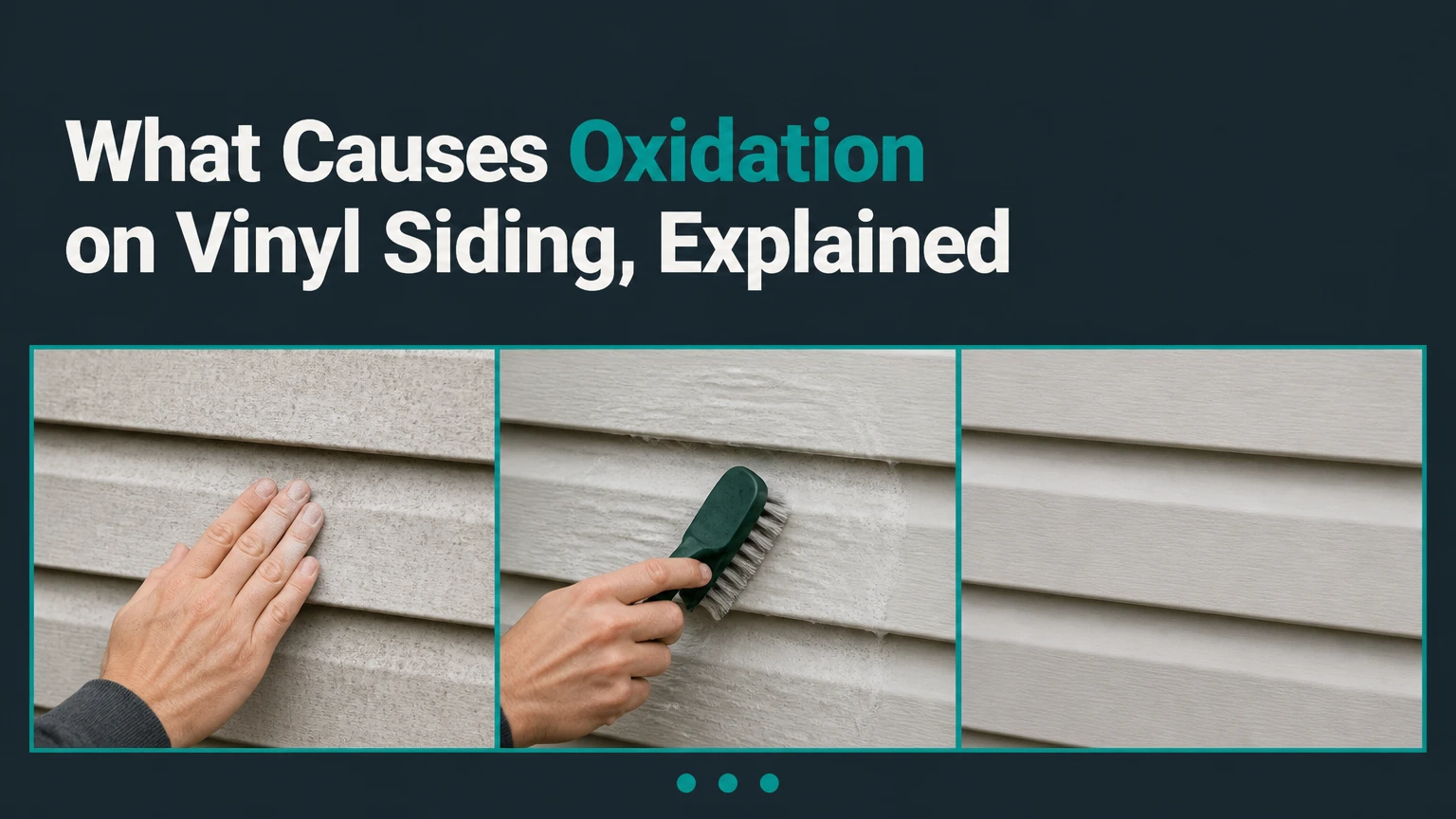
Vinyl siding oxidation is surface degradation of polyvinyl chloride (PVC) caused mainly by ultraviolet sunlight, oxygen, heat, and weather exposure. UV energy initiates chemical changes in the outer PVC layer, while oxygen and depleted stabilizers allow the reaction to continue, producing chalky residue, fading, roughness, and eventually brittleness.
Key Facts at a Glance
- Ultraviolet radiation is usually the initiating cause of vinyl siding oxidation.
- Oxidation is different from mildew: oxidation produces dry white chalk, while mildew usually appears green, gray, or black in damp areas.
- Titanium dioxide may remain visible in chalking, but the residue is not necessarily pure titanium dioxide.
- South- and west-facing walls often weather sooner, although a universal “300% faster” rate is not a reliable industry rule.
- Cleaning can remove loose chalk, but it cannot restore polymer or pigment that has already degraded.
- Brittle, cracked, deeply faded siding is usually a painting or replacement candidate rather than a cleaning candidate.
What Causes Oxidation on Vinyl Siding?
Sunlight causes most vinyl siding oxidation, with oxygen, heat, moisture, air pollution, and time increasing the rate of damage. The PVC surface absorbs UV radiation, forms reactive chemical sites, and gradually loses the stabilizers and resin structure that protect its color and smooth finish.
Vinyl siding contains PVC resin, pigments, impact modifiers, heat stabilizers, and UV stabilizers. Light-colored panels commonly contain titanium dioxide, a highly effective white pigment that also helps scatter UV energy. The exact formulation differs by manufacturer, product line, color, thickness, and production year.
Oxidation is therefore a formulation-and-exposure problem, not simply a cleaning problem. A premium panel installed under a shaded porch may remain sound longer than a basic dark panel on an unobstructed west wall.
How UV Light and Oxygen Damage PVC
UV photodegradation starts when high-energy sunlight disrupts vulnerable chemical bonds near the siding surface. Reactive fragments then interact with oxygen, creating an oxidation chain that alters the polymer and consumes protective additives.
The practical sequence looks like this:
- UV exposure initiates damage. Ultraviolet radiation reaches the outer PVC layer.
- Reactive sites form. Broken or altered bonds create chemically active locations in the polymer.
- Oxygen continues the reaction. Atmospheric oxygen reacts with those sites and produces oxidized polymer compounds.
- Stabilizers become depleted. UV absorbers and other protective additives can no longer shield the exposed surface as effectively.
- The surface erodes and chalks. Loose degraded resin and exposed pigment transfer to a finger or cloth.
- The damage may deepen. Continued exposure can reduce flexibility, color uniformity, and impact resistance.
The simplified explanation that oxidation “leaves behind titanium dioxide” is directionally useful but incomplete. Chalking generally contains exposed pigment plus degraded and loosened polymer material; its exact composition depends on the siding formulation.
Does Heat Make Vinyl Siding Oxidize Faster?
Heat usually accelerates oxidation because higher surface temperatures speed chemical reactions and increase thermal cycling. Dark siding absorbs more solar energy than light siding, so a dark panel can become substantially hotter even when both walls receive the same sunlight.
Thermal cycling also matters. A panel may heat strongly during afternoon sun, expand, cool after sunset, and repeat that cycle thousands of times. Repeated expansion and contraction can stress the surface, seams, fastener slots, and older brittle material.
Color is not a stand-alone failure predictor. A dark panel with strong stabilizers and partial shade may outperform a lighter, poorly formulated panel in full exposure, but dark replacement paint creates additional heat risk if the coating is not approved for vinyl.
Which Environmental Factors Speed Up Chalking?
Direct sun, high surface temperature, long exposure duration, airborne pollutants, and salt-laden moisture can accelerate vinyl siding chalking. Rain does not normally initiate the primary oxidation reaction, but repeated wetting and drying can loosen degraded residue and expose fresh material.
| Factor | Mechanism | Typical field effect |
|---|---|---|
| South or west exposure | Higher cumulative UV and afternoon heat | Earlier fading and chalking than shaded elevations |
| Dark siding color | Greater solar heat absorption | More thermal stress and possible panel distortion |
| High altitude | More intense UV exposure | Faster weathering than comparable lowland shade |
| Coastal salt air | Deposits retain moisture and increase surface contamination | More frequent cleaning and faster surface dulling |
| Industrial pollution | Sulfur compounds and particulates contaminate the surface | Darker deposits and accelerated weathering in some locations |
| Shade and vegetation | Lower UV exposure but higher humidity | Less oxidation, with greater algae or mildew risk |
| Frequent wet-dry cycles | Swelling, residue movement, and contamination | More visible streaking and uneven chalk removal |
The often-repeated claim that south- or west-facing siding degrades “300% faster” should not be treated as a universal measurement. Weathering rates depend on latitude, UV index, wall orientation, overhangs, color, resin formulation, ventilation, and local pollution, so a product-specific warranty and field inspection are more useful than a single multiplier.
Does Moisture Cause Vinyl Siding Oxidation?
Moisture is usually an accelerator and residue-mover rather than the primary cause of PVC oxidation. Rain, dew, humidity, and condensation can wash loose chalk downward, create vertical streaks, and leave contaminants on the surface.
Water also changes the diagnosis. A dry white surface may look gray when wet, while dirt can appear temporarily cleaner after rinsing. Persistent moisture under trees, near sprinklers, or on a north-facing wall creates a separate biological risk from algae, mildew, and mold.
Hydrolysis is not the best general explanation for ordinary vinyl siding chalking. PVC weathering is dominated by UV-driven photo-oxidation and thermal effects; moisture can contribute to weathering and contamination, but it should not be presented as the equal primary cause in every installation.
Why Does Vinyl Siding Become White and Powdery?
Vinyl siding becomes white and powdery when degraded surface resin loosens and pigment particles become exposed. A dry swipe transfers chalk because the outer layer no longer holds its original polymer and pigment structure tightly.
Chalking may be barely visible on white siding because the residue resembles the original color. On blue, green, red, or gray panels, the contrast is stronger: the panel appears faded, cloudy, or washed out even after surface dirt is removed.
Oxidation is a surface condition with a depth gradient. Early chalking may be confined to a very thin outer layer, but no universal 1-5 micron depth applies to every panel or exposure. A residue’s thickness also does not predict whether the underlying vinyl remains flexible.
Oxidation, Mildew, Dirt, or Sun Fading?
A dry swipe test, location pattern, color, and panel flexibility usually separate oxidation from mildew, dirt, and ordinary fading. No single test proves the diagnosis, because a wall can have oxidation underneath mildew or pollution deposits.
| Condition | Appearance | Simple test | Correct first response |
|---|---|---|---|
| Oxidation or chalking | White, pale, dusty, uneven film | Dry dark cloth picks up powder | Gentle oxidation cleaning and reassessment |
| Mildew or algae | Green, black, gray, or fuzzy patches | Concentrated in damp or shaded areas | Detergent or labeled mildewcide treatment |
| Dirt or pollution | Brown, gray, gritty, or streaked deposit | Soap and water improve appearance | Low-pressure washing or hand cleaning |
| Sun fading | Color is lighter but surface stays relatively smooth | Little powder transfers | Cleaning will not restore lost pigment |
| Oxidized brittle vinyl | Chalk plus cracking, splits, or stiffness | Flex test shows fracture risk | Paint evaluation or replacement |
Perform the inspection on a dry panel. Rub a small inconspicuous area with a dark microfiber cloth, then wash a second test patch with mild detergent and water. If powder transfers before washing and the color remains pale afterward, oxidation and pigment loss are both likely.
Can Cleaning Remove Oxidation?
Cleaning can remove loose chalk and improve appearance, but cleaning cannot reverse chemical degradation or restore pigment that sunlight has destroyed. Restoration has the best odds when the panel remains flexible, the color loss is shallow, and the surface responds evenly to a small test area.
Safer Cleaning Method
Use a manufacturer-approved vinyl cleaner or a product specifically labeled for oxidation removal, and test it on a hidden panel before treating the elevation. Work from the bottom upward during application to reduce streaking, then rinse from the top downward with a garden hose.
- Inspect the panel. Reject aggressive cleaning if the siding cracks when lightly flexed or has open splits.
- Protect nearby materials. Wet plants, cover delicate metal, and redirect runoff away from storm drains where local rules require it.
- Choose mild equipment. Start with a soft nylon brush, microfiber cloth, bucket, and garden hose.
- Work in small sections. A 4-by-4-foot test section makes dwell time and results easier to control.
- Apply the labeled cleaner. Follow the product’s dilution, dwell time, and personal protective equipment instructions.
- Agitate gently. Use overlapping strokes without grinding chalk into the panel.
- Rinse completely. Do not allow cleaner to dry on siding, windows, trim, or landscaping.
- Let the test dry. Judge the result after several hours, because wet vinyl hides uneven color.
- Repeat only if appropriate. Multiple light applications are safer than one aggressive treatment.
A 50:50 vinegar-and-water mixture may loosen light mineral film or some dirt, but it is not a dependable treatment for established polymer oxidation. Household bleach kills many organic growths; it does not rebuild degraded PVC or restore sun-faded pigment.
What Pressure Is Safe?
There is no universal pressure setting that makes pressure washing harmless. A practical starting point is a garden hose, followed only if necessary by low pressure, a wide fan nozzle, adequate distance, and downward spray that follows the panel overlap.
| Equipment or method | Practical starting point | Main risk |
|---|---|---|
| Garden hose | Household supply, usually 40-80 psi | Lowest cleaning force, limited oxidation removal |
| Soft brush and cleaner | Hand pressure only | Scratches or uneven sheen if scrubbed aggressively |
| Pressure washer | Keep well below 1,500 psi; begin lower | Water intrusion, marks, brittle-panel damage |
| Narrow nozzle | Avoid on siding | Cuts, etches, and concentrated damage |
| Upward spray | Avoid entirely | Forces water behind laps and around openings |
Manufacturers’ care instructions control over generic pressure recommendations. Pressure washing cannot remove deeply degraded resin without also risking surface damage, so more force is not a substitute for correct chemistry and patience.
What Are the Treatment Options and Costs?
Typical professional costs are about $0.30-$0.70 per square foot for specialized cleaning, $1.50-$3.50 per square foot for preparation and vinyl-compatible painting, and roughly $8,000-$20,000 or more for full replacement on a standard home. Local labor, access, stories, repairs, region, and siding type can change every range.
| Option | Typical cost | Expected service window | Best condition |
|---|---|---|---|
| DIY hand cleaning | $50-$150 in supplies | 1-3 years of cosmetic improvement | Light chalk on flexible panels |
| Professional oxidation cleaning | $0.30-$0.70/sq. ft. | Often 2-5 years | Sound siding with removable residue |
| Vinyl-compatible painting | $1.50-$3.50/sq. ft. | Often 5-10 years, product-dependent | Sound but permanently faded siding |
| Replacement | $8,000-$20,000+ per home | Commonly 20-40 years, product-dependent | Brittle, cracked, warped, or deeply degraded panels |
The 2,000-square-foot-home figures sometimes quoted online can be misleading because siding area is not the same as floor area. A two-story home, attached garage, gables, and complex trim can produce far more siding surface than its stated living area suggests.
Cleaning Versus Painting Versus Replacement
Cleaning is the lowest-cost choice when chalk is loose and the underlying color remains acceptable. Painting makes sense when the panel is structurally sound but permanently faded, while replacement becomes more rational when the vinyl is brittle, warped, cracked, or repeatedly failing at seams.
| Decision factor | Cleaning | Vinyl-compatible paint | Replacement |
|---|---|---|---|
| Upfront cost | Lowest, $50-$0.70/sq. ft. | $1.50-$3.50/sq. ft. | $8,000-$20,000+ typical home |
| Changes original color | No | Yes, within manufacturer limits | Yes |
| Hides deep fading | Limited | Usually | Completely |
| Corrects brittleness | No | No | Yes |
| Typical project duration | 1 day DIY, often 1-2 days professional | Several days including preparation | Several days to weeks |
| Main failure risk | Uneven or temporary result | Peeling, heat distortion, poor adhesion | Cost, waste, installation defects |
A paint manufacturer’s vinyl color guidance matters more than a generic “light colors only” rule. Many systems identify approved colors by solar-reflective value or a VinylSafe-style palette, because an unsuitable dark coating can raise panel temperature and cause buckling.
When Does Oxidized Siding Need Replacement?
Replacement is usually justified when vinyl siding is brittle, cracked, warped, perforated, or too deeply faded for uniform cleaning or painting. A chalky but flexible panel does not automatically require replacement, especially when a test patch responds evenly and the attachment system remains sound.
Check these conditions before choosing replacement:
- The panel snaps or cracks during gentle flexing.
- Nail hem slots are torn or panels no longer move freely.
- Wind has opened seams or loosened large areas.
- Water has reached sheathing through damaged laps or trim.
- Cleaning exposes blotchy pigment loss across the whole elevation.
- Previous paint is peeling, incompatible, or too thick.
- Replacement panels are unavailable because the profile is discontinued.
Do not use a flexibility test on a cold panel, because vinyl becomes less forgiving at low temperatures. Inspect in moderate conditions and avoid bending a panel that already shows splits.
What Mistakes Make Oxidized Siding Worse?
The most damaging mistakes are excessive pressure, abrasive scrubbing, dried chemical residue, unapproved paint color, and treating oxidation as mildew. Each mistake can create marks or distortion that cleaning cannot repair.
- Using a narrow pressure-washer jet: Concentrated water can etch the chalk layer and drive water behind laps. Switch to a hose or wide fan pattern.
- Spraying upward: Upward water can enter seams, soffit edges, vents, and window openings. Keep the spray directed downward.
- Using bleach as an oxidation remover: Bleach addresses organic growth, not degraded PVC. Use a labeled oxidation product for chalk.
- Scrubbing dry siding: Dry abrasive contact can create shiny tracks and uneven color. Lubricate with the approved cleaner.
- Allowing cleaner to dry: Dried chemistry can streak glass, stain metal, or stress plants. Work in shade and rinse continuously.
- Painting without adhesion preparation: Chalk left under paint can cause poor bonding. Clean, rinse, dry, and follow the coating manufacturer’s preparation requirements.
- Choosing a dark unapproved paint: Excess heat can warp vinyl. Select an approved color system designed for plastic siding.
A practitioner rule is simple: never judge a restoration chemical on a wet panel. Water temporarily darkens vinyl and can conceal the difference between remaining pigment and removed chalk.
How Can You Prevent Vinyl Siding Oxidation?
You cannot eliminate outdoor PVC oxidation, but you can slow it by reducing direct exposure, controlling heat, keeping the surface clean, and selecting siding with a reputable weathering warranty. Prevention begins before installation because orientation, color, overhangs, and product formulation determine the exposure burden.
Use these measures:
- Choose a product with documented UV stabilizers and a clear color-fade warranty.
- Use lighter or manufacturer-approved reflective colors on high-sun elevations.
- Install properly sized overhangs where design and drainage allow.
- Keep sprinkler heads from wetting siding every day.
- Remove pollen, bird residue, salt, and pollution before they accumulate.
- Trim vegetation enough to improve airflow without creating direct sprinkler exposure.
- Inspect west and south walls annually, especially after severe heat or hail.
- Record the product name and color before repairs become necessary.
Do not apply automotive wax, silicone dressing, or an unapproved oily coating as a permanent UV shield. Such products can attract dirt, interfere with later painting, and produce an artificial gloss that makes uneven weathering more visible.
Frequently Asked Questions
Does vinyl siding oxidation mean the siding is old?
Not necessarily. Strong west exposure, dark color, coastal air, high altitude, poor formulation, and nearby reflected heat can produce visible chalking earlier than the age of the installation suggests. Conversely, shaded premium siding may remain stable well beyond a decade, so age alone cannot determine whether cleaning or replacement is appropriate.
Can new vinyl siding oxidize?
New vinyl siding can begin weathering soon after installation, but pronounced chalking within the first few years deserves investigation. Check installation records, product warranty language, cleaning chemicals, reflected heat from windows, and unusual exposure before assuming normal aging.
Is white residue always oxidation?
No. White residue can also be mineral scale, dried detergent, efflorescence from adjacent masonry, or construction dust. Oxidation is more likely when a dry cloth picks up fine powder across exposed panel faces and the surface remains pale after gentle washing.
Will rain wash oxidation away?
Rain can remove loose chalk from some areas, but it usually redistributes the residue into streaks rather than reversing the degradation. Repeated wetting may make the wall look temporarily cleaner while exposing additional weathered surface after drying.
Can I paint over chalky vinyl siding?
Painting over loose chalk without proper preparation is unreliable because the coating bonds to unstable residue rather than sound siding. Clean and rinse the surface, allow it to dry, verify that the panel is flexible, and use an exterior coating and color specifically approved for vinyl.
The Bottom Line
What causes oxidation on vinyl siding is primarily prolonged UV exposure acting on PVC in the presence of oxygen, with heat, thermal cycling, moisture, pollutants, color, and product formulation changing the speed and severity. Test a dry section before treatment: flexible siding with removable chalk may be cleaned, permanently faded but sound siding may be painted with an approved system, and brittle or damaged siding usually warrants replacement.