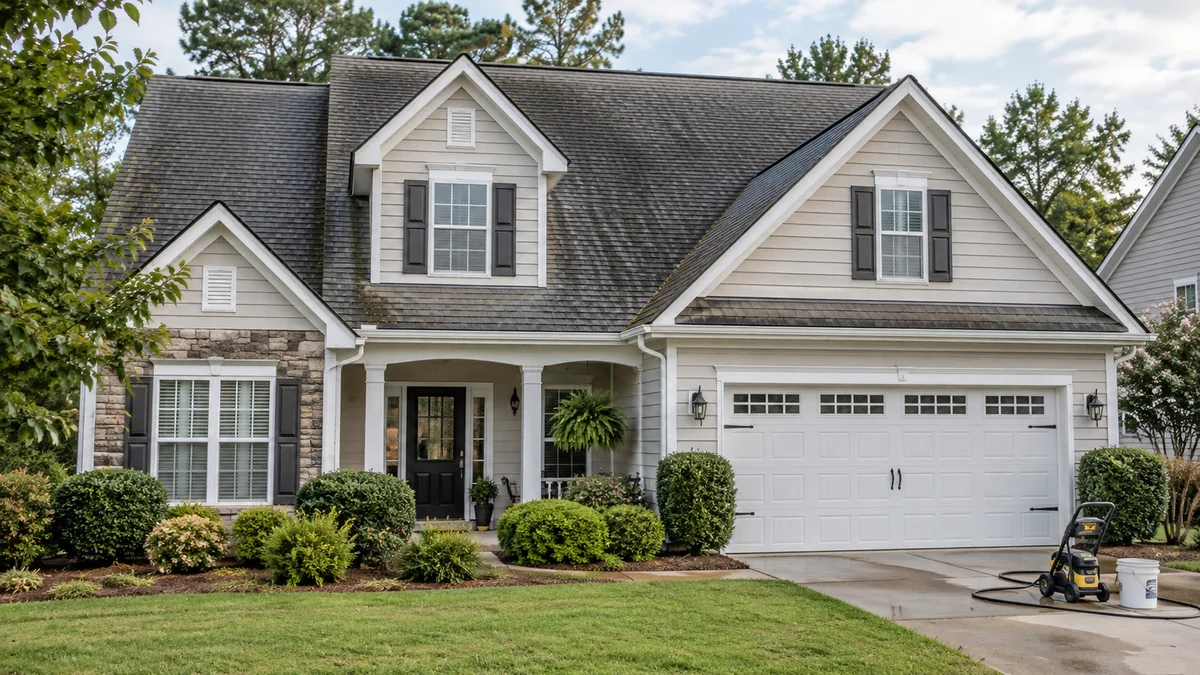
Black streaks on asphalt roof shingles are usually caused by Gloeocapsa magma, a wind-borne blue-green alga, also called cyanobacteria. The organism settles in damp areas, forms a dark ultraviolet-protective coating, and spreads downward with rainwater. Low-pressure chemical cleaning removes active growth, while zinc or copper strips and algae-resistant shingles reduce recurrence.
Key Facts at a Glance
- Gloeocapsa magma is the usual cause of smooth black or blue-black streaks on asphalt shingles.
- Limestone filler in many asphalt shingles supplies calcium carbonate that supports cyanobacterial colonies.
- North-facing, shaded, humid, and slow-drying roof sections develop algae most often.
- Pressure washing can remove protective granules from shingles and shorten roof life.
- A professional soft wash typically costs about $300-$900 for an average accessible roof.
- Cleaning removes existing discoloration, but metal strips or algae-resistant shingles provide longer-term prevention.
What Causes Black Streaks on Roofs?
Black roof streaks are primarily caused by Gloeocapsa magma, a photosynthetic cyanobacterium that travels through the air and colonizes damp asphalt shingles. The organism is not ordinary dirt, soot, or tree sap, although those materials can create similar-looking discoloration in isolated cases.
Modern asphalt shingles commonly contain crushed limestone, or calcium carbonate, as filler and ballast. Limestone does not mean the shingle is defective. It does, however, provide a mineral surface that can support algae when moisture, shade, and airborne spores occur together.
Black streaks usually begin as small colonies near the upper or middle shingle courses. Rain then carries pigment and biological residue down the roof, creating vertical lines. The streak pattern is therefore a clue: long downward trails across several courses usually indicate algae rather than a single spill or isolated stain.
How Does the Algae Become Black?
Gloeocapsa magma develops a dark pigment-rich sheath that helps shield the colony from ultraviolet radiation. The dark material is therefore a biological sunscreen, not simply accumulated mud.
The algae can appear blue-green, gray, brown, or nearly black depending on moisture and lighting. A wet roof may show greener growth, while a dry roof often displays charcoal-colored streaks. New colonies may be faint and irregular before forming continuous lines.
Which Roof Areas Are Most Vulnerable?
North-facing slopes, roof sections below overhanging trees, and areas near tall buildings remain damp longer than exposed south-facing slopes. Morning dew, rainfall, poor air movement, and leaf debris combine to create the slow-drying microclimate algae needs.
Roof pitch also matters. A low-slope roof drains more slowly than a steep roof, so biological residue remains in contact with shingles for longer. Clogged gutters and valleys can increase moisture at the eaves, although they do not usually create the original algae colony by themselves.
| Risk factor | Typical effect | What to inspect |
|---|---|---|
| North-facing slope | Receives less direct drying sunlight | Dark streaking and damp shingle surfaces |
| Dense tree canopy | Blocks sun and traps humidity | Branches, needles, leaves, and moss |
| Low roof pitch | Slows water drainage | Persistent dampness after rainfall |
| Poor attic ventilation | Keeps roof surfaces warmer and moisture-prone | Intake vents, ridge vents, soffits |
| Coastal or humid climate | Increases drying time | Recurring growth within 1-3 years |
| Clogged gutters | Retains water near lower courses | Sagging gutters and wet eaves |
Are Black Roof Streaks Algae, Moss, or Lichen?
Smooth, flat, downward-running discoloration is usually algae. Moss forms a raised green or yellow-green mat, while lichen appears as crusty, branching, or leafy growth attached firmly to the shingle surface.
Correct identification matters because the treatments behave differently. Chemical cleaners can kill algae relatively quickly, but moss and lichen may remain attached after they die. Pulling or scraping those growths away can remove granules and tear shingle edges.
| Roof appearance | More likely cause | Safe initial response |
|---|---|---|
| Smooth black vertical lines | Gloeocapsa magma algae | Low-pressure roof-cleaning solution |
| Raised green clumps | Moss | Treat, allow deterioration, then remove gently |
| Gray-white crust or branching patches | Lichen | Professional assessment and repeated treatment |
| Orange or red powder near metal | Rust or corrosion | Locate metal source before cleaning |
| Soot-like film near chimney | Smoke or combustion residue | Inspect chimney and ventilation |
| Irregular pale patches with granule loss | Weathering or damage | Roof inspection before washing |
A roof inspection becomes more important when the surface is blistered, brittle, curling, or missing granules. Cleaning cannot repair aged asphalt, exposed fiberglass mat, failed flashing, or leaking underlayment.
Does Algae Damage Asphalt Shingles?
Algae usually begins as a cosmetic problem, but persistent biological film can retain moisture and contribute to faster surface weathering. The available industry position is more restrained than many cleaning advertisements suggest: the Asphalt Roofing Manufacturers Association has stated that no definitive evidence shows algae immediately destroys the fiberglass shingle mat.
The practical concern is granule loss. Ceramic-coated granules protect asphalt from ultraviolet exposure and weather. Repeated moisture, aggressive cleaning, foot traffic, and aging can loosen granules, so a roof with visible algae should be assessed for actual surface loss rather than judged by color alone.
A standard “30-year” shingle is not guaranteed to last 30 years in every climate. Typical service life may be reduced by severe sun, poor ventilation, storms, installation defects, and maintenance damage. Claims that algae alone always removes 3-10 years of life are estimates, not a universal engineering rule.
Can Black Streaks Raise Cooling Costs?
A darkened roof absorbs more solar radiation than a clean, lighter roof, but the effect on household cooling bills varies widely. Attic insulation, roof color, ventilation, air-conditioning efficiency, window area, weather, and electricity rates usually matter more than algae alone.
The reliable conclusion is narrower: algae can reduce the roof surface’s reflectance, especially when it covers a large portion of a light-colored roof. Homeowners should not expect a roof wash to produce a predictable 5%-10% utility reduction.
What Is the Safest Treatment for Black Roof Streaks?
Low-pressure chemical cleaning, commonly called soft washing, is the standard treatment for algae on asphalt shingles. The cleaner should apply an appropriate roof-washing product without abrasive brushing or high-pressure spraying, control runoff, and follow the shingle manufacturer’s instructions.
A professional service is preferable when the roof is steep, more than one story high, brittle, wet, difficult to access, or surrounded by sensitive landscaping. Roof cleaning is a fall hazard even when the biological problem is minor.
Treatment Comparison
| Treatment | Typical cost | Visible result | Typical recurrence or life | Main limitation |
|---|---|---|---|---|
| DIY roof-cleaning product | $50-$150 | Days to several months | Often 1-3 years in humid areas | Fall, mixing, and runoff risks |
| Professional soft wash | $300-$900 | Same day to several days | Often 2-5 years | Requires qualified operator |
| Zinc strip installation | $100-$1,200 | Preventive, not immediate cleaning | About 5-10 years before replacement may be needed | Coverage is limited by rainfall |
| Copper strip installation | $150-$1,500 | Preventive, not immediate cleaning | Often 5-10 years or longer | Higher material cost and staining risk |
| Algae-resistant shingles | Roof replacement cost | Clean appearance after replacement | Product warranty may cover 10-25 years | Not economical for a sound roof |
| Pressure washing | Often $150-$600 | Immediate but potentially damaging | Unpredictable | Can strip granules and void warranty |
Chemical formulation, roof size, access, pitch, region, and landscaping protection cause prices to vary. The ranges above are typical U.S. homeowner figures, not fixed quotes.
How Do You Soft-Wash an Asphalt Roof?
A safe soft wash uses low pressure, controlled chemical application, and thorough plant protection. The work commonly takes 2-5 hours for an average roof, but steep access, multiple roof levels, and extensive rinsing can extend the job.
Before You Start
| Requirement | Typical specification |
|---|---|
| Weather | Overcast or lightly cloudy, calm, 50-85°F |
| Working time | 2-5 hours for an average accessible roof |
| DIY material cost | $50-$150 |
| Application tool | Pump sprayer or low-pressure chemical system |
| Rinsing tool | Garden hose, not a pressure washer |
| Safety | Ground-based application preferred; professional access for steep roofs |
| Plant protection | Clean-water pre-wetting and post-rinsing |
| Prerequisite | Confirm shingle manufacturer guidance and roof condition |
Do not mix sodium hypochlorite with acids, ammonia, vinegar, or other cleaners. Chemical reactions can release dangerous gases. Wear eye protection, chemical-resistant gloves, protective clothing, and footwear appropriate for wet ground conditions.
Step 1: Inspect the Roof and Surroundings
Check the roof from the ground for missing shingles, exposed fiberglass, severe curling, fragile tabs, and loose flashing. Identify downspouts and direct chemical runoff away from ponds, vegetable gardens, and sensitive plants.
You will know the inspection is complete when the cleaning method matches the roof’s condition and all runoff paths are understood. The common mistake is starting with a ladder or roof climb before deciding whether the roof can safely support access.
Step 2: Protect and Saturate Vegetation
Water shrubs, grass, and nearby plants thoroughly before applying cleaner. Cover delicate plants when practical, disconnect or redirect downspouts, and keep people and pets away from the work area.
Pre-wetting dilutes incidental overspray. It does not make concentrated runoff harmless, so continue flushing plants during and after the application.
Step 3: Apply a Manufacturer-Compatible Cleaner
Apply a commercial roof-cleaning product or a properly prepared sodium hypochlorite solution according to the product label and shingle manufacturer’s guidance. The frequently repeated 50% bleach and 50% water recipe is not universally appropriate because household bleach strength varies and the final active concentration can be excessive.
Avoid guessing chemical strength. A qualified roof cleaner can select concentration, dwell time, and surfactant based on roof age, algae thickness, temperature, and nearby vegetation.
Apply from a stable location with low pressure. The goal is to wet the algae, not blast the surface.
Step 4: Allow Dwell Time Without Drying
Many products require approximately 10-20 minutes of dwell time, but the label controls. Keep the surface from drying prematurely by working in manageable sections or lightly reapplying product where permitted.
The algae may fade from black to brown, gray, or translucent as the pigment breaks down. A common mistake is scrubbing immediately because the color does not disappear in the first few minutes.
Step 5: Rinse Gently From Ridge Toward Eaves
Rinse with a garden hose at ordinary hose pressure, moving from the ridge toward the eaves. Do not force water beneath shingle tabs, across flashing joints, or into roof vents.
Some oxygen-based or sodium percarbonate products are designed to weather away gradually with rain rather than receive immediate rinsing. Follow that product’s instructions instead of combining methods.
Step 6: Flush Gutters and Landscaping
Flush gutters, downspouts, soil, and plants with clean water after treatment. Collect or redirect concentrated runoff where necessary, especially near fish ponds, storm drains, and edible gardens.
The work is successful when the active streaks have lightened, no granules appear in unusual quantities, and plants show no chemical stress over the following days. Residual faint color does not always mean living algae remains.
Why Should You Never Pressure-Wash Roof Shingles?
Pressure washing can strip ceramic granules, erode asphalt, lift shingle edges, and drive water beneath the roofing system. Even a visibly clean roof may be left with exposed fiberglass, shortened weather resistance, and damage that appears only after the next storm.
The exact pressure threshold depends on equipment, nozzle, distance, and operator technique, so “under 100 PSI” should not be treated as a universal safety guarantee. A low-pressure pump application is safer than relying on a pressure washer set to a low number.
Avoid wire brushes, abrasive pads, scrapers, and walking repeatedly across the shingle field. Chemicals should do the biological work.
Which Treatment Should You Choose?
The best treatment depends mainly on roof age, surface condition, recurrence, and access. Cleaning is appropriate for a structurally sound roof with surface algae, prevention is useful after cleaning in recurring areas, and replacement is reserved for an aging or failing roof.
| Homeowner situation | Preferred option | Why | Avoid |
|---|---|---|---|
| Sound roof, mild streaking | Professional soft wash | Lowest cost for immediate appearance | Replacement for cosmetic staining |
| DIY homeowner on a low roof | Labeled oxygen-based product | Slower action with less caustic runoff | Climbing a steep or wet roof |
| Shaded roof with repeated regrowth | Cleaning plus metal strip assessment | Combines removal and prevention | Assuming strips clean existing algae |
| Roof older than 20 years with granule loss | Roof inspection and replacement estimate | Cleaning may expose fragile shingles | Aggressive washing |
| Home seller needing rapid curb appeal | Professional soft wash | Same-day visual improvement is possible | Unsupervised chemical mixing |
| Roof with moss and lichen | Specialist treatment | Growth may require several applications | Pulling attached growth by hand |
Are Zinc or Copper Strips Worth Installing?
Zinc and copper strips can reduce algae regrowth because rainwater carries small amounts of metal ions down the roof surface. Installers typically place strips beneath ridge caps, but the protection is strongest directly below the metal and weakens across wide roof planes, complex valleys, dormers, and sections shielded from rainfall.
Metal strips do not remove established streaks. They also do not fix shade, trapped leaves, poor ventilation, or persistent dampness. Fasteners and installation details must be compatible with the roofing system, and improper penetration can create leaks.
Copper generally costs more than zinc but is often selected for stronger biological control. Both metals oxidize over time, and runoff may stain light-colored siding or affect sensitive plants.
When Do Algae-Resistant Shingles Make Sense?
Algae-resistant shingles make sense when replacement is already due or when a roof has widespread deterioration. Many products use copper-containing granules, and manufacturer warranties may cover algae discoloration for approximately 10-25 years, subject to product terms and exclusions.
Replacing a sound five-year-old roof solely because of black streaks is usually poor economics. A professional cleaning and a prevention plan cost far less than a complete replacement, which commonly reaches $8,000-$20,000 or more depending on roof size, materials, tear-off, region, and structural repairs.
What Causes Treatment to Fail?
Treatment fails when the wrong material is diagnosed, the chemical never reaches the colony, the solution dries too quickly, or the roof is cleaned without addressing persistent moisture. Fast regrowth can also indicate that nearby trees, roof debris, and shaded surfaces continue supplying favorable conditions.
- Streaks return within 12 months: The roof may have heavy shade, incomplete treatment, or a weak application. Inspect moisture and coverage before repeating chemicals.
- Black areas remain raised: The material may be lichen, moss, or embedded weathering rather than flat algae.
- Granules appear in gutters: Stop abrasive cleaning and arrange a roof inspection.
- Plants turn yellow or brown: Chemical runoff may have stressed vegetation. Flush affected areas and review runoff controls.
- Streaks look unchanged after cleaning: Some discoloration is permanent weathering, rust, or asphalt oxidation.
- A leak appears after washing: Inspect flashing, penetrations, ridge areas, and damaged shingle tabs. Cleaning may reveal an existing defect rather than cause it.
How Can You Prevent Black Streaks From Returning?
Prevention combines moisture control, debris removal, periodic inspection, and an appropriate roof design choice. No prevention method guarantees a permanently clean roof in a humid, heavily shaded environment.
Trim branches so they do not touch or continuously shade the roof, remove leaves from valleys and gutters, and keep downspouts flowing. Do not seal roof surfaces with paint or household coatings, because those products can interfere with shingle performance and warranty conditions.
Inspect the roof twice each year, ideally in spring and fall, and after major storms. If the roof repeatedly regrows algae in one shaded section, address that section’s drying conditions rather than scheduling increasingly aggressive washes.
FAQ
Are black roof streaks a health hazard?
Algae streaks on shingles are generally an exterior maintenance issue rather than an indoor health hazard. The greater risks are roof access, chemical exposure, runoff, and hidden roof deterioration. Mold inside an attic or living space is a separate moisture problem that requires inspection of ventilation, leaks, and insulation.
Can rain remove black algae naturally?
Rain may gradually fade dead algae, especially after an oxygen-based treatment, but ordinary rainfall rarely removes an established colony quickly. Rain can also spread pigment downward, which explains why streaks often become longer before they improve. Persistent growth usually needs treatment or long-term moisture control.
Should I clean the roof every year?
Annual cleaning is not automatically necessary and can create avoidable chemical exposure and surface wear. Inspect the roof annually, then clean only when active growth is visible and the shingles remain structurally sound. Humid, shaded homes may need treatment every 2-5 years, while sunny roofs may remain clear longer.
Will homeowners insurance pay for algae removal?
Homeowners insurance normally treats algae staining as maintenance rather than a sudden covered loss. Policies vary, and a storm-related roof defect may be covered separately from the discoloration. Review the policy and ask the insurer before assuming cleaning or replacement qualifies for reimbursement.
Can I use vinegar to remove roof algae?
Vinegar is not a dependable primary treatment for established roof algae and may create runoff concerns near plants and metal components. A labeled roof-cleaning product gives clearer instructions for concentration, dwell time, surface compatibility, and disposal. Never mix vinegar with bleach or other chemical cleaners.
The Bottom Line
The answer to “what causes black streaks on roofs and how to treat them” is usually Gloeocapsa magma algae growing on damp asphalt shingles and producing a dark protective sheath. Treat sound shingles with a low-pressure, manufacturer-compatible soft wash, protect landscaping, and never pressure-wash the surface. Add moisture control or zinc and copper prevention when regrowth is persistent. Replace the roof only when age, granule loss, leaks, or broader deterioration justify replacement.