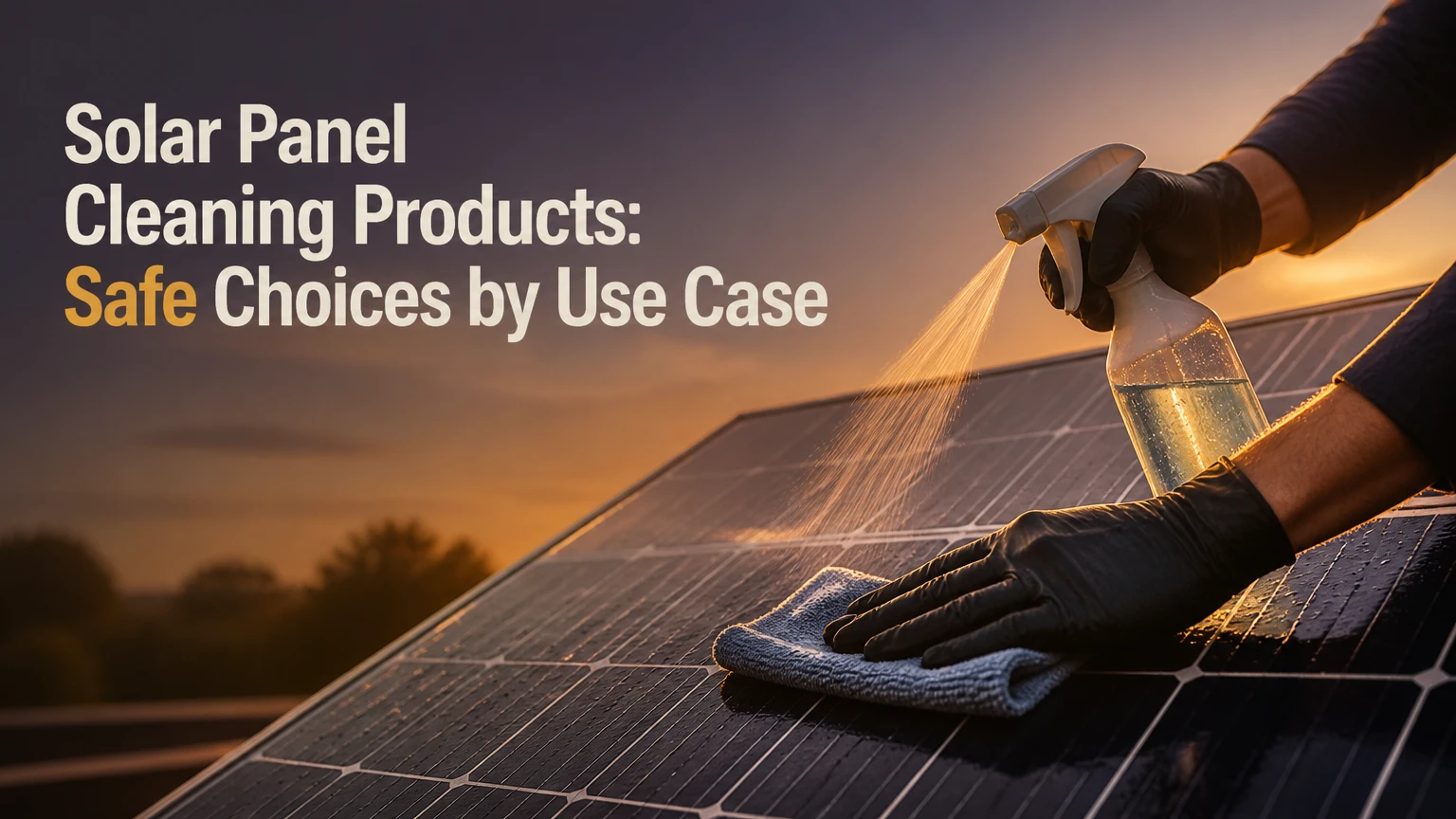
Solar panel cleaning products include purified-water systems, water-fed brushes, non-abrasive cleaners, microfiber tools, and robotic equipment used to remove soiling from photovoltaic modules. The best choice depends on the contaminant, water mineral content, roof access, array size, module instructions, and whether cleaning recovers more energy value than it costs.
Key Facts at a Glance
- Deionized water below 10 parts per million total dissolved solids usually dries with fewer mineral spots than untreated tap water.
- A soft, non-abrasive brush and low-pressure water are safer for module glass, seals, and coatings than pressure washing.
- Solar-safe detergent is mainly useful for oily film, bird droppings, tree sap, and industrial residue that pure water cannot loosen.
- A typical homeowner kit costs $150-$450, while commercial robotic systems commonly cost $5,000-$25,000 or more.
- Cleaning frequency should follow measured soiling and energy loss, not a fixed annual calendar.
- Daylight can leave PV modules electrically energized, so shutdown and access procedures must follow the inverter, installer, and module manuals.
What Are Solar Panel Cleaning Products?
Solar panel cleaning products are maintenance equipment and formulations designed for photovoltaic glass, not ordinary household windows. The category includes DI or RO water purification, telescoping water-fed poles, soft nylon or microfiber heads, approved cleaning concentrates, squeegees, TDS meters, and automated brush or roller robots.
Product choice starts with the residue. Loose desert dust needs gentle rinsing and brushing, while bird droppings may need soaking; salt deposits need purified water, and oily industrial film may need a compatible surfactant. A stronger chemical is not automatically a better cleaner because the module’s anti-reflective layer, polymer components, warranty terms, and frame seals impose material limits.
The U.S. Department of Energy’s Energy Saver guidance treats periodic cleaning as one part of solar maintenance, but cleaning does not correct shading, inverter faults, degraded cells, or damaged wiring. A clear module can still produce less power when a string has a failed bypass diode or a nearby tree blocks irradiance.
Which contaminants require specialized products?
| Contaminant | Best first treatment | Typical dwell or action | Product to avoid |
|---|---|---|---|
| Loose dust and pollen | DI water plus soft brush | 1-2 passes | Dry abrasive pad |
| Bird droppings | Pure-water soak, then microfiber or soft nylon | 5-10 minutes | Scraping blade |
| Tree sap | Approved solar-safe surfactant, diluted per label | 3-5 minutes | Solvent or alcohol |
| Coastal salt film | DI or RO rinse followed by soft agitation | 2-4 passes | Hard-water rinse |
| Cement or mineral scale | Installer-approved descaling procedure | Specialist assessment | Vinegar or acid on an unapproved coating |
| Oily industrial residue | Compatible low-residue solar detergent | Label-defined dwell | Laundry detergent |
How Do Solar Panel Cleaning Products Work?
Purified-water systems remove dissolved calcium, magnesium, silica, and other minerals that can remain as spots after evaporation. The brush then lifts softened particles from the glass with low friction, while a final rinse carries the suspended residue away before the surface dries.
A DI cartridge exchanges dissolved ions in resin and can produce very low-TDS water until the resin becomes exhausted. An RO membrane rejects much of the dissolved load before DI polishing, which usually extends resin life, although RO requires adequate pressure, a drain stream, and periodic membrane maintenance. A handheld TDS meter provides a useful check at the outlet.
Pure water is not a universal solvent. It may remove dust effectively but struggle with hydrocarbons, baked bird waste, and tree sap. Those residues require controlled soaking with a product whose label permits photovoltaic glass, followed by a complete purified-water rinse.
Practitioner rule: Test the rinse water at the brush outlet, not only at the tap. Long hoses, mixed fittings, or a bypassed filter can reintroduce mineral contamination after filtration.
What specifications matter in a cleaning kit?
| Component | Useful specification | Why it matters | Replacement or operating issue |
|---|---|---|---|
| TDS meter | 0-999 ppm range, 1 ppm resolution | Shows whether rinse water is mineral-rich | Calibrate or replace periodically |
| DI filter | 10-inch or 20-inch resin vessel | Determines flow and resin capacity | Exhaustion causes white spotting |
| Water-fed pole | 15-30 feet for many homes | Reaches from ground level | Longer carbon poles flex more |
| Brush head | Soft nylon or microfiber, 10-16 inches | Covers glass without abrasive contact | Worn bristles trap grit |
| Hose | 30-100 feet, food-grade or system-rated | Connects purification to pole | Dirty hoses can contaminate water |
| TDS threshold | Preferably below 10 ppm | Reduces visible mineral residue | Local water may require RO plus DI |
A TDS reading is a screening measurement, not proof that water is chemically harmless. Silica and other weakly ionized compounds may not appear fully in a conductivity-based reading, so persistent spotting can require a different filtration stage or professional assessment.
Which Solar Panel Cleaning Products Should You Buy?
For most accessible residential arrays, the best starting combination is a soft water-fed pole, a TDS meter, and DI-purified water. Add a compatible low-residue detergent only when the array has sticky organic or oily contamination that water alone cannot remove.
| User or site | Recommended product set | Typical purchase cost | Main limitation |
|---|---|---|---|
| Ground-mounted home array | Hose, soft brush, DI cartridge, TDS meter | $100-$300 | Requires nearby water access |
| Roof-mounted residential array | 15-30-foot carbon pole, DI filter, hose | $150-$450 | Does not eliminate roof-fall risk |
| Small commercial roof | RO-DI cart, 25-40-foot pole, spare resin | $800-$3,000 | Storage and transport are required |
| Agricultural installation | RO-DI trailer, soft brushes, quarterly service plan | $2,000-$10,000 setup | Mud and manure increase labor |
| Large flat commercial roof | Autonomous roller robot, charging system | $5,000-$25,000-plus per unit | Needs compatible roof layout |
| Arid utility site | Waterless robot or specialist vehicle | Project-specific, often above $25,000 | Sand abrasion and tracking geometry |
Check five attributes before ordering: module manufacturer instructions, pole reach, brush softness, filtration capacity, and replacement cost. A kit with a long pole but no TDS meter leaves the operator unable to confirm whether the rinse will spot. A concentrated soap that requires heavy rinsing may increase water use and leave a film if the operator cannot complete the final rinse.
Are solar panel soaps necessary?
Solar panel soap is optional for ordinary dust and pollen, but useful for sap, oily smog, dried droppings, and some agricultural residues. Choose a product labeled for photovoltaic modules, non-abrasive glass, and low-residue rinsing; follow the dilution rate exactly because excess concentrate increases film and rinse demand.
Avoid products containing abrasive particles, strong acids, strong alkalis, petroleum solvents, bleach, or unapproved alcohol mixtures. Household glass cleaner may contain ammonia or other ingredients that the module manufacturer does not permit. The product label is only one control, so the module warranty and installer guidance take precedence.
Is a robotic cleaner suitable for home panels?
Robotic cleaners are suitable mainly for large, regular, low-slope arrays where labor, water transport, and repeated cleaning justify their capital cost. Track geometry, clamp height, roof edges, drainage channels, module spacing, tilt, and wind determine whether a robot can operate safely.
Robots are poor substitutes for inspection. A roller can remove dust while missing a cracked module, loose cable, corrosion, bird nesting, or a blocked drain. Waterless systems also have a limitation: dry microfiber or brush contact can drag abrasive sand across glass if the operator does not control grit loading.
How Do You Clean Solar Panels Safely?
Safe solar panel cleaning uses a cool surface, controlled access, loose-debris removal, low-pressure washing, gentle agitation, and a complete spot-free rinse. A typical 20-panel residential array takes 30-60 minutes once equipment is ready, but roof access and safety setup often take longer than the washing itself.
Before starting, confirm the module and inverter manuals, inspect from the ground, check weather, and decide whether a qualified solar or roofing contractor is required. Do not assume an AC disconnect makes the DC side safe. PV modules produce voltage in daylight, and electrical work requires qualified personnel.
Step 1: Plan the work and isolate hazards
Schedule early morning or late afternoon when the glass is cool, wind is low, and glare is limited. Remove trip hazards, keep hoses away from walkways, and use compliant fall protection when roof access is unavoidable.
Success checkpoint: The array is cool, reachable, and free from active electrical or roof hazards.
Common mistake: Treating a shutdown inverter as proof that exposed DC wiring is de-energized.
Step 2: Inspect the modules before applying water
Look for cracked glass, delamination, brown cells, loose frames, damaged cables, nesting, and heavy mineral scale. Photograph defects and stop if water could enter a damaged junction box or connector.
Success checkpoint: Every visible defect is recorded before cleaning can hide or spread residue.
Common mistake: Scrubbing a cracked panel and worsening water intrusion.
Step 3: Remove loose debris without grinding it into glass
Use a soft, clean brush to remove leaves, twigs, sand piles, and loose dust. Do not drag a dirty pad across dry glass because embedded grit can create fine scratches that reduce optical transmission.
Success checkpoint: Large particles are gone and the brush has no trapped stones.
Common mistake: Using a household broom with stiff, contaminated bristles.
Step 4: Pre-rinse with purified water
Apply DI or RO water from the top of each module downward using low pressure. Use enough flow to float dust away rather than forcing water beneath frames or toward junction boxes.
Success checkpoint: Dry powder has become a loose slurry without visible hard-water spotting.
Common mistake: Using untreated tap water in a hard-water region.
Step 5: Soak and agitate resistant residue
For droppings, sap, or oily film, apply the approved diluted cleaner to a small area and allow the label-specified dwell time, commonly 3-10 minutes. Agitate with a soft wet brush or microfiber pad using light overlapping passes.
Success checkpoint: Residue releases without scraping, force, or repeated dry rubbing.
Common mistake: Increasing detergent concentration instead of increasing soak time.
Step 6: Rinse until no film remains
Rinse from the upper edge downward with purified water. Inspect at a low angle while the glass is wet, because detergent trails and mineral deposits become easier to see before evaporation.
Success checkpoint: Water sheets or beads consistently, with no cloudy trails after drying.
Common mistake: Allowing soap solution to dry on the module.
Step 7: Inspect output and restart only under the correct procedure
Check for streaks, remaining residue, displaced cables, and new damage. Restart the system according to the inverter manual, then compare production with a similar clear day rather than expecting an immediate fixed percentage increase.
Success checkpoint: The system shows normal status and no new fault code.
Common mistake: Opening connectors or touching wiring to diagnose a cleaning-related fault.
How Do DI Water, Soap, and Robots Compare?
DI water is the strongest general choice for dust and mineral-sensitive glass, solar-safe soap is better for sticky contamination, and robots are best when repeated commercial labor costs exceed their capital and maintenance burden. No option is ideal for every roof, contaminant, or array size.
| Cleaning approach | Water or labor profile | Best application | Main risk | Typical cost |
|---|---|---|---|---|
| DI water and pole | Moderate water, low chemical use | Residential dust and pollen | Resin exhaustion | $150-$450 |
| RO plus DI cart | Higher equipment efficiency | Commercial and agricultural arrays | Pump, membrane, and drain needs | $800-$3,000 |
| Solar-safe detergent | More rinsing and handling | Sap, oil, dried droppings | Film or coating incompatibility | $15-$60 concentrate |
| Waterless robot | Low water, low direct labor | Large regular arrays | Sand abrasion and navigation failure | $5,000-$25,000-plus |
| Professional service | Outsourced labor and safety | Steep, fragile, or inaccessible roofs | Recurring service cost | $150-$600 residential visit |
Professional cleaning often makes more financial sense than buying equipment when an array is small, roof access is hazardous, or cleaning is needed only once annually. DIY equipment becomes more defensible for ground-mounted systems, multiple properties, or frequent agricultural soiling.
Is rain enough to clean solar panels?
Rain can remove loose dust but usually does not remove bird droppings, oily deposits, salt film, or baked mineral scale. Rain also leaves concentrated residue at the lower frame as water evaporates, so a rainy climate does not guarantee a clean optical surface.
A practical decision uses measured evidence. Compare a module’s output, irradiance, and temperature before and after cleaning, or compare a cleaned test section with an uncleaned section. The recovered energy value should exceed cleaning labor, water, equipment wear, and safety costs.
How Often Should Solar Panels Be Cleaned?
Most residential arrays need inspection annually and cleaning when visible residue or measured performance loss justifies the work; one or two cleanings per year is a typical starting point, not a universal rule. Agricultural, construction-adjacent, desert, wildfire-affected, and bird-heavy sites may require quarterly or event-driven service.
Soiling loss varies sharply by rainfall, particle type, tilt, wind, vegetation, and local emissions. The frequently quoted 5%-30% range describes possible annual output loss across very different environments, not a guaranteed loss for every dirty panel. IEA PVPS Task 13 reports that soiling behavior is site-specific and recommends measurement rather than relying on a universal cleaning interval.
Use a trigger-based schedule:
- Inspect after construction, wildfire smoke, dust storms, or prolonged drought.
- Check production against irradiance and historical weather data.
- Clean a representative section when output decline and visible soiling coincide.
- Recheck after cleaning to calculate recovered energy.
- Shorten the interval only when the recovered value supports it.
Expert insight: A light, uniform dust layer may have less financial impact than a single opaque bird dropping because localized shade can activate bypass behavior and affect a larger cell substring.
What Should You Never Use on Solar Panels?
Never use abrasive powders, razor blades, stiff brushes, household solvents, unapproved acids, or high-pressure jets on photovoltaic modules. These products can scratch glass, damage anti-reflective coatings, attack seals, force water into electrical areas, or leave a residue that attracts more dust.
Pressure washing deserves a precise distinction. A gentle hose rinse is not the same as a high-pressure washer, but even moderate pressure can be unsafe near frames, connectors, junction boxes, and damaged modules. Follow the module manufacturer’s maximum cleaning pressure if one is specified; otherwise, use controlled low-pressure flow.
| Mistake | Immediate consequence | Correct recovery |
|---|---|---|
| Tap water on hard glass | White calcium or magnesium spots | Rewash with DI or RO water |
| Dry scrubbing sand | Fine scratches and optical loss | Stop and replace contaminated pad |
| Excess detergent | Cloudy film and dust attraction | Repeat purified-water rinses |
| Midday cold-water wash | Thermal stress and glare | Wait for cool modules |
| Pressure near seals | Water intrusion risk | Stop, inspect, and call a technician if faults appear |
| Walking on modules | Cracks and cell damage | Use approved access routes only |
Manufacturers differ. Some module warranties permit mild soap and water, while others specify water quality, brush material, or prohibited chemicals. The warranty document is the controlling reference when generic cleaning advice conflicts with it.
How Do You Fix Common Cleaning Problems?
White streaks usually indicate mineral-rich rinse water, sticky patches indicate insufficient soaking or incompatible detergent, and inverter fault codes require immediate electrical caution rather than repeated washing. Troubleshooting should begin by identifying whether the failure is cosmetic, mechanical, or electrical.
White streaks after drying
Measure outlet TDS and inspect the filter path for a bypass or exhausted cartridge. Rewash a small test area with verified purified water; if streaks remain, mineral scale may need a manufacturer-approved specialist treatment.
Sticky residue remains
Reapply a compatible cleaner at the stated dilution, allow the full dwell time, and use a wet soft brush. Do not use a fingernail, scraper, solvent, or abrasive pad on coated glass.
The panel still produces less power
Cleaning cannot restore output lost to shading, inverter clipping, degradation, wiring faults, snow, or a failed bypass diode. Compare the affected string with neighboring strings and consult the inverter monitoring data before purchasing stronger chemicals.
An inverter fault appears after washing
Stop work, keep people away from exposed electrical equipment, and follow the inverter manufacturer’s emergency procedure. Do not open connectors or restart repeatedly; a qualified solar electrician should inspect suspected water ingress, insulation faults, or damaged junction boxes.
Salt or cement dust will not release
Do not escalate to acid without written module approval. Salt often responds to repeated purified-water rinsing, while cement residue may permanently etch glass and require specialist evaluation.
Which Product Fits Your Situation?
A homeowner with a ground-mounted array should choose a soft brush, DI filter, TDS meter, and low-pressure hose. A steep-roof owner should usually buy safety and access expertise rather than a longer pole, because a ground-level tool does not remove fall risk at roof edges or skylights.
Commercial owners should compare RO-DI productivity, resin consumption, water storage, labor time, and service access. Robotic equipment becomes attractive when the roof is broad, flat, repetitive, and cleaned often enough to amortize a $5,000-$25,000-plus purchase.
Utility operators in arid regions should evaluate waterless robots against sand abrasion, tracker movement, module spacing, wind, charging logistics, and field repair. Waterless operation reduces water hauling, but it does not eliminate brush wear, dust management, or inspection requirements.
What is the cost threshold for professional cleaning?
A typical residential service costs about $150-$600, while a DIY kit costs approximately $150-$450 before replacement resin and safety equipment. Professional service is usually the better value when one cleaning per year is needed, roof access is dangerous, or the array has fewer than roughly 20 panels.
The economic test is simple:
Net cleaning value = recovered annual electricity value minus cleaning cost and equipment wear.
Use measured post-cleaning output whenever possible. If cleaning raises annual production by only a small amount, rain-only monitoring may be more rational; if bird waste, salt, or agricultural dust causes repeated measurable losses, scheduled service can pay back faster.
Frequently Asked Questions
Can I use distilled water instead of deionized water?
Yes, distilled water can work for small spot cleaning, but its purity and cost vary by supplier. DI or RO-DI systems are generally more practical for a full array because they provide continuous rinse water and allow outlet TDS monitoring. Use a clean container and hose so purified water does not become contaminated before application.
Do solar panel cleaning products remove snow?
Most brushes and water-fed poles are not snow-removal tools. Dry, light snow may slide from steep modules, but scraping packed snow can damage glass, frames, and wiring. Follow the module manufacturer’s snow guidance, and never climb onto icy panels without professional access equipment and a documented safety plan.
Can I clean panels with vinegar?
Do not assume vinegar is safe because it is a household product. Acetic acid can affect certain coatings, frames, seals, and adjacent materials, and module manufacturers may prohibit acidic cleaners. Use only a product approved for the specific module or obtain written guidance from the installer or manufacturer.
Will cleaning increase solar output by 30%?
Cleaning can recover substantial output at heavily soiled sites, but a 30% increase is not a normal expectation for every array. The result depends on dust loading, rain, panel tilt, shading, system degradation, and measurement conditions. Compare irradiance-matched production before and after cleaning instead of relying on a fixed percentage.
How do I know whether a brush is safe?
Choose a brush labeled for solar modules or delicate coated glass, with soft, non-abrasive nylon or microfiber fibers. Inspect the head before each use, remove trapped grit, and replace worn or hardened bristles. Test the product on a small accessible area under wet conditions before cleaning the entire array.
Should I buy a solar cleaning robot or hire a contractor?
Hire a contractor for a small, steep, irregular, or fragile residential roof. Consider a robot only for a large, low-slope, repetitive commercial array where cleaning occurs frequently and the roof layout matches the robot’s navigation limits. A robot removes labor from washing, not from inspection, maintenance planning, or fault response.
The Bottom Line
Solar panel cleaning products work best when the product matches the residue and the site. For most homes, a soft water-fed brush, verified DI or RO-DI water, a TDS meter, and an approved low-residue cleaner for stubborn spots provide the safest balance of cost and performance. Use professional service for hazardous access, and choose robotic equipment only when array scale and cleaning frequency justify its limitations. Include safety procedures, warranty requirements, and measured energy recovery in every cleaning decision involving solar panel cleaning products.