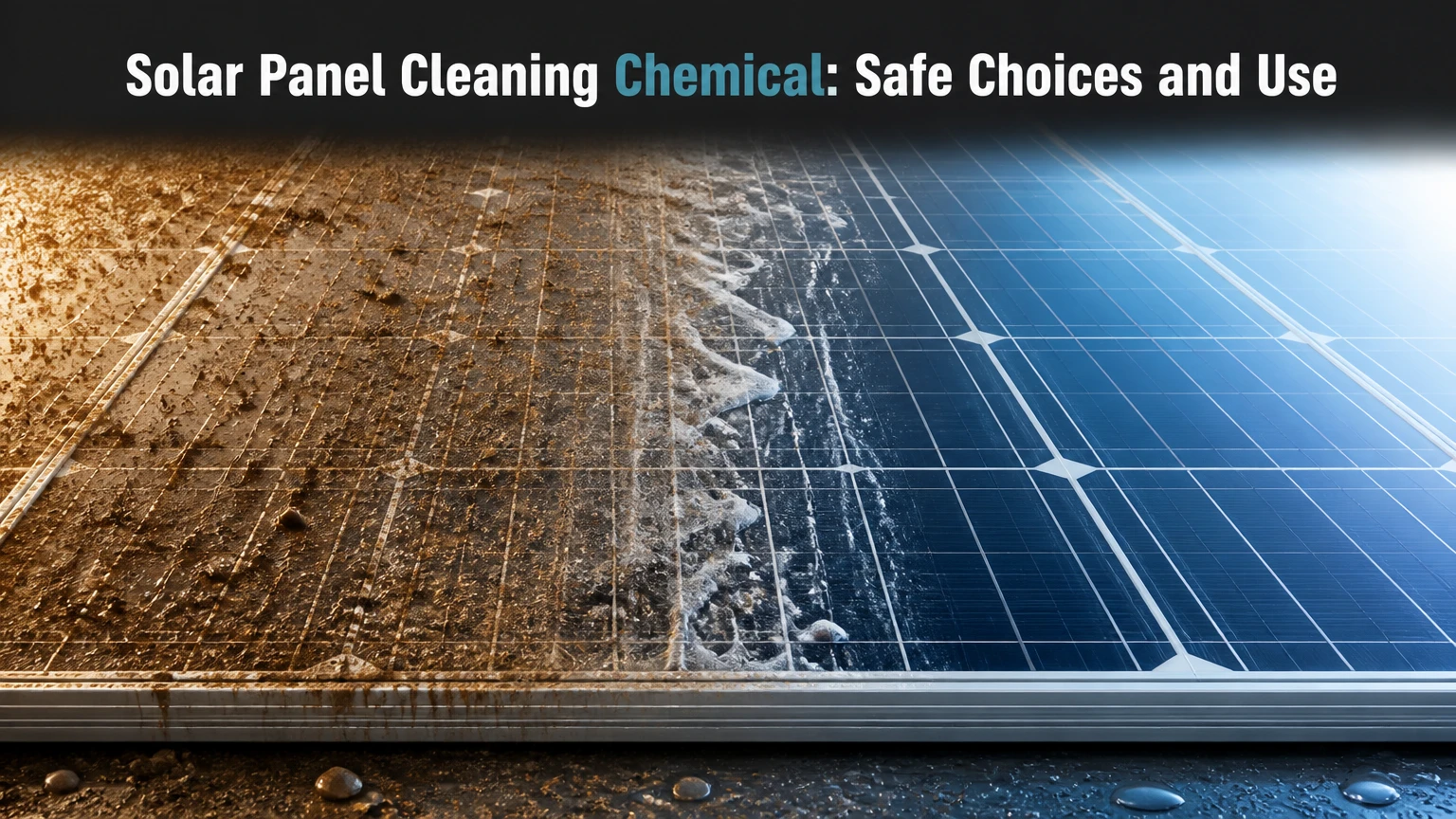
A solar panel cleaning chemical is a low-residue, non-abrasive cleaning concentrate formulated for photovoltaic module glass, frames, and seals. The safest choice is usually purified water for loose dust, or a manufacturer-approved, near-neutral cleaner for oily, biological, or industrial deposits that water alone cannot dissolve.
Key Facts at a Glance
- Deionized or reverse-osmosis water with low dissolved solids usually provides the lowest residue risk.
- A solar cleaning chemical must be compatible with the module manufacturer’s glass coating, sealants, frame, and warranty terms.
- Typical soiling losses range from roughly 2%-5% in many ordinary installations, but severe dust, ash, pollen, or bird fouling can produce much larger local losses.
- Household dish soap, laundry detergent, abrasive pads, and unapproved solvents can leave residue or damage surfaces.
- Panel cleaning requires cool glass, soft tools, controlled water pressure, and no chemical drying on the module.
- Turning off an inverter does not necessarily make illuminated PV modules electrically dead; roof access and connector work require qualified personnel.
What Is a Solar Panel Cleaning Chemical?
A solar panel cleaning chemical is a diluted surface-cleaning formulation designed to remove deposits from PV module glass without leaving a conductive, oily, abrasive, or optically hazy film. Commercial products commonly contain water, biodegradable surfactants, builders or chelating agents, and sometimes polymers intended to reduce static attraction or improve wetting.
The product is not a coating restorer, panel “degrader,” or guaranteed performance enhancer. Cleaning can recover power blocked by dirt, but it cannot reverse cell degradation, cracked glass, delamination, PID, inverter faults, or shading from trees.
NREL uses the term soiling for “the accumulation of dust and other material on the surface of photovoltaic modules.” The energy effect depends on deposit thickness, optical absorption, module tilt, rainfall, and whether dirt creates partial shading across cells. A light dust layer may have little economic effect after rain, while bird droppings can create concentrated losses because one opaque deposit shades several cell strings.
How does the cleaner remove dirt?
Surfactants lower water’s surface tension, helping the liquid spread beneath oily soot, pollen, and organic residues. Builders and chelating agents bind hardness ions such as calcium and magnesium, reducing the chance that tap water leaves carbonate spots as it dries.
Antistatic additives may reduce short-term dust attraction, but their performance depends on formulation, humidity, surface condition, and airborne particle type. They do not make modules permanently dustproof. Biodegradable ingredients reduce persistence in runoff, yet “biodegradable” does not automatically mean harmless to aquatic life, soil, painted roofing, or skin.
The practical distinction is simple: purified water removes soluble and loosely attached contamination mechanically; a detergent-based product changes the chemistry of sticky contamination so a soft brush can lift it. Neither option can safely replace inspection when deposits are cement-like, corrosive, or embedded in damaged glass.
Which Formula Attributes Matter?
The label and technical data sheet matter more than a product’s name. Choose a formulation that identifies PV modules as an intended application, states dilution ratios, provides an SDS, and excludes abrasive particles, strong caustics, hydrofluoric acid, chlorine bleach, and unapproved solvents.
pH and coating compatibility
A near-neutral cleaner, often approximately pH 6.5-8 when diluted, is a sensible screening point, but no universal pH range guarantees compatibility. Some module coatings and aluminum finishes have different chemical tolerances, so the panel manufacturer’s cleaning instructions and warranty conditions control the decision.
Check these attributes before buying:
| Attribute | Practical target | Why it matters | Verification method |
|---|---|---|---|
| Diluted pH | Approximately 6.5-8 | Limits acid or alkali attack on coatings and aluminum | Product label or SDS |
| Abrasive solids | None | Prevents micro-scratches and optical scattering | Ingredients and technical sheet |
| Rinseability | No visible film after drying | Reduces repeat dust adhesion and haze | Small shaded spot test |
| Water hardness control | Chelating or low-mineral rinse | Reduces calcium carbonate spotting | SDS, TDS meter, or supplier data |
| Module compatibility | PV glass explicitly listed | Aligns use with warranty expectations | Module manual and cleaner label |
| Safety documentation | Current SDS available | Identifies hazards, PPE, storage, and disposal | Manufacturer website or supplier |
A product that claims antistatic protection deserves extra scrutiny. A polymer left on glass can reduce wetting and create optical haze if overdosed, incompletely rinsed, or exposed to dust before curing. Treat the additive as optional, not inherently superior.
What TDS should rinse water have?
Low-TDS water is preferred for spot-free drying, and professional water-fed systems often target below 30 parts per million. The exact threshold depends on temperature, humidity, glass angle, and operator technique; water below 10 ppm provides a larger margin in hot, low-humidity conditions.
Tap water can be acceptable when its mineral content is low and the operator squeegees promptly. High-hardness water is the common cause of white rings and milky streaks. A TDS meter measures dissolved ionic material, but it does not identify every contaminant, and a low reading does not prove that a detergent residue has been rinsed away.
Main Solar Panel Cleaning Chemical Options
The best option depends on the deposit and rinse water, not on the strongest advertised formula. Pure water is usually the lowest-risk maintenance method, while a purpose-made cleaner becomes useful when organic oils, bird residue, soot, or biological growth resist gentle washing.
| Option | Typical use | Water or dilution | Main advantage | Main limitation |
|---|---|---|---|---|
| DI or RO water | Loose dust and routine maintenance | TDS commonly below 30 ppm | Dries with minimal mineral residue | Weak against baked-on organic film |
| PV-safe shampoo | Pollen, bird residue, oily grime | Commonly 1:50-1:100 for light soil | Improves wetting and soil release | Requires complete rinsing |
| Heavy-duty PV cleaner | Soot, construction dust, dense biological deposits | Often 1:10-1:50, label dependent | Higher soil-cutting capacity | Greater compatibility and runoff risk |
| Targeted mineral remover | Confirmed calcium or cement scale | Product-specific, often localized | Treats deposits water cannot dissolve | Acids can attack frames, coatings, and roofs |
| Antistatic wash | Recurrent dry dust in exposed sites | Product-specific | May extend the cleaning interval | Benefits vary and residue control is demanding |
Pure water versus a chemical cleaner
Pure water is preferable when the deposit is dry dust, pollen, or light airborne soil and the operator has a soft brush or water-fed pole. A dedicated cleaner is preferable when water beads around greasy deposits, bird droppings remain after soaking, or industrial soot forms a persistent film.
| Decision factor | DI or RO water | PV-safe shampoo | Targeted remediation agent | Recommended winner |
|---|---|---|---|---|
| Loose desert dust | Excellent | Good | Poor choice | DI or RO water |
| Bird droppings | Fair after soaking | Excellent | Usually unnecessary | PV-safe shampoo |
| Mineral scale | Poor | Poor to fair | Good when approved | Targeted agent |
| Residue risk | Lowest | Moderate if under-rinsed | Highest | DI or RO water |
| Equipment cost | $300-$2,500 typical system | $15-$40 per concentrate gallon typical | $25-$100 per specialty container typical | Depends on scale |
| DIY error tolerance | Highest | Moderate | Lowest | DI or RO water |
A chemical cleaner is not automatically more effective than pure water. In many residential systems, better technique, cooler glass, and purified rinse water produce more improvement than switching to a stronger concentrate.
How Much Does Solar Panel Cleaner Cost?
Typical concentrated PV cleaners cost about $15-$40 per gallon, while a small residential cleaning may consume only 0.25-1 gallon of diluted solution. The chemical cost can therefore fall below $10 per visit, but water purification, access equipment, labor, travel, and roof safety usually dominate the total cost.
| Cleaning context | Chemical or water cost | Labor or equipment factor | Typical interval | Typical total implication |
|---|---|---|---|---|
| Small residential array | $3-$15 per visit | Hose, pole, and safe ground access | 3-6 months | DIY often costs under $30 |
| Hard-water residential site | $5-$20 per visit | DI resin or RO equipment | 2-6 months | Water treatment may exceed chemical cost |
| Commercial rooftop | $20-$150 per visit | Water-fed poles, lift, or access controls | 1-3 months | Labor and roof access dominate |
| Utility-scale array | $0.05-$0.50 per module cleaning estimate | Robotics, tractors, or crews | Weather and production based | Contract pricing varies widely |
These are typical planning ranges, not universal market prices. Compare ready-to-use cost, not container price: a $30 concentrate that makes 100 gallons costs $0.30 per diluted gallon, while an inexpensive ready-to-use product may cost several times more per application.
How Do You Apply a Solar Panel Cleaning Chemical?
A safe cleaning session usually takes 20-45 minutes for a small, ground-accessible array, excluding setup and purification. The determining factor is controlled rinsing: a compatible cleaner that dries on hot glass can create more work than the original dirt.
Before you start
- Difficulty: Moderate on ground-mounted panels, high on roof-mounted arrays.
- Materials: PV-approved concentrate, 5-10 gallons of water, soft split-fiber brush, microfiber pad, hose or water-fed pole, gloves, eye protection, and a TDS meter if using purified water.
- Conditions: Cool glass, low wind, no rain during dwell time, and no need to walk on modules.
- Prerequisites: Read the module manual, cleaner label, SDS, and roof-access requirements.
- Safety boundary: Do not disconnect MC4 connectors, open junction boxes, or work near exposed conductors unless qualified.
Step 1: Inspect and establish electrical safety
Review the array layout, damaged glass, loose cables, exposed connectors, nesting animals, and roof hazards. Follow the inverter manufacturer’s shutdown procedure if the system owner requires it, but remember that PV modules generate DC voltage whenever illuminated.
Success checkpoint: No cracked module, exposed conductor, unstable ladder, or unsafe roof route is ignored.
Common mistake: Assuming an inverter shutdown eliminates DC voltage at the modules.
Step 2: Work during cool conditions
Clean early morning, late afternoon, or under suitable cloud cover when the glass is cool. Avoid pouring cold water onto very hot modules because rapid temperature changes can stress already damaged glass, although claims that every ordinary rinse immediately causes microcracking are overstated.
Success checkpoint: Water remains liquid long enough to spread and the panel surface is comfortable to touch without direct sun exposure.
Common mistake: Cleaning at midday, when rapid evaporation concentrates detergent and minerals.
Step 3: Remove loose debris
Use a soft nylon brush or air blower to remove leaves, grit, twigs, and loose sand. Do not dry-scrub abrasive particles across the glass, especially on thin-film or coated surfaces.
Success checkpoint: No visible gravel or coarse particles remain before wet agitation.
Common mistake: Turning loose desert dust into an abrasive paste with the first wet stroke.
Step 4: Mix the solution accurately
Use the label’s dilution ratio. A light maintenance ratio may be 1:50 or 1:100, while a heavy-deposit ratio may be 1:4 or 1:10, but those values are examples rather than a universal recipe.
Success checkpoint: The measured concentrate and water match the manufacturer’s volume instructions.
Common mistake: Increasing concentration because stronger foam appears to clean better. Excess surfactant increases rinsing time and residue risk.
Step 5: Apply and allow controlled dwell time
Wet the module first when the instructions permit, then apply the diluted cleaner with a low-pressure sprayer or water-fed brush. Allow approximately 2-5 minutes for common organic deposits, keeping the surface wet and shaded.
Success checkpoint: Bird residue softens without the solution drying into a visible edge.
Common mistake: Leaving chemical on the glass for 15-20 minutes in direct sun.
Step 6: Agitate with a soft tool
Use overlapping strokes from the upper edge downward with a clean, soft split-fiber brush or microfiber pad. Apply light pressure; the chemical should perform most of the soil release.
Success checkpoint: The brush glides without grinding grit and the runoff becomes progressively clearer.
Common mistake: Using a razor, steel wool, kitchen scouring pad, or hard-bristle deck brush.
Step 7: Rinse and dry completely
Rinse from the top down with low-pressure water until no foam or slickness remains. Use DI or RO water for final rinsing when mineral spotting is likely, then squeegee only with a clean, soft rubber blade if the module instructions permit it.
Success checkpoint: The dry glass has no rainbow sheen, white rings, tacky feel, or detergent smell.
Common mistake: Stopping after the first clear-looking rinse. Surfactant residue can remain invisible while wet.
Which Cleaner Fits Your Environment?
Environmental deposits require different chemistry and cleaning intervals. A product chosen for desert dust may be poorly suited to salt crust, while an acid intended for mineral scale can damage aluminum when used as a general-purpose wash.
| Environment | Dominant deposit | First choice | Cleaning trigger | Avoid |
|---|---|---|---|---|
| Inland temperate area | Dust, pollen, rain marks | DI or RO water | Visible film or measured output decline | Routine strong acids |
| Desert or dry agricultural area | Fine dust, pollen, irrigation minerals | Purified water plus soft brush | Dust after wind events | Dry abrasive brushing |
| Coastal location | Salt aerosol and bird residue | Fresh-water rinse, then PV-safe cleaner | Salt film or bird fouling | Chloride cleaners and bleach |
| Industrial district | Soot, oily particulate, cement dust | PV-approved degreasing cleaner | Persistent gray or oily film | Solvent-based household products |
| Heavy tree cover | Pollen, sap, leaves, bird fouling | PV shampoo with controlled dwell | Sticky deposits or shade-producing debris | Metal scraping |
| Construction site | Cement and alkaline dust | Immediate low-pressure rinse, professional assessment | Dust after site activity | Uninhibited acid on frames |
Cleaning frequency should follow measured soiling, not a fixed calendar. A residential array may need attention every 3-6 months, a dusty commercial roof every 1-3 months, and a rainy temperate site only after unusual deposits. Rain removes loose dust but does not reliably remove oily soot, bird waste, or mineral crust.
What Should You Never Use?
Do not use household dish detergent, laundry detergent, glass polish, bleach, ammonia, abrasive powder, acetone, gasoline, or unapproved acidic descaler on PV modules. Household products can contain fragrances, polymers, solvents, salts, or builders that leave an optical film or attack coatings and anodized aluminum.
Pressure washing is also a poor default. A high-pressure jet can force water toward seals, cable glands, junction boxes, and connectors, while the spray impact can move grit across the glass. Low-pressure rinsing is adequate for most cleaning tasks.
Vinegar is not a universal safe alternative. Dilute acetic acid may help with certain mineral deposits on some glass surfaces, but module frames, coatings, sealants, runoff areas, and warranties differ. Use a labeled PV-compatible mineral treatment or ask the module manufacturer before applying acid.
How Do You Fix Common Cleaning Problems?
Most post-cleaning defects result from mineral-rich rinse water, dried detergent, excessive pressure, or the wrong chemical for the deposit. Diagnose the visible symptom before repeating the wash with a stronger product.
| Symptom | Likely cause | Immediate response | Escalation point |
|---|---|---|---|
| White rings or milky streaks | Hard-water minerals | Rewash with compatible cleaner and low-TDS rinse | Professional mineral removal if scale remains |
| Rainbow or oily haze | Surfactant or polymer residue | Rinse thoroughly with purified water | Manufacturer or coating specialist |
| Sticky brown spots | Sap, bird waste, or soot | Rewet for 2-5 minutes and use soft agitation | Localized approved treatment |
| Chalky cement deposits | Alkaline construction dust | Stop abrasive scrubbing and identify material | Qualified restoration service |
| Lower output after washing | Wet connector, shading, or unrelated fault | Follow shutdown and electrical inspection procedure | Licensed solar technician |
| Scratched or cloudy glass | Abrasive tool or coating damage | Stop cleaning and photograph condition | Installer or module manufacturer |
A sudden production decline should not be attributed to dirt without checking inverter status, irradiance, shading, temperature, and monitoring data. Cleaning cannot repair a failed bypass diode or damaged connector.
When Is Professional Cleaning the Better Choice?
Professional service is the safer choice for steep roofs, fragile tiles, arrays above difficult access points, damaged modules, industrial contamination, and any task requiring connector or electrical inspection. A professional should provide insurance, a risk assessment, chemical SDS documentation, and a clear statement of whether the service includes purified water.
Commercial and utility operators should evaluate cleaning by recovered energy per dollar, not by visual brightness. A robotic brush system may reduce labor and water use at scale, while a chemical-heavy approach can create disposal, corrosion, and rinse-water costs that outweigh its production benefit.
One practical rule is to compare a clean reference module with a soiled module under similar irradiance. If the measured difference is smaller than the cleaning cost threshold, postpone routine chemical washing and inspect again after the next dust event.
FAQ
Can I clean solar panels with distilled water only?
Yes. Distilled, deionized, or reverse-osmosis water is suitable for loose dust and light pollen when applied with a soft brush and rinsed before drying. Pure water has limited ability to dissolve oily soot, sap, or baked bird residue, so a PV-approved low-residue cleaner may be needed for those deposits.
Is a solar panel cleaning chemical safe for aluminum frames?
A PV-specific, diluted, near-neutral product is generally lower risk than household acid or alkaline cleaners, but safety is product-specific. Check the SDS and module manual, avoid prolonged dwell time, prevent chemical from drying on the frame, and test a concealed area before treating the entire array.
Does cleaning increase solar panel efficiency?
Cleaning can increase delivered energy when deposits block light, but it does not improve the module’s rated conversion efficiency or reverse aging. The gain may be small after rainfall in a temperate climate and substantial after persistent dust, ash, bird fouling, or industrial soot.
How often should solar panels be chemically cleaned?
Chemical cleaning is usually needed only when water and gentle agitation cannot remove the deposit. Typical intervals range from 1-3 months at dusty commercial sites to 3-6 months for many residential arrays, with inspections after construction, wildfire smoke, storms, or bird activity.
Can rain replace panel cleaning?
Rain can remove loose dust, but it rarely removes oily soot, dried bird waste, tree sap, salt crust, or cement dust. Rainwater can also dry into spots when it collects dissolved material from the module, frame, roof, or airborne pollution before reaching the glass.
Is an antistatic solar cleaner worth paying more for?
An antistatic cleaner may be worthwhile where dry dust rapidly returns after washing, but the benefit is not guaranteed and depends on the additive, surface, humidity, and deposit. Compare measured production and cleaning intervals rather than accepting claims that the product permanently repels dust.
The Bottom Line
The safest solar panel cleaning chemical is a PV-labeled, non-abrasive, low-residue formulation used at its specified dilution, with cool glass, soft tools, and a complete rinse. For ordinary dust, DI or RO water is usually the better first choice; reserve chemical cleaners for organic, oily, biological, or industrial deposits, and escalate mineral scale, damaged modules, roof hazards, and electrical concerns to a qualified professional.