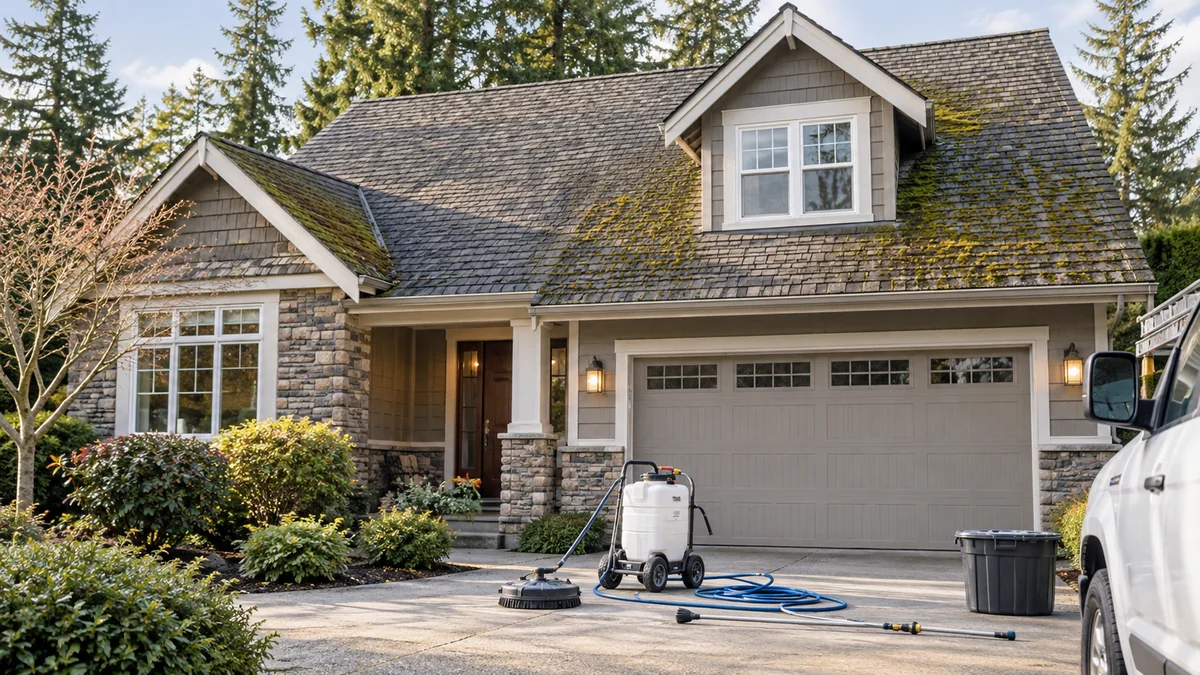
Soft washing is usually the safer primary method for killing roof moss, while scraping is better for removing thick, loose growth that must come off immediately. For most roofs, the strongest decision is a controlled hybrid: gently remove heavy mats, then apply a suitable biocide without damaging shingles, tiles, flashing, plants, or gutters.
Key facts at a glance
- Soft washing uses low-pressure water and a moss-killing solution; it treats biological growth without the abrasion caused by scraping.
- Manual scraping produces a cleaner appearance immediately but does not reliably kill spores or growth remaining in overlaps and pores.
- Asphalt shingles should never be aggressively brushed or scraped because granule loss can shorten shingle life.
- Clay, slate, and brittle historic roofing can crack under foot traffic, making low-pressure treatment preferable when the roof is sound.
- Typical professional pricing ranges from $800-$1,500 for chemical treatment and $1,200-$2,500 for labor-intensive scraping on a 2,000-square-foot home.
- A prevention plan must address shade, moisture, debris, gutters, overhanging branches, and residual biological growth.
Soft Washing vs Scraping for Roof Moss Removal
Soft washing and manual scraping solve different parts of the problem. Soft washing targets the living organism and its anchoring structures, while scraping removes visible moss mechanically. The best choice depends on roof material, moss thickness, roof condition, access, runoff sensitivity, and whether immediate cosmetic improvement matters more than minimizing abrasion.
A roof with thin moss staining often needs only a properly selected treatment. A roof with thick cushions of moss may need limited hand removal before treatment because a chemical solution cannot evenly reach growth that is several inches deep. That does not make aggressive scraping the default. Heavy mechanical work can dislodge shingles, remove asphalt granules, crack tile edges, and push debris into gutters.
Master comparison
| Decision criterion | Soft washing | Manual scraping | Hybrid treatment |
|---|---|---|---|
| Primary action | Kills moss and residual growth | Detaches visible moss | Removes bulk growth, then kills remnants |
| Typical pressure | 60-100 PSI, low pressure | 0 PSI water pressure, hand force | Low pressure plus limited hand force |
| Visible result | Whitening first, debris may remain | Immediate bulk removal | Immediate removal with biological treatment |
| Typical service time | 2-4 hours | 1-2 days | 4-8 hours, depending on growth |
| Typical cost, 2,000 sq. ft. | $800-$1,500 | $1,200-$2,500 | $1,000-$2,000 |
| Main roof risk | Chemical or runoff damage | Abrasion, foot traffic, broken materials | Poor technique in either stage |
| Best material fit | Slate, clay, brittle tile, sound shingles | Durable tile with thick loose growth | Most sound roofs with moderate or heavy moss |
These figures are typical practitioner ranges, not guaranteed prices. Roof pitch, stories, access, local labor rates, containment requirements, material age, and moss depth can change the estimate substantially.
Which method kills moss more effectively?
Soft washing generally provides better biological control because the solution reaches moss tissue and growth left in shingle overlaps or tile pores. Scraping removes the visible plant but can leave rhizoids, spores, and protected fragments behind, so untreated moss often returns sooner in damp, shaded conditions.
“Kills 100% of microscopic spores” is not a defensible universal promise. No roof treatment can sterilize an outdoor roof, and wind, birds, nearby trees, and airborne moisture can reintroduce spores. A more accurate claim is that a suitable biocide can kill active moss on treated surfaces when the roof is properly covered and the solution remains wet for the required dwell period.
Soft washing is therefore stronger for recurrence control. Scraping is stronger for immediate bulk removal. The hybrid method combines both benefits when technicians limit mechanical force.
What chemicals are used in soft washing?
Sodium hypochlorite, quaternary ammonium compounds, surfactants, and zinc-based products are the main chemical categories used for roof biological growth. Product labels control dilution, dwell time, protective equipment, discharge rules, and approved surfaces; concentration should never be improvised from a generic recipe.
| Treatment type | Typical result time | Residual action | Main concern | Appropriate use |
|---|---|---|---|---|
| Sodium hypochlorite solution | Minutes to hours | Limited after rinsing | Plant, metal, and runoff damage | Fast treatment by trained operators |
| Quaternary ammonium biocide | Weeks to months | Longer residual effect | Slow cosmetic improvement | Sensitive sites and maintenance treatments |
| Zinc strip or zinc treatment | Months of rainfall | Gradual inhibition | Limited coverage below obstructions | Prevention on suitable roof designs |
| Copper strip or copper treatment | Months of rainfall | Stronger inhibition in some settings | Runoff staining and aquatic toxicity | Carefully specified prevention |
A sodium hypochlorite blend may visibly turn moss white, yellow, or brown during treatment. That color change indicates tissue damage, not complete removal. Dead material can remain attached for weeks or months and may detach during rainfall.
Quaternary ammonium products are slower. They can be useful where immediate whitening, plant sensitivity, or runoff control makes chlorine-based treatment unsuitable, but they are not a substitute for sound containment and surface preparation.
Is scraping safer for the roof?
Scraping is safer than high-pressure washing, but it is not automatically safer than a carefully controlled chemical treatment. The worker’s body weight, tool angle, repeated contact, and material fragility determine the mechanical risk.
Asphalt shingles are especially sensitive to abrasion. Steel wire brushes and sharp metal blades can remove protective mineral granules, expose the asphalt mat, disturb adhesive seals, and create visible strips that age faster under ultraviolet light. Plastic scrapers and soft nylon brushes are less aggressive, but they still require restraint.
Profile-matched tools are more appropriate on some concrete and clay tiles because they can follow the tile contour without levering against edges. Even then, stepping on brittle, interlocking, cracked, or historic tiles can cause damage that is invisible from the ground.
A practical rule is simple: if moss can be removed with light downward pressure, mechanical cleaning may be reasonable; if the operator must pry, gouge, or lean heavily into the roof, the method is too aggressive.
How does each roof-moss removal method work?
Soft washing applies a low-pressure solution across the roof, allows sufficient dwell time, and either rinses lightly or leaves the treated material to break down through weather exposure. Scraping uses hand tools to separate the moss from the roof surface, then requires gutter cleanup and preferably a follow-up biocide.
Neither method should begin before a roof inspection. The technician should identify broken tiles, exposed underlayment, loose flashing, open valleys, failed seal strips, brittle shingles, skylights, solar panels, and areas where walking is unsafe.
Soft-washing protocol
- Inspect the roof and surroundings. Confirm the material, roof age, slope, weather, drainage routes, and existing damage. Do not use treatment to conceal a leak or structural defect.
- Protect vegetation and surfaces. Pre-soak plants, cover sensitive items, disconnect or redirect downspouts where practical, and prevent concentrated discharge toward ponds, storm drains, or neighboring property.
- Remove loose debris. Use a soft broom or air-based method from a safe position. Avoid dragging debris across granulated shingles.
- Apply the solution evenly. Work in manageable sections, usually from the eave upward for coverage control, while avoiding overspray onto windows, siding, painted metal, and electrical equipment.
- Maintain wet dwell time. A typical treatment window is 20-45 minutes, but the label and weather control the actual duration. Do not allow a strong solution to dry on a hot roof.
- Rinse only as specified. Some treatments require a gentle rinse; others are designed to remain and weather away. High-pressure rinsing defeats the purpose of low-pressure cleaning.
- Rinse and inspect the property. Flush plants and hard surfaces with clean water, clear gutters, and verify that runoff did not collect in a concentrated stream.
The success checkpoint is an even color change without dry streaks, damaged vegetation, or concentrated discharge. A common error is applying a strong solution too quickly on a hot, dry roof, which creates uneven bleaching and increases surface damage.
Scraping protocol
- Establish safe access. Use appropriate fall protection, ladder stabilizers, roof anchors where required, and a ground spotter. A telescoping pole does not make roof work automatically safe.
- Match the tool to the profile. Use a plastic or purpose-built profile tool for the specific tile or shingle. Avoid steel wire brushes on asphalt shingles.
- Work from ridge toward eave. Downward movement follows shingle and tile overlaps. Upward scraping can lift seals, catch tile lips, or force water beneath the covering.
- Use light, controlled passes. Remove the moss mat without digging into the substrate. Do not pry against cracked tile, exposed fasteners, flashing, or shingle edges.
- Collect falling debris. Protect landscaping with tarps where appropriate, clear valleys, and remove moss from gutters before it blocks outlets.
- Apply a compatible follow-up treatment. A labeled biocide can address growth left in joints and pores. Zinc or copper prevention may help where roof design and runoff conditions permit.
- Inspect after drying. Look for lifted shingles, cracked tiles, exposed granules, displaced flashing, blocked outlets, and remaining growth.
The success checkpoint is a clean substrate with intact edges, seals, granules, and tile surfaces. A common error is prioritizing a perfectly bare appearance over preserving the roof covering.
Which method fits each roofing material?
Roofing material is the strongest early decision variable. Asphalt shingles usually favor low-pressure treatment, while durable concrete tiles may tolerate carefully controlled scraping when the growth is thick and loose. Slate, clay, and historic roofs require special caution because replacement pieces, matching, and installation can be difficult.
| Roof material | Preferred first option | Scraping risk | Important restriction |
|---|---|---|---|
| Asphalt shingles | Low-pressure biocide | Granule loss and seal damage | Avoid wire brushes and aggressive foot traffic |
| Concrete tile | Treatment or limited profile scraping | Cracked edges and displaced tiles | Walk only on approved support points |
| Clay tile | Low-pressure treatment | Breakage from weight or leverage | Do not step on unsupported tile pans |
| Natural slate | Low-pressure treatment by a slate-aware contractor | Fracture and slipped slates | Protect flashings and avoid routine walking |
| Metal roofing | Labeled treatment and gentle washing | Scratches and coating damage | Check paint, fasteners, seams, and drainage |
| Historic roofing | Conservation-led treatment | Irreplaceable material damage | Obtain specialist inspection before cleaning |
A chemical treatment is not automatically safe for every material. Some coatings, sealants, metals, membranes, and painted surfaces react badly to alkaline or oxidizing solutions. The product label and roof manufacturer’s guidance take priority over a generic soft-washing formula.
When is the hybrid method best?
The hybrid method is best when thick moss creates a physical drainage or appearance problem, but the roof surface is too vulnerable for aggressive scraping. Technicians remove only loose, heavy mats, then use a suitable treatment to address the remaining biological layer.
Hybrid cleaning is particularly useful where moss has accumulated in valleys, behind chimneys, around skylights, or at shingle courses. Those areas can trap water and debris even after a general treatment. Limited hand removal restores drainage while reducing total roof contact.
The hybrid method is not a license to scrape every square inch. The mechanical stage should be the smallest intervention that achieves safe drainage and acceptable appearance.
How much does roof moss removal cost?
Typical professional roof-moss removal costs are $800-$2,500 for a 2,000-square-foot home, with soft washing usually costing less than full manual scraping. A hybrid service often falls between the two, although difficult access, containment, steep pitch, and fragile materials can reverse that pattern.
| Project condition | Soft washing | Scraping | Hybrid |
|---|---|---|---|
| Light moss, one-story roof | $500-$900 | $800-$1,400 | $700-$1,100 |
| Moderate moss, 2,000 sq. ft. | $800-$1,500 | $1,200-$2,000 | $1,000-$1,700 |
| Heavy moss, steep access | $1,200-$2,200 | $1,800-$3,500 | $1,500-$2,800 |
| Historic or fragile roof | $1,000-$2,500 | $2,000-$4,000 | $1,500-$3,500 |
Prices are typical planning ranges, not published universal rates. Ask whether the quote includes plant protection, gutter clearing, runoff control, biocide, roof inspection, debris collection, and a return visit.
The cheapest estimate may omit the work that prevents damage. A quote that excludes downspout management or post-treatment inspection is not directly comparable with a fully contained service.
How long do results last?
Visible results can last roughly one to five years, but the range depends more on moisture and prevention than on the cleaning label. A treated, sunny, well-ventilated roof may remain clear for several years, while a shaded roof beneath dense trees may regrow within one wet season.
| Site condition | Likely recurrence pressure | Maintenance implication |
|---|---|---|
| Full sun, trimmed branches | Low | Inspect every 2-3 years |
| Morning shade, moderate debris | Medium | Inspect annually |
| Dense evergreen canopy | High | Trim vegetation and inspect twice yearly |
| Poor ventilation and damp roof | High | Correct moisture source before treatment |
| Untreated residual moss | Very high | Apply compatible follow-up biocide |
Scraping alone commonly provides a shorter prevention window because it removes bulk growth without treating the remaining biological layer. A post-scrape biocide improves the result, but it still cannot prevent new spores from arriving.
What are the main failure modes?
Most roof-moss cleaning failures result from incorrect pressure, poor runoff control, unsuitable tools, or treating symptoms while leaving the roof damp. The method name matters less than execution.
- High-pressure washing damages shingles and coatings. Replace pressure washing with low-pressure application and controlled rinsing.
- Strong chemicals dry on hot surfaces. Work in smaller sections, monitor dwell time, and follow label directions.
- Scraping upward lifts overlaps. Move from ridge to eave and stop at vulnerable edges.
- Moss enters blocked gutters. Collect loose material and clear outlets before the next rainfall.
- Plants receive concentrated runoff. Pre-wet vegetation, redirect discharge, and rinse thoroughly.
- Technicians walk on fragile materials. Use safe access from ladders or specialist systems, and decline the job when the roof cannot be accessed without breakage.
- The roof looks clean but remains damp. Trim branches, clear gutters, improve ventilation, and repair drainage defects.
One counterintuitive point matters: removing every visible trace can be more damaging than leaving a thin treated residue to weather away. Roof longevity depends on preserving granules, seals, tile edges, and flashings, not on achieving a perfectly bare surface on the service date.
Can homeowners remove roof moss themselves?
Homeowners can often handle ground-level prevention and light treatment on a low, safely accessible roof, but roof walking and chemical application become high-risk on steep, tall, brittle, or complex roofs. A telescoping pole reduces reach requirements, yet it does not replace fall protection or control chemical runoff.
A homeowner should generally hire a qualified contractor when the roof is two stories, steeper than a comfortable walking slope, slate or historic tile, visibly damaged, near overhead power, or adjacent to a pond and storm-drain system. The contractor should identify the product, dilution or label directions, containment plan, insurance, access method, and cleanup scope.
Safe homeowner tasks include trimming branches, removing leaves from gutters from a stable ladder position, improving roof ventilation, and installing prevention products only when compatible with the roof and local runoff requirements. Do not mix bleach with acids, ammonia, or other cleaners.
Which should you choose?
Choose soft washing for sound asphalt shingles, slate, clay, or brittle tile when the main goal is biological control with minimal abrasion. Choose limited scraping when thick, loose moss must be removed immediately or is blocking drainage, and choose the hybrid method for most heavy infestations on a serviceable roof.
Choose soft washing when
- The roof is fragile, historic, or difficult to walk on.
- Moss is thin or moderately established.
- The roof has intact drainage and no thick mats.
- Immediate cosmetic perfection is not required.
- Plants and runoff can be protected properly.
Choose scraping when
- Thick moss is physically blocking valleys or gutters.
- The roof covering is durable and the technician can work safely.
- The owner needs bulk moss removed on the same day.
- A compatible biocide will follow the mechanical work.
- The operator can avoid asphalt granule loss and tile breakage.
Choose a hybrid service when
- Moss is thick but the roof is vulnerable.
- Treatment alone would leave obstructive debris.
- The property requires both immediate cleanup and longer biological control.
- The contractor can limit scraping to loose mats and problem areas.
How can you prevent roof moss from returning?
Roof moss prevention combines drying, debris control, and residual treatment. Cleaning alone cannot overcome permanent shade, blocked gutters, leaking flashing, poor ventilation, or branches that deposit organic matter across the roof.
Use a maintenance plan that includes:
- Inspecting the roof and gutters each spring and autumn.
- Removing leaves before they form damp organic mats.
- Trimming branches that shade the roof or touch shingles.
- Repairing leaks, failed flashing, and overflowing gutters.
- Improving attic ventilation when condensation keeps the roof damp.
- Applying a compatible labeled biocide at the interval recommended for the site.
- Using zinc or copper strips only after checking roof material, runoff, fasteners, plants, and local environmental rules.
Metal strips are prevention aids, not substitutes for removing established moss. They also work unevenly when chimneys, dormers, valleys, or roof geometry prevent treated rainwater from reaching lower sections.
FAQ
Does soft washing remove moss immediately?
Soft washing kills active moss quickly, but the dead material may remain attached for weeks or months. Rain gradually removes it. A light treatment can look substantially better within hours, while thick growth may require limited manual removal for immediate drainage and appearance.
Is bleach safe for asphalt shingles?
A properly controlled, labeled sodium hypochlorite treatment can be used on some asphalt-shingle roofs, but excessive concentration, prolonged dwell time, drying, or repeated treatment can harm granules, plants, metals, and coatings. Confirm manufacturer guidance and use runoff controls before application.
Will roof moss damage the roof?
Moss can retain moisture, lift shingle edges, obstruct drainage, and worsen deterioration over time, especially where freeze-thaw cycles occur. Moss does not automatically mean the roof requires replacement, but cracked shingles, exposed underlayment, rotten decking, or persistent leaks require repair or replacement evaluation.
Can zinc strips stop moss permanently?
Zinc strips can reduce moss growth below the strip when rainwater reaches the surface, but they do not stop new spores, treat shaded areas outside the runoff path, or remove established moss. Their effectiveness also depends on roof geometry, installation, rainfall, and nearby metal compatibility.
Should gutters be cleaned after moss removal?
Yes. Moss debris can block gutter outlets and downspouts, causing water to back up beneath roofing or overflow near foundations. A complete service should inspect valleys, gutters, downspouts, and ground-level drainage after the roof treatment and after the first substantial rainfall.
What should you ask a roof-moss contractor?
Ask for the proposed method, roof-material precautions, pressure range, chemical product and label, plant-protection plan, runoff destination, access and fall-protection plan, gutter cleanup scope, insurance, and expected visual timeline. Also ask whether the quote includes a follow-up treatment or only same-day debris removal.
The Bottom Line
Soft washing versus scraping for roof moss removal is not a contest between one universally superior method and one inferior method. Soft washing is usually the better biological treatment, scraping is useful for thick loose growth and immediate cleanup, and a restrained hybrid approach often provides the best balance for a sound roof. Protect the roofing material first, then control moss, runoff, moisture, and regrowth.