A soft wash system kit is a chemical-resistant, low-pressure exterior-cleaning setup that applies a diluted sodium hypochlorite solution through a pump, hose, gun, and wide-orifice nozzle. The chemical kills organic growth such as algae, mold, mildew, moss, and lichen, while controlled flow limits the mechanical impact on roofing, siding, render, and other delicate surfaces.
Key Facts at a Glance
- A typical 12V soft wash pump delivers about 5-7 gallons per minute at approximately 60-100 PSI.
- Gas-powered diaphragm systems commonly deliver 9-12 or more gallons per minute for high-volume work.
- Soft washing depends on chemical dwell time and complete coverage, not high-pressure blasting.
- Typical sodium hypochlorite strength is 1%-1.5% for many siding jobs and 4%-6% for asphalt-shingle roof cleaning, subject to the product label and surface manufacturer.
- Chemical-rated hose, seals, valves, tanks, and fittings are mandatory because sodium hypochlorite attacks unsuitable metals and elastomers.
- Plant pre-wetting, runoff control, PPE, and a thorough post-rinse are part of the cleaning process, not optional extras.
What Is a Soft Wash System Kit?
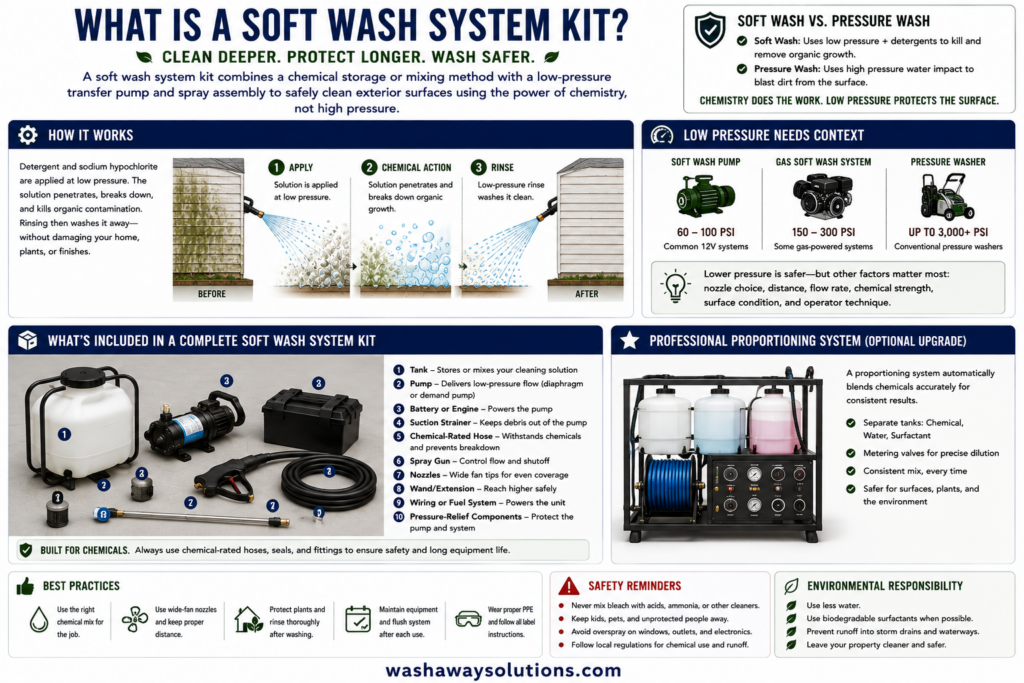
A soft wash system kit combines a chemical storage or mixing method with a low-pressure transfer pump and spray assembly. Unlike a pressure washer, which removes contamination mainly through water impact, a soft wash setup uses detergent and sodium hypochlorite to break down organic contamination at the surface and in porous material.
The term “low pressure” needs context. A soft wash pump may produce 60-100 PSI in a common 12V configuration, while some gas systems reach 150-300 PSI. Those figures remain far below a conventional pressure washer that can exceed 3,000 PSI, but pressure alone does not make a system safe. Nozzle choice, distance, flow, chemical strength, surface condition, and operator technique determine the actual risk.
A complete kit normally includes a tank, pump, battery or engine, suction strainer, chemical-rated hose, spray gun, nozzles, wiring or fuel system, and pressure-relief components. A professional proportioning system adds separate chemical, water, and surfactant tanks with metering valves.
What Does a Soft Wash Kit Clean?
Soft wash equipment is commonly used on asphalt shingles, tile roofs, vinyl siding, painted surfaces, fences, render, brick, concrete, gutters, and exterior walls. Organic staining responds particularly well because sodium hypochlorite oxidizes biological growth rather than merely loosening its outer layer.
Soft washing is less suitable for removing thick grease, paint, rust, mineral scale, chewing gum, or deeply embedded construction residue. Those contaminants may require a pressure washer, hot-water machine, specialty detergent, abrasion, or a combination process. Using stronger bleach cannot solve every non-biological cleaning problem.
How Does a Soft Wash System Work?
A soft wash system works through four linked stages: chemical preparation, low-pressure pumping, controlled spray coverage, and low-pressure rinsing. The pump moves a diluted solution from a tank through chemical-resistant plumbing, and the solution remains on the surface long enough to react before it is rinsed away.
- Prepare or meter the solution. A batch tank contains water, sodium hypochlorite, and a compatible surfactant. A proportioner draws separate liquids through metering valves and blends them during application.
- Draw and transfer. The pump pulls liquid through an inlet strainer. A tank vent must remain open so a vacuum does not restrict flow.
- Apply evenly. The spray gun and nozzle distribute a fan or controlled stream over the target surface. The operator works in manageable sections.
- Maintain dwell time. The solution usually remains wet for approximately 5-20 minutes, depending on temperature, sunlight, wind, porosity, contamination, and mix strength.
- Rinse completely. Clean water removes dead growth and chemical residue. Rinsing normally proceeds from the top downward.
- Protect surrounding materials. Landscaping, windows, painted trim, vehicles, and exposed metals receive continuous monitoring and fresh-water rinsing.
The common instruction to spray from the bottom upward can reduce dirty streaks on some vertical surfaces, but it is not universal. Roof work, runoff direction, wind, and the surface manufacturer’s instructions may require a different sequence. Preventing drying is more important than following one fixed spray direction.
Batch Mixing or Proportioning?
Batch mixing costs less and suits occasional homeowners or small contractors. The operator prepares a known volume in one tank, but changing strength requires draining, dilution, or making another batch.
Proportioning systems cost more but provide repeatable adjustment during a job. Separate tanks reduce premixing waste and let a contractor move between siding, roof, and concrete applications without carrying several premixed solutions.
| Mixing method | Typical configuration | Best use | Main limitation |
|---|---|---|---|
| Batch tank | One 50-100 gallon solution tank | Homeowner and low-volume work | Mix changes require draining or dilution |
| Two-tank proportioner | Chemical tank plus water tank | Residential service routes | Requires calibrated valves |
| Three-tank proportioner | Chemical, water, and surfactant tanks | Professional roof and exterior cleaning | Higher cost and plumbing complexity |
| Downstream injector | Pressure washer detergent circuit | Light detergent application | Usually cannot deliver strong roof-cleaning mixes |
Which Soft Wash Pump Type Should You Choose?
A 12V diaphragm pump is the practical starting point for most residential users, while a gas diaphragm pump fits contractors who need higher flow, greater hose reach, and less dependence on battery capacity. Air-diaphragm equipment is a specialist choice for chemical resistance and industrial duty.
| Pump type | Typical flow | Typical pressure | Best-fit workload | Key trade-off |
|---|---|---|---|---|
| 12V electric diaphragm | 5-7 GPM | 60-100 PSI | One to several residential jobs | Battery runtime and pump wear |
| Gas diaphragm | 9-12+ GPM | 150-300 PSI | Commercial walls and large roofs | Noise, fuel, and engine maintenance |
| Air diaphragm | 6-10 GPM | Up to about 100 PSI | Industrial chemical applications | Requires a correctly sized compressor |
| Small transfer pump | 2-5 GPM | 30-70 PSI | Spot treatment and portable use | Limited height and rinse productivity |
12V Electric Systems
A 12V system typically uses a marine deep-cycle battery, a 5.3-7 GPM diaphragm pump, an inline fuse, battery leads, and a chemical-rated hose. It starts easily, runs quietly, and fits a compact tank or skid, which makes it suitable for vinyl siding, fences, single-story roofs, and moderate residential work.
Battery sizing depends on pump amperage, duty cycle, temperature, and job duration. A pump that draws 20-25 amps can consume substantial capacity during continuous spraying, so a voltage monitor and spare charged battery are more useful than relying on an advertised runtime.
A 12V pump is not automatically disposable. Clean-water flushing, correct nozzle sizing, strainer maintenance, and preventing chemical crystallization can extend service life. Running a small pump against a severely restricted nozzle creates heat and pressure-switch cycling.
Gas Diaphragm Systems
Gas-powered diaphragm pumps commonly use a small engine, such as a Honda GX200-class motor, connected to a high-flow pump. The higher output improves production on large roofs and multi-story walls, particularly when the hose run is long or the operator must reach 50 feet or more.
Gas systems require oil checks, fuel management, spark-plug service, winterization, and safe outdoor operation. Carbon monoxide makes indoor or poorly ventilated use unacceptable. The increased pressure also demands more discipline because a narrow nozzle or close-range spray can damage surfaces despite the system’s soft wash label.
Air-Diaphragm Systems
Air-operated double-diaphragm pumps use compressed air rather than an electric motor or gasoline engine. They tolerate many aggressive chemicals and can often survive dry-running conditions better than standard electric pumps, although dry operation still accelerates wear in some models.
The compressor must supply the pump’s required air volume at its operating pressure. An undersized compressor causes pulsing, low flow, and poor spray consistency. Air systems make sense for specialized industrial cleaning, not for a homeowner who needs to wash a house twice yearly.
What Components Should a Kit Include?
A reliable kit needs chemical compatibility, adequate flow, serviceable plumbing, and a way to control application. The pump is only one part of the system; an unsuitable hose or fitting can fail before the pump reaches its expected service interval.
| Component | Practical specification | Why it matters | Typical replacement concern |
|---|---|---|---|
| Chemical pump | 5.3-7 GPM for 12V residential work | Sets coverage rate and reach | Diaphragm, check valve, pressure switch |
| Suction line | Chemical-rated hose with inlet strainer | Prevents debris and air entry | Cracked hose or blocked screen |
| Delivery hose | 150-300 feet, compatible PVC or Kynar-type hose | Determines reach and pressure loss | Softening, kinks, chemical attack |
| Tank | 50-100 gallons for small skids | Provides usable job volume | UV damage, fittings, vent blockage |
| Hose reel | Corrosion-resistant manual or electric reel | Speeds deployment and storage | Reel seals and frame corrosion |
| Spray gun | Chemical-rated gun with replaceable seals | Controls flow at the operator | Trigger and seal deterioration |
| Nozzles | Wide-orifice fan tips, commonly #30-#60 | Controls pattern and back pressure | Clogging or excessive restriction |
| Electrical protection | Inline fuse and weather-resistant connectors | Limits wiring and pump damage | Corrosion, loose terminals, blown fuse |
Brass, iron, and ordinary steel fittings are poor choices in prolonged sodium hypochlorite service. Plastic, polypropylene, PVC, suitable stainless components, and seals rated by the pump manufacturer generally offer better compatibility, but the chemical label and equipment manual remain the final authority.
A 0-degree nozzle is a concentrated jet and is usually inappropriate for delicate soft washing. Wide fan patterns provide safer distribution, while the correct orifice must keep pump back pressure within specification. A larger tip can reduce pulsing, but it may also reduce reach.
What Chemical Mix Does Each Surface Need?
The required sodium hypochlorite concentration depends on the starting strength of the product, surface porosity, biological load, temperature, and dwell time. The percentages below describe approximate available chlorine concentration at the surface, not the percentage of a stronger stock product poured directly into a tank.
| Surface or contamination | Typical SH at surface | Dwell range | Operating note |
|---|---|---|---|
| Vinyl siding | 0.5%-1.5% | 5-10 minutes | Use lower strength for light growth |
| Painted siding and render | 0.5%-1.5% | 5-10 minutes | Test an inconspicuous area first |
| Asphalt shingles | 3%-6% | 10-20 minutes | Follow roofing and chemical guidance |
| Concrete and unsealed masonry | 2%-4% | 10-20 minutes | Porosity and staining can extend treatment |
| Wood fencing | 0.5%-1.5% | 5-10 minutes | Prevent drying and rinse thoroughly |
| Heavy moss or lichen | Often repeated treatment | 10-20 minutes | Do not force removal mechanically from fragile roofs |
A surfactant commonly improves cling and reduces rapid runoff. A typical field starting point is 1-2 fluid ounces per 5 gallons of finished solution, but excessive surfactant can leave residue, increase rinsing time, or affect downstream plants.
Never mix sodium hypochlorite with acids, ammonia, or other incompatible chemicals. Chemical labels, Safety Data Sheets, local regulations, and surface warranties override generic internet recipes. Professional operators should calculate the finished concentration from the stock percentage rather than guessing from a cup-per-gallon shortcut.
How Do You Use a Soft Wash Kit Safely?
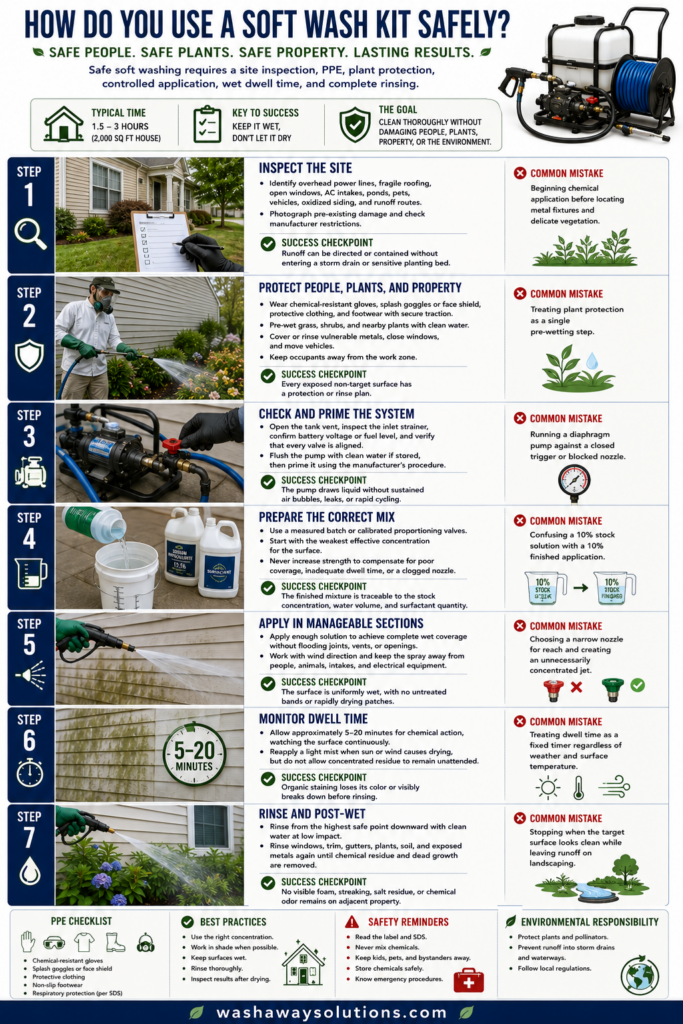
Safe soft washing requires a site inspection, PPE, plant protection, controlled application, wet dwell time, and complete rinsing. A typical 2,000-square-foot house takes about 1.5-3 hours from setup through teardown, although access, roof pitch, landscaping, and rinsing requirements can change that range.
Step 1: Inspect the Site
Identify overhead power lines, fragile roofing, open windows, air-conditioning intakes, ponds, pets, vehicles, oxidized siding, and runoff routes. Photograph pre-existing damage and check whether the roof or siding manufacturer restricts chemical treatment.
Success checkpoint: runoff can be directed or contained without entering a storm drain or sensitive planting bed.
Common mistake: beginning chemical application before locating metal fixtures and delicate vegetation.
Step 2: Protect People, Plants, and Property
Wear chemical-resistant gloves, splash goggles or a face shield, protective clothing, and footwear with secure traction. Respiratory protection is not a universal one-size-fits-all item, so select it through the product SDS and a proper workplace respiratory program rather than wearing an arbitrary dust mask.
Pre-wet grass, shrubs, and nearby plants with clean water. Cover or rinse vulnerable metals, close windows, and move vehicles. Keep occupants away from the work zone.
Success checkpoint: every exposed non-target surface has a protection or rinse plan.
Common mistake: treating plant protection as a single pre-wetting step.
Step 3: Check and Prime the System
Open the tank vent, inspect the inlet strainer, confirm battery voltage or fuel level, and verify that every valve is aligned. Flush the pump with clean water if it has been stored, then prime it using the manufacturer’s procedure.
Success checkpoint: the pump draws liquid without sustained air bubbles, leaks, or rapid cycling.
Common mistake: running a diaphragm pump against a closed trigger or blocked nozzle.
Step 4: Prepare the Correct Mix
Use a measured batch or calibrated proportioning valves. Start with the weakest effective concentration for the surface, and never increase strength to compensate for poor coverage, inadequate dwell time, or a clogged nozzle.
Success checkpoint: the finished mixture is traceable to the stock concentration, water volume, and surfactant quantity.
Common mistake: confusing a 10% stock solution with a 10% finished application.
Step 5: Apply in Manageable Sections
Apply enough solution to achieve complete wet coverage without flooding joints, vents, or openings. Work with wind direction and keep the spray away from people, animals, intakes, and electrical equipment.
Success checkpoint: the surface is uniformly wet, with no untreated bands or rapidly drying patches.
Common mistake: choosing a narrow nozzle for reach and creating an unnecessarily concentrated jet.
Step 6: Monitor Dwell Time
Allow approximately 5-20 minutes for chemical action, watching the surface continuously. Reapply a light mist when sun or wind causes drying, but do not allow concentrated residue to remain unattended.
Success checkpoint: organic staining loses its color or visibly breaks down before rinsing.
Common mistake: treating dwell time as a fixed timer regardless of weather and surface temperature.
Step 7: Rinse and Post-Wet
Rinse from the highest safe point downward with clean water at low impact. Rinse windows, trim, gutters, plants, soil, and exposed metals again until chemical residue and dead growth are removed.
Success checkpoint: no visible foam, streaking, salt residue, or chemical odor remains on adjacent property.
Common mistake: stopping when the target surface looks clean while leaving runoff on landscaping.
How Much Does a Soft Wash System Kit Cost?
A portable DIY system typically costs about $300-$700, a professional 12V skid commonly costs $1,500-$3,500, and a gas or air commercial build can exceed $6,000-$15,000 before a custom trailer. Regional taxes, shipping, tanks, reels, batteries, PPE, and chemical storage can materially increase the installed cost.
| Kit level | Typical equipment | Typical price | Assembly or setup time | Suitable workload |
|---|---|---|---|---|
| Portable DIY | 5.3 GPM 12V pump, 25-65 gallon tank, hose, gun | $300-$700 | 2-4 hours | Occasional home cleaning |
| Entry professional | 5.3-7 GPM pump, 50-100 gallon tank, reel, battery | $900-$1,800 | 4-8 hours | Small residential route |
| Proportioning skid | 7 GPM pump, 2-3 tanks, manifold, 200-300 foot reel | $1,500-$3,500 | Factory assembled or 1 day | Regular contractor work |
| Gas diaphragm skid | 9-12+ GPM pump, engine, large tanks, reel | $3,500-$7,500 | 1-2 days | High-volume roofs and walls |
| Air commercial build | Air pump, compressor, manifold, tanks, trailer | $6,000-$15,000+ | Custom installation | Industrial and multi-crew use |
Budget for consumables and maintenance separately. A battery, pump diaphragm, hose, strainer, nozzle set, chemical, PPE, and replacement fittings are operating costs, not one-time accessories.
Soft Washing Versus Pressure Washing: Which Is Better?
Soft washing is usually better for organic growth on fragile or water-sensitive surfaces, while pressure washing is better for hard-surface soil, loose debris, and some non-biological deposits. The correct choice depends on contamination and substrate rather than the marketing name attached to the machine.
| Decision factor | Soft wash system | Pressure washer | Practical winner |
|---|---|---|---|
| Asphalt-shingle algae | Chemical treatment at 3%-6% SH | High-impact water can dislodge granules | Soft wash |
| Vinyl siding growth | 60-100 PSI typical pump output | Often 1,000-2,500 PSI at equipment | Soft wash |
| Oil on concrete | Detergent and dwell may help | Hot water and pressure improve removal | Pressure washer |
| Loose mud on masonry | Chemical action is unnecessary | 1,500-3,000 PSI can rinse efficiently | Pressure washer |
| Fragile painted wood | Low-impact application and rinse | High pressure can strip coating | Soft wash |
| Thick lichen roots | Chemical treatment, often repeated | Mechanical removal may damage roofing | Soft wash, with patience |
| Large flat commercial concrete | Lower mechanical impact, slower rinse | High flow and hot water improve production | Pressure washer |
Soft washing does not mean zero pressure, and pressure washing does not always mean unsafe cleaning. A trained operator can use low pressure with a pressure-washer pump for rinsing, provided the nozzle, distance, flow, and substrate are controlled.
What Are the Most Common Kit Failures?
Most soft wash failures originate in chemical incompatibility, restriction, air leakage, or poor rinsing rather than an underpowered pump. Diagnosing the fluid path from the tank to the nozzle usually identifies the problem faster than replacing the entire kit.
| Symptom | Likely cause | First diagnostic action | Typical correction |
|---|---|---|---|
| Pump runs but will not prime | Air leak or blocked strainer | Inspect suction hose and inlet screen | Tighten fittings or clean strainer |
| Pump pulses rapidly | Nozzle too small or trigger restricted | Spray through a larger approved orifice | Reduce back pressure |
| No pressure or weak flow | Low battery, torn diaphragm, stuck check valve | Test voltage and inspect pump head | Charge battery or service pump |
| Chemical strength seems inconsistent | Uncalibrated proportioner | Measure output from each line | Recalibrate valves |
| Hose becomes soft or leaks | Incompatible material | Check chemical compatibility chart | Replace with rated hose |
| White residue appears | Solution dried on surface | Rinse immediately with clean water | Rewet and rinse, then reassess |
| Plants wilt after cleaning | Overspray or contaminated runoff | Flush vegetation and soil | Increase shielding and rinse volume |
A pump that cycles after a nozzle change may be reacting to excessive restriction, not failing internally. Conversely, continuous cycling with a correctly sized open nozzle can indicate a pressure-switch, check-valve, or diaphragm problem.
Dried sodium hypochlorite crystallization can damage check valves and diaphragms. Fresh-water flushing after every chemical session is among the lowest-cost maintenance actions in the system.
Which Kit Fits Your Situation?
A homeowner should choose a portable 12V batch system with a 5.3 GPM pump and a modest tank. The system is easier to store, quieter than a gas unit, and adequate for occasional siding, fence, and small-roof cleaning when the operator can work from safe ground positions.
A residential startup should choose a 5.3-7 GPM 12V skid with a 50-100 gallon tank, chemical-rated reel, spare diaphragm, spare nozzle set, and basic proportioning capability. The additional cost improves consistency and reduces downtime between jobs.
A high-volume contractor should choose a 9-12+ GPM gas diaphragm system when long hose runs, multi-story access, and rapid rinsing determine profitability. The contractor must also budget for engine maintenance, fuel storage, noise management, and more rigorous overspray controls.
An industrial user should consider an air-diaphragm pump only when chemical compatibility, dry-run tolerance, or an existing compressed-air infrastructure justifies the complexity. An air pump without an appropriately sized compressor is not a high-performance system.
What Is a Soft Wash Kit Not Good For?
A soft wash system is not a universal substitute for hot-water pressure washing, abrasive restoration, or hazardous-material remediation. It is also a poor choice for untrained roof access, indoor spraying, uncontrolled runoff, or surfaces whose manufacturer prohibits hypochlorite.
The most counterintuitive practitioner rule is that stronger chemical does not compensate for poor technique. Complete coverage, correct dwell time, wetting control, and rinsing often produce a better result than an unnecessarily aggressive mix.
How Do You Buy Without Overspending?
Buy for required flow, hose distance, surface type, and job frequency rather than buying the largest pump available. A 12V 5.3 GPM kit can be economical for residential work, but a 7 GPM pump may justify its price when the operator repeatedly cleans larger homes or needs faster rinsing.
Before purchasing, verify these specifications:
- Chemical compatibility: Confirm pump diaphragms, valves, seals, hose, gun, reel, and fittings are rated for the intended solution.
- Flow under operating conditions: Do not compare only the pump’s maximum advertised GPM. Hose length, elevation, nozzle orifice, and chemical viscosity reduce delivered flow.
- Serviceability: Check the price and availability of diaphragms, check valves, pressure switches, strainers, and replacement hoses.
- Power logistics: A 12V system needs battery capacity and charging access. A gas system needs fuel, ventilation, and maintenance. An air system needs compressor capacity.
- Runoff controls: Include plant-rinse hoses, tarps or shields where appropriate, drain protection, and enough clean water for post-treatment.
- Storage: Sodium hypochlorite degrades with heat, sunlight, contamination, and prolonged storage. A larger tank is not automatically more economical if solution sits unused.
Frequently Asked Questions
Can I Build a Soft Wash System From Individual Parts?
Yes, a soft wash system can be assembled from a compatible pump, tank, chemical-rated plumbing, reel, hose, gun, nozzles, battery or engine, fuse, and strainers. DIY assembly can reduce purchase cost, but incorrect wiring, incompatible seals, inadequate ventilation, or poorly supported plumbing creates safety and reliability problems.
How Long Does Sodium Hypochlorite Stay Effective?
Sodium hypochlorite loses strength over time, especially in warm, sunny, contaminated, or vented storage. Buy only the quantity a job schedule can use, store it cool and shaded according to the label, and avoid assuming that an old container still has its original concentration.
Can a Soft Wash System Clean Gutters?
A soft wash system can clean exterior gutter staining and organic growth when the gutter material and surrounding surfaces tolerate the solution. Protect painted finishes, aluminum, plants, and windows, and rinse thoroughly because concentrated hypochlorite can discolor or corrode nearby metals.
What GPM Is Enough for House Washing?
A 5.3 GPM 12V pump is generally enough for many single-home siding and small-roof jobs, while 7 GPM improves coverage and rinsing speed. Contractors cleaning large buildings, multi-story surfaces, or long hose runs may need 9-12 GPM from a gas diaphragm system.
Is a Soft Wash System Safe for Asphalt Shingles?
A soft wash system is commonly used for asphalt-shingle algae when the chemical concentration, application method, runoff control, and rinse procedure follow roofing guidance. Walking on fragile or steep shingles remains hazardous, and a roof manufacturer’s warranty instructions should be checked before treatment.
How Do I Store a Soft Wash Kit Between Jobs?
Flush the pump, hose, gun, and proportioning lines with clean water, drain exposed plumbing where freezing is possible, clean the inlet strainer, protect electrical connectors, and store nozzles dry. Do not leave sodium hypochlorite sitting in the pump unless the manufacturer explicitly permits that practice.
The Bottom Line
The best soft wash system kit matches pump output and chemical compatibility to the surfaces, hose distance, and cleaning volume. Choose a 5.3-7 GPM 12V batch or proportioning system for most residential work, move to a 9-12+ GPM gas diaphragm skid for high-volume production, and reserve air-diaphragm equipment for specialized industrial demands. Safe results depend on measured chemistry, controlled dwell time, low-impact application, plant protection, and complete rinsing.