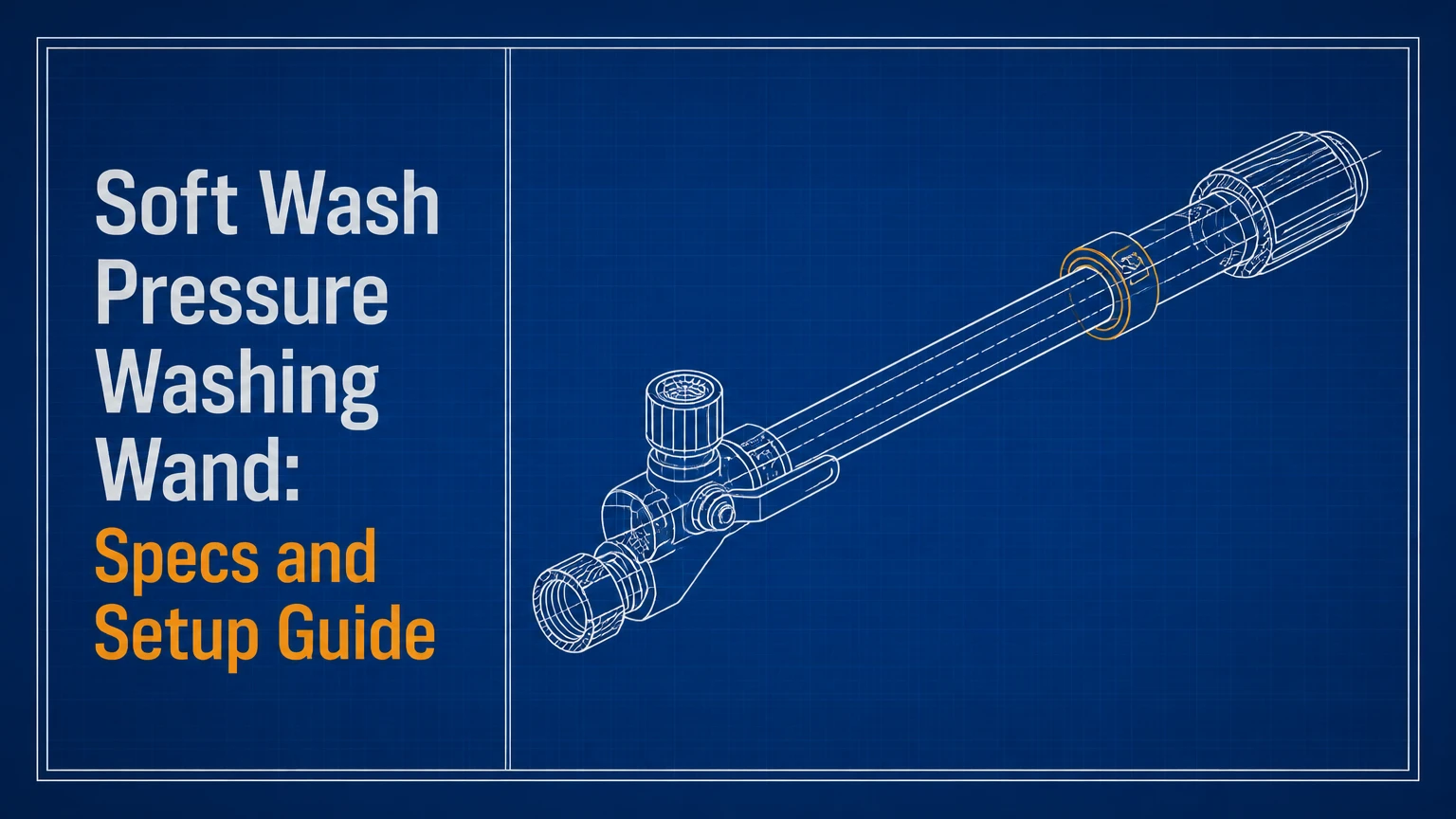
A soft wash pressure washing wand is a low-pressure applicator used to deliver cleaning solution and rinse water onto roofs, siding, fencing, and masonry. Unlike a conventional pressure-washing lance, the soft wash wand prioritizes adequate flow, chemical compatibility, controlled reach, and low surface impact rather than extreme PSI.
Key Facts at a Glance
- A soft wash wand controls fluid at the end of a system that may include a tank, pump, hose, valve, lance, and nozzle.
- Typical professional systems deliver approximately 3-10 GPM, while operating pressure depends on the pump, hose, nozzle, and elevation.
- Polypropylene, PVDF, stainless steel, Viton, and PTFE are common chemical-compatible materials.
- A wide-orifice soft-wash nozzle reduces impact and can produce a coarse stream or fan pattern without the atomization of a fine pressure-washer tip.
- A dedicated fresh-water flush after chemical use reduces salt crystallization, seal damage, valve sticking, and corrosion.
- Sodium hypochlorite concentration must follow the chemical label, surface requirements, local rules, and runoff controls.
What Is a Soft Wash Pressure Washing Wand?
A soft wash pressure washing wand is the operator-controlled spray assembly for applying low-pressure detergent or sodium-hypochlorite solution. The assembly normally includes a chemical-resistant trigger gun or ball valve, a lance or extension pole, hose fittings, and a wide-orifice nozzle or nozzle manifold.
The wand does not create the cleaning chemistry. A pump, downstream injector, or proportioning system moves liquid from the source to the wand. That distinction matters because a wand rated for 10 GPM cannot compensate for a pump that supplies only 2 GPM, a restricted hose, or an injector that will not draw chemical at the selected flow.
Soft washing removes organic contamination through chemical action and rinsing. Pressure washing relies more heavily on mechanical impact. Neither method is automatically safe: excessive pressure can damage siding or dislodge roof granules, while poorly controlled bleach can injure plants, discolor materials, or create hazardous runoff.
How Does the Wand Work?
A soft wash wand works by opening a relatively unrestricted valve and shaping a high-volume liquid stream through a large nozzle orifice. The fluid path is typically tank or water source, pump or injector, chemical-resistant hose, valve, lance, nozzle, and target surface.
A full-port ball valve often produces less restriction than a small trigger gun. That difference can improve flow and vertical reach when the pump has sufficient capacity. However, a large valve does not increase the pump’s output, and a nozzle that is too small can raise pressure rapidly.
The operator should distinguish three measurements:
- Pressure: force at the nozzle, measured in PSI.
- Flow: delivered volume, measured in GPM.
- Solution strength: chemical concentration at the surface, often discussed as percent sodium hypochlorite.
A 2023 technical bulletin from the U.S. Department of Agriculture’s National Agricultural Aviation Research Center describes spray drift as strongly affected by droplet size and wind. Soft-wash operators should therefore prefer a coarse, controlled pattern over a finely atomized mist, especially near people, vehicles, air intakes, and vegetation.
Why does high flow matter more than maximum PSI?
High flow helps wet large areas, move dead organic matter, and carry solution to elevated surfaces, while maximum PSI mainly increases impact. For roof and siding treatment, a practical system often operates below 300 PSI, but the correct value depends on the equipment manufacturer and the surface.
A 12-volt diaphragm pump, gas-powered soft-wash pump, air-diaphragm pump, or pressure washer with downstream injection can feed a wand. Each arrangement has different limits. Downstream injection may produce a weaker mixture and shorter reach, while a dedicated chemical pump can deliver stronger batches but requires more careful material selection.
Which Wand Materials Handle Soft-Wash Chemicals?
Polypropylene and PVDF generally provide strong resistance to sodium hypochlorite solutions, while 304 or 316 stainless steel offers greater impact resistance and long-term structural durability. Aluminum is light but needs more careful chemical management because bleach exposure and trapped solution can accelerate corrosion.
Material selection should include both the body and internal wetted parts. A stainless wand with an incompatible spring or seal can fail sooner than a plastic assembly with chemically suitable internals. Viton and PTFE are common choices, but the equipment manufacturer’s chemical compatibility chart has priority because concentration, temperature, exposure time, and additives affect service life.
| Material or seal | Typical strength | Main limitation | Suitable application |
|---|---|---|---|
| Polypropylene body | 1-10 GPM typical | Can crack after impact or freezing | Homeowner and light commercial use |
| PVDF wetted parts | Manufacturer-specific | Higher purchase price | Stronger chemical exposure |
| 304 stainless steel | 3-10 GPM typical | Heavier than polymer | Daily commercial work |
| 316 stainless steel | 3-10 GPM typical | Costs more than 304 | Repeated chemical and coastal exposure |
| Viton seal | Chemical-resistant elastomer | Not compatible with every chemical | Many hypochlorite applications |
| PTFE seal | Broad chemical resistance | Can require precise valve design | Aggressive or mixed solutions |
| Aluminum body | 3-8 GPM typical | Corrosion if chemical remains inside | Rinse-focused or carefully flushed systems |
Standard rubber is not automatically unsuitable. Buna-N and EPDM have different compatibility profiles, and EPDM can resist some water-based chemicals well. The accurate rule is to verify the specific seal against the product’s concentration and temperature rather than assume that every non-Viton seal dissolves immediately.
What Types of Soft Wash Wands Are Available?
Soft wash wands fall into four practical configurations: short trigger guns, full-port ball-valve lances, telescoping poles, and multi-nozzle J-rods. The right configuration depends on required reach, daily operating time, chemical strength, and whether the operator needs rapid spray-pattern changes.
| Configuration | Typical reach | Typical flow range | Best use | Main trade-off |
|---|---|---|---|---|
| 18-36 inch trigger wand | 6-15 feet | 2-5 GPM | Fences, siding, patios | Limited height and smaller passages |
| 24-48 inch ball-valve lance | 10-25 feet | 4-10 GPM | Residential roof edges and walls | More hand weight |
| J-rod manifold | 10-30 feet | 4-10 GPM | Switching between application patterns | More fittings and chemical exposure points |
| Fiberglass extension pole | 15-30 feet | 3-8 GPM | Two-story siding and roof sections | Flex and wind load |
| Carbon-fiber telescoping pole | 18-40 feet | Manufacturer-specific | High-reach commercial work | High purchase cost and wind sensitivity |
Trigger gun or full-port ball valve?
A trigger gun is easier to operate in short sessions, whereas a full-port ball valve usually favors flow and simplicity during high-volume commercial work. The better choice depends on hand fatigue, shutoff control, required GPM, and whether the gun’s internal passages restrict the pump.
A trigger assembly provides a familiar squeeze handle and can be useful around delicate work. A ball valve with a lever has fewer moving parts and often a larger internal passage, but the lever may require a different grip and can be tiring during repetitive use.
A J-rod adds interchangeable nozzle positions for chemical application, rinsing, and different reach patterns. Quick-connect fittings make changes fast, but every connection introduces a possible leak path. Inspect O-rings and couplers before pressurizing the system.
Which Specifications Should You Check?
The most important soft-wash wand specifications are inlet size, maximum flow, chemical compatibility, pressure rating, nozzle compatibility, reach, and serviceability. Buyers should match those specifications to the pump’s delivered output, not to the pump’s advertised maximum.
| Specification | Typical working range | Why it matters | Buyer checkpoint |
|---|---|---|---|
| Inlet connection | 3/8 or 1/2 inch NPT | Controls restriction and fitting compatibility | Match hose, valve, and pump plumbing |
| Delivered flow | 3-10 GPM | Determines wetting speed and reach | Measure actual pump output |
| Working pressure | 50-300 PSI | Limits surface impact | Follow wand and surface ratings |
| Rated maximum pressure | 500-1,000 PSI | Prevents component overload | Never treat the maximum as a target |
| Nozzle orifice | Manufacturer-specific | Shapes flow and pressure | Use the maker’s nozzle chart |
| Hose internal diameter | 3/8-1/2 inch typical | Affects friction loss | Use larger ID for long runs |
| Vertical reach | 15-40 feet typical | Determines ground-based operation | Allow for wind and elevation loss |
Nozzle labels are not universal. A “#40” tip can refer to an orifice designation that differs by manufacturer, and nozzle geometry changes the resulting pattern. Select the tip using the nozzle maker’s chart for the actual GPM and pressure, then verify that the spray is coarse enough for the application.
A useful field rule is to change one variable at a time. If reach is poor, inspect the water supply, pump output, hose restrictions, fittings, nozzle obstruction, and elevation before simply installing a smaller orifice.
How Much Does a Soft Wash Wand Cost?
A soft wash wand typically costs $30-$60 for a basic polymer assembly, $100-$250 for a commercial lance and valve setup, and $400-$900 for a carbon-fiber telescoping system. Those ranges are typical retail estimates, not fixed market prices, and fittings, nozzles, hose, and tax may cost extra.
| Setup level | Typical purchase price | Included equipment | Typical service expectation |
|---|---|---|---|
| Basic polymer wand | $30-$60 | Trigger, short lance, one nozzle | 2-5 years with seasonal use |
| Commercial ball-valve wand | $120-$250 | Valve, lance, fittings, nozzle options | 1-3 years of frequent use |
| J-rod assembly | $100-$250 | Manifold and multiple tips | Replace seals and tips as needed |
| Fiberglass pole system | $150-$450 | Pole, hose routing, nozzle holder | 1-3 years depending on abuse |
| Carbon-fiber pole system | $400-$900 | Telescoping pole and accessories | Longer life with careful handling |
Commercial operators should budget for O-rings, valve seats, strainers, nozzle tips, hose, and quick couplers. A $150 wand that needs a $12 seal kit is usually more economical to repair than a low-cost assembly with unavailable replacement parts.
How Do You Use a Soft Wash Wand Safely?
Safe soft washing follows six stages: inspect and protect, prepare the solution according to its label, apply with controlled overlap, allow dwell time, rinse thoroughly, and flush the entire chemical path. A typical residential job takes 30-90 minutes, with wind, height, buildup, and rinsing requirements controlling the schedule.
Before You Start
| Requirement | Typical value |
|---|---|
| Operator time | 30-90 minutes per residential elevation |
| Flush time | 2-5 minutes with fresh water |
| PPE | Chemical-resistant gloves, eye protection, protective clothing |
| Minimum tools | Wand, hose, nozzle, clean-water source, plant-rinse hose |
| Chemical measurement | Label-defined, never guessed from color |
| Weather check | Avoid gusty wind, freezing conditions, and rapid drying |
Step 1: Inspect the system
Check the hose, clamps, fittings, valve, nozzle, pump, and chemical tank. Confirm that the wand’s pressure rating exceeds the system’s regulated pressure and that the nozzle is installed securely.
You will know the system is ready when the valve moves smoothly, fittings remain dry, and clean water flows without pulsing. A common mistake is starting with a partially blocked nozzle, which can create an unpredictable jet.
Step 2: Protect and pre-wet vegetation
Cover or move vulnerable items, close windows, protect electrical equipment, and saturate nearby plants with clean water. Pre-wetting reduces the concentration of runoff absorbed by foliage, but it does not make chemical overspray harmless.
You will know the area is prepared when leaves, soil, windowsills, vehicles, and outdoor furniture have been inspected. The common mistake is protecting only visible shrubs while ignoring roof drains and downspouts.
Step 3: Prepare the cleaning solution
Use the product label, site conditions, and surface manufacturer guidance to determine the mixture. Do not treat a single percentage as universal: a roof treatment, painted siding wash, and masonry cleaner may require different strengths and dwell times.
Never mix sodium hypochlorite with acids, ammonia, or incompatible cleaners. The Centers for Disease Control and Prevention states, “Never mix household bleach with ammonia or any other cleanser.” Use ventilation and never combine products in a closed tank without documented compatibility.
Step 4: Apply from bottom to top
Apply a controlled coarse spray from the lower section upward, keeping the wand at a manageable distance and avoiding windows, openings, occupants, and electrical components. Bottom-up application can reduce visible streaking because lower sections receive solution before runoff from upper sections reaches them.
You will know coverage is adequate when the surface is uniformly wet without heavy curtains of runoff. The common mistake is using a narrow, high-impact tip to increase reach, which can damage coatings and overload the pump.
Step 5: Control dwell time
Allow the solution to work for a period specified by the product and surface conditions. A typical interval is 5-15 minutes, but hot sun, porous masonry, cool temperatures, and heavy organic growth can change the required time.
Keep the surface wet enough to prevent premature drying. You will know dwell time is working when organic staining loosens and the surface can rinse clean without aggressive impact. The common mistake is allowing chemistry to dry on glass, painted surfaces, or metal.
Step 6: Rinse from top to bottom
Rinse with clean water from the highest treated area downward, using the widest appropriate pattern and enough flow to remove dead growth and residue. Keep checking gutters, flashing, window frames, and plant beds for runoff.
You will know the rinse is complete when no visible residue remains and the runoff is controlled. The common mistake is rinsing too briefly, leaving chemical residue that can dry into streaks or continue affecting nearby materials.
Step 7: Flush the chemical path
Run fresh water through the tank or pickup line, pump, hose, valve, lance, and nozzle until the discharge is clear and odor is substantially reduced. Open and close the valve during flushing so fresh water reaches internal seats.
You will know flushing is complete when the outlet produces clean water consistently. The common mistake is flushing only the wand while leaving bleach in the pump head and supply hose.
Which Setup Fits Different Jobs?
A homeowner cleaning siding once or twice yearly usually needs a chemical-resistant polymer trigger wand with a 24-inch lance and compatible hose fittings. A contractor cleaning several properties daily benefits from a full-port stainless ball valve, 1/2-inch plumbing where compatible, replaceable seals, and quick-change nozzles.
| User and job | Recommended wand | Pump or flow target | Avoid |
|---|---|---|---|
| Homeowner, one-story siding | Polymer trigger, 18-24 inch | 2-5 GPM | Expensive telescoping pole |
| Homeowner, small roof edge | Short lance or fiberglass pole | 3-5 GPM | Climbing to compensate for poor reach |
| Light commercial contractor | Stainless ball valve, J-rod | 4-8 GPM | Small restrictive trigger passages |
| Two-story siding specialist | Fiberglass or carbon pole | 4-8 GPM | Operating in strong crosswinds |
| High-volume roof cleaner | Ball valve plus dedicated pole | 5-10 GPM | Unrated aluminum and unknown seals |
Can a soft wash wand clean a two-story roof?
A soft wash wand can reach portions of a two-story roof from the ground when the pump, hose, nozzle, elevation, and weather conditions provide enough delivered flow. A telescoping pole improves control and reduces the need for ladders, but wind can turn a long pole into an unstable lever.
A reach claim should be tested on the actual property. Roof pitch, ridge height, nozzle pattern, solution viscosity, and hose friction all reduce practical reach compared with a manufacturer’s laboratory or showroom figure.
How Does a Soft Wash Wand Compare With Alternatives?
A dedicated low-pressure wand provides better chemical control and lower impact than a conventional pressure-washer lance, while downstream injection offers a cheaper entry route with less control over solution strength. A 12-volt or gas soft-wash pump gives stronger independent chemical delivery but costs more and demands stricter maintenance.
| Method | Typical pressure | Chemical control | Reach potential | Best fit |
|---|---|---|---|---|
| Soft wash wand with dedicated pump | 50-300 PSI | High | 20-40 feet | Roofs and organic growth |
| Pressure washer downstream injector | 500-3,000 PSI system | Moderate to low | 15-30 feet | Light house washing |
| Garden hose sprayer | Under 100 PSI | Low to moderate | 10-20 feet | Small areas and rinsing |
| High-pressure lance | 1,000-4,000 PSI | Separate chemical system | 15-35 feet | Hard surfaces, not delicate roofs |
| Telescoping soft-wash pole | Pump-dependent | High | 25-40 feet | Ground-based high-reach work |
Pressure-washer accessories are not interchangeable by default. A restrictive pressure nozzle can overpressure a low-pressure pump or turn a controlled soft wash into a damaging jet. Always check thread type, pressure rating, flow capacity, and chemical compatibility before connecting components.
What Problems Affect Soft Wash Wands?
The most common soft-wand problems are leaks, low reach, sputtering, valve failure, and uneven spray. These faults usually come from chemical crystallization, air entering the pump inlet, clogged tips, undersized plumbing, incompatible seals, or a pump operating outside its intended flow range.
| Symptom | Likely cause | Corrective action |
|---|---|---|
| Leak at trigger or valve | Worn O-ring or seat | Install the specified seal kit |
| Sputtering discharge | Air leak or low tank level | Tighten suction fittings and refill |
| Weak vertical reach | Clogged tip or excessive friction | Clean tip and inspect hose ID |
| Valve stays open | Crystals or damaged seat | Flush, disassemble, and replace parts |
| Uneven fan pattern | Damaged or mismatched nozzle | Replace tip using the maker’s chart |
| Pump surging | Restricted inlet or inadequate supply | Remove blockage and verify feed rate |
| Metal discoloration | Chemical left in assembly | Flush immediately and inspect corrosion |
Do not clear a pressurized nozzle with a finger, pin, or improvised tool. Shut down the pump, relieve pressure, remove the tip, and follow the nozzle manufacturer’s cleaning procedure.
What Are the Important Edge Cases?
Soft wash systems need special caution on oxidized paint, old stucco, lead-painted surfaces, untreated wood, delicate metal, solar panels, and areas with sensitive landscaping. Chemical compatibility and runoff control matter as much as the wand’s pressure rating.
Oxidized paint can chalk when wet, and strong chemistry can make the appearance uneven. Old mortar, failing caulk, and loose roof granules can be dislodged even at relatively low pressure if the operator uses excessive flow or directs the nozzle too closely.
Wind is a practical operating limit. A wand may reach 30 feet in still air but provide poor control during gusts, and drift can affect neighboring property. Stop when the pattern cannot remain on the target surface.
How Should You Clean and Store the Wand?
Flush the complete fluid path with fresh water after every chemical application, then relieve pressure, remove residue from the nozzle, and store the wand dry and protected from freezing. Daily commercial users commonly spend 2-5 minutes flushing, while seasonal users should flush before extended storage.
Inspect the valve, hose barb, couplers, O-rings, nozzle seat, pole sections, and clamps during storage. Keep polymer components out of prolonged direct sunlight when the manufacturer recommends UV protection, and never leave trapped water in a freezing environment.
A small inline strainer can protect the nozzle and valve from tank debris, but the strainer itself must be cleaned. A blocked strainer can imitate pump failure by reducing inlet flow and causing pulsing.
FAQ
Can I use regular bleach in a soft wash wand?
Use only a product and concentration permitted by the equipment manufacturer, chemical label, surface guidance, and local regulations. Household bleach may contain additives or have a different concentration than professional sodium hypochlorite. Never mix bleach with ammonia, acids, or other cleaners, and protect people, plants, animals, and runoff routes.
What hose size is best for a soft wash system?
A 1/2-inch inside-diameter hose is often preferred for higher-flow systems and longer runs because it reduces friction compared with smaller tubing. A 3/8-inch hose can work for shorter, lower-flow assemblies. Match the hose to pump output, distance, fittings, pressure rating, and chemical compatibility.
Can I connect a soft wash wand to any pressure washer?
No. The pump, hose, fittings, valve, and nozzle must share compatible pressure, flow, thread, and chemical ratings. A pressure washer may feed a low-pressure applicator only when its regulated output and nozzle arrangement are suitable. A standard high-pressure tip can create excessive impact or overload a soft-wash component.
Why does my soft wash wand lose pressure after several minutes?
A loss of reach usually indicates a clogged nozzle, restricted inlet, low tank level, air leak, undersized hose, failing pump diaphragm, or excessive elevation. Check the system from the source forward, beginning with liquid level and suction fittings, before changing nozzle size or increasing pressure.
How long should a soft wash wand last?
A residential polymer wand can last approximately 2-5 years with seasonal use and thorough flushing. Daily commercial equipment may need seals, valve seats, nozzles, or hose replacement within months, while the complete assembly may last 1-3 years depending on chemical strength, impact, storage, and repair access.
Is a telescoping pole safer than a ladder?
A telescoping soft-wash pole can reduce ladder use by allowing ground-based application, but it does not remove all hazards. Wind, overhead wires, slippery surfaces, chemical drift, and unstable footing remain risks. Operators should follow local safety rules, inspect the pole, and avoid working when control of the tip is uncertain.
The Bottom Line
A soft wash pressure washing wand is best selected as part of a complete fluid-delivery system, not as an isolated accessory. Match the valve and nozzle to actual GPM, choose wetted materials and seals for the chemical used, protect vegetation, control drift, and flush every component after application. For occasional home use, polymer is usually sufficient; for daily high-flow work, a serviceable stainless ball-valve assembly or compatible telescoping pole provides better control and repairability.