You can soft wash a house with a pressure washer by applying a properly diluted exterior-cleaning solution through a downstream injector, then rinsing with low mechanical force. The chemical does most of the cleaning, while the pressure washer supplies water and reach. Success depends more on chemical control, plant protection, and preventing dry-down than on maximum PSI.
Key facts
- Soft washing removes organic growth through chemical action rather than high-pressure impact.
- A downstream injector keeps cleaning chemicals downstream of the pressure washer pump.
- Typical siding rinsing uses approximately 500-1,000 PSI at the surface, although pressure varies by equipment and distance.
- Sodium hypochlorite can damage plants, metals, fabrics, glass finishes, and painted surfaces when misapplied.
- Never mix bleach or sodium hypochlorite with acids, ammonia, or other cleaners.
- A typical two-story house takes 2-4 hours, including setup, application, rinsing, and cleanup.
What Does Soft Washing a House Mean?
Soft washing is an exterior-cleaning method that combines a detergent or surfactant solution with controlled water delivery. A pressure washer can provide that delivery, but the process is not conventional pressure washing because the operator avoids using concentrated high-pressure impact to strip contamination.
The term “soft wash” has no single universal pressure limit. Many contractors describe application or rinsing below 300 PSI, while other systems produce higher pressure at the pump but much less force at a wide-angle nozzle and at the surface. The safe value depends on the substrate, nozzle, distance, flow rate, and surface condition.
Soft washing is most useful for mildew, algae, lichen, and organic discoloration on vinyl siding, painted cladding, some stucco, and compatible masonry. It is not a repair method for failed paint, rotten wood, cracked render, loose shingles, or defective window seals.
How Does Soft Washing Work?
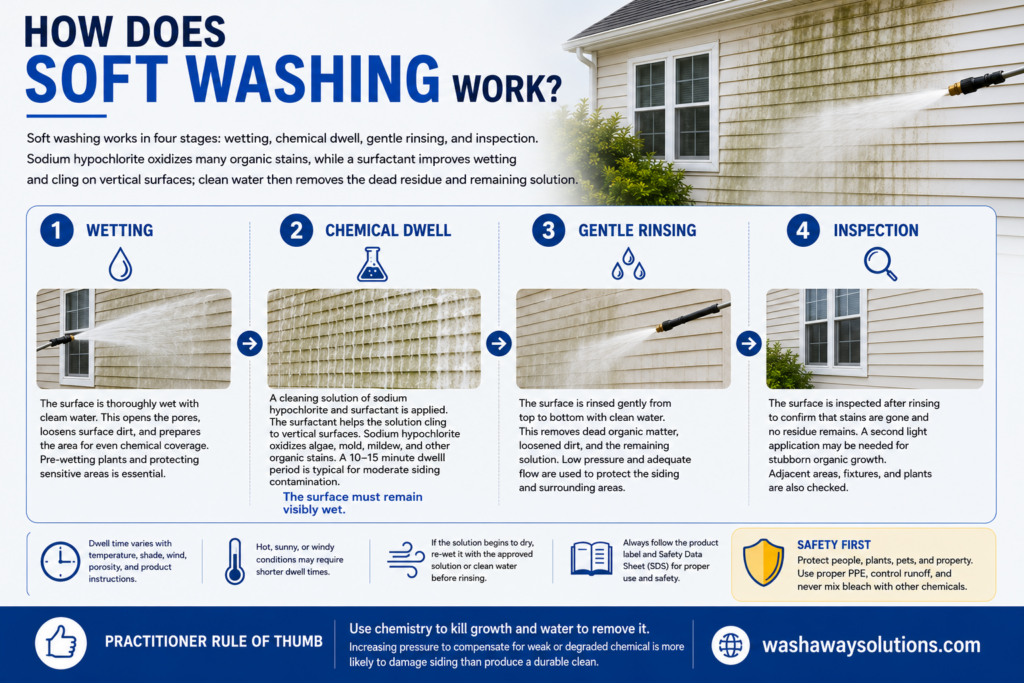
Soft washing works in four stages: wetting, chemical dwell, gentle rinsing, and inspection. Sodium hypochlorite oxidizes many organic stains, while a surfactant improves wetting and cling on vertical surfaces; clean water then removes the dead residue and remaining solution.
A 10-15 minute dwell period is typical for moderate siding contamination, but temperature, shade, wind, porosity, and product instructions change the required time. The surface must remain visibly wet. If the solution dries, re-wet it with the approved solution or clean water before rinsing.
A practitioner rule of thumb is simple: use chemistry to kill growth and water to remove it. Increasing pressure to compensate for weak or degraded chemical is more likely to damage siding than produce a durable clean.
Which Pressure Washer Setup Works Best?
A pressure washer with a downstream injector, chemical hose, and wide-angle soap nozzle is the most practical setup for a homeowner cleaning ordinary siding. The injector draws solution after the pump, reducing exposure of pump seals and valves to corrosive sodium hypochlorite.
A functioning downstream injector requires suitable water flow and low enough backpressure. A typical injector may dilute the chemical at approximately 1:7 to 1:10, but actual draw varies with the washer’s gallons per minute, hose length, nozzle, elevation, and injector model.
| Setup | Typical output | Best application | Main limitation |
|---|---|---|---|
| Electric washer with injector | 1.2-2.0 GPM | Small vinyl siding areas | Weak draw and limited reach |
| Gas washer with injector | 3.0-5.5 GPM | Whole-house siding and gutters | Requires correct injector sizing |
| 12-volt soft-wash pump | 4-7 GPM at 40-100 PSI | Roofs and large exteriors | Costs more and needs chemical-rated parts |
| Pump sprayer | 0.2-0.5 GPM | Spot treatment and small sections | Slow application and poor reach |
How Much Pressure Should You Use?
Use the lowest pressure that rinses away residue without forcing water behind the cladding. For many vinyl-sided homes, a wide fan and a wand held several feet away are safer than relying on a specific PSI number, because nozzle geometry changes impact force substantially.
Do not use a zero-degree or 15-degree tip on siding, soffits, window seals, roof shingles, or painted wood. A black soap nozzle, low-pressure rinse tip, or purpose-built soft-wash fan is more appropriate. Test the spray on an inconspicuous area before cleaning the visible elevation.
The pressure washer’s pump rating is not the same as pressure at the surface. A machine labeled 3,000 PSI does not mean the wall receives 3,000 PSI when a wide-angle nozzle, long hose, and stand-off distance reduce force.
When Does a Dedicated Soft-Wash Pump Make Sense?
A dedicated 12-volt diaphragm pump makes sense for roofs, large properties, high elevations, or chemical strengths that a downstream injector cannot deliver. The separate pump applies solution at low pressure and avoids sending concentrated sodium hypochlorite through the pressure washer’s internal plumbing.
A dedicated system is not automatically safer. Incorrect proportioning, overspray, wind, and poor runoff control can still damage landscaping and finishes. Homeowners usually need this equipment only when a downstream injector cannot reach or clean the intended surface effectively.
What Solution Should You Use?
Use a labeled exterior-cleaning product or fresh sodium hypochlorite diluted according to the product label, surface type, and equipment output. The final concentration at the surface is more important than the strength in the storage container, and injector dilution makes home recipes unreliable.
Commercial pool chlorine commonly contains 10-12.5% sodium hypochlorite, while household bleach may contain approximately 4-6%, depending on the product. Concentration declines with age, heat, sunlight, and storage conditions. A surfactant formulated for exterior cleaning can improve cling, but ordinary dish detergent may create excessive foam, leave residue, or harm landscaping.
| Surface | Typical chemical approach | Typical dwell | Mechanical approach |
|---|---|---|---|
| Vinyl siding | Label-directed low-strength SH solution | 5-15 minutes | Wide fan rinse |
| Painted wood | Weaker test mix and spot testing | 5-10 minutes | Minimal pressure |
| Stucco or EIFS | Manufacturer-approved cleaner | 5-10 minutes | Gentle, uniform rinse |
| Asphalt shingles | Roof-cleaning product or professional mix | 10-20 minutes | No pressure washing |
Do not combine sodium hypochlorite with muriatic acid, vinegar, ammonia, acidic rust removers, or other household cleaners. Mixing bleach with acids can release chlorine gas, while ammonia-based mixtures can produce toxic chloramines.
Why Is a Surfactant Used?
A surfactant lowers water’s surface tension, helping the solution wet dusty siding and remain on vertical surfaces long enough to react. Surfactants also make missed areas easier to see because the solution spreads more uniformly.
Surfactant does not replace the active cleaner. Excess product can leave a sticky film that attracts dirt, increases rinsing time, or makes windows streak. Follow the product label rather than adding a large amount to force cling.
Before You Start: Protect the Site
Preparation determines whether a house wash remains a cleaning job or becomes a landscaping and property-damage claim. Move furniture, toys, vehicles, grills, fabrics, and pet bowls away from the work area, then identify plants, ponds, HVAC equipment, electrical fixtures, and vulnerable finishes.
Turn off or shield outdoor electrical outlets, cameras, doorbells, speakers, and light fixtures with weather-appropriate protection. Do not seal equipment that needs ventilation, and do not spray directly into openings.
Weather and Site Conditions
Choose a cool, calm period with no immediate rain forecast. Wind increases chemical drift, direct hot sunlight accelerates drying, and rain can dilute the treatment before dwell time is complete.
Pre-wet vegetation with clean water before applying solution. Keep plants wet during the work, cover only when the cover will not trap heat, and rinse leaves, soil, and hardscape thoroughly after each section. Never allow concentrated runoff to collect around roots or enter a pond.
Step-by-Step Soft Washing Process
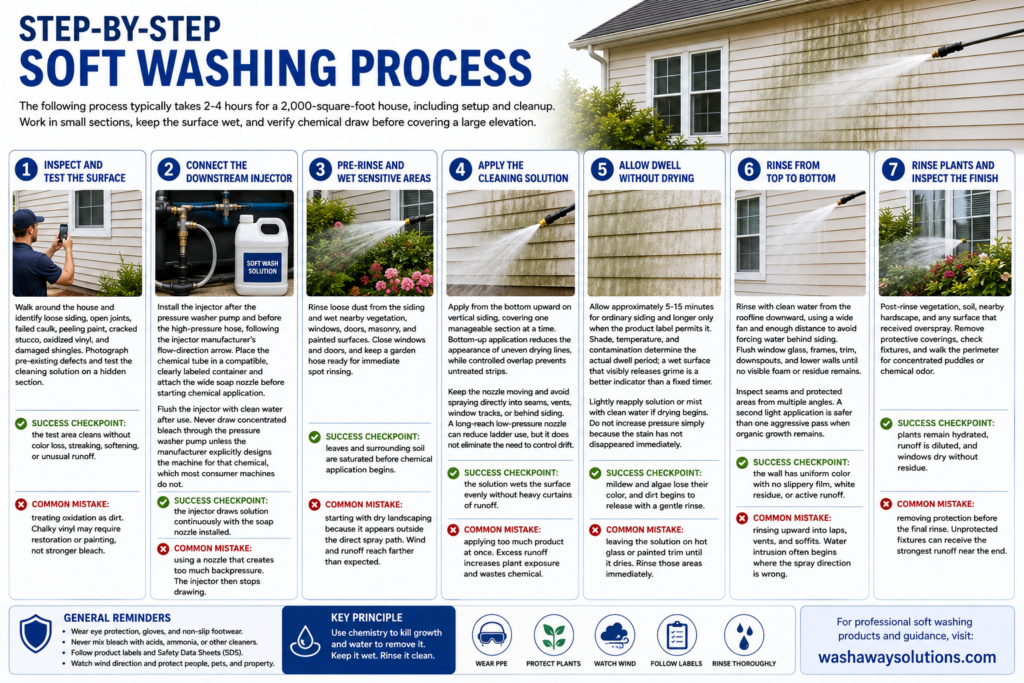
The following process typically takes 2-4 hours for a 2,000-square-foot house, including setup and cleanup. Work in small sections, keep the surface wet, and verify chemical draw before covering a large elevation.
Step 1: Inspect and Test the Surface
Walk around the house and identify loose siding, open joints, failed caulk, peeling paint, cracked stucco, oxidized vinyl, and damaged shingles. Photograph pre-existing defects and test the cleaning solution on a hidden section.
Success checkpoint: the test area cleans without color loss, streaking, softening, or unusual runoff.
Common mistake: treating oxidation as dirt. Chalky vinyl may require restoration or painting, not stronger bleach.
Step 2: Connect the Downstream Injector
Install the injector after the pressure washer pump and before the high-pressure hose, following the injector manufacturer’s flow-direction arrow. Place the chemical tube in a compatible, clearly labeled container and attach the wide soap nozzle before starting chemical application.
Flush the injector with clean water after use. Never draw concentrated bleach through the pressure washer pump unless the manufacturer explicitly designs the machine for that chemical, which most consumer machines do not.
Success checkpoint: the injector draws solution continuously with the soap nozzle installed.
Common mistake: using a nozzle that creates too much backpressure. The injector then stops drawing.
Step 3: Pre-Rinse and Wet Sensitive Areas
Rinse loose dust from the siding and wet nearby vegetation, windows, doors, masonry, and painted surfaces. Close windows and doors, and keep a garden hose ready for immediate spot rinsing.
Success checkpoint: leaves and surrounding soil are saturated before chemical application begins.
Common mistake: starting with dry landscaping because it appears outside the direct spray path. Wind and runoff reach farther than expected.
Step 4: Apply the Cleaning Solution
Apply from the bottom upward on vertical siding, covering one manageable section at a time. Bottom-up application reduces the appearance of uneven drying lines, while controlled overlap prevents untreated strips.
Keep the nozzle moving and avoid spraying directly into seams, vents, window tracks, or behind siding. A long-reach low-pressure nozzle can reduce ladder use, but it does not eliminate the need to control drift.
Success checkpoint: the solution wets the surface evenly without heavy curtains of runoff.
Common mistake: applying too much product at once. Excess runoff increases plant exposure and wastes chemical.
Step 5: Allow Dwell Without Drying
Allow approximately 5-15 minutes for ordinary siding and longer only when the product label permits it. Shade, temperature, and contamination determine the actual dwell period; a wet surface that visibly releases grime is a better indicator than a fixed timer.
Lightly reapply solution or mist with clean water if drying begins. Do not increase pressure simply because the stain has not disappeared immediately.
Success checkpoint: mildew and algae lose their color, and dirt begins to release with a gentle rinse.
Common mistake: leaving the solution on hot glass or painted trim until it dries. Rinse those areas immediately.
Step 6: Rinse From Top to Bottom
Rinse with clean water from the roofline downward, using a wide fan and enough distance to avoid forcing water behind siding. Flush window glass, frames, trim, downspouts, and lower walls until no visible foam or residue remains.
Inspect seams and protected areas from multiple angles. A second light application is safer than one aggressive pass when organic growth remains.
Success checkpoint: the wall has uniform color with no slippery film, white residue, or active runoff.
Common mistake: rinsing upward into laps, vents, and soffits. Water intrusion often begins where the spray direction is wrong.
Step 7: Rinse Plants and Inspect the Finish
Post-rinse vegetation, soil, nearby hardscape, and any surface that received overspray. Remove protective coverings, check fixtures, and walk the perimeter for concentrated puddles or chemical odor.
Success checkpoint: plants remain hydrated, runoff is diluted, and windows dry without residue.
Common mistake: removing protection before the final rinse. Unprotected fixtures can receive the strongest runoff near the end.
Which Surfaces Should You Soft Wash?
Soft washing suits organic staining on many exterior surfaces, but “low pressure” does not make every material chemically compatible. Product labels, manufacturer warranties, substrate age, and existing damage control the decision.
| Surface | Preferred method | Pressure guidance | Important limitation |
|---|---|---|---|
| Vinyl siding | Soft wash plus gentle rinse | Low surface force | Oxidation may remain |
| Painted wood | Mild cleaner and soft brush | Under approximately 500 PSI | Failed paint can lift |
| Asphalt shingles | Professional roof treatment | Do not pressure wash | Walking can damage shingles |
| Concrete driveway | Pressure washing or surface cleaner | Approximately 2,000-3,500 PSI when appropriate | SH alone may not remove oil |
| Natural stone | Material-specific cleaner | Test first | Acid sensitivity varies |
What About Roof Shingles?
Do not use a conventional pressure washer to blast asphalt shingles. The Asphalt Roofing Manufacturers Association recommends non-pressure cleaning methods for algae and moss, because aggressive pressure can remove granules and shorten roof life.
Roof treatments often use a stronger sodium hypochlorite solution than siding, but concentration and application should follow roofing guidance or be handled by a trained contractor. Steep roofs, fragile shingles, skylights, and overhead electrical lines create fall and property risks that low pressure does not solve.
What About Stucco, EIFS, and Brick?
Stucco and EIFS require a gentle, uniform application because porous areas hold solution and water. Inspect cracks and failed sealants first, and avoid forcing water into expansion joints or wall penetrations.
Brick tolerates some rinsing, but mortar may be soft, aged, or already eroded. Chemical compatibility varies by brick, mortar, sealant, and previous repairs. Test a small area and avoid acidic products unless the masonry manufacturer approves them.
Soft Washing vs. Pressure Washing
Soft washing is the better choice for organic growth on siding, painted surfaces, and roofs, while pressure washing is better for durable horizontal surfaces with embedded soil, tire marks, or grease. The correct method depends on the contaminant and substrate, not the equipment available.
| Decision factor | Soft washing | Pressure washing |
|---|---|---|
| Main cleaning mechanism | Chemical oxidation and surfactant action | Water impact and shear force |
| Typical house-siding force | Approximately 100-1,000 PSI at surface | Often 1,500-3,000 PSI |
| Organic growth | Kills and removes surface growth | May remove color while leaving roots |
| Best targets | Siding, stucco, roofs, painted wood | Concrete, some brick, durable paving |
| Primary risk | Chemical overspray and dry-down | Water intrusion and surface abrasion |
| Equipment cost | Injector from about $30, pump systems $250-$600 | Existing washer often sufficient |
Pressure washing can appear cleaner immediately on algae-stained siding, but surviving spores and damaged coating may produce faster recurrence. Soft washing can also fail when the solution is weak, stale, poorly applied, or rinsed before it has time to react.
Common Mistakes and How to Fix Them

The Injector Will Not Draw
Check the soap nozzle, injector orientation, chemical tube, filter, hose kinks, and water flow. A high-pressure tip creates backpressure that prevents Venturi suction, while an injector sized for 5 GPM may draw poorly on a 1.5 GPM electric machine.
White Film Appears on Windows
White residue usually indicates dried chemical salts or unremoved surfactant. Rinse glass immediately with abundant clean water, then use a manufacturer-approved glass cleaner; do not allow concentrated solution to dry on window coatings.
Plants Turn Yellow or Brown
Chemical burn results from concentrated overspray, dry leaves, contaminated soil, or inadequate post-rinsing. Continue flushing affected vegetation with clean water, remove contaminated mulch if necessary, and contact a local horticulture professional when severe damage appears.
Brown Streaks Remain After Cleaning
Brown discoloration may be tannin bleed from wood, rust runoff, or oxidation rather than organic growth. Do not keep increasing bleach strength. Identify the stain first, then use a compatible specialty product, such as an oxalic-acid cleaner for some iron or tannin stains, only after thoroughly removing and neutralizing bleach residue according to product directions.
Mold Returns Quickly
Rapid recurrence often indicates shade, dampness, clogged gutters, leaking downspouts, overhanging vegetation, or an incomplete treatment. Correct the moisture source and clean adjacent roof edges, gutters, and shaded elevations rather than repeating stronger chemical applications.
Cost, Time, and Equipment
Typical homeowner spending ranges from $30-$80 for a downstream injector, hose, nozzle, and small amount of cleaner when a pressure washer is already available. A dedicated 12-volt setup commonly costs $250-$600 before adding storage, hose reels, proportioning equipment, and chemical-resistant fittings.
Professional house washing commonly costs about $250-$600 for a standard 2,000-square-foot home, although access, height, regional labor rates, roof sections, and landscaping can move the price substantially. A 2-4 hour service window is typical for setup, treatment, rinsing, and cleanup.
| Project size | Typical DIY time | Typical professional price | Likely equipment |
|---|---|---|---|
| Small single-story home | 1.5-3 hours | $200-$400 | Electric or small gas washer |
| 2,000-square-foot house | 2-4 hours | $250-$600 | 3-5.5 GPM washer and injector |
| Large two-story home | 4-7 hours | $500-$1,000 | Long-reach or dedicated pump |
| Roof treatment | 3-6 hours | $400-$1,200 | Chemical-rated pump and fall controls |
Who Should Do the Work?
A homeowner with a single-story vinyl house, mild organic staining, calm weather, and functioning water access can usually use a downstream injector safely if the product label is followed. A professional is the better choice for steep roofs, extensive landscaping, weak or damaged siding, overhead utilities, poor drainage, or uncertain chemical handling.
The pressure washer itself is not the main qualification. Chemical exposure, ladder falls, runoff, and water intrusion create the most serious risks. If a worker cannot identify the surface, isolate runoff, protect plants, and rinse chemical residue completely, the project exceeds the safe DIY threshold.
FAQ
Can I Use Household Bleach for House Washing?
Household bleach may contain sodium hypochlorite, but concentration, additives, and freshness vary by product. Use an exterior-cleaning product or label-approved bleach, never mix it with other cleaners, and calculate the final concentration after equipment dilution. Do not assume a household bleach recipe is interchangeable with pool chlorine.
Should I Soft Wash in Direct Sunlight?
Direct sun is usually less favorable because heat and ultraviolet exposure accelerate drying. Work on shaded elevations during cooler periods, keep the surface wet, and rinse windows and painted trim quickly. Wind matters more than temperature when overspray could reach neighboring property or sensitive plants.
How Long Does a Soft-Washed House Stay Clean?
A typical result may last 1-3 years, but climate, shade, humidity, tree cover, and drainage determine regrowth. Houses beneath dense trees or in persistently damp climates may need annual maintenance, while sunny, well-drained elevations can remain presentable longer.
Can I Rent a Pressure Washer for Soft Washing?
You can rent a pressure washer for siding when the machine accepts a suitable downstream injector and has adequate water flow. Confirm the injector compatibility before renting, and do not run sodium hypochlorite through the pump. Renting a high-PSI machine does not make roof cleaning appropriate.
Does Soft Washing Remove Dirt Without Chemicals?
Soft washing is designed to rely on chemical action, so plain water may remove loose dust but usually will not kill mildew, algae, or lichen. For chemical-sensitive surfaces, use the material manufacturer’s approved cleaner and mechanical method rather than substituting high pressure.
Conclusion
To soft wash a house with a pressure washer, use a downstream injector for ordinary siding, apply a label-directed exterior cleaner, maintain a wet 5-15 minute dwell, and rinse gently from top to bottom. Protect plants before application, keep chemicals out of the pump, and choose a professional for roofs or damaged surfaces.