Soft washing a house with bleach uses diluted sodium hypochlorite, surfactant, and low-pressure application to kill mold, mildew, algae, and lichen without relying on high-impact water. A typical house wash takes 5-15 minutes of wet dwell time, followed by a gentle rinse, but the correct strength depends on the surface, product concentration, weather, and organic growth.
Key Facts at a Glance
- Sodium hypochlorite is the active oxidizing ingredient in liquid household bleach and pool chlorinating solution.
- A typical vinyl-siding wash uses approximately 0.5%-1.5% available SH at the surface, not necessarily the concentration inside the supply tank.
- Soft washing uses chemical action and low water impact, while pressure washing uses high water impact to remove contamination.
- The solution must remain wet during its 5-15 minute dwell period and must never be allowed to dry on glass, siding, metal, or painted trim.
- Plant protection requires pre-wetting, controlling overspray and runoff, then rinsing vegetation and soil after application.
- Never mix sodium hypochlorite with acids, ammonia, solvents, or unapproved cleaners because toxic gases or dangerous reactions can result.
What Does Soft Washing With Bleach Do?
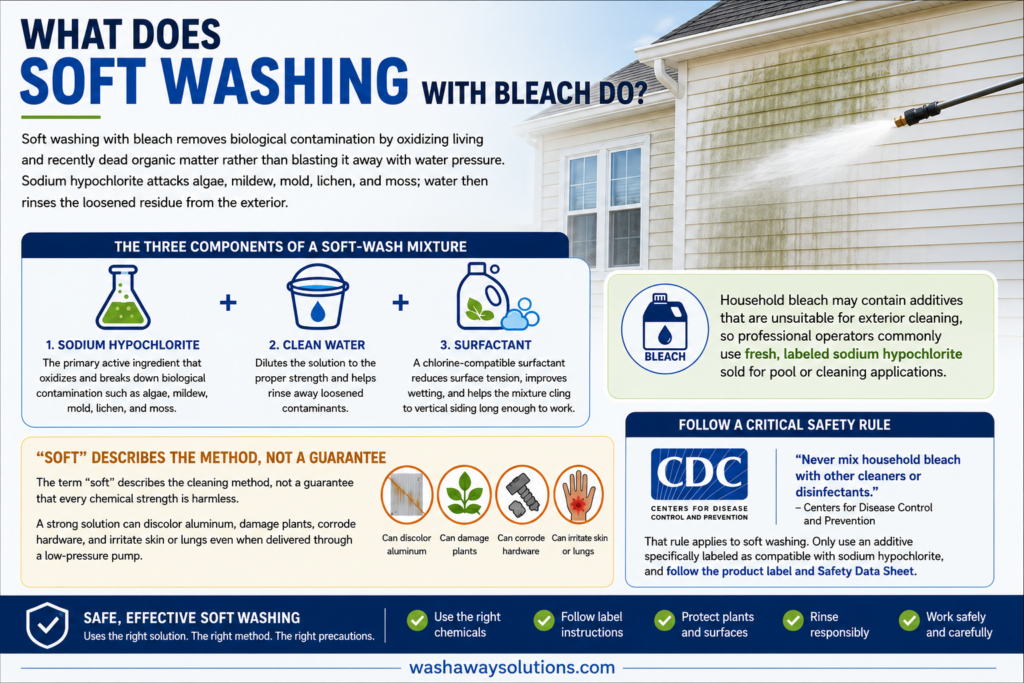
Soft washing with bleach removes biological contamination by oxidizing living and recently dead organic matter rather than blasting it away with water pressure. Sodium hypochlorite attacks algae, mildew, mold, lichen, and moss; water then rinses the loosened residue from the exterior.
A soft-wash mixture usually contains three components: sodium hypochlorite, clean water, and a chlorine-compatible surfactant. The surfactant reduces surface tension, improves wetting, and helps the mixture cling to vertical siding long enough to work. Household bleach may contain additives that are unsuitable for exterior cleaning, so professional operators commonly use fresh, labeled sodium hypochlorite sold for pool or cleaning applications.
The term “soft” describes the cleaning method, not a guarantee that every chemical strength is harmless. A strong solution can discolor aluminum, damage plants, corrode hardware, and irritate skin or lungs even when delivered through a low-pressure pump.
The Centers for Disease Control and Prevention states, “Never mix household bleach with other cleaners or disinfectants.” That rule applies to soft washing. Only use an additive specifically labeled as compatible with sodium hypochlorite, and follow the product label and Safety Data Sheet.
How Strong Should the Solution Be?
The final applied sodium hypochlorite concentration should start low and increase only after a test patch confirms that the surface tolerates it. Typical starting ranges are about 0.5%-1.0% SH for painted wood, 0.75%-1.5% for vinyl siding, and 1.0%-2.0% for heavily stained masonry, although product strength and local practice vary.
| Surface | Typical starting SH at surface | Typical dwell time | Main risk |
|---|---|---|---|
| Painted wood or cedar | 0.5%-1.0% | 5-10 minutes | Paint fading or raised grain |
| Vinyl siding | 0.75%-1.5% | 5-10 minutes | Oxidation, streaking, trapped runoff |
| Stucco or EIFS | 1.0%-2.0% | 8-15 minutes | Water intrusion and color variation |
| Brick or concrete | 1.0%-3.0% | 10-15 minutes | Mortar, metal, and plant exposure |
| Asphalt shingles | Often 1.0%-3.0% | 10-20 minutes | Granule loss and roof safety |
These are practitioner ranges, not universal formulas. Aged siding, direct sun, high heat, porous masonry, and weakened paint require a lower starting concentration. Roof cleaning has separate manufacturer, warranty, runoff, and fall-protection considerations.
To estimate a mixture, use:
Final SH percentage = supply SH percentage × supply volume ÷ total final volume
For example, four gallons of 12.5% SH diluted with 46 gallons of water produces approximately 1.0% SH in a 50-gallon batch before accounting for surfactant volume. Actual strength can be lower because sodium hypochlorite loses potency through heat, sunlight, age, and contaminated storage containers.
Do not confuse tank concentration with wall concentration. A downstream injector may dilute a stronger supply solution substantially before it reaches the surface.
Which Application System Fits the Job?
A downstream injector is usually the lowest-cost option for a one-story vinyl house, while a dedicated diaphragm-pump system provides stronger, more consistent chemical delivery and greater reach. A proportioner adds adjustable metering but costs more and requires disciplined calibration.
| System | Typical operating pressure | Applied SH control | Typical use |
|---|---|---|---|
| Pump sprayer | 20-60 PSI | Low, manual batch mix | Small areas and spot treatment |
| Downstream injector | Often below 500 PSI at nozzle | Limited by injector ratio | One- and two-story siding |
| 12-volt diaphragm pump | 40-100 PSI | Moderate to high | Roofs, stucco, commercial walls |
| Proportioner manifold | 40-100 PSI | Adjustable during application | Professional multi-surface work |
A downstream injector draws chemical through a Venturi effect when water flow and backpressure are appropriate. A high-pressure nozzle often prevents chemical draw, while a low-pressure soap nozzle increases flow and reduces backpressure. Injector performance depends on pump gallons per minute, hose length, nozzle selection, elevation, and the injector’s actual draw ratio.
A dedicated soft-wash pump draws from a chemical-resistant tank and can deliver more solution at greater height. That capability also increases the consequences of a mistake. A professional system should include chemical-rated hoses, shutoff valves, strainers, appropriate storage, and a controlled rinse supply.
Before You Start
Typical time: 2-4 hours for a small house, excluding setup and difficult access.
Difficulty: Moderate for a one-story vinyl exterior, advanced for roofs, EIFS, high walls, or complex landscaping.
Typical DIY material cost: $75-$350 if a suitable pressure washer or pump is already available.
Core supplies: fresh sodium hypochlorite, clean water, chlorine-stable surfactant, low-pressure applicator, garden hose, PPE, test strips if used by the product instructions, and plant-rinse water.
Wear chemical-resistant gloves, splash goggles, long sleeves, long pants, and footwear that resists slipping. Keep children, pets, and bystanders away from the work area. Provide ventilation around enclosed porches and never spray toward open windows, air intakes, or occupied spaces.
Inspect the siding, caulk, screens, light fixtures, outlets, gutters, roof edges, and painted surfaces first. Photograph pre-existing oxidation, failed paint, cracked sealant, and damaged screens. A bleach wash cannot repair oxidation, rust, failing coatings, or water-damaged cladding.
How to Soft Wash House With Bleach Safely
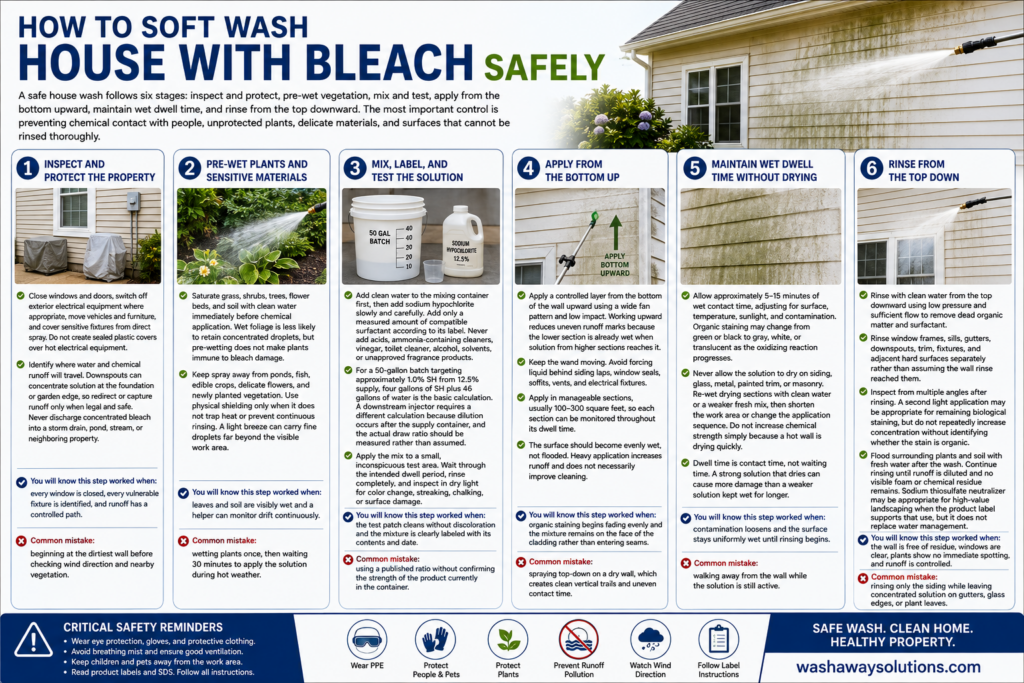
A safe house wash follows six stages: inspect and protect, pre-wet vegetation, mix and test, apply from the bottom upward, maintain wet dwell time, and rinse from the top downward. The most important control is preventing chemical contact with people, unprotected plants, delicate materials, and surfaces that cannot be rinsed thoroughly.
Step 1: Inspect and Protect the Property
Close windows and doors, switch off exterior electrical equipment where appropriate, move vehicles and furniture, and cover sensitive fixtures from direct spray. Do not create sealed plastic covers over hot electrical equipment because trapped heat and moisture can create another hazard.
Identify where water and chemical runoff will travel. Downspouts can concentrate solution at the foundation or garden edge, so redirect or capture runoff only when the method is legal and safe for the property. Never discharge concentrated bleach into a storm drain, pond, stream, or neighboring property.
You will know this step worked when: every window is closed, every vulnerable fixture is identified, and runoff has a controlled path.
Common mistake: beginning at the dirtiest wall before checking wind direction and nearby vegetation.
Step 2: Pre-Wet Plants and Sensitive Materials
Saturate grass, shrubs, trees, flower beds, and soil with clean water immediately before chemical application. Wet foliage is less likely to retain concentrated droplets, but pre-wetting does not make plants immune to bleach damage.
Keep spray away from ponds, fish, edible crops, delicate flowers, and newly planted vegetation. Use physical shielding only when it does not trap heat or prevent continuous rinsing. A light breeze can carry fine droplets far beyond the visible work area.
You will know this step worked when: leaves and soil are visibly wet and a helper can monitor drift continuously.
Common mistake: wetting plants once, then waiting 30 minutes to apply the solution during hot weather.
Step 3: Mix, Label, and Test the Solution
Add clean water to the mixing container first, then add sodium hypochlorite slowly and carefully. Add only a measured amount of compatible surfactant according to its label. Never add acids, ammonia-containing cleaners, vinegar, toilet cleaner, alcohol, solvents, or unapproved fragrance products.
For a 50-gallon batch targeting approximately 1.0% SH from 12.5% supply, four gallons of SH plus 46 gallons of water is the basic calculation. A downstream injector requires a different calculation because dilution occurs after the supply container, and the actual draw ratio should be measured rather than assumed.
Apply the mix to a small, inconspicuous test area. Wait through the intended dwell period, rinse completely, and inspect in dry light for color change, streaking, chalking, or surface damage.
You will know this step worked when: the test patch cleans without discoloration and the mixture is clearly labeled with its contents and date.
Common mistake: using a published ratio without confirming the strength of the product currently in the container.
Step 4: Apply From the Bottom Up
Apply a controlled layer from the bottom of the wall upward using a wide fan pattern and low impact. Working upward reduces uneven runoff marks because the lower section is already wet when solution from higher sections reaches it.
Keep the wand moving. Avoid forcing liquid behind siding laps, window seals, soffits, vents, and electrical fixtures. Apply in manageable sections, usually 100-300 square feet, so each section can be monitored throughout its dwell time.
The surface should become evenly wet, not flooded. Heavy application increases runoff and does not necessarily improve cleaning.
You will know this step worked when: organic staining begins fading evenly and the mixture remains on the face of the cladding rather than entering seams.
Common mistake: spraying top-down on a dry wall, which creates clean vertical trails and uneven contact time.
Step 5: Maintain Dwell Time Without Drying
Allow approximately 5-15 minutes of wet contact time, adjusting for surface, temperature, sunlight, and contamination. Organic staining may change from green or black to gray, white, or translucent as the oxidizing reaction progresses.
Never allow the solution to dry on siding, glass, metal, painted trim, or masonry. Re-wet drying sections with clean water or a weaker fresh mix, then shorten the work area or change the application sequence. Do not increase chemical strength simply because a hot wall is drying quickly.
Dwell time is contact time, not waiting time. A strong solution that dries can cause more damage than a weaker solution kept wet for longer.
You will know this step worked when: contamination loosens and the surface stays uniformly wet until rinsing begins.
Common mistake: walking away from the wall while the solution is still active.
Step 6: Rinse From the Top Down
Rinse with clean water from the top downward using low pressure and sufficient flow to remove dead organic matter and surfactant. Rinse window frames, sills, gutters, downspouts, trim, fixtures, and adjacent hard surfaces separately rather than assuming the wall rinse reached them.
Inspect from multiple angles after rinsing. A second light application may be appropriate for remaining biological staining, but do not repeatedly increase concentration without identifying whether the stain is organic.
Flood surrounding plants and soil with fresh water after the wash. Continue rinsing until runoff is diluted and no visible foam or chemical residue remains. Sodium thiosulfate neutralizer may be appropriate for high-value landscaping when the product label supports that use, but it does not replace water management.
You will know this step worked when: the wall is free of residue, windows are clear, plants show no immediate spotting, and runoff is controlled.
Common mistake: rinsing only the siding while leaving concentrated solution on gutters, glass edges, or plant leaves.
Is Soft Washing Better Than Pressure Washing?
Soft washing is generally safer for painted siding, roof shingles, screens, and delicate trim, while pressure washing is usually better for unpainted concrete and some durable masonry. Neither method is universally superior because the correct choice depends on the material, contamination, water access, and required finish.
| Cleaning need | Soft washing with bleach | Pressure washing | Better choice |
|---|---|---|---|
| Vinyl siding algae | 0.75%-1.5% SH, low impact | 1,500-2,500 PSI risk at seams | Soft wash |
| Painted wood | 0.5%-1.0% SH, careful rinse | Paint and grain damage risk | Soft wash |
| Asphalt roof algae | Low-pressure chemical treatment | Granule loss above low impact | Soft wash or roof specialist |
| Unpainted concrete | 1.0%-3.0% SH plus rinse | 2,500-4,000 PSI typical | Combined method |
| Oil-stained driveway | Limited bleach effect | Degreaser and controlled pressure | Pressure or specialty cleaning |
| Rust or irrigation stains | Bleach does not remove rust | Pressure alone rarely removes rust | Specialty acid treatment |
Pressure can force water behind siding, under flashing, through screens, or into wall cavities. Soft washing reduces that mechanical risk, but chemical exposure becomes the main control problem.
Soft washing also has limits. Bleach does not remove chalky oxidation from old vinyl, dissolve mineral scale reliably, eliminate rust stains, or repair failing paint. A clean-looking surface can still have structural defects beneath it.
Which Surfaces Need a Different Approach?
Roof shingles, oxidized aluminum, EIFS, painted wood, and porous masonry need separate procedures rather than one house-wash formula. The surface condition often matters more than the nominal material because aged coatings and damaged joints tolerate less chemical and water exposure.
Asphalt shingle roofs require fall protection, controlled runoff, and compliance with shingle manufacturer guidance. Walking on a wet roof creates a serious slip hazard. Hire a roof-cleaning professional when the roof is steep, tall, fragile, or difficult to rinse from the ground.
Aluminum siding may develop chalking or color variation that bleach cannot correct. Test an inconspicuous area and rinse quickly. Painted wood needs low chemical strength, limited dwell, and careful inspection of failed paint and open joints.
EIFS and stucco can hide cracks and water pathways. Use low pressure, avoid forcing solution into openings, and confirm that the wall assembly can be rinsed adequately. Brick tolerates more chemical exposure than painted siding, but mortar, metal ties, windows, and landscaping still require protection.
What Mistakes Damage a Soft-Washed House?
The most common damage comes from drying solution, excessive concentration, uncontrolled runoff, and pressure directed into openings. Recovery depends on acting immediately, because dried residue and plant exposure become harder to correct with time.
| Failure mode | Visible symptom | Immediate response | Prevention |
|---|---|---|---|
| Solution dries | White residue, cloudy glass, streaks | Re-wet and rinse thoroughly | Work in smaller sections |
| Plant exposure | Brown leaf spots or yellow turf | Flood leaves and soil with water | Pre-wet, shield, and post-rinse |
| Excess SH | Faded or blotchy siding | Rinse immediately, stop chemical use | Test patch and reduce strength |
| Oxidized siding | Chalky wipe marks remain | Use a separate restoration process | Identify oxidation before washing |
| Injector failure | Clear water, no chemical draw | Check nozzle, filter, hose, injector | Use correct low-pressure tip |
| Runoff concentration | Strong discharge at downspout | Redirect and dilute safely | Plan drainage before application |
A professional rule of thumb is to treat drying as a process failure, not as a reason to use stronger chemical. Reduce section size, work in shade when possible, and keep a rinse hose ready.
Do not scrub aggressively after a bleach wash unless the surface manufacturer allows it. Abrasive brushing can remove oxidized finishes, damage paint, or spread contamination into porous materials.
What Are the Alternatives to Bleach?
Bleach alternatives include hydrogen peroxide-based cleaners, quaternary ammonium products, alkaline detergents, and plain water with controlled pressure. Alternatives may reduce chlorine exposure, but they can work more slowly, cost more, or perform poorly against established algae and mold.
| Alternative | Best use | Typical limitation | Rinse requirement |
|---|---|---|---|
| Hydrogen peroxide cleaner | Light organic staining | Higher product cost | Moderate |
| Quaternary ammonium cleaner | Preventive or maintenance treatment | Longer dwell and residue control | Thorough |
| Alkaline detergent | Dirt and grease | Limited biological kill | Thorough |
| Steam or hot water | Small hard-surface areas | Equipment cost and access | Moderate |
| Low-pressure water only | Loose dust and pollen | Does not reliably kill growth | Moderate |
A bleach-free choice makes sense near sensitive landscaping, where runoff controls are difficult, or where a manufacturer specifically prohibits hypochlorite. The operator still needs PPE, label compliance, test patches, and wastewater controls.
How Much Does Professional Soft Washing Cost?
Typical professional house soft washing costs about $250-$500 for a small one-story home, $400-$800 for a larger two-story home, and $300-$700 for a roof add-on. Local labor rates, access, height, surface type, travel, plant protection, and wastewater controls can move the final quote substantially.
| Job type | Typical price range | Typical duration | Main price driver |
|---|---|---|---|
| Small one-story siding wash | $250-$500 | 1.5-3 hours | Access and landscaping |
| Two-story exterior | $400-$800 | 2-4 hours | Reach and setup |
| Roof soft wash add-on | $300-$700 | 2-5 hours | Pitch and fall protection |
| Large stucco or EIFS home | $600-$1,500 | 3-6 hours | Testing and rinse control |
| Typical house-wash rate | $0.15-$0.50 per square foot | Site dependent | Measured exterior area |
A quote based only on interior floor area can be misleading because exterior wall height, roof geometry, porches, garages, and access determine labor. Ask whether the price includes plant protection, window rinsing, gutter exteriors, chemical treatment, and remediation of missed areas.
Should You Hire a Professional?
Hire a professional for a steep roof, a tall or wind-exposed building, fragile historic materials, extensive landscaping, EIFS, uncertain runoff, or any job requiring ladders near chemical spray. DIY work is more reasonable for a small, accessible, one-story vinyl exterior when the operator can control drift and rinse every surface.
DIY equipment may cost less than one service visit, but the operator assumes responsibility for concentration, storage, personal exposure, property damage, and wastewater. A professional should be able to explain the chemical product, applied method, surface precautions, insurance coverage, and plant-protection process.
Ask these questions before hiring:
- What solution will you apply, and how do you adjust it by surface?
- How will you protect and rinse plants, windows, fixtures, and neighboring property?
- What pressure and nozzle type will you use on siding?
- How will you handle roof access and chemical runoff?
- What happens if oxidation, failed paint, or pre-existing damage appears?
Frequently Asked Questions
Can I use household bleach to soft wash siding?
Household bleach can contain sodium hypochlorite, but its concentration, additives, and age vary. Use only a clearly labeled product suitable for the intended application, calculate the final concentration, perform a test patch, and never mix it with another cleaner. Fresh pool chlorinating solution is not automatically safer than household bleach.
Will bleach kill mold permanently on a house?
Bleach can kill and remove much surface biological growth, but it does not guarantee permanent prevention. Moisture, shade, dirt, porous materials, roof debris, and nearby vegetation can support regrowth. Correcting drainage, improving airflow, repairing leaks, and scheduling maintenance usually extends the clean appearance more effectively than repeatedly increasing chemical strength.
How long should bleach stay on house siding?
A typical wet dwell time is 5-10 minutes for vinyl siding and painted surfaces, while heavily contaminated masonry may need 10-15 minutes. Temperature, sunlight, wind, concentration, and surface absorption change the effective time. Rinse before drying, and re-wet the section if evaporation is rapid.
Can bleach damage vinyl siding?
Bleach can damage or discolor vinyl siding when the solution is too strong, allowed to dry, applied in hot sun, or left in seams and textured areas. Oxidized vinyl may also show uneven color after cleaning because the chalky layer was already unstable. Test a hidden area and rinse thoroughly.
Is bleach safe around pets?
Keep pets away during application, dwell time, rinsing, and until treated surfaces and nearby ground are fully rinsed and dry. Do not allow animals to drink runoff or walk through wet chemical residue. Follow the product label and contact a veterinarian or poison-control service if exposure occurs.
Can I soft wash in windy or rainy weather?
Avoid windy conditions because drift becomes difficult to control, and avoid rain when it will dilute the solution or carry runoff beyond the work area. Light, stable weather with moderate temperatures is easier to manage. Never apply when freezing conditions could trap water or create unsafe footing.
The Bottom Line
Soft washing a house with bleach is effective when diluted sodium hypochlorite is matched to the surface, applied at low impact, kept wet for a controlled dwell period, and rinsed completely.
Protect plants before and after the job, never mix bleach with other cleaners, and choose a professional for roofs, tall walls, fragile materials, or uncontrolled runoff.