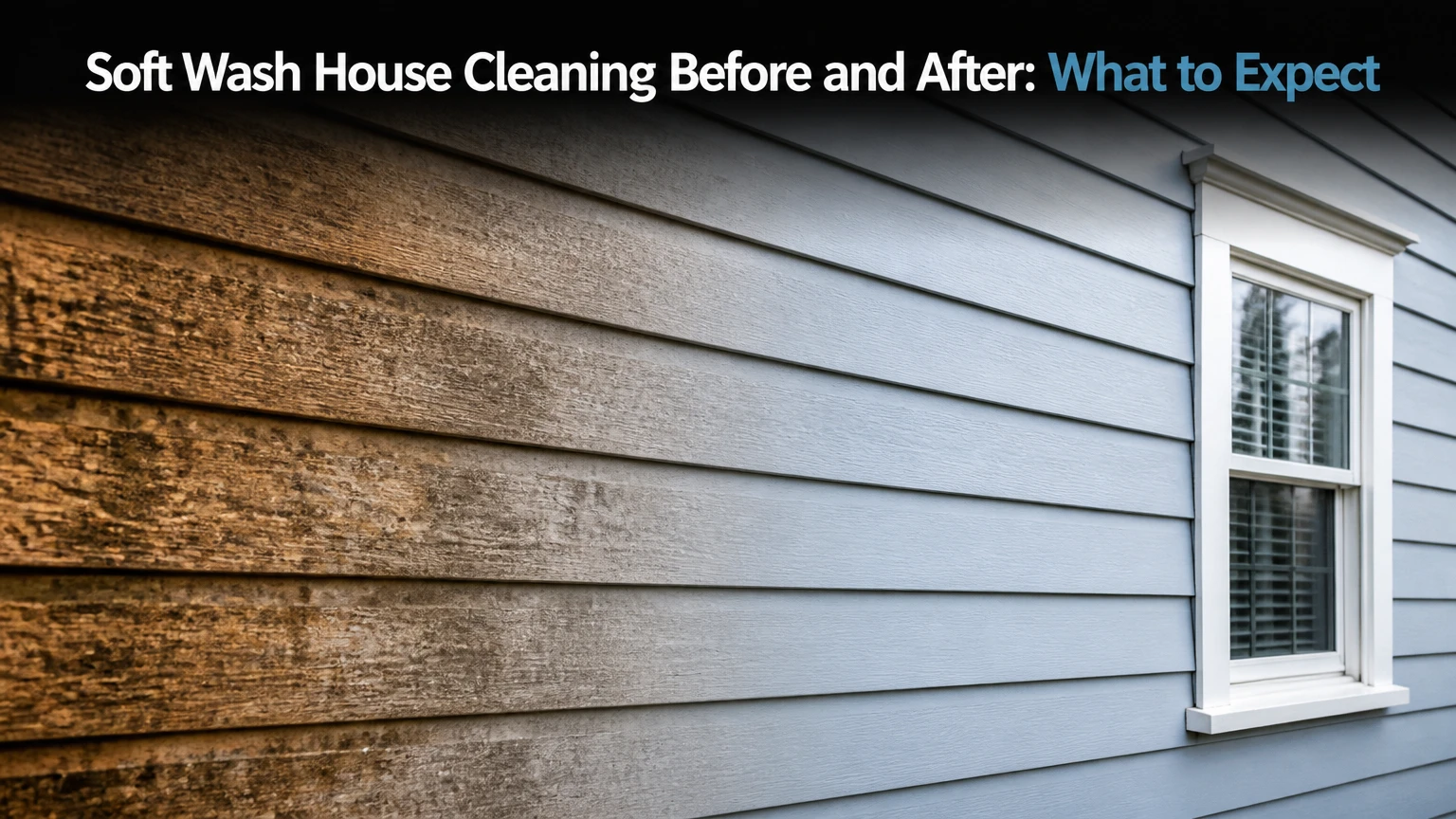
Soft wash house cleaning before and after results usually show a large reduction in algae, mildew, mold staining, dirt, and organic discoloration without the surface damage associated with high-pressure blasting. A professional applies a surface-appropriate cleaning solution, allows controlled dwell time, then rinses with low pressure while protecting plants, windows, fixtures, and painted finishes.
Key Facts at a Glance
- Soft washing removes biological growth primarily through chemical action, not high-velocity water.
- Typical house-wash visits take 1.5-3 hours for an average home, while heavy growth or complex access can take 4-6 hours.
- Typical residential house-wash prices range from $250-$650, with larger homes and roof cleaning often priced separately.
- Dead algae may turn pale brown, white, or gray before it rinses away or loosens through weather.
- Soft washing does not reliably remove rust, oxidation, failing paint, or construction residue.
- Plant protection requires pre-wetting, controlled application, immediate correction of overspray, and post-rinsing.
What Does Soft Wash House Cleaning Before and After Look Like?
Soft wash house cleaning before and after normally changes a stained exterior from green, gray, brown, or black to a more uniform original color. The method is especially effective against algae, mildew, mold, moss, and lichen on vinyl siding, stucco, painted surfaces, and some roof materials when the chemical and rinse method match the substrate.
Before cleaning, organic growth often appears as shaded streaks beneath gutters, green film on north-facing walls, black spotting around window trim, or lichen colonies on roof shingles. After cleaning, the growth should be dead or removed, but the underlying surface may still reveal oxidation, failed paint, rust, permanent staining, or physical wear.
The visual result depends on three variables: the type of stain, the surface condition, and whether the technician allows sufficient dwell time without letting the solution dry. A clean surface is not automatically a repaired surface.
How should you read before-and-after photos?
A credible before-and-after comparison uses the same camera position, focal length, lighting, and framing. Brightened after-images can make a mediocre result appear better, while wet siding can temporarily look darker and more uniform than it will after drying.
Look for details in the photographs:
- Window trim should remain intact and free from white chemical residue.
- Siding color should look consistent after the surface dries.
- Roof granules should remain in place rather than appearing in gutters.
- Plants should show no fresh brown spotting several days later.
- Persistent stains should be identified instead of hidden by aggressive editing.
How Does Soft Washing Work?
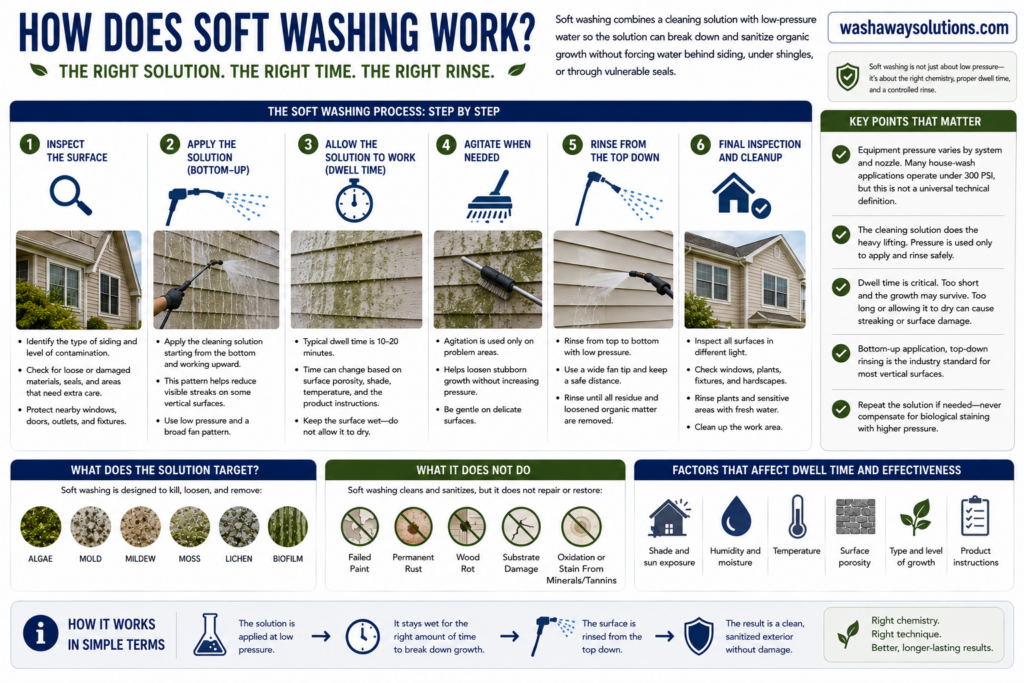
Soft washing combines a cleaning solution with low-pressure water so the solution can break down and sanitize organic growth without forcing water behind siding, under shingles, or through vulnerable seals. The technician applies the solution, manages its dwell time, and rinses from a safe distance with a broad spray pattern.
Most professional systems use an agricultural-style pump or chemical-delivery system. Operating pressure varies by equipment and nozzle, so “under 300 PSI” is a useful description of many house-wash applications, not a universal technical definition.
Typical dwell time is 10-20 minutes, although porous masonry, dense lichen, heavy shade, temperature, and product instructions can change the interval. The solution must remain wet long enough to work and must not dry on glass, metal, painted trim, or siding.
The common bottom-up application pattern helps reduce visible runs on some vertical surfaces, while the final rinse generally proceeds from the top downward. A technician may repeat an application rather than increase pressure when biological staining remains.
What happens during the chemical reaction?
Sodium hypochlorite, where appropriate and permitted by the product label, oxidizes and kills many organic organisms. Surfactants help the solution cling to vertical surfaces and can improve contact with greasy or dusty films.
The color change is not always immediate removal. Green algae can become pale or translucent while remaining attached to textured siding, and black mold staining can leave a faint shadow when pigment has penetrated porous material.
The U.S. Centers for Disease Control and Prevention warns, “Never mix household bleach with ammonia or any other cleaner.” A professional should use labeled products, correct storage, ventilation, protective equipment, and runoff controls rather than improvised mixtures.
What Are the Before-and-After Results by Surface?
Soft washing is most predictable when the stain is biological and the substrate can tolerate the selected solution. Surface age, paint condition, oxidation, porosity, previous cleaning, and weather exposure determine whether the final color matches the original finish.
| Surface | Typical before condition | Typical after condition | Main limitation |
|---|---|---|---|
| Vinyl siding | Green algae film, mildew streaks, gray dirt | More uniform original color within 1-3 hours | Oxidation and faded pigment remain |
| Stucco or render | Dark biological patches, dust in texture | Lighter, cleaner texture after 10-20 minutes dwell | Cracks and deep mineral staining remain |
| Painted wood | Mildew spots, green film, surface dirt | Cleaner paint with less organic discoloration | Loose paint and wood damage require repair |
| Asphalt shingles | Black streaks, moss, lichen colonies | Reduced streaking and dead growth | Missing granules, brittleness, and curled shingles remain |
| Brick and masonry | Green film, mildew in joints, surface soot | Cleaner face and mortar appearance | Efflorescence, rust, and deep soot may persist |
| Concrete or pavers | Algae, moss, dirt, tire marks | Biological film reduced or removed | Oil, rust, and embedded dirt may need another method |
Is soft washing safe for vinyl siding?
Soft washing is generally safer for vinyl siding than high-pressure cleaning when the operator uses a compatible solution, controlled spray, and thorough rinse. High pressure can drive water behind laps, damage caulk, loosen panels, or create visible streaking.
Oxidized vinyl siding is the main visual trap. Oxidation creates a chalky layer that may clean unevenly, making some panels appear brighter than others. Chemical cleaning does not restore the original polymer color, so a hand-cleaning or oxidation-removal process may be needed.
What changes on stucco, wood, and roofs?
Stucco requires attention to cracks, weep paths, windows, and porous texture. Wood requires lower mechanical force and careful evaluation of paint adhesion because cleaning can expose existing coating failure.
Roof cleaning has additional fall, runoff, and material risks. The Asphalt Roofing Manufacturers Association has advised against aggressive pressure on asphalt shingles because mechanical force can remove protective granules; a roof cleaner should follow the shingle manufacturer’s maintenance guidance and avoid walking on fragile areas.
What Is the Professional Soft Washing Process?
A professional house wash usually follows seven stages: inspection, protection, plant pre-wetting, solution preparation, controlled application, dwell management, and low-pressure rinsing. The technician should adjust the process for siding type, weather, stain severity, nearby vegetation, electrical fixtures, and drainage.
| Stage | Typical action | Typical time | Verification point |
|---|---|---|---|
| Inspection | Identify substrate, stains, damage, outlets, windows, and access | 10-20 minutes | Vulnerable areas documented |
| Site protection | Cover fixtures, outdoor electronics, furniture, and delicate items | 10-25 minutes | Covers secured and openings protected |
| Plant preparation | Saturate leaves, soil, shrubs, and grass with fresh water | 5-15 minutes | Vegetation is visibly wet |
| Application | Spray a controlled solution in manageable sections | 20-60 minutes | Surface remains evenly wet |
| Dwell | Allow chemical contact without drying | 10-20 minutes per section | Growth changes color or loosens |
| Rinse | Use fresh water at low pressure, commonly top down | 20-60 minutes | No visible residue or active growth |
| Cleanup | Rinse plants and hardscape, remove covers, inspect glass | 15-30 minutes | Property is left free of runoff residue |
The 10-20 minute dwell range is typical, not a universal instruction. Product labels, surface manufacturers, local regulations, and temperature take priority over a generic online recipe.
How are plants and property protected?
Plants are usually pre-wetted so leaves and soil contain fresh water before chemical contact. Technicians may use tarps, temporary redirects, low-overspray nozzles, spot rinsing, and repeated post-rinsing, but plastic sheeting should not trap heat against sun-exposed foliage.
A responsible operator also checks wind direction and protects vehicles, outdoor kitchens, cameras, door hardware, unsealed stone, fishponds, and irrigation components. Chemical runoff should not be sent into storm drains, ponds, or waterways.
What equipment delivers a soft wash?
Dedicated 12-volt or gas-powered pumps provide controlled chemical delivery at low pressure. Downstream injectors dilute solution through a pressure washer line and can suit light maintenance, while external injectors such as X-Jet-style systems keep concentrated chemical out of the primary pump.
| Delivery method | Typical pressure or reach | Best use | Main trade-off |
|---|---|---|---|
| Dedicated 12-volt pump | Approximately 100-150 PSI | House siding, roofs, controlled chemical application | Higher equipment cost and chemical maintenance |
| Gas soft-wash pump | Approximately 100-300 PSI | Large homes, long hose runs, commercial work | Noise, fuel, and operator training |
| Downstream injector | Commonly 10:1 or greater dilution | Light house maintenance and detergent application | May lack strength for heavy growth |
| X-Jet-style external injector | Typical reach of 20-30 feet, setup dependent | Stronger remote application without bleach through pump | More overspray and technique sensitivity |
| Garden sprayer | Hand-pump pressure | Small spot treatment with label-approved product | Slow, limited reach, inconsistent coverage |
Pressure and water volume are separate variables. Many professional systems deliver approximately 4-8 gallons per minute, but a high-flow rinse at low pressure can clean effectively without acting like a high-pressure surface stripper.
How Much Does House Soft Washing Cost?
Typical residential soft washing costs $250-$650 for many single- and two-story homes, while large properties, steep access, heavy growth, roof sections, and difficult plant protection can raise the price above $1,000. A quote should identify the surfaces included rather than use “whole house” as an unexplained package.
| Project scope | Typical price | Typical duration | Common price drivers |
|---|---|---|---|
| Small one-story house, under 1,500 square feet | $250-$400 | 1.5-2.5 hours | Access, algae severity, local labor |
| Two-story house, 1,500-2,500 square feet | $400-$650 | 2-4 hours | Height, hose distance, windows and landscaping |
| Large house or estate, over 2,500 square feet | $700-$1,200+ | 4-6 hours | Multiple elevations, roofline, heavy growth |
| Roof soft washing only | $400-$900 | 2-5 hours | Pitch, material, safety setup, runoff controls |
| Spot treatment or small elevation | $150-$300 | 45-90 minutes | Minimum service charge and access |
Prices vary by region and are typical market ranges, not guaranteed rates. Ask whether the quote includes gutters, soffits, fascia, exterior windows, detached buildings, plant protection, and a second application for persistent growth.
Is Soft Washing Better Than Pressure Washing?
Soft washing is usually the better choice for organic growth on siding, stucco, painted wood, and asphalt shingles. Pressure washing is generally better for hard, durable surfaces such as concrete, some brick, pavers, and heavily embedded nonbiological debris, provided the pressure and nozzle are suitable.
| Decision factor | Soft washing | Pressure washing |
|---|---|---|
| Primary cleaning force | Chemical action | Mechanical water force |
| Typical house-wall pressure | About 100-300 PSI | Often 1,500-3,000+ PSI |
| Best stain type | Algae, mildew, mold, moss | Mud, loose dirt, some surface debris |
| Preferred roof method | Often suitable with material guidance | Usually risky for asphalt shingles |
| Water volume | Commonly 4-8 GPM during rinse | Commonly 2-8 GPM, equipment dependent |
| Surface damage risk | Lower when correctly applied | Higher on paint, wood, seals, and shingles |
| Result duration | Often longer for biological growth | Can return sooner if organisms survive |
| Main weakness | Chemical and runoff management | Can leave or regrow biological stains |
The phrase “soft washing kills the roots” is useful shorthand but oversimplifies the result. Chemical treatment can kill organisms at the surface and in shallow colonies, yet stains may return when moisture, shade, nutrients, and spores remain.
Which method should each surface receive?
Use soft washing for biological staining on vinyl, stucco, painted surfaces, and compatible roofing materials. Use pressure washing selectively on concrete, pavers, and durable masonry after testing a small area.
Some jobs need both methods. A patio may receive a biological pretreatment followed by controlled surface cleaning, while a house may receive chemical washing on siding and a gentler rinse around windows and trim.
What Will Soft Washing Not Remove?
Soft washing is not a universal stain-removal method. It is weak against rust, oil, paint overspray, efflorescence, artillery fungus, hard-water deposits, oxidation, and failing coatings because those conditions are not living biological growth.
A dark mark can have several causes. Algae may disappear after treatment, while a rust streak remains because iron oxide requires a different, surface-compatible chemistry. Chalky siding may look worse after cleaning because dirt no longer masks the uneven oxidation.
Soft washing also cannot repair:
- Cracked stucco or mortar joints
- Missing roof granules
- Rotting wood
- Loose or peeling paint
- Warped siding
- Failed sealant
- Permanent ultraviolet fading
A skilled contractor identifies these limits before cleaning and records pre-existing damage in photographs. That step prevents a homeowner from confusing cleaning failure with an underlying maintenance problem.
What Commonly Goes Wrong After a Soft Wash?
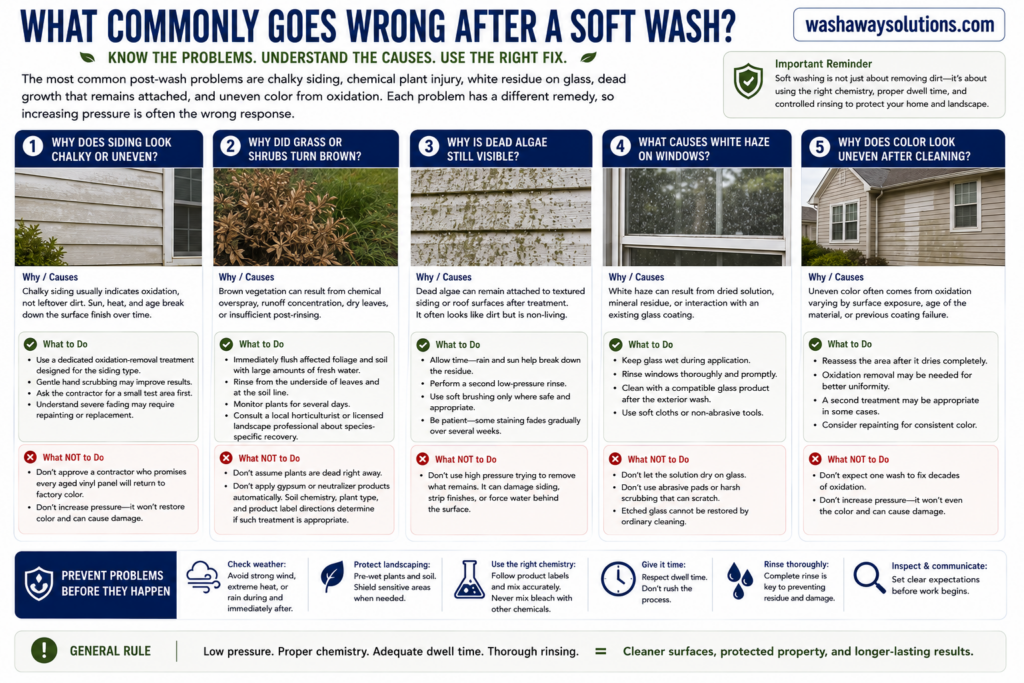
The most common post-wash problems are chalky siding, chemical plant injury, white residue on glass, dead growth that remains attached, and uneven color from oxidation. Each problem has a different remedy, so increasing pressure is often the wrong response.
Why does siding look chalky or uneven?
Chalky siding usually indicates oxidation, not leftover dirt. A dedicated oxidation-removal treatment and controlled hand scrubbing may improve the appearance, but severe fading may require repainting or replacement.
Do not approve a contractor who promises every aged vinyl panel will return to factory color. Ask for a test area first.
Why did grass or shrubs turn brown?
Brown vegetation can result from chemical overspray, runoff concentration, dry leaves, or insufficient post-rinsing. Immediately flush affected foliage and soil with large amounts of fresh water, then ask a local horticulturist or licensed landscape professional about species-specific recovery.
Gypsum or neutralizer products should not be applied automatically. Soil chemistry, plant type, and product label directions determine whether such treatment is appropriate.
Why is dead algae still visible?
Dead algae can remain attached to textured siding or roof surfaces after treatment. A second low-pressure rinse, soft brushing where safe, or several rain events may remove the residue; aggressive pressure can create more damage than improvement.
What causes white haze on windows?
White haze can result from dried solution, mineral residue, or interaction with an existing glass coating. Keep glass wet during application, rinse promptly, and clean it with a compatible glass product after the exterior wash. Etched glass cannot be restored by ordinary window cleaning.
Can Homeowners Soft Wash a House Safely?
Homeowners can handle small, low-risk spot treatments only when they understand the product label, chemical hazards, plant protection, electrical safety, and runoff requirements. Full-house washing, roof work, ladder access, high-concentration chemicals, and windy conditions are better assigned to a trained, insured professional.
Avoid treating a generic household bleach percentage as a universal recipe. Concentration changes during storage, temperature affects performance, and the correct application strength depends on the product, substrate, stain, and local rules.
At minimum, a homeowner would need chemical-resistant gloves, eye protection, protective clothing, fresh water for rinsing, a low-pressure applicator, a way to control runoff, and a safe method to reach the work area without climbing onto a fragile roof. Respiratory protection requires correct selection and fit; improvised masks do not reliably protect against chemical vapors.
Never mix bleach with ammonia, acids, or other cleaners. The CDC specifically warns against mixing bleach with ammonia or any other cleaner because dangerous gases can form.
How Often Should a House Be Soft Washed?
Many homes need inspection every 12-24 months, but the correct interval depends on shade, humidity, tree cover, roof moisture, orientation, and the amount of organic debris. A north-facing wall beneath trees may need attention sooner than a sunny, exposed elevation.
A fixed claim that every soft-washed surface stays clean for exactly two or three times longer than pressure-washed surfaces is not a dependable guarantee. Longevity varies because cleaning method, weather, organism type, and building exposure vary.
Schedule an inspection when green film returns, black streaks expand, gutters remain damp, or moss begins lifting roofing materials. Preventive cleaning at early growth stages generally requires less chemical, less dwell time, and less labor than restoration cleaning.
How Should You Choose a Soft Washing Contractor?
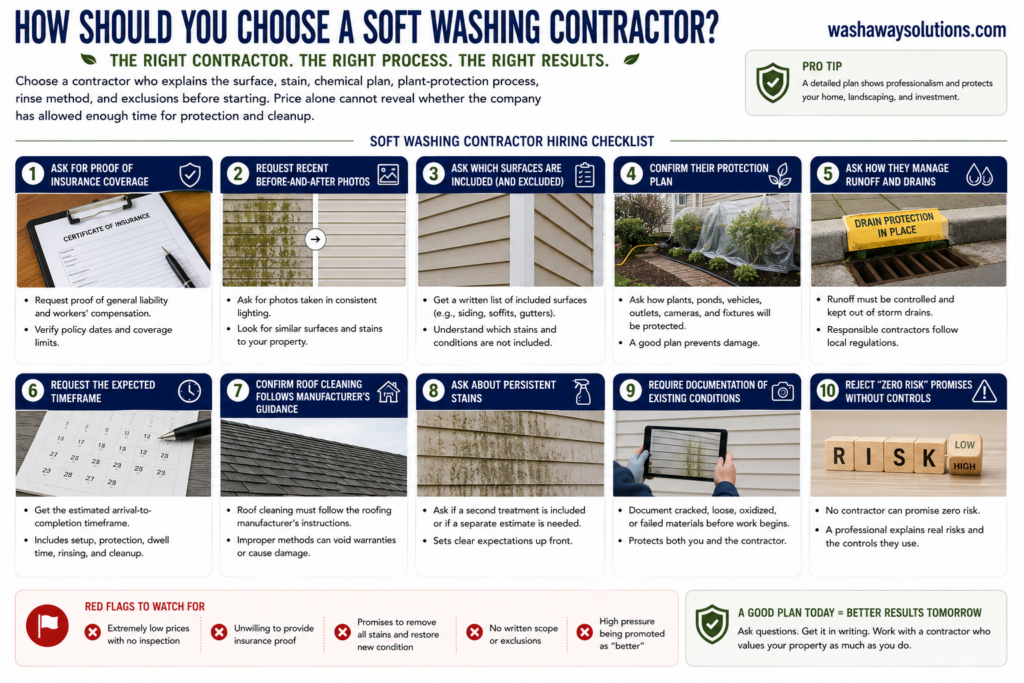
Choose a contractor who explains the surface, stain, chemical plan, plant-protection process, rinse method, and exclusions before starting. Price alone cannot reveal whether the company has allowed enough time for protection and cleanup.
Use this hiring checklist:
- Ask for proof of general liability and workers’ compensation coverage.
- Request recent before-and-after photographs taken in consistent lighting.
- Ask which surfaces are included and which stains are excluded.
- Confirm how plants, ponds, vehicles, outlets, cameras, and outdoor fixtures will be protected.
- Ask how the company manages chemical runoff and storm-drain exposure.
- Request the expected arrival-to-completion timeframe.
- Confirm whether roof cleaning follows the roofing manufacturer’s guidance.
- Ask whether persistent stains receive a second treatment or a separate estimate.
- Require documentation of existing cracked, loose, oxidized, or failed materials.
- Reject any proposal that promises zero risk without describing controls.
What are three practitioner rules that improve results?
Rule 1: Test the weakest surface first. A strong solution that works on vinyl may discolor oxidized paint, unsealed stone, or delicate landscaping. A small test patch exposes compatibility problems before the full elevation is treated.
Rule 2: Keep the surface wet, not merely chemically covered. Drying causes residue, uneven reaction, and avoidable plant or glass damage. Sun, wind, low humidity, and dark-colored materials shorten the practical dwell window.
Rule 3: Lower pressure before increasing chemistry. When growth remains, the first correction should usually be better coverage, appropriate dwell, or a second application, not a narrower nozzle and higher impact force.
FAQ
Will soft washing remove black streaks from roof shingles?
Soft washing can substantially reduce black streaks caused by roof algae when the roofing material, chemical, dwell time, and rinse method are appropriate. The streaks may not disappear immediately, and brittle shingles, missing granules, moss roots, or lichen attachment require a roof inspection before cleaning.
Can rain damage a freshly soft-washed house?
Light rain after a thoroughly rinsed house wash usually does not damage the cleaned surface, but rain during application can dilute the solution and reduce dwell time. Contractors commonly avoid active precipitation, strong wind, freezing temperatures, and conditions that prevent safe runoff control.
Does soft washing remove mold permanently?
Soft washing can kill and remove much of the mold or mildew present during treatment, but it cannot permanently eliminate the moisture and spores that support regrowth. Leaks, blocked gutters, shade, poor ventilation, and persistent dampness must be corrected for longer-lasting results.
Should gutters be cleaned before or after house washing?
Gutters should generally be cleared before a house wash if blocked gutters could overflow dirty water onto cleaned siding. Final gutter brightening or exterior rinsing often occurs after the wall wash so runoff and cleaning residue do not recontaminate the finished surface.
What should I do if the house still looks stained after soft washing?
Wait until the surface is fully dry, then identify whether the remaining mark is biological growth, oxidation, rust, efflorescence, paint failure, or permanent discoloration. Request a documented reinspection instead of authorizing higher pressure, because each stain category requires a different treatment.
The Bottom Line
Soft wash house cleaning before and after results are strongest when the discoloration is algae, mildew, mold, moss, or lichen and the technician matches the chemistry and rinse method to the surface. The process commonly takes 1.5-3 hours and costs $250-$650 for many homes, but it will not repair oxidation, rust, failed paint, cracked masonry, or damaged roofing. Ask for a test area, a protection plan, clear exclusions, and consistent before-and-after photographs before booking.