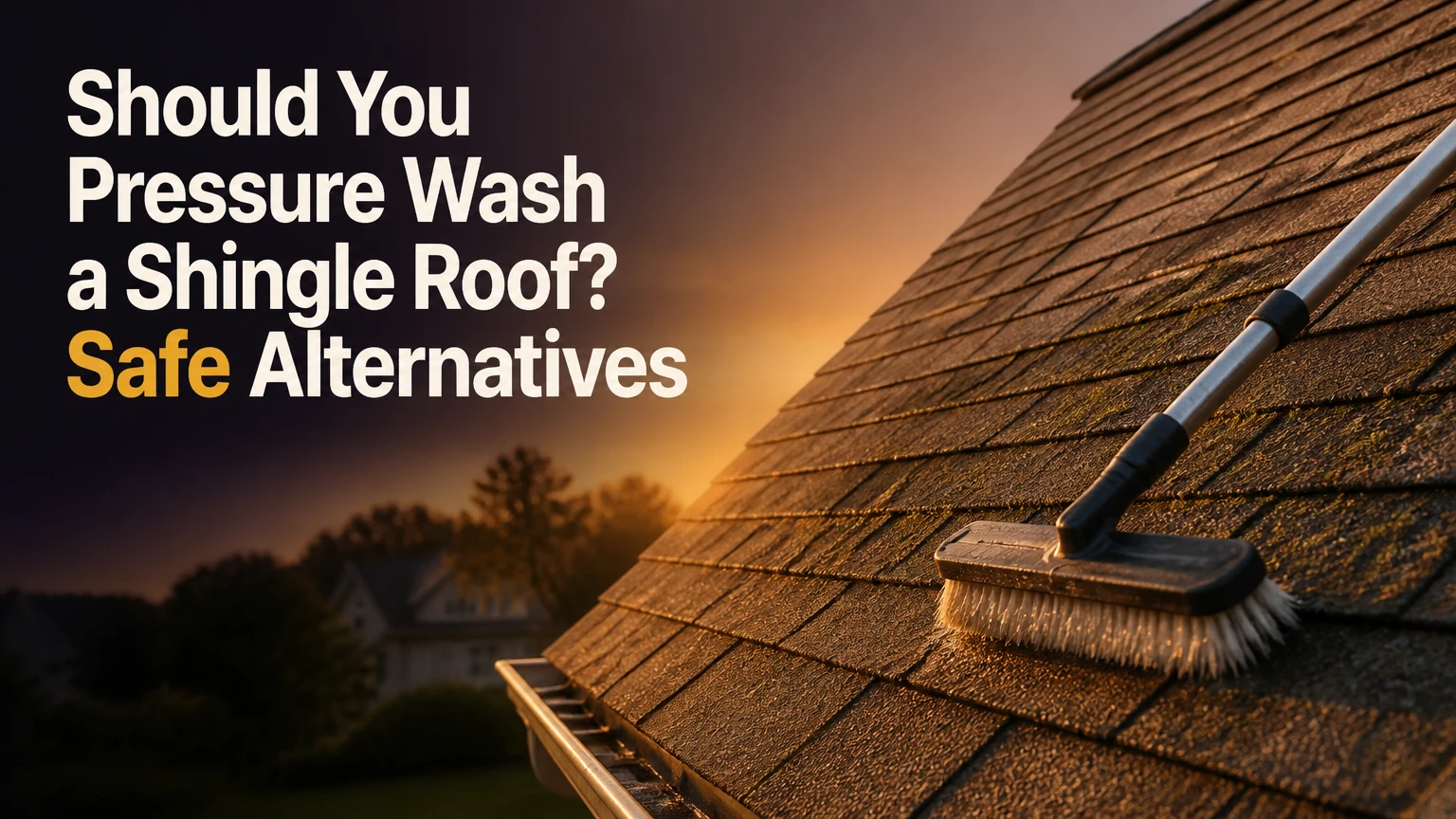
No, you should not pressure wash an asphalt shingle roof. High-pressure water can dislodge protective mineral granules, cut or lift shingle surfaces, drive water beneath laps, and create damage that may affect warranty coverage. Use a manufacturer-approved low-pressure cleaning method, usually performed by an experienced roof-cleaning professional.
Key Facts at a Glance
- Pressure washing can remove asphalt shingle granules that protect the roof from ultraviolet radiation and weather.
- Low-pressure chemical cleaning is the usual method for algae, moss, and lichen on asphalt shingles.
- A universal 50/50 bleach recipe is not appropriate for every roof; product labels and shingle manufacturer instructions control the dilution.
- Typical professional roof cleaning costs about $400-$1,200, with steepness, access, roof size, and biological growth affecting the quote.
- Moss may remain visibly attached after treatment, then loosen naturally over several rain cycles rather than disappearing immediately.
- Cleaning cannot repair blistered, cracked, brittle, leaking, or structurally failing shingles.
Why Should You Not Pressure Wash a Shingle Roof?
Pressure washing damages shingles because mechanical water force removes roofing material instead of merely removing contamination. Asphalt shingles contain mineral granules embedded in a weather-resistant surface; those granules shield the asphalt coating from sunlight and help control surface wear.
A pressure washer can also lift shingle edges, expose fiberglass reinforcement, break seals, and force water beneath overlapping courses. The risk rises when an operator uses a narrow nozzle, stands close to the roof, sprays upward, or cleans an old roof with brittle shingles.
The Asphalt Roofing Manufacturers Association, commonly called ARMA, warns against using a pressure washer on asphalt shingles because the force can damage the roofing system. The important principle is broader than a single PSI number: asphalt shingles are designed for rainwater flowing downward, not a concentrated jet striking the surface at close range.
What Damage Can High-Pressure Water Cause?
| Damage mechanism | Roof component affected | Typical consequence | Inspection clue |
|---|---|---|---|
| Granule displacement | Mineral surface coating | Faster ultraviolet aging | Bare or shiny patches in gutters |
| Edge lifting | Shingle seal strip and tabs | Wind vulnerability | Tabs curl or no longer lie flat |
| Water intrusion | Shingle laps and underlayment | Wet decking or attic leakage | Damp sheathing after cleaning |
| Surface cutting | Asphalt coating and fiberglass mat | Premature deterioration | Linear gouges near nozzle paths |
| Impact stress | Brittle or aged shingles | Cracks and fractures | Visible splits around fasteners |
A clean roof is not automatically a healthy roof. Granules washed into the gutters may indicate that a cleaning method removed part of the roof’s protective surface, even when the roof looks darker and more uniform afterward.
What Pressure Is Safe for Asphalt Shingles?
No single PSI value guarantees safety, because nozzle type, spray angle, distance, flow rate, operator technique, and roof condition all change the force delivered to the shingle. ARMA and shingle manufacturers generally favor low-pressure application and chemical treatment rather than pressure washing.
Pressure-washing machines commonly operate at roughly 1,500-4,000 PSI. Soft-wash pumps often deliver roughly 40-300 PSI, but a low-pressure pump can still cause damage if an operator uses a tight nozzle close to the shingle or sprays under the tabs.
“Low pressure” therefore describes a method, not a permission to spray aggressively. A garden hose may be suitable for a gentle final rinse in some systems, while a pressure washer set to its lowest setting may remain unsuitable because of its nozzle concentration and recoil.
How Do Pressure Washing and Soft Washing Differ?
| Attribute | Pressure washing | Soft washing | Manual removal |
|---|---|---|---|
| Main action | Mechanical water impact | Chemical treatment plus gentle rinse | Hand tools and limited water |
| Typical equipment pressure | 1,500-4,000 PSI | About 40-300 PSI | Near 0 PSI |
| Best target | Concrete, masonry, some metal | Algae, moss, and lichen on compatible roofs | Loose debris and dead surface growth |
| Main roof risk | Granule loss and lifted tabs | Chemical or runoff damage if mishandled | Scraping, tearing, and foot traffic |
| Visual result | Often immediate | Algae fades quickly; moss may detach later | Immediate where growth is loose |
| Primary limitation | Unsuitable for asphalt shingles | Requires chemical control and protection | Labor-intensive and incomplete |
Soft washing does not mean “washing with no risk.” Sodium hypochlorite can discolor siding, corrode untreated metals, injure plants, and harm aquatic life if runoff is poorly managed. The safer method still requires roof inspection, controlled application, correct dilution, and thorough site protection.
How Does Soft Washing Clean Asphalt Shingles?
Soft washing uses a low-pressure sprayer to apply a cleaning solution that kills or weakens organic growth, followed by a controlled rinse or natural weathering. The chemical action addresses the organisms’ biological attachment, while water removes residue without the concentrated impact of a pressure washer.
Black streaks usually come from cyanobacteria, often identified as Gloeocapsa magma in roofing discussions. Moss is a larger plant that holds moisture against the roof, while lichen forms a stronger attachment and may require repeated treatment. These growth types should not be treated as interchangeable stains.
A professional should inspect the roof first, protect vegetation with fresh water, cover or avoid vulnerable materials, control downspouts, apply the solution from a safe position, and prevent the mixture from drying on adjacent surfaces. The exact chemical concentration must follow the product label, local requirements, and shingle manufacturer guidance.
What Is the Correct Roof-Cleaning Chemical Mixture?
There is no universal safe recipe for every asphalt shingle roof. A commonly used professional soft-wash range is approximately 1%-3% available sodium hypochlorite at the roof surface, but the required concentration varies with growth severity, product strength, temperature, dwell time, and the operator’s equipment.
The often-repeated instruction to mix 50% outdoor bleach with 50% water is not a blanket rule. A strong mixture may be appropriate for a particular commercial product or severe growth under controlled conditions, but copying it without checking concentration can overexpose shingles, landscaping, siding, and metal components.
Never mix sodium hypochlorite with ammonia, acids, vinegar, or other incompatible cleaners. A surfactant may improve cling on a steep roof, but it does not make an excessive concentration safe.
How Do Professionals Clean a Shingle Roof?
A competent roof-cleaning job follows an inspection, protection, application, dwell, rinse, and cleanup sequence. The operator’s most important success measure is controlled runoff and preserved roofing material, not the fastest possible color change.
Step 1: Inspect the Roof and Site
Check for missing tabs, exposed fasteners, open seams, cracked pipe boots, soft decking, leaks, sagging, brittle shingles, solar panels, skylights, and nearby metal. Photograph pre-existing conditions before chemicals or water touch the roof.
Confirm the roof material. Asphalt shingles require different handling from clay tile, concrete tile, slate, wood shakes, and synthetic roofing. Also check the shingle manufacturer’s maintenance instructions and warranty documents.
You will know the inspection is adequate when the cleaner can identify fragile areas, water entry points, runoff routes, and materials requiring protection. A common mistake is accepting a cleaning quote without a roof-condition assessment.
Step 2: Protect Plants, Siding, and Drainage
Water landscaping thoroughly before application, move portable furniture, shield sensitive plants where practical, and plan where gutters and downspouts will discharge. Keep chemical runoff away from ponds, streams, rain barrels, and storm drains when local rules require it.
A second worker may continuously rinse walls, windows, gutters, and plants during application. Rainwater collection systems should be disconnected or bypassed until the roof and collection surfaces have been rinsed and the chemical has cleared.
The protection step is complete when runoff is visible, controlled, and diluted before reaching vulnerable surfaces. Allowing solution to dry on windows or painted siding is a frequent and avoidable failure.
Step 3: Apply the Approved Low-Pressure Solution
Apply the properly diluted solution with a dedicated low-pressure system, following the chemical label and the roof manufacturer’s instructions. Work in manageable sections, avoid walking on the shingles when possible, and never direct spray upward beneath shingle courses.
A typical dwell time is about 10-20 minutes, although temperature, sunlight, product instructions, and growth severity may require adjustment. Keep the surface wet enough to prevent premature drying without flooding the roof.
The treatment is working when black biological staining begins to fade and green growth changes color. A common mistake is increasing chemical strength because the first few minutes do not produce a fully uniform appearance.
Step 4: Rinse or Allow Controlled Weathering
Rinse gently from the ridge toward the eaves when the cleaning system and manufacturer instructions call for rinsing. Do not use a concentrated jet, and do not spray against laps, flashing, vents, or roof penetrations.
Some professional systems allow dead moss and lichen to weather away naturally instead of forcing immediate removal. Moss may take 60-90 days to detach, particularly when roots have grown into surface irregularities.
The roof is ready for final cleanup when no active chemical residue remains on surrounding surfaces and the gutters are free of excessive debris. A common mistake is scraping growth that has already died, which can remove granules along with the moss.
Step 5: Rinse the Property and Document the Result
Rinse siding, windows, plants, gutters, walkways, and equipment. Remove loose debris from gutters and confirm that downspouts are flowing, but do not treat gutter cleaning as proof that the roof itself was safely cleaned.
Photograph the finished roof from the same angles used during the inspection. Record the product, dilution, weather conditions, dwell time, and any areas excluded because of roof damage.
You will know the job is complete when the property is free of visible chemical residue and the roof has no newly disturbed tabs or bare patches. A clean appearance cannot confirm hidden underlayment damage, so attic inspection may be warranted after a leak or aggressive prior washing.
Which Roof-Cleaning Method Should You Choose?
Soft washing is usually the best choice for active algae, moss, or lichen on sound asphalt shingles, while gentle debris removal may be enough for leaves and branches. Manual work has a place when growth is loose, but aggressive scraping is unsuitable for fragile or granule-shedding roofs.
| Roof condition or contamination | Preferred method | Avoid | Reason |
|---|---|---|---|
| Black algae streaks on sound shingles | Manufacturer-compatible soft wash | Pressure washing | Chemical treatment targets biological growth |
| Loose leaves and twigs | Low-power blower from a safe position | Walking across the roof | Debris needs removal, not blasting |
| Thick moss on stable shingles | Soft wash, then natural detachment | Immediate forceful scraping | Roots may pull away granules |
| Brittle shingles near replacement | Inspection and possible replacement | Any aggressive cleaning | Cleaning can accelerate visible failure |
| Lichen attached to older shingles | Controlled repeated treatment | High-pressure removal | Lichen attachment can tear the surface |
| Construction dust on a compatible roof | Gentle low-pressure rinse if approved | Narrow pressure-washer jet | Mechanical force is unnecessary |
Is Manual Moss Removal Safer Than Soft Washing?
Manual moss removal is safer only when the growth is loose and the operator can avoid damaging the shingle surface. Pulling or scraping moss that has anchored beneath granules can tear the mat, loosen tabs, and create more damage than the original growth.
A roof professional may remove large loose clumps by hand after treatment, using tools that do not gouge the surface. The roof should not be brushed aggressively, and walking should be minimized because concentrated foot traffic can fracture aged shingles.
Manual removal also does not reliably kill remaining biological material. Treatment and prevention are separate tasks: removal changes appearance, while a compatible biocide addresses active growth.
How Much Does Shingle Roof Cleaning Cost?
Professional shingle roof cleaning typically costs about $400-$1,200 for an average home, or approximately $0.30-$0.80 per square foot in many markets. A small, accessible single-story roof may cost less, while steep roofs, heavy moss, difficult access, and extensive protection can push the price higher.
| Project factor | Typical range or value | Cost effect | What the quote should specify |
|---|---|---|---|
| Small single-story roof | $250-$600 | Lower setup and access cost | Minimum service charge |
| Average residential roof | $400-$1,200 | Common project range | Included roof area and method |
| Large or steep roof | $900-$2,000+ | More labor and safety equipment | Steepness and access surcharge |
| Treatment rate | $0.30-$0.80 per sq. ft. | Scales with measured roof area | Measurement method |
| Heavy moss or lichen | 2 visits may be needed | Adds labor and follow-up | Included return visit |
| Repairs | Separate from cleaning | Raises total project cost | Written repair exclusion |
Prices vary substantially by location, roof pitch, height, insurance requirements, chemical protection, and whether gutters or exterior walls are included. A quote that is dramatically cheaper may exclude plant protection, inspection, insurance, or a return visit for biological growth that detaches slowly.
Ask whether the price includes disposal, runoff management, gutter clearing, warranty documentation, and a written statement that pressure washing will not be used on asphalt shingles.
How Long Does Roof Cleaning Take?
A typical professional crew needs about 2-5 hours for setup, protection, treatment, rinsing, and cleanup. The roof’s visual improvement may occur during the same visit, but moss and lichen can require 60-90 days to weather away after they are dead.
| Result or activity | Typical timeframe | What affects it |
|---|---|---|
| Site setup and protection | 30-60 minutes | Landscaping and building complexity |
| Chemical application and dwell | 30-90 minutes | Roof size, growth, and weather |
| Rinse and cleanup | 45-120 minutes | Siding, gutters, and runoff |
| Black algae appearance change | Same day to several days | Stain depth and sunlight |
| Dead moss detachment | 60-90 days | Rain, wind, thickness, and roots |
| Recurrence monitoring | Every 6-24 months | Climate, shade, and moisture |
A roof that remains visibly mossy immediately after treatment has not necessarily failed. Color change, loss of green growth, and gradual detachment are more meaningful indicators than instant cosmetic uniformity.
Can You Clean a Shingle Roof Yourself?
A homeowner can remove loose ground-level debris and inspect visible gutters, but chemical roof cleaning is a poor DIY project when it requires climbing, mixing concentrated chemicals, or walking on a steep surface. Falls, chemical exposure, runoff damage, and shingle breakage create more serious risks than the original staining.
Do not use a pressure washer from a ladder. Recoil can destabilize the operator, and ladder placement against gutters or fragile roof edges can damage the drainage system.
A safer homeowner role includes photographing the growth, checking the roof warranty, trimming branches that create shade, cleaning accessible gutters, and obtaining two or three insured professional quotes. A hose-end preventive product should be used only when its label explicitly permits the roof material and the application can be made from the ground.
When Should a Homeowner Call a Roofer Instead?
Call a roofer before cleaning when the roof is leaking, sagging, missing shingles, heavily granule-shedding, older than its expected service life, or covered by a warranty with specific maintenance rules. Call a roof-cleaning specialist when the roof is sound but has biological growth and the contractor can document low-pressure procedures.
Solar panels, skylights, copper components, rainwater tanks, delicate landscaping, and neighboring properties increase the need for site planning. A cleaning contractor may not be qualified to repair flashing or replace shingles, so confirm who handles defects before approving the work.
When Is Cleaning the Wrong Decision?
Cleaning is the wrong decision when the roof’s remaining service life is short and the process cannot improve its economic outcome. A 20-year-old roof with widespread exposed fiberglass, curled tabs, repeated leaks, and substantial granule loss may need replacement rather than cosmetic treatment.
Cleaning also cannot correct inadequate attic ventilation, chronic condensation, failed flashing, broken plumbing boots, or roof pitch problems. Biological growth may return if branches keep the roof shaded and damp, so the recurrence source must be addressed.
A practitioner rule of thumb is to inspect first, price repair or replacement second, and clean third. Cleaning a failing roof can obscure defects temporarily while adding handling stress to already-brittle shingles.
How Can You Prevent Algae and Moss From Returning?
You can reduce recurrence by controlling shade, moisture, and debris rather than relying only on repeated chemical treatments. Trim branches that overhang the roof, keep gutters flowing, improve attic ventilation where appropriate, and remove leaf accumulation without walking unnecessarily on the shingles.
Some asphalt shingles contain algae-resistant copper or zinc granules, but resistance does not mean permanent immunity. Zinc or copper strips near the ridge may help limit new growth when installed according to roofing guidance, yet they do not remove established moss and may create runoff concerns for plants or aquatic environments.
Schedule an inspection after severe storms and monitor shaded roof planes twice yearly. Cleaning frequency has no universal interval; a sunny, dry roof may remain clear for years, while a north-facing roof under trees may need attention within 1-2 years.
What Should a Roof-Cleaning Quote Include?
A reliable quote identifies the roof material, cleaning method, chemical product category, estimated roof area, protection plan, insurance status, and exclusions. It should state that high-pressure washing will not be used on asphalt shingles and should explain whether the contractor will rinse or allow treated growth to weather naturally.
Use this checklist before hiring:
- Request proof of general liability and workers’ compensation insurance.
- Ask for the contractor’s written pressure limit and nozzle policy.
- Confirm the chemical dilution follows the label and roof manufacturer guidance.
- Identify who protects plants, siding, windows, metals, pets, and rainwater systems.
- Ask whether repairs, gutter cleaning, and follow-up visits cost extra.
- Require before-and-after photographs and a written damage report.
- Check whether the contractor offers a workmanship or retreatment guarantee.
A contractor who promises instant removal of deep moss by blasting the roof is describing a cosmetic shortcut, not a low-impact maintenance method.
FAQ
Will Pressure Washing Make a Roof Leak?
Pressure washing can cause or reveal leaks by lifting shingle tabs, forcing water beneath laps, damaging flashing, or exposing deteriorated underlayment. A roof may not leak immediately if the attic remains dry, but hidden damage can appear during later rain or wind. Use a roof inspection rather than pressure washing to investigate an existing leak.
What Is the Best Cleaner for Black Streaks on Shingles?
A manufacturer-compatible soft-wash solution is generally the preferred treatment for black algae streaks on asphalt shingles. Sodium hypochlorite is commonly used at a controlled roof-surface concentration, often around 1%-3%, but the product label, local rules, and shingle manufacturer instructions determine the correct application.
Does Roof Cleaning Void a Shingle Warranty?
Roof cleaning does not automatically void every shingle warranty, but improper methods can create warranty problems and manufacturers impose different maintenance requirements. Review the specific warranty and care instructions before work begins, and retain the contractor’s method, product, photographs, and invoice as maintenance records.
Should You Clean a Roof Before Selling a House?
Cleaning may improve curb appeal before selling when the shingles are sound and the growth is mainly cosmetic. Do not use cleaning to conceal curling, missing granules, leaks, or structural defects. A roof inspection and documented disclosure are more valuable than a temporary cosmetic improvement on a failing roof.
Can You Pressure Wash Roof Tiles Instead?
Some concrete or clay tile systems tolerate different cleaning procedures than asphalt shingles, but pressure limits still depend on the tile, underlayment, coating, age, and manufacturer. Never transfer an asphalt-shingle recommendation to tile, slate, or wood roofing without checking the material-specific maintenance instructions.
The Bottom Line
Should you pressure wash a shingle roof? No. Pressure washing can strip mineral granules, lift shingle tabs, force water into laps, and damage an aging asphalt roofing system. For algae, moss, or lichen, choose a documented low-pressure soft-wash process that follows the shingle manufacturer’s instructions, uses controlled chemical dilution, protects the property, and begins with a roof-condition inspection.