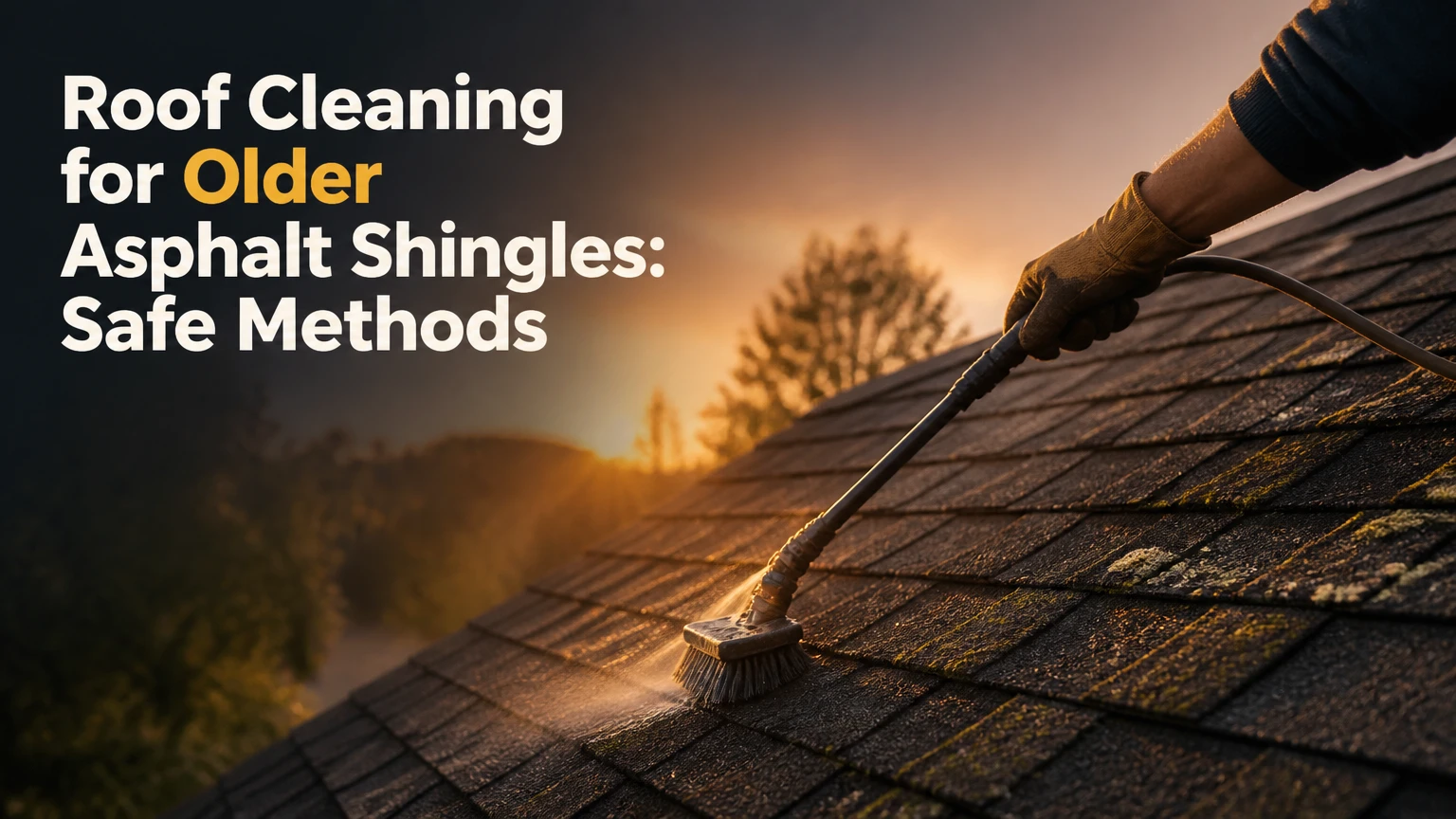
Roof cleaning for older asphalt shingles should use a low-impact chemical treatment, not pressure washing or aggressive scraping. First inspect granule loss, cracking, exposed fiberglass, loose tabs, and roof age; if the shingles are failing, cleaning can worsen damage and replacement is safer. For sound but stained shingles, controlled biocide application, runoff protection, and minimal foot traffic preserve remaining service life.
Key Facts at a Glance
Older asphalt shingles commonly become more fragile after about 12-25 years, although climate and installation quality matter more than age alone.
Pressure washing can dislodge ceramic granules and force water beneath shingle edges; asphalt-roof manufacturers generally prohibit or discourage it.
Typical professional cleaning costs about $400-$900 for a 2,000-square-foot roof, before repairs or difficult-access charges.
Sodium hypochlorite usually gives the fastest algae and moss kill, while oxygen-based and slower biocides reduce some handling and runoff concerns.
Dead moss may detach over 2-6 weeks; immediate scraping is usually more damaging than leaving chemically killed growth in place.
Cleaning cannot restore missing granules, repair brittle asphalt, reseal failed flashing, or extend a roof that has reached functional failure.
What Does Roof Cleaning for Older Asphalt Shingles Involve?
Roof cleaning for older asphalt shingles means removing algae, moss, lichen, leaves, and other debris with a method that protects the shingle granule surface. The process normally combines a roof inspection, dry debris removal, plant protection, a labeled biocide, controlled dwell time, and either a gentle rinse or natural rain removal.
Black streaks usually indicate algae, often associated with Gloeocapsa magma. Green cushions or mats indicate moss, while pale branching growth attached to shingle surfaces may be lichen. Algae mainly affects appearance and can retain moisture; moss and lichen create greater physical risk because their structures hold water and anchor around granules and shingle edges.
The term “older” is not a precise engineering category. A 15-year-old roof in a dry, sunny climate may be stronger than a 10-year-old roof exposed to repeated freeze-thaw cycles, poor ventilation, and heavy shade. The inspection result controls the cleaning decision.
Which roof conditions make cleaning unsafe?
Cleaning should stop when shingles show widespread bald areas, exposed fiberglass mat, curled or broken tabs, deep cracks, missing sections, active leaks, or granules collecting heavily in gutters. A roof with those conditions needs a roofing contractor’s repair or replacement assessment, not cosmetic washing.
| Inspection finding | Likely meaning | Cleaning decision |
|---|---|---|
| Black streaks with intact granules | Surface algae staining | Chemical treatment may be suitable |
| Small moss patches with firm tabs | Early biological growth | Treat gently and monitor detachment |
| Granules covering gutter outlets | Accelerated surface loss | Obtain a roofing inspection first |
| Exposed fiberglass mat | Shingle weathering and asphalt loss | Do not clean mechanically |
| Curling, cracking, or lifted tabs | Functional shingle failure | Repair or replace before treatment |
| Damp attic, ceiling stain, or active leak | Moisture entry | Diagnose the leak before cleaning |
A practitioner rule of thumb is simple: if touching a shingle edge causes cracking or releases a handful of granules, the roof has little cleaning tolerance. A clean-looking roof is not worth sacrificing its remaining waterproofing.
How Does Soft Washing Work on Aging Shingles?
Soft washing uses a chemical solution to kill and loosen organic growth while avoiding the mechanical force that removes granules. The treatment depends on chemistry, coverage, dwell time, and runoff control, not on blasting water across the roof.
Sodium hypochlorite oxidizes organic pigments and kills algae, moss, and lichen quickly when the concentration and contact time match the product directions. Surfactants help the solution remain in contact with sloped shingles. Oxygen-based cleaners rely on peroxygen chemistry and generally work more slowly, while quaternary ammonium or other registered biocides may continue working through later rain cycles.
The phrase “low pressure” does not establish a universal safe number. A pump may deliver low pressure at the roof while a narrow nozzle, short distance, or concentrated stream still damages shingles. Application technique, fan pattern, flow rate, nozzle selection, roof temperature, and the shingle manufacturer’s instructions matter more than an arbitrary PSI threshold.
The Asphalt Roofing Manufacturers Association recommends non-pressure cleaning methods for asphalt shingles and warns against power washing. The U.S. Occupational Safety and Health Administration also states in 29 CFR 1926.1053(b)(1), “The length of the ladder shall be such that the ladder side rails extend at least 3 feet above the upper landing surface.” Roof cleaning remains a fall-protection task even when the chemical method is gentle.
Which cleaning chemical is best?
Sodium hypochlorite is usually the fastest option for heavy algae, moss, and lichen, but it carries the greatest plant, metal, fabric, and color-management burden. Oxygen-based cleaners suit light-to-moderate staining and sensitive landscaping, while registered slower biocides suit prevention or gradual cleanup rather than urgent curb appeal.
| Cleaning chemistry | Typical visible result | Typical use | Main limitation |
|---|---|---|---|
| Sodium hypochlorite solution | Same day to 48 hours | Heavy algae, moss, and lichen | Can injure plants, metals, and pigments |
| Sodium percarbonate cleaner | Several days to weeks | Light or moderate organic staining | Slower on thick moss and lichen |
| Quaternary ammonium biocide | Weeks to months | Preventive or gradual treatment | Must follow the product label exactly |
| Manufacturer-approved detergent blend | Same day to several days | Staining with light organic debris | Detergent alone may not kill roots |
Do not copy a bleach ratio from an unrelated roof, product, or climate. Commercial products differ in active concentration, and roof cleaners should calculate the final active ingredient from the label rather than guessing from household bleach strength. Never mix sodium hypochlorite with acids, ammonia, vinegar, or other cleaners.
How Should You Clean Older Asphalt Shingles?
A careful cleaning job takes about 2-5 hours of active work for a typical 2,000-square-foot roof, although moss may remain visible for several weeks afterward. The decisive factor is preserving the granule layer while achieving full chemical coverage without allowing the solution to dry on the shingles or injure nearby property.
Before You Start
| Item | Typical requirement | Why it matters |
|---|---|---|
| Active labor | 2-5 hours | Covers setup, treatment, protection, and cleanup |
| Materials | $50-$150 for DIY supplies | Excludes fall-protection equipment and repairs |
| Water supply | Garden hose with reliable flow | Supports pre-wetting and rinsing |
| Application equipment | Low-impact pump sprayer or ground lance | Produces a broad, controlled pattern |
| Protection | Plastic sheeting, tarps, bags, hose, absorbent material | Limits runoff and plant exposure |
| Prerequisites | Roof inspection, weather check, label review | Prevents avoidable damage |
Avoid hot, windy, freezing, or intensely sunny conditions. A shaded, overcast day with no immediate heavy rain is easier to control, but the product label determines the acceptable weather window. Keep children and pets away from wet treatment areas, and protect ponds, rain barrels, vegetable gardens, painted surfaces, and unsealed metals.
Step 1: Inspect the Roof and Property
Inspect from the ground, attic, eaves, ladder position, and accessible roof areas without unnecessary walking. Photograph damaged shingles, gutters, skylights, vents, siding, plants, and existing stains before chemical application.
Check whether the growth is algae, moss, lichen, or ordinary leaf debris. Confirm that gutters and downspouts can carry rinse water, and identify where runoff will discharge. If downspout water reaches a storm drain, stream, pond, or neighboring property, follow local requirements and the chemical label before proceeding.
You will know the inspection is complete when the roof has a documented cleaning boundary and every vulnerable surface has a protection plan. The common mistake is treating visible black streaks as the only issue while missing loose tabs or an active leak.
Step 2: Protect Vegetation and Control Runoff
Pre-soak grass, shrubs, trees, and garden beds with clean water before applying any biocide. Move portable items, cover delicate surfaces with breathable protection, and route or temporarily collect downspout discharge where the label requires it.
Maintain a clean-water hose during application so exposed plants can be rinsed immediately. Do not allow wet chemical solution to pool on foliage, painted siding, aluminum, copper, or galvanized fixtures. Do not use impermeable covers that trap heat against plants in direct sun.
The success checkpoint is controlled runoff that never reaches an unprotected planting bed. The common mistake is watering plants once at the beginning and ignoring concentrated discharge from a downspout later.
Step 3: Remove Loose Dry Debris
Use a leaf blower from a safe position or a very soft brush for unattached leaves, twigs, and loose surface debris. Remove only material that releases without pulling, scraping, or levering against the shingle surface.
Leave firmly attached moss and lichen for chemical treatment. Dead growth often needs rain and wind to detach naturally, and forcing it off can remove the granules that protect the asphalt from ultraviolet radiation.
You will know the step worked when gutters and valleys are clear of loose debris but the shingle faces remain unscuffed. The common mistake is using a roof rake, wire brush, scraper, or pressure washer to accelerate the process.
Step 4: Apply the Labeled Biocide Evenly
Mix and apply the product exactly as its current label specifies, using the final concentration, personal protective equipment, application rate, and re-entry instructions on that label. Keep the spray broad and controlled, and avoid creating a high-velocity jet.
Work in manageable sections from a stable position. Ensure complete wetting of algae streaks and moss-covered areas without flooding valleys or forcing liquid under shingle laps. A surfactant can improve cling only when the chemical label permits its use.
The success checkpoint is uniform coverage with no dry islands and no visible runoff flooding. The common mistake is increasing chemical strength because one pass looks slow, which can bleach pigments or damage landscaping.
Step 5: Observe Dwell Time Without Letting the Roof Dry
Allow the solution to remain wet for the label-directed dwell period. A typical working window is 15-30 minutes, but temperature, wind, sunlight, shade, concentration, and product chemistry can change that interval.
Reapply a light amount to drying sections rather than allowing concentrated residue to bake onto hot shingles. Do not extend dwell time indefinitely to compensate for poor coverage or an unsuitable chemical. If heavy moss remains attached after treatment, that does not prove the treatment failed.
The success checkpoint is visible color change in algae and wet contact across the treated area. The common mistake is rinsing immediately, which can shorten contact time before the biocide reaches embedded growth.
Step 6: Rinse or Allow Controlled Rain Removal
For light algae staining, the label may allow a rain-activated or rain-off finish. For heavy moss or lichen, rinse gently with high volume and low impact only if the product instructions call for rinsing.
Never direct a concentrated stream beneath shingle edges, across flashing joints, or into ridge vents. Collect or dilute runoff where required, and rinse plants, siding, windows, and metal surfaces thoroughly.
Dead moss can detach over approximately 2-6 weeks. The success checkpoint is a clean or steadily improving roof with no fresh granule trails in the gutters. The common mistake is scraping three days after treatment because dead moss still looks attached.
Step 7: Clean Up and Reinspect
Flush equipment according to the label, rinse affected property surfaces, remove protection, and inspect downspouts for blocked moss. Photograph the roof again, noting areas that need monitoring rather than immediate retreatment.
A second treatment should follow the product label and a measured inspection, not impatience. Roof cleaners should also tell the owner whether cleaning exposed pre-existing damage, because chemical treatment does not create a warranty against leaks.
How Do Cleaning Methods Compare?
Professional soft washing is generally the safest choice when the roof is steep, tall, heavily shaded, or covered with moss. DIY ground application can suit light algae on a sound, low-slope roof, while preventive metal strips reduce recurrence but do not replace cleaning or repairs.
| Approach | Typical cost | Visible result | Best fit | Principal risk |
|---|---|---|---|---|
| Professional chemical soft wash | $400-$900 for 2,000 sq. ft. | Same day to 6 weeks | Fragile, steep, or heavily affected roofs | Poor runoff control |
| DIY labeled ground application | $50-$150 materials | Several days to months | Light staining and safe access | Chemical or fall exposure |
| Oxygen-based treatment | $50-$200 materials or service | Days to weeks | Sensitive landscaping | Slow moss removal |
| Zinc or copper prevention | $100-$600 installed, typical | Weeks to months | Recurrence control near ridges | Improper fastening or corrosion |
| Pressure washing | Often $250-$700 | Immediate | Not recommended for asphalt shingles | Granule loss and water intrusion |
| Roof replacement | Commonly $8,000-$20,000+, highly variable | Immediate after installation | Failed or end-of-life shingles | Higher upfront cost |
Prices vary by region, roof geometry, access, insurance, chemical handling, and whether a contractor includes gutter cleaning or repairs. A quote that excludes plant protection, runoff management, or a written condition report is not directly comparable with a more complete quote.
Is pressure washing ever appropriate for asphalt shingles?
Pressure washing is generally inappropriate for older asphalt shingles because water force can dislodge granules, lift edges, and drive moisture beneath the roofing system. A contractor who proposes pressure washing should provide written manufacturer approval for that exact shingle and equipment, which is uncommon.
The frequently repeated “under 100 PSI” rule is not a universal safety standard. A 90-PSI narrow jet can damage a shingle, while a properly controlled low-impact rinse may behave differently; nozzle design, distance, flow, and operator technique determine the actual impact.
When Should You Choose Cleaning, Prevention, or Replacement?
Choose cleaning when the roof has intact tabs, acceptable granule retention, no active leak, and biological growth that is primarily superficial. Choose replacement when cleaning would disturb already-failed shingles, when the roof has widespread damage, or when its remaining service life does not justify treatment.
Roof Cleaning for a Home Sale
A professional chemical treatment offers the fastest visual improvement, often within hours for black algae streaks. Request before-and-after photographs and a written statement that distinguishes cosmetic cleaning from roof-condition certification, because a cleaner cannot guarantee hidden flashing, decking, or ventilation performance.
Roofs in Heavy Shade or High Humidity
Shaded roofs often need inspection every 6-12 months and cleaning intervals closer to 2-3 years than 3-5 years. Trim branches where practical, improve airflow, keep gutters clear, and correct persistent moisture sources before installing a preventive metal strip.
Historic Homes and Sensitive Landscapes
Use the least aggressive labeled chemistry that can achieve the goal, protect ornamental plants, and verify local discharge requirements. A slower oxygen-based or registered biocide may be preferable when immediate whitening is less important than reducing plant and finish risk.
Roofs Near Copper, Zinc, or Fish Ponds
Metal ions can affect aquatic life and some finishes, while chemical runoff can harm fish, amphibians, and beneficial soil organisms. Isolate ponds and rainwater collection systems, and obtain product-specific disposal instructions before treatment.
What Problems Occur After Cleaning?
Most post-cleaning problems result from pre-existing roof deterioration, incomplete chemical coverage, drying solution, or uncontrolled runoff. Diagnosis should begin with the timing, location, and physical evidence rather than automatically applying a stronger mixture.
| Symptom | Likely cause | Correct response |
|---|---|---|
| Streaks return within 6 months | Shade, incomplete coverage, or active spores | Inspect coverage and moisture conditions before retreating |
| White or faded shingles | Dried or overly strong oxidizer | Document damage and contact roofer or manufacturer |
| Moss remains after 3 days | Dead growth still attached | Wait 2-6 weeks unless the label specifies otherwise |
| Brown plant edges | Chemical runoff or inadequate rinsing | Flood-rinse plants and review runoff controls |
| New leaks after washing | Existing failure or water forced beneath laps | Stop work and obtain a roofing inspection |
| Granules appear in gutters | Mechanical disturbance or advanced weathering | Compare before-and-after photos and assess roof condition |
A second expert rule is to compare gutters before and after cleaning. A sudden increase in granule deposits is more meaningful than a temporary change in roof color and should trigger a condition assessment.
What if the roof looks worse immediately afterward?
Do not judge moss removal by the first three days. Chemically killed moss can darken, dry, and remain attached before weather removes it, but widespread pale bleaching, exposed mat, or new granule piles indicates possible treatment or pre-existing damage.
Do not scrape the roof to improve its appearance. Photograph the affected areas, retain the chemical label and contractor invoice, rinse adjacent property if residue remains, and ask a qualified roofing professional to assess the shingles.
How Much Does Older-Roof Cleaning Cost?
Professional cleaning typically costs $400-$900 for a 2,000-square-foot asphalt roof, while a homeowner may spend $50-$150 on labeled chemical, hoses, protective materials, and cleanup supplies. Steep pitch, multiple roof levels, heavy moss, limited access, fragile landscaping, and required runoff collection increase the price.
| Cost factor | Typical added amount | Why it changes the quote |
|---|---|---|
| Basic 2,000-square-foot treatment | $400-$900 | Labor, chemistry, setup, and cleanup |
| Heavy moss or lichen | $100-$400 | More protection, sections, and follow-up |
| Steep or multi-level roof | $150-$500 | Slower access and fall-protection requirements |
| Difficult landscaping protection | $75-$300 | Extra tarps, rinsing, and runoff control |
| Minor gutter debris removal | $75-$250 | Separate labor and disposal |
| Roof repair or replacement | Highly variable | Cleaning does not include roofing work |
Ask whether the quote includes an inspection, plant pre-wetting, downspout management, chemical details, rinse procedures, insurance, and a post-treatment report. Avoid selecting a contractor solely because the price is lowest; omitted runoff controls can shift the cost into damaged landscaping or siding.
How Can You Prevent Moss and Algae From Returning?
Prevention works by reducing shade, moisture, and spore accumulation, then adding a compatible metal or biocide control where appropriate. Copper or zinc strips can suppress new growth as rain carries metal ions down the roof, but strips do not remove established moss and may be unsuitable for some roof details or aquatic environments.
Keep gutters and valleys clear, trim branches that keep shingles damp, and repair clogged or overflowing drainage. Inspect after wet seasons and treat small recurrence before moss forms a thick mat.
Metal strips should be installed without damaging old shingles, and fastening methods should be approved for the roof system. On a fragile roof, pulling up shingle courses to install a strip may cause more immediate harm than the prevention benefit justifies.
What Should You Ask a Roof-Cleaning Contractor?
Ask for the cleaning chemistry, final application rate, label instructions, protection plan, rinse or rain-off method, insurance certificate, and written exclusions. A competent contractor should also identify conditions that make cleaning unsafe instead of promising a perfect appearance on every aging roof.
Use this selection checklist:
- Does the contractor inspect granules, tabs, flashing, vents, and leaks first?
- Does the proposal prohibit pressure washing and abrasive scraping?
- Does the crew pre-wet and rinse plants?
- Where will downspout runoff go?
- What product label controls concentration and dwell time?
- Will the company photograph pre-existing damage?
- Does the price include cleanup and gutter blockage checks?
- What happens if moss remains attached after 2-6 weeks?
- Does the contractor carry general liability and workers’ compensation coverage?
- Will the contractor explain whether cleaning affects the shingle manufacturer’s warranty?
A strong proposal describes controls, not merely a promise of “soft washing.” The absence of a roof-condition inspection is a significant warning sign on an older roof.
Frequently Asked Questions
Can I clean 20-year-old asphalt shingles?
You can clean 20-year-old asphalt shingles only when an inspection finds adequate granule retention, firm tabs, no active leaks, and no widespread cracking or curling. Age alone does not prohibit cleaning, but a roof near the end of its expected service life may gain little practical value from treatment compared with replacement planning.
Is bleach safe for old asphalt shingles?
A labeled sodium hypochlorite roof product can be used on some older asphalt shingles, but household bleach strength and roof-cleaning formulations are not interchangeable. Safe use depends on the final concentration, dwell time, weather, application pattern, plant protection, and the shingle manufacturer’s guidance. Never mix bleach with acids or ammonia.
How long should I wait before judging moss removal?
Wait approximately 2-6 weeks before judging moss detachment unless the product label gives a different timeframe. Dead moss can remain physically anchored after the organisms are killed. Scraping during that interval may remove shingle granules and cause more damage than the remaining dead material.
Will roof cleaning stop leaks?
Roof cleaning will not stop leaks caused by failed flashing, cracked pipe boots, damaged underlayment, missing shingles, or deteriorated decking. Cleaning can remove debris that blocks drainage, but a leak requires diagnosis and repair by a roofing professional. Treating a leaking roof without finding its entry point can conceal a worsening defect.
Are zinc strips better than copper strips?
Zinc and copper strips can both suppress new organic growth when rain wets the exposed metal and carries ions down the roof. Neither strip removes established moss, and compatibility, appearance, cost, runoff, and installation risk determine the better choice. Follow the roofing manufacturer’s requirements and avoid aquatic contamination.
Should I clean the roof myself?
DIY treatment is reasonable only when the roof can be treated from the ground or another protected position, the roof passes an inspection, and the homeowner can follow the product label and control runoff. Do not climb a wet, chemically treated roof. Hire a professional for steep access, heavy moss, fragile shingles, or complex landscaping.
The Bottom Line
Roof cleaning for older asphalt shingles is appropriate when the shingles remain structurally sound and the treatment uses controlled chemistry rather than pressure or scraping. Inspect first, protect vegetation and drainage, follow the chemical label, allow dead moss time to detach, and replace or repair the roof when granule loss, cracking, leaks, or curling make cleaning unsafe.