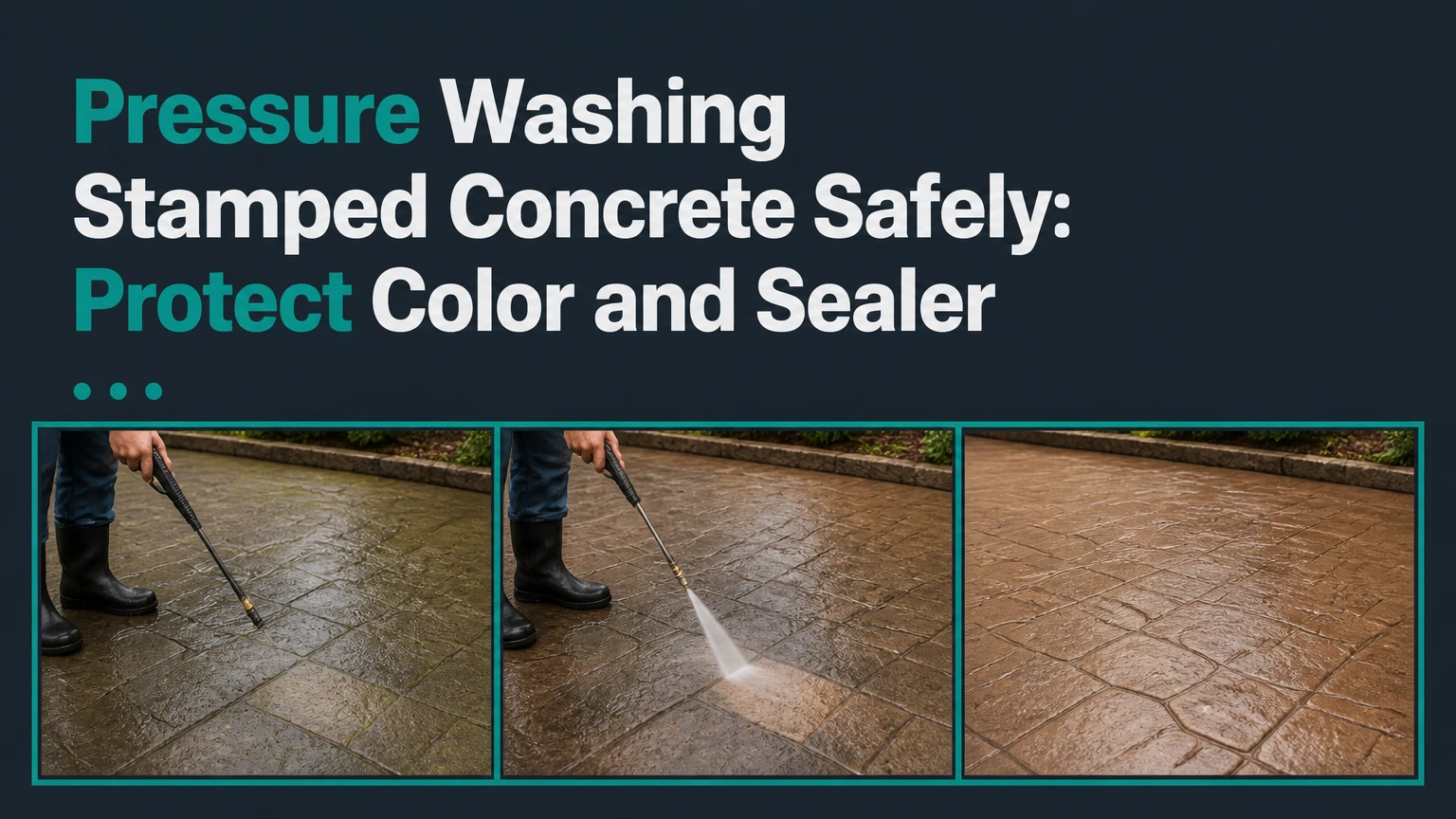
Pressure washing stamped concrete safely requires low, controlled pressure, a wide fan pattern, chemical pretreatment, and continuous wand movement. Start around 1,000-1,500 PSI on an intact sealed surface, test an inconspicuous area, and increase force only when the sealer and decorative color remain undamaged.
Key Facts at a Glance
- Sealed stamped concrete typically cleans effectively at 1,000-1,500 PSI, but the machine’s pressure rating is not the pressure actually reaching the slab.
- A 40-degree nozzle, 12-18-inch working distance, and moving spray reduce concentrated impact.
- A surface cleaner can produce more uniform results, but only when its nozzle pressure, height, and rotation suit the slab.
- Sodium hypochlorite is useful for algae and mildew, while alkaline degreasers target oil; neither replaces a surface test or runoff control.
- A water-beading test indicates some surface repellency, but it does not prove that the sealer is thick, bonded, or ready for another coat.
- Flaking sealer, exposed aggregate, powdering color, deep cracks, and unknown coatings justify hand cleaning or professional evaluation before washing.
What Makes Stamped Concrete Different?
Stamped concrete is ordinary concrete textured with patterned mats while the concrete is still workable, creating appearances such as slate, brick, flagstone, tile, or wood plank. Decorative color usually comes from integral pigment, dry-shake color hardener, release powder, stain, or a combination of these materials.
Acrylic, polyurethane, or epoxy sealer may sit on the surface. The sealer provides gloss, color enhancement, stain resistance, and reduced water absorption, but it can soften, delaminate, whiten, or wear away with age. Pressure washing stamped concrete safely therefore means protecting two layers: the decorative concrete surface and the coating above it.
A stamped pattern also contains recessed joints and narrow texture valleys. Dirt accumulates in those areas, which tempts operators to move the nozzle closer. That response concentrates impact precisely where color and sealer may already be weakest.
Which Surface Conditions Change the Method?
| Surface condition | Initial method | Working pressure | Main risk |
|---|---|---|---|
| Intact clear sealer, under 5 years old | Detergent plus wide fan | 1,000-1,500 PSI | Sealer scarring |
| Dull but bonded sealer, 5-10 years old | Test section, mild cleaner | 800-1,200 PSI | Whitening or color change |
| Flaking or peeling sealer | Low-pressure rinse and inspection | Under 800 PSI | Lifting remaining coating |
| Unsealed, powdering, or exposed aggregate | Scrub or professional soft wash | Under 500 PSI | Aggregate and pigment loss |
| Fresh installation under 28 days | Do not pressure wash | 0 PSI | Concrete and sealer cure damage |
| Oil-marked driveway with sound sealer | Alkaline degreaser first | 800-1,500 PSI | Repeated passes and gloss loss |
The installation date matters. Decorative concrete commonly needs at least 28 days to hydrate before routine pressure cleaning, while a newly applied sealer may require the product label’s full cure period, often 24-72 hours or longer under cool, humid conditions.
What PSI Is Safe for Stamped Concrete?
A practical starting range is 800-1,500 PSI at the surface for sealed stamped concrete, with 2.0-4.0 GPM preferred when the equipment allows it. The correct setting depends on sealer adhesion, nozzle size, distance, water temperature, and the contaminant, so a universal “maximum safe PSI” is misleading.
A machine advertised at 2,000 PSI may deliver less pressure through a larger nozzle, while a narrow nozzle can create a damaging concentrated jet. Pressure and flow are different variables: PSI supplies impact, whereas gallons per minute carry loosened soil away. Increasing GPM can improve productivity without increasing impact.
Start at the lowest useful setting. Test a 2-square-foot hidden section, rinse it, and compare its gloss, color, texture, and water absorption with an untouched area. Stop if the test leaves a lighter stripe, roughened feel, milky film, or visible color transfer.
What Nozzle and Distance Should You Use?
| Nozzle or tool | Typical angle or setting | Starting distance | Suitable use |
|---|---|---|---|
| White fan tip | 40 degrees | 12-18 inches | General rinsing and sealed surfaces |
| Green fan tip | 25 degrees | 18-24 inches | Carefully controlled spot work |
| Black soap tip | Low pressure | 12-18 inches | Applying compatible detergent |
| Red tip | 0 degrees | Do not use | Never appropriate for decorative concrete |
| Yellow tip | 15 degrees | Avoid | Excessive concentration risk |
| Rotary surface cleaner | Manufacturer-specified | Fixed deck height | Broad, even cleaning after testing |
The white 40-degree tip is the safest common pressure-washer nozzle, but “safe” does not mean harmless. Keep the fan moving, hold the wand at roughly 30-45 degrees instead of pointing straight down, and overlap passes by about one-third.
The 0-degree red tip and 15-degree yellow tip should not be used on decorative stamped concrete. A narrow jet can cut through acrylic sealer, remove release color, and etch a visible line in seconds.
Which Equipment Is Best for the Job?
A properly adjusted surface cleaner is usually the most consistent choice for broad patios and driveways, while a 40-degree wand is better for steps, borders, drains, and tight corners. Neither tool is automatically safe because the operator’s pressure, speed, height, and chemical choice determine the actual result.
A rotary surface cleaner encloses spinning spray bars beneath a housing. It reduces wand-height variation and zebra striping, but an incorrectly sized unit can leave circular marks, stall on low-flow equipment, or trap debris beneath the deck. Choose a cleaner whose required GPM is compatible with the machine.
Equipment Comparison
| Equipment | Typical specification | Best area size | Limitation |
|---|---|---|---|
| Electric washer | 1,300-2,000 PSI, 1.2-2.0 GPM | Under 500 square feet | Slow rinsing and limited lift |
| Gas washer | 2,000-4,000 PSI, 2.5-4.0 GPM | 500-2,000 square feet | Requires regulation and fuel ventilation |
| 12-inch surface cleaner | 2.0-3.0 GPM requirement | Patios and walkways | Poor access near walls |
| 16-20-inch surface cleaner | 3.0-4.0 GPM requirement | Driveways and large slabs | Can overload small machines |
| Pump sprayer | 1-2 gallon capacity | Pretreatment and edges | Requires manual application |
| Stiff nylon brush | 10-18-inch head | Delicate or unsealed slabs | Labor-intensive on large areas |
A professional may use a 4,000-PSI, 4-GPM machine while reducing output through an unloader or regulator. The machine’s maximum rating is not the recommended slab setting. A homeowner should not assume that owning a high-output washer makes high-pressure cleaning appropriate.
How Do You Pressure Washing Stamped Concrete Safely?
Pressure washing stamped concrete safely takes five practical stages: inspect, protect, pretreat, wash, and rinse. A 500-square-foot patio usually takes 1-2 hours of active work, excluding drying, and the surface test is the most important step because it reveals whether the coating can tolerate mechanical cleaning.
Before You Start
| Requirement | Typical amount or value | Why it matters |
|---|---|---|
| Active cleaning time | 1-2 hours per 500 square feet | Sets a realistic work block |
| Drying before evaluation | 24 hours | Reveals whitening and absorption |
| Washer starting point | 800-1,500 PSI | Limits impact on sound sealer |
| Water supply | 2.5-4.0 GPM preferred | Improves soil removal |
| Cleaner quantity | 1 gallon per 300-500 square feet | Typical diluted-use allowance |
| DIY equipment budget | $115-$180 per day | Rental, cleaner, and attachment |
| Protective gear | Gloves, eye protection, boots | Reduces chemical and splash exposure |
Do not begin if rain is likely during chemical dwell, temperatures are near freezing, or runoff will enter a storm drain without control. Move furniture and vehicles, sweep debris, photograph existing damage, and identify nearby electrical outlets, irrigation heads, expansion joints, and low drainage points.
Step 1: Inspect and Test the Sealer
Check for cracks, loose pieces, powdering, exposed aggregate, peeling film, white blush, and areas where the pattern color has already faded. Place a few drops of water on clean, dry concrete and observe whether the spot beads or darkens within about 60 seconds.
The splash test is only a screening tool. A beaded surface may still have poorly bonded sealer, and a slightly darkened spot may reflect worn coating rather than structural damage. Use a plastic scraper lightly on a hidden edge to identify loose film, then stop if the coating lifts.
You will know the step worked when: the test section has no color transfer, gloss change, soft film, or roughened texture after drying.
Common mistake: treating an old, peeling sealer as if it were intact because water still beads in isolated areas.
Step 2: Protect Plants, Buildings, and Drains
Sweep loose debris, cover sensitive metal, move planters, and pre-wet grass and shrubs with clean water. Block or filter storm-drain routes where local rules allow, and collect concentrated runoff rather than sending cleaner into a gutter.
Protecting vegetation is not optional. Sodium hypochlorite can scorch leaves, alkaline degreasers can damage soil biology, and dirty rinse water can carry oil into drainage systems. Post-rinse landscaping with clean water after the concrete is washed.
You will know the step worked when: runoff remains directed to an approved collection or absorption area, and plants are wet before chemical application.
Common mistake: relying on dilution after concentrated bleach or degreaser has already contacted dry leaves.
Step 3: Choose and Apply the Cleaner
Match chemistry to the contaminant instead of increasing pressure. Use a concrete-safe alkaline degreaser for oil, a labeled sodium-hypochlorite product for algae and mildew, and a mild acidic cleaner only for confirmed mineral deposits after testing.
Do not use a blanket bleach ratio such as one part product to four parts water. Commercial bleach, pool chlorine, and ready-to-use cleaners have different strengths, and the final sodium-hypochlorite concentration can vary substantially. Follow the product label, use the weakest effective dilution, never mix bleach with acids or ammonia, and wear eye and skin protection.
Apply with a pump sprayer or low-pressure soap system. Allow 5-15 minutes of dwell time while keeping the slab wet. Agitate oily or deeply textured areas with a nylon brush before rinsing.
You will know the step worked when: grime loosens, algae changes appearance, or oil begins to break into a removable film without the cleaner drying.
Common mistake: allowing detergent to dry in direct sun, which can leave haze or uneven residue on sealer.
Step 4: Wash in Small, Controlled Sections
Divide the slab into sections of about 25-100 square feet. Begin with a 40-degree nozzle at 800-1,000 PSI, hold the tip 12-18 inches away, and make parallel overlapping passes while maintaining a 30-45-degree angle.
Use a rotary surface cleaner only after testing its spray pattern. Keep the deck moving at a steady walking pace, avoid stopping over one stamp, and make a second slower pass only where soil remains. Use the wand for edges, stair risers, grooves, and areas the surface cleaner cannot reach.
Follow pattern joints when possible, but do not force the spray into cracks or expansion joints. High pressure can widen weak joints and drive dirty water beneath a coating.
You will know the step worked when: the cleaned section has an even color, no sharp transition lines, and no loose sealer at its edges.
Common mistake: moving closer when a stain remains. Pretreat and agitate instead.
Step 5: Rinse and Let the Slab Dry
Rinse from the highest area toward the drainage outlet using clean water and a broad fan. Remove all detergent, loosened soil, and chemical residue from recessed pattern lines, steps, and corners.
Let the slab dry for at least 24 hours before evaluating color or sealer. Delay resealing until the concrete and joints are fully dry, the weather meets the sealer label, and overnight dew will not trap moisture.
You will know the step worked when: rinse water runs clear, no slippery residue remains, and the dry surface has an even sheen.
Common mistake: judging the result while the concrete is wet. Wetting temporarily darkens worn areas and can hide patchy cleaning.
Which Cleaner Works for Each Stain?
| Contaminant | Preferred treatment | Dwell or action | Avoid |
|---|---|---|---|
| Algae or mildew | Labeled sodium hypochlorite cleaner | 5-15 minutes wet | Uncontrolled runoff |
| Oil or grease | Concrete-safe alkaline degreaser | 10-20 minutes plus brushing | Acid as a first response |
| Tire marks | Mild alkaline cleaner and nylon agitation | 5-10 minutes | Narrow high-pressure jet |
| Rust | Product labeled for concrete rust removal | Follow label exactly | Unverified acids |
| Efflorescence | Mild phosphoric or sulfamic product | Short test dwell | Muriatic acid on colored slabs |
| Food or drink | Neutral detergent and warm water | 5-10 minutes | Abrasive pads on sealer |
| Chewing gum | Ice, scraper, or controlled hot water | Until hardened or softened | Direct 0-degree spray |
Muriatic or hydrochloric acid is not a general-purpose stamped-concrete cleaner. Acid can remove cement paste, alter color, attack nearby metals, and damage topical finishes. Acid treatment belongs to controlled stripping or specialized mineral-deposit work, not routine maintenance.
Hot water can improve oil and gum removal at lower pressure, but heat can soften some acrylic coatings. Keep water temperature within the cleaner and sealer manufacturer’s limits.
Can You Clean Stamped Concrete Without Pressure Washing?
Manual scrubbing with a nylon brush, detergent, and a garden hose is the safest alternative for fresh, delicate, unsealed, or visibly failing stamped concrete. Soft washing can also clean organic growth with low mechanical pressure, provided the chemical is compatible with the sealer and runoff is managed.
| Method | Typical pressure | Cost range | Best application |
|---|---|---|---|
| Garden hose and brush | Under 100 PSI | $10-$40 supplies | Light annual dirt |
| Low-pressure soft wash | 100-500 PSI | $150-$350 service minimum | Algae and mildew |
| Wand pressure washing | 800-1,500 PSI | $115-$180 DIY rental | Edges and small patios |
| Surface cleaner washing | 800-1,500 PSI | $25-$40 attachment rental | Broad sealed areas |
| Professional restoration | Variable after testing | $0.25-$0.45 per square foot typical | Failed sealer and color repair |
Pressure washing is not the best answer for every slab. A 20-year-old driveway with exposed aggregate may become permanently lighter after one aggressive cleaning, while a brush-and-detergent method may preserve its remaining decorative color.
How Much Does Stamped-Concrete Cleaning Cost?
Typical DIY rental costs total $115-$180 for one day, including a washer, surface-cleaner attachment, and concrete cleaner. Professional cleaning commonly costs $0.25-$0.45 per square foot, with a typical minimum charge of $150-$250, although heavy restoration, access, stain treatment, and resealing raise the price.
| Project | DIY active time | Typical professional price | Drying or access time |
|---|---|---|---|
| 200-square-foot walkway | 45-90 minutes | $150-$250 minimum | 24 hours |
| 500-square-foot patio | 1-2 hours | $150-$225 | 24 hours |
| 1,000-square-foot driveway | 3-5 hours | $250-$450 | 48 hours before vehicles |
| 1,500-square-foot pool deck | 4-6 hours | $375-$675 | 24-48 hours |
| Cleaning plus resealing | 1-2 days | $1.50-$4.00 per square foot typical | Product-dependent cure |
These are typical planning ranges, not a universal price list. Contractors charge more for furniture removal, oil extraction, color matching, wastewater recovery, difficult access, or coating removal.
What Problems Occur After Washing?
Why Did Zebra Striping Appear?
Zebra stripes occur when a wand changes height, angle, speed, or overlap between passes. Rewash the entire affected section with a surface cleaner or broad fan, rather than tracing individual lines with a narrow nozzle.
Allow the slab to dry before deciding whether the contrast is dirt or removed color. If the original release pigment has been blasted away, additional cleaning will not restore it.
Why Did the Sealer Turn White?
White or milky sealer can result from moisture trapped in an acrylic film, coating delamination, incompatible chemicals, or a damaged surface. Allow several dry, warm days before attempting repair, because moisture blush may clear as vapor escapes.
Do not automatically apply xylene. Xylene can reflow some solvent-based acrylic sealers, but it will not reliably repair polyurethane, epoxy, badly delaminated films, or chemically damaged concrete. Confirm the coating chemistry, test a hidden area, ventilate the space, eliminate ignition sources, and follow the product safety data sheet.
Why Did the Color Fade?
Color loss usually means the wash removed weak release color, stain, or weathered sealer rather than merely removing dirt. A contractor may restore appearance with compatible antiquing stain and a new sealer, but a patch can remain visible because adjacent sections have aged differently.
When Should You Stop and Call a Professional?
Stop cleaning when the surface powders under light brushing, the coating peels, aggregate becomes exposed, cracks widen, color transfers to the rinse water, or a test patch changes sheen. Professional restoration is appropriate when the slab needs stripping, color matching, crack repair, stain removal, and resealing as one coordinated system.
How Often Should Stamped Concrete Be Washed?
Most residential stamped concrete needs light cleaning once or twice yearly, with stronger algae treatment scheduled when organic growth appears rather than on a rigid calendar. Commercial pool decks and shaded walkways may need spring and autumn service because moisture, sunscreen, body oils, and leaf litter accumulate faster.
Use a brush and hose for routine dust when possible. Reserve pressure washing for bonded grime that detergent and gentle agitation cannot remove. Frequent high-impact washing shortens the life of acrylic sealer and can accelerate decorative color loss.
In freezing climates, clean before sustained freezing weather only when the slab can dry completely. Water retained in cracks and porous concrete can freeze, expand, and worsen existing defects.
Expert Rules That Prevent Expensive Damage
- Machine PSI is not surface PSI. Nozzle orifice, trigger flow, distance, and angle change the force delivered to the sealer.
- Chemistry should precede force. A properly selected cleaner can remove organic soil or oil with less mechanical impact than repeated blasting.
- Uniformity beats maximum power. A slower, consistent surface-cleaner pass usually produces a better appearance than fast wand work at higher pressure.
- A water-beading test has limits. Beading indicates repellency, not coating adhesion, film thickness, or compatibility with a new sealer.
- Cleaning and resealing are separate operations. A wet slab can look ready for sealer while still holding moisture in joints and porous areas.
The most common professional error is treating stamped concrete like plain, uncoated broom-finished concrete. Decorative slabs require a test patch, compatible chemistry, lower initial force, and a drying inspection before the operator decides whether more cleaning is justified.
Frequently Asked Questions
Can I use a 2,000-PSI electric pressure washer on stamped concrete?
Yes, a 2,000-PSI electric washer can be suitable for sealed stamped concrete when used with a 40-degree nozzle, 12-18-inch distance, and a moving spray pattern. Start below the machine’s maximum output and test first. Avoid the red and yellow tips, which concentrate impact too sharply.
Is a surface cleaner safe for an old stamped-concrete patio?
A surface cleaner may be safe for an old patio only after testing the sealer and confirming that the deck’s nozzle pressure and GPM match the equipment. Peeling sealer, powdering pigment, or exposed aggregate requires lower-pressure cleaning or hand scrubbing. A fixed-height tool cannot correct a failing coating.
How long after pressure washing can I reseal stamped concrete?
Wait at least 24 hours after cleaning, then confirm that the surface, joints, and cracks are dry. Cool, humid, shaded, or porous conditions may require 48-72 hours. Follow the sealer manufacturer’s moisture and temperature requirements, because trapped water can cause whitening or adhesion failure.
Will pressure washing remove oil stains from stamped concrete?
Pressure washing alone often leaves embedded oil because water does not dissolve hydrocarbons effectively. Apply a concrete-safe alkaline degreaser, allow the labeled dwell time, agitate with a nylon brush, and rinse broadly. Older oil may require repeated treatment or professional extraction, and complete removal is not guaranteed.
Can pressure washing damage an unsealed stamped-concrete driveway?
Yes, pressure washing can damage an unsealed driveway by removing weak surface paste, release color, or fine aggregate. Use a garden hose, neutral cleaner, and nylon brush first. If the concrete powders, absorbs water immediately, or has widespread color loss, obtain a restoration assessment before using mechanical pressure.
How often should I reseal stamped concrete?
Resealing commonly occurs every 2-5 years, but exposure, traffic, coating type, climate, and preparation control the interval. Reseal when the existing coating is sound but water absorption and color dullness show wear. Do not coat over peeling sealer, trapped moisture, grease, or incompatible residue.
The Bottom Line
Pressure washing stamped concrete safely means using the least aggressive combination of cleaner, water flow, pressure, nozzle angle, and dwell time that removes the contaminant. Start with a hidden test at 800-1,000 PSI, use a 40-degree fan at 12-18 inches, keep the spray moving, and stop when the sealer or decorative color begins to change.
Choose hand cleaning for fragile or unsealed slabs, a tested surface cleaner for broad intact surfaces, and professional restoration for peeling sealer, color loss, exposed aggregate, or unknown coatings. Pressure washing stamped concrete safely protects the finish by treating surface condition as the controlling variable, not the washer’s maximum PSI.