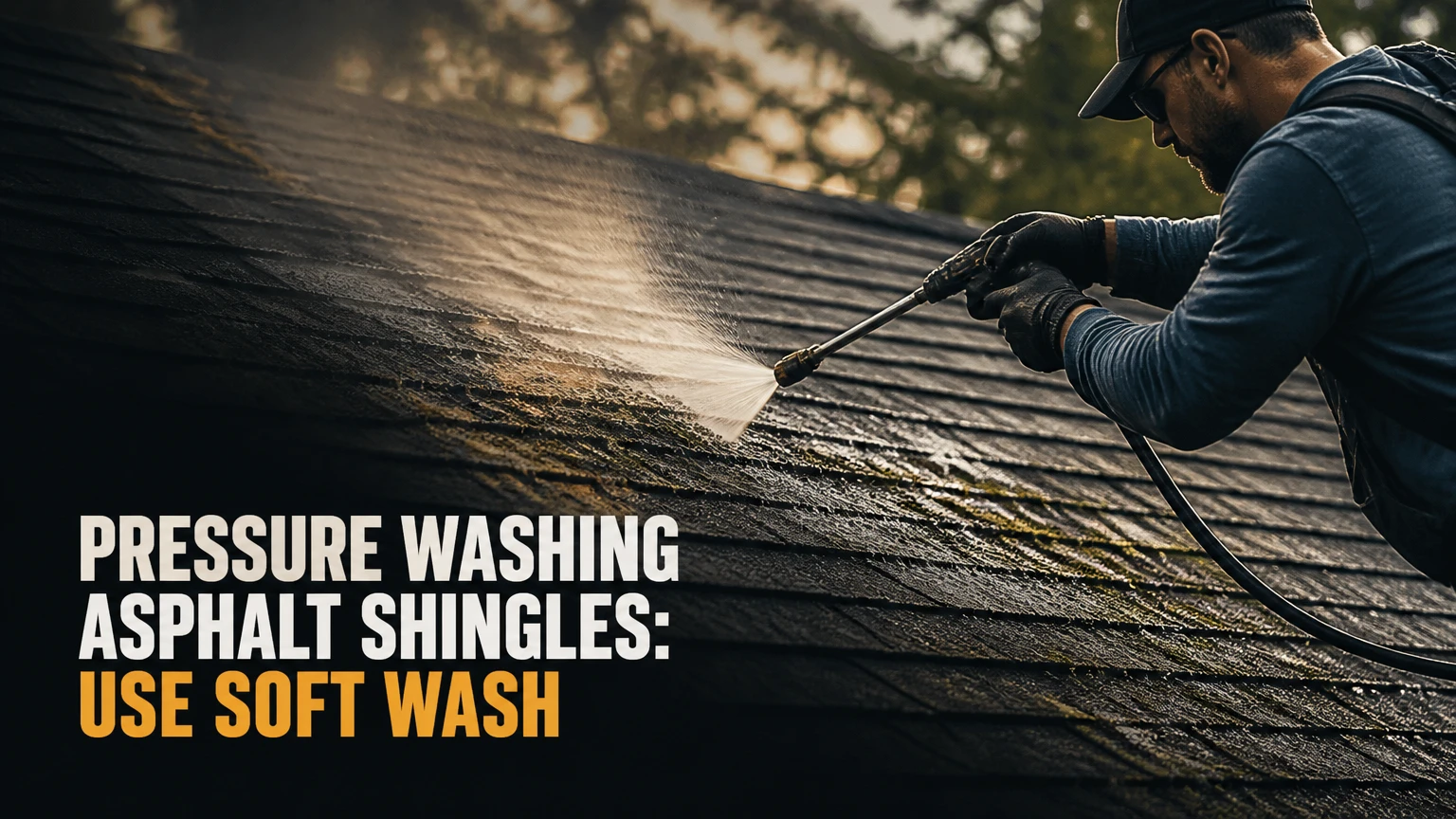
Pressure washing asphalt shingles is generally unsafe and should not be used for routine roof cleaning. High-pressure water can dislodge protective mineral granules, damage shingle edges, drive water beneath laps, and complicate warranty claims. For algae, moss, and lichen, roofing manufacturers and the Asphalt Roofing Manufacturers Association recommend a controlled chemical-cleaning method with minimal physical force.
Key Facts at a Glance
- High-pressure washing can remove the ceramic-coated mineral granules that protect asphalt shingles from ultraviolet exposure.
- Soft washing uses a cleaning solution and low-pressure application rather than high-pressure impact.
- No universal PSI limit guarantees safety; the shingle manufacturer’s instructions, nozzle, flow, distance, and roof condition all matter.
- Moss and lichen may remain attached after treatment because dead growth does not always detach immediately.
- Typical professional roof-cleaning prices range from $0.30-$0.75 per square foot, but access, pitch, and runoff controls can change the estimate.
- A roof with widespread granule loss, exposed mat, brittle shingles, or active leaks may need repair or replacement instead of cleaning.
Can You Pressure Wash Asphalt Shingles?
You should not pressure wash an asphalt shingle roof with a conventional power washer. Typical pressure-washing equipment operates around 1,500-4,000 PSI, while asphalt shingles are designed to shed rain, not withstand a concentrated jet that can lift granules and force water under overlapping courses.
The damage can be subtle. A roof may look cleaner immediately while losing granules that protect the asphalt coating from ultraviolet radiation and weathering. Pressure can also open weak seams, break already-brittle tabs, bend flashing, and expose underlayment to moisture.
The Asphalt Roofing Manufacturers Association, commonly called ARMA, advises homeowners to avoid power washing asphalt shingles and to follow the individual manufacturer’s maintenance instructions. A contractor’s statement that a pressure washer is being used “from a safe distance” does not establish that the method is approved.
Why does high pressure damage shingles?
High-pressure cleaning transfers kinetic energy to a thin, layered roofing product. The water stream can loosen mineral granules, abrade the asphalt surface, and enter beneath shingle laps when directed against the normal drainage path.
Granules are not decorative grit. They form the weathering surface of the shingle and help shield asphalt from solar degradation. Once granules are lost, exposed areas can age faster, and loose granules may accumulate in gutters after cleaning.
Roof age changes the risk. A 20-year-old shingle with brittle edges and existing granule loss can fail under a force that a newer roof might temporarily tolerate. Temporary visual success is therefore a poor test of cleaning safety.
What Are Asphalt Shingles Made Of?
Asphalt shingles usually contain a fiberglass reinforcement mat, asphalt coatings, mineral stabilizers, and ceramic-coated mineral granules. The fiberglass mat provides dimensional reinforcement, the asphalt helps resist water, and the granules create the exposed surface that receives sunlight and weather.
The granule layer also contributes to the shingle’s fire classification and appearance. Missing granules can reveal darker asphalt spots, especially around valleys, eaves, ridges, or areas where a wand has passed repeatedly.
Which roof conditions require inspection first?
A roof should be inspected before cleaning when it is more than 15-20 years old, has visible curling, has bare patches, leaks, lifted tabs, damaged flashing, or sheds granules heavily. Cleaning cannot restore lost granules or repair failed sealant.
| Pre-clean condition | What to check | Recommended decision |
|---|---|---|
| Newer roof, under 10 years | Black streaks, small algae patches, intact granules | Obtain manufacturer-approved cleaning guidance |
| Mid-life roof, 10-20 years | Granule density, brittle corners, flashing, attic leaks | Use a roof professional before treatment |
| Older roof, over 20 years | Curling, exposed mat, cracking, widespread granule loss | Price repair or replacement before cleaning |
| Moss-covered roof | Lifted shingles, trapped moisture, blocked valleys | Remove growth carefully and inspect affected courses |
| Steep or complex roof | Access, fall protection, skylights, solar equipment | Hire an insured roofing or soft-wash contractor |
How Does Soft Washing Clean a Shingle Roof?
Soft washing removes roof growth through chemical action and low-impact rinsing. A contractor applies a properly labeled cleaning solution with a low-pressure pump, allows dwell time for the solution to work, and rinses without abrading the shingle surface.
Soft washing is not a single regulated pressure number. “Under 100 PSI” is a common practitioner description, but a low-pressure pump can still cause damage if the nozzle is too close, the spray is concentrated, or the operator directs water under shingle laps. Manufacturer instructions control.
The solution must match the organism and roof material. Sodium hypochlorite is commonly used for algae, moss, and organic staining, while surfactants improve wetting and cling. Concentration, dwell time, temperature, sunlight, and growth density all affect results.
What pressure is safe for asphalt shingles?
There is no universal PSI value that guarantees safe asphalt-shingle cleaning. ARMA and shingle manufacturers focus on avoiding power washing and physical damage, while professional cleaners often apply solutions at garden-hose-like pressure, commonly about 40-100 PSI.
The nozzle and technique matter as much as the gauge. A narrow jet at close range can damage shingles at a lower gauge reading, whereas a wide fan pattern applied from an appropriate distance distributes force more gently. A contractor should provide the equipment method and follow the shingle maker’s instructions.
What chemicals are used?
Roof cleaners commonly use diluted sodium hypochlorite with water and a compatible surfactant. ARMA roof-care guidance has historically described chlorine-bleach solutions for algae and moss, but exact ratios should come from the shingle manufacturer, product label, local regulation, and site conditions rather than a generic internet formula.
Never mix bleach with ammonia, acids, acidic detergents, or products containing incompatible chemicals. Those combinations can release toxic gases. A professional should identify the active ingredient, dilution method, dwell time, plant-protection procedure, and disposal plan in writing.
How Do You Clean Asphalt Shingles Safely?
A safe cleaning workflow begins with inspection and property protection, not with a ladder and spray wand. Typical professional work takes 2-5 hours for a straightforward residential roof, although steep access, heavy moss, multiple roof sections, and runoff management can extend the job.
Step 1: Inspect the roof and read the warranty
Confirm the shingle manufacturer, product line, installation date if available, roof pitch, visible damage, and warranty requirements. Photograph existing granule loss, stains, cracked tabs, flashing, skylights, gutters, and nearby landscaping.
Do not clean a roof with active structural problems until a qualified roofer evaluates it. You will know this step is complete when the contractor can distinguish biological growth from shingle deterioration.
Common mistake: Treating every dark roof mark as algae. Some marks are exposed asphalt, shadowing, rust runoff, or failed materials.
Step 2: Plan access, weather, and runoff
Choose a calm day without rain in the immediate forecast, extreme heat, or freezing conditions. Secure ladders on stable ground, protect skylights and exterior fixtures, and establish how solution runoff will be controlled.
Roof walking creates a fall hazard, especially when shingles and moss are wet. Homeowners should not climb steep roofs to operate cleaning equipment. A harness, ladder, and respirator do not replace training, anchor selection, or a compliant fall-protection plan.
Common mistake: Starting during wind. Overspray can reach siding, vehicles, ponds, neighboring property, or sensitive vegetation.
Step 3: Saturate and protect landscaping
Thoroughly wet grass, shrubs, trees, and garden beds before chemical application. Cover sensitive plants temporarily where practical, keep solution away from ponds and streams, and arrange to dilute runoff with clean water.
Plastic covers should not remain over plants in hot sun, because heat can damage leaves even when the cleaner does not. Gutter bags or collection systems may be appropriate on some sites, but they must not create an uncontrolled pool of chemical runoff.
Common mistake: Protecting plants only after spraying begins. Pre-wetting reduces absorption but does not make careless overspray harmless.
Step 4: Apply the manufacturer-approved solution
Use a chemical-resistant pump sprayer or soft-wash system with a broad fan pattern. Apply evenly from a stable position, generally working in manageable sections and avoiding direct spray beneath shingle edges, flashing, vents, and siding.
The correct concentration depends on product instructions, growth severity, roof age, temperature, and local rules. Do not copy a fixed bleach recipe when the shingle manufacturer specifies another approach.
Common mistake: Increasing chemical strength because the first pass appears slow. Extend dwell time or arrange a second treatment when the product label permits it.
Step 5: Allow controlled dwell time
Many professional treatments dwell for approximately 10-20 minutes, but the label determines the safe range. Keep the surface appropriately wet and prevent solution from drying on shingles, painted surfaces, windows, or plants.
Algae may lighten quickly, while moss and lichen can remain physically attached after the organisms die. The treatment has worked when growth loses color and vitality, not necessarily when every fragment disappears immediately.
Common mistake: Scrubbing aggressively during dwell time. Abrasion can remove granules and damage the shingle surface.
Step 6: Rinse with low-impact water flow
Rinse with a garden hose or low-pressure system in the roof’s normal drainage direction, from the ridge toward the eaves. Use enough water to remove residue without directing a concentrated stream under the laps.
Some roofs need no active rinse when the product instructions specify a no-rinse treatment. Follow the label and manufacturer guidance rather than assuming every chemical process uses the same sequence.
Common mistake: Spraying upward from below. Water directed against laps can enter beneath shingles and reach underlayment or roof decking.
Step 7: Flush plants, gutters, and surrounding surfaces
Rinse landscaping, siding, windows, walkways, and equipment after the roof treatment. Remove temporary covers promptly, inspect gutters for loosened granules or dead growth, and verify that downspouts discharge safely.
Photograph the finished roof and record the product, dilution, weather, date, and observed condition. Documentation helps resolve warranty or maintenance questions later.
Common mistake: Leaving concentrated runoff in a low area. Dilute pooling immediately with fresh water and follow local disposal rules.
Pressure Washing Asphalt Shingles Compared With Alternatives
Pressure washing asphalt shingles is fast-looking but mechanically aggressive. Soft washing is usually the better choice for algae and organic growth because it targets the organism without relying on abrasive impact.
| Method | Typical operating approach | Best use | Main roof risk |
|---|---|---|---|
| High-pressure washing | 1,500-4,000 PSI water jet | Concrete, masonry, some metal surfaces | Granule loss, lifted tabs, under-lap water |
| Low-pressure soft wash | Approximately 40-100 PSI application | Algae, moss, lichen, organic staining | Chemical or runoff damage if mismanaged |
| Manual removal | Hand tools, limited physical contact | Thick moss after treatment | Granule abrasion and broken tabs |
| Zinc or copper strips | Metal ions released by rain | Preventing recurring growth below ridges | Limited coverage and installation damage |
| Oxygen-based cleaner | Label-specific oxidizing solution | Situations limiting chlorine use | Slower results and possible residue |
Is soft washing better than scraping?
Soft washing is generally preferable for algae and light-to-moderate moss because it kills or weakens growth without scraping the weathering layer. Thick moss may still require careful manual removal after treatment, but tools should not be used to pry up attached shingles or gouge granules.
Zinc and copper strips can reduce regrowth in areas below the metal, but they do not clean an existing roof and cannot correct shade, moisture, clogged gutters, or poor drainage. Metal strips also require compatible installation details to avoid corrosion or fastener problems.
Does soft washing void a roof warranty?
Soft washing does not automatically preserve every roof warranty, and pressure washing does not automatically void every warranty. Warranty terms differ by manufacturer and product, so the owner should obtain written maintenance guidance before cleaning.
A contractor should document the roof condition, use an approved product and procedure, avoid cutting or lifting shingles, and disclose any chemical application. Warranty protection also depends on installation defects, ventilation, storm damage, and maintenance records.
How Much Does Roof Cleaning Cost?
Typical professional asphalt-shingle cleaning costs range from $0.30-$0.75 per square foot, making a 2,000-square-foot roof approximately $600-$1,500 before unusual access or repairs. Contractors may price by roof area, not the home’s floor area, so a two-story house can have a much larger roof than its footprint suggests.
| Project factor | Typical range or value | Why the price changes |
|---|---|---|
| Basic roof soft wash | $0.30-$0.75 per sq. ft. | Roof size and ordinary access |
| 2,000-sq.-ft. roof | $600-$1,500 | Typical calculation before extras |
| Professional duration | 2-5 hours | Pitch, growth density, setup, rinsing |
| DIY sprayer and safety gear | $100-$250 | Excludes roof repairs and liability |
| Follow-up treatment | 6-24 months | Heavy moss or shaded conditions |
| Typical clean appearance | 3-5 years | Climate, shade, moisture, and growth pressure |
The roof’s measured area, pitch, height, dormers, solar panels, fragile landscaping, waterway proximity, and required containment can add cost. A low estimate may omit plant protection, gutter cleaning, second applications, or pre-clean inspection.
Is DIY roof cleaning worth the risk?
DIY cleaning may cost less in equipment, but the fall risk, chemical exposure, runoff liability, and possibility of shingle damage make ground-based or professional work safer for many homeowners. A long-range applicator can reduce climbing, but it does not remove overspray, dilution, or drainage hazards.
DIY is a poor choice when the roof is steep, wet, brittle, moss-covered, more than 15-20 years old, or adjacent to a pond. A homeowner who cannot inspect the roof safely should not attempt to clean it safely.
What Should You Do About Black Streaks, Moss, and Lichen?
Black streaks are commonly associated with algae, while moss forms raised green or brown growth and lichen develops crusty, branching attachments. Appearance alone cannot confirm the cause, so treatment should begin with inspection rather than maximum chemical strength.
| Visible condition | Likely cause | Appropriate response | Avoid |
|---|---|---|---|
| Thin black or brown streaks | Algae or weathering variation | Approved low-pressure treatment | High-pressure blasting |
| Green cushion-like patches | Moss retaining moisture | Treat, then remove only loosened material | Pulling attached shingles |
| Gray crusty growth | Lichen | Repeated approved treatment if needed | Wire brushes and scraping |
| Granule-filled gutters | Aging, storm damage, or prior cleaning | Roof inspection | Assuming cleaning caused all loss |
| Rust-colored streaks | Metal runoff or corrosion | Inspect fasteners and flashing | Bleach-only treatment |
Moss can hold moisture against shingles and lift edges as its growth thickens. Dead moss may turn pale or white and remain attached for weeks, after which rain and wind can remove it gradually.
A second treatment may be safer than forceful removal when the first application changes color but leaves attachment points. However, repeated chemical applications on a failing roof do not make the roof sound.
When should a stained roof be replaced?
Replacement becomes more appropriate when staining accompanies widespread granule loss, exposed fiberglass mat, brittle or curled shingles, recurring leaks, deteriorated flashing, or a roof near the end of its expected service life. Cleaning addresses surface growth, not structural or weathering failure.
An independent roofer should inspect the attic and roof surface before a homeowner spends money on cosmetic treatment. A clean roof still leaks when the underlayment, flashing, decking, or ventilation system has failed.
Which Roof-Cleaning Contractor Should You Choose?
Choose a contractor who offers a written soft-wash procedure, carries liability and workers’ compensation insurance, identifies the cleaning product, explains runoff controls, and agrees to inspect the roof before applying chemicals. Reject proposals that promise to pressure wash asphalt shingles or guarantee a fixed lifespan extension.
Ask these questions before hiring:
- What pressure and nozzle type will you use on the shingles?
- Which manufacturer or ARMA guidance supports the method?
- What product, concentration, dwell time, and rinse procedure will you use?
- How will you protect plants, siding, windows, vehicles, and waterways?
- Will you photograph existing granule loss and roof damage?
- Is chemical roof cleaning covered by your insurance?
- What happens if moss remains attached after treatment?
- Are repairs included, or will a licensed roofer handle them separately?
A contractor should separate cleaning from repair in the estimate. That distinction prevents a cleaner from disguising damaged shingles as a maintenance problem.
Common Mistakes and How to Fix Them
| Mistake | Likely consequence | Safer correction |
|---|---|---|
| Using a 2,000-4,000 PSI washer | Granule loss and lifted shingle edges | Stop and use approved low-pressure treatment |
| Spraying upward under laps | Moisture intrusion and leaks | Rinse from ridge toward eaves |
| Letting bleach dry | Plant, paint, and surface damage | Keep surfaces wet and follow label dwell time |
| Mixing bleach with ammonia | Toxic chloramine gas | Never combine incompatible cleaners |
| Scrubbing black streaks | Abrasion without killing algae | Use chemical action and repeat if approved |
| Ignoring roof age | Breakage during otherwise careful cleaning | Obtain a condition inspection first |
One counterintuitive roof-care rule matters most: immediate visual improvement does not prove a method was safe. Granule loss may be visible only in gutters or during the next storm, after the pressure-washing visit has ended.
Another practitioner rule is to treat runoff as part of the job, not as cleanup afterward. A chemically effective roof treatment can still be a failed project if it kills landscaping, contaminates a pond, or damages painted siding.
How Can You Prevent Roof Growth After Cleaning?
Roof growth is reduced by controlling moisture, shade, debris, and recurrence pathways. Keep gutters clear, trim branches that shade the roof, correct overflowing downspouts, and inspect valleys where leaves retain moisture.
Zinc or copper strips may help limit new growth below roof ridges, but they are preventive accessories rather than replacements for cleaning or repair. Their effectiveness depends on rainfall reaching the metal and washing ions across the affected shingle area.
Schedule an inspection after severe weather and review the roof annually from the ground. Do not schedule routine cleaning solely by calendar age; a shaded, wet roof may need attention sooner than a sunny, well-ventilated roof.
FAQ
Can I use a garden hose on asphalt shingles?
A garden hose can be appropriate for rinsing a manufacturer-approved cleaning treatment when the water flows downward and does not force water beneath shingle laps. A hose alone usually will not remove established algae, moss, or lichen without chemical action, and climbing onto a wet roof remains hazardous.
Will bleach damage asphalt shingles?
A correctly selected and diluted sodium hypochlorite solution can be used for some asphalt-shingle cleaning procedures, but excessive concentration, prolonged dwell time, drying, and poor rinsing can damage adjacent materials and landscaping. Follow the shingle manufacturer’s instructions and product label instead of relying on a universal recipe.
How often should asphalt shingles be cleaned?
Many roofs need cleaning every 3-5 years, but shaded or humid properties can develop growth sooner, while dry, sunny roofs may remain clean longer. Inspect annually and clean when biological growth is established, rather than using pressure washing as a routine appearance treatment.
Will rain remove dead moss from a roof?
Rain and wind may remove dead, chemically treated moss over several weeks, especially when the moss has lost its attachment. Thick growth can remain lodged around shingle edges and may need careful follow-up by a trained professional. Pulling moss prematurely can lift shingles and remove granules.
Can roof cleaning remove granules?
Any aggressive physical method, including pressure washing, scraping, or stiff brushing, can remove mineral granules. Normal aging and hail can also cause granule loss, so gutters containing granules do not automatically prove that a recent cleaner caused the loss. A pre-treatment condition record helps establish the roof’s baseline.
Should I clean the roof before selling a house?
Cleaning may improve curb appeal when stains are superficial and the shingles remain sound, but a roof inspection should come first. If the roof has leaks, widespread granule loss, or brittle shingles, disclosure and repair planning matter more than cosmetic treatment. Pressure washing asphalt shingles before a sale creates unnecessary damage and warranty risk.
Conclusion
Pressure washing asphalt shingles is the wrong method for routine algae, moss, and lichen removal because high-pressure impact can strip granules, damage shingle edges, and drive water beneath laps. Use a manufacturer-approved soft-wash process, protect landscaping and drainage, document roof condition, and replace or repair shingles when cleaning cannot correct underlying deterioration.