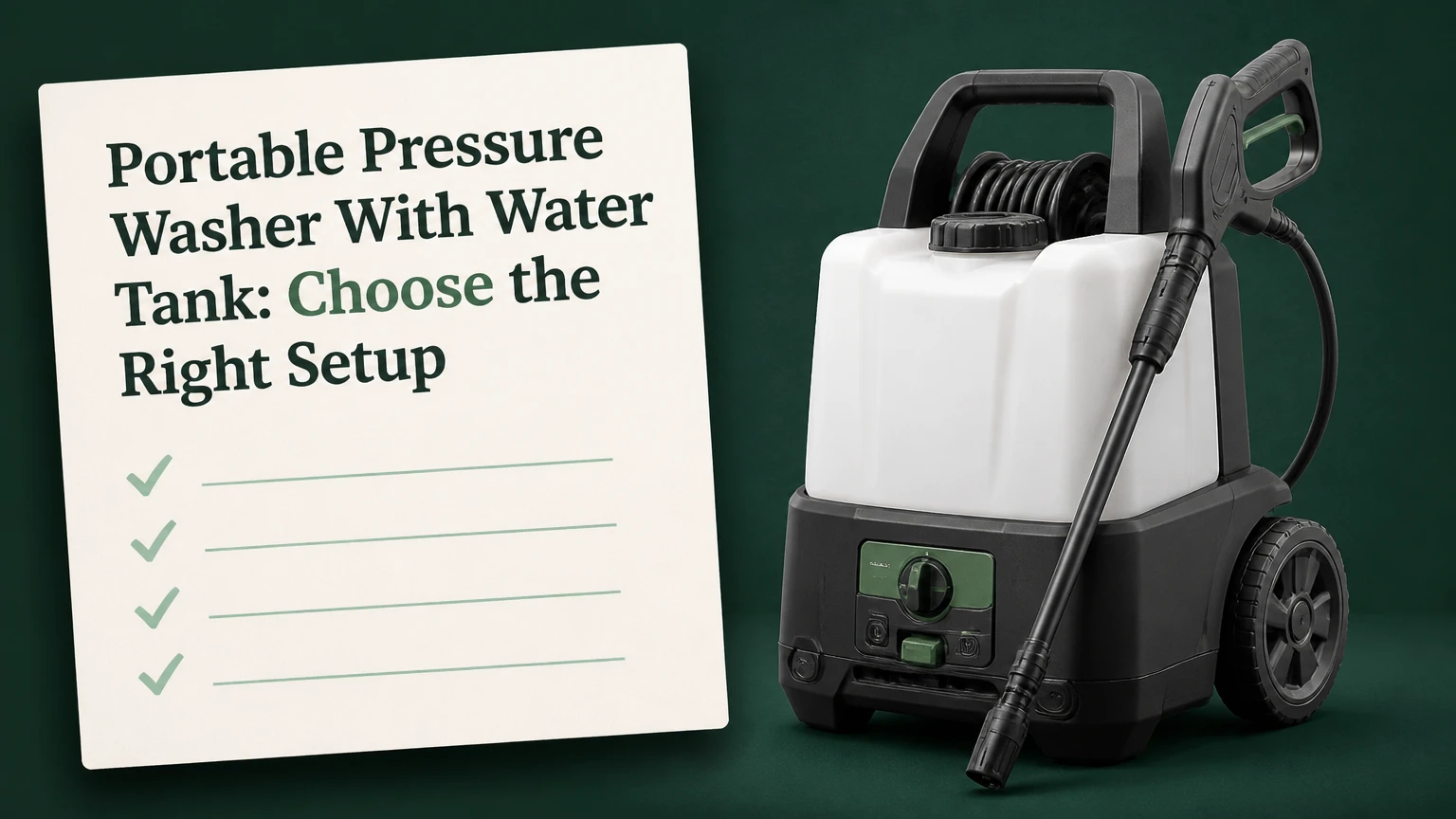
A portable pressure washer with water tank from Home Depot is usually a cordless power cleaner that draws cold water from an integrated reservoir, bucket, bottle, or siphon hose instead of a pressurized outdoor faucet. Home Depot’s Ryobi EZClean range covers compact 320 PSI and 600 PSI cleaners, while larger cordless models reach about 1,200 PSI for mobile vehicle and property maintenance.
Key Facts at a Glance
- Home Depot’s portable tank-free cleaners commonly draw from a bucket, bottle, or open water source through a filtered siphon hose.
- The Ryobi 18V EZClean 320 PSI cleaner is suited to bikes, boots, patio furniture, and light rinsing.
- The Ryobi 18V HP EZClean 600 PSI cleaner provides more rinsing force while remaining compact and mobile.
- A 0.7-0.8 GPM machine can use approximately 3.5-4 gallons during a five-minute continuous spray.
- Tool-only prices exclude the battery and charger, so an existing Ryobi ONE+ battery can materially reduce the purchase cost.
- A bucket-fed washer is portable, but it is not a substitute for a 2,000-3,000 PSI machine on large concrete or heavy oil deposits.
What Does a Home Depot Portable Washer With a Water Tank Mean?
A Home Depot portable washer with a water tank is a low-to-medium-output cleaning machine that stores or sources water locally and pumps it through a pressurized nozzle. The phrase “with water tank” describes the water-supply method, not necessarily a product with a built-in tank.
Many products listed under Home Depot’s cordless pressure washer category use a detachable siphon tube rather than a permanent reservoir. The filtered intake sits in a bucket or jerry can, and the machine pulls water through the hose. Some compact power cleaners also accept a standard bottle adapter, which is useful for a small rinse but unsuitable for extended washing.
The distinction matters because a 5-gallon bucket is consumed quickly. At 0.8 GPM, continuous spraying uses roughly 4 gallons in five minutes, before allowing for pauses, hose priming, or water left below the intake filter. A user cleaning a vehicle should therefore plan several buckets or use a larger clean-water container.
Integrated Tank Versus Bucket-Fed Siphon
An integrated tank carries water inside the machine, while a siphon-fed cleaner carries only the pump and hose. Integrated tanks simplify transport but add weight and restrict capacity. Bucket-fed designs offer greater capacity flexibility, although the user must provide a stable container and keep the intake filter submerged.
| Water-supply design | Typical capacity | Mobility advantage | Main limitation |
|---|---|---|---|
| 2-liter bottle adapter | 0.53 gal | Fits in a vehicle or apartment closet | Usually under two minutes of intermittent rinsing |
| 5-gallon bucket | 5 gal | Inexpensive and widely available | About 5-7 minutes at 0.7-1.0 GPM |
| 10-gallon water jug | 10 gal | Supports longer remote jobs | Weighs about 83 pounds when full |
| Integrated portable tank | 1-5 gal typical | No separate bucket required | Adds carried weight and limits refill volume |
The most useful Home Depot interpretation is therefore “portable cordless cleaner that can draw from a non-pressurized water source.” Check the product listing and manual before assuming a permanent tank is included.
How Does a portable pressure washer with water tank Work?
A portable pressure washer with water tank uses a battery motor and pump to pull water through an intake filter, pressurize it, and discharge it through a narrow nozzle. The siphon hose must be airtight, the filter must remain submerged, and the pump must be filled with water before the motor runs.
The operating sequence has four mechanical stages:
- Water sourcing: Water enters from a built-in reservoir, bottle adapter, bucket, or siphon hose.
- Suction: The pump creates low pressure at the intake, lifting water through the hose.
- Pressurization: A DC motor drives the pump, increasing water pressure above the source pressure.
- Targeted delivery: The nozzle converts flow into a concentrated spray pattern.
The pump does not create unlimited cleaning force. PSI describes pressure, while GPM describes water volume. A 1,200 PSI machine may rinse faster than a 320 PSI cleaner, but nozzle distance, spray angle, detergent dwell time, and the looseness of the dirt also determine results.
Why Priming Matters
Air in the intake line interrupts water flow and can cause sputtering, overheating, or a motor that runs without producing pressure. Prime the system by placing the filter fully underwater, connecting the intake firmly, and holding the trigger until a steady stream exits, commonly for 15-30 seconds.
Never run the pump dry. A dry pump lacks the water that cools and lubricates internal components, and repeated dry starts can damage seals or check valves.
Which Home Depot Models Fit Different Cleaning Jobs?
The compact Ryobi 18V 320 PSI EZClean is the practical budget choice for light rinsing, the Ryobi 18V HP 600 PSI EZClean is the stronger compact option, and the Ryobi 40V HP platform is the higher-output choice for mobile car and property work. Product names, package contents, prices, and inventory can change.
| Home Depot product type | Pressure and flow | Water-source approach | Best practical use |
|---|---|---|---|
| Ryobi ONE+ 18V EZClean 320 PSI | 320 PSI, 0.8 GPM | Siphon hose or bottle adapter | Boots, bikes, chairs, camping equipment |
| Ryobi ONE+ HP 18V EZClean | 600 PSI, 0.7 GPM | Siphon hose or bucket | Cars, kayaks, patio furniture, muddy tools |
| Ryobi 40V HP cordless washer | Up to about 1,200 PSI, roughly 0.7-1.0 GPM | Siphon hose or remote water source, model dependent | Mobile detailing and larger rinsing jobs |
| Corded electric pressure washer | Commonly 1,500-2,000 PSI, 1.2-1.5 GPM | Usually garden hose | Driveways, siding, decks near an outlet and spigot |
The 320 PSI model has a narrow job envelope. It can remove loose mud and dust, but it will not quickly strip baked-on grease or old concrete staining. The 600 PSI model offers a better compromise for vehicle rinsing because it adds cleaning force without the size and battery weight of a larger platform.
A 40V machine may improve rinsing productivity, but the price calculation changes if the buyer needs a battery and charger. Home Depot often sells cordless tools as tool-only products, so compare the complete system cost rather than the displayed tool price.
What Do PSI, GPM, Runtime, and Water Use Tell You?
PSI indicates the pressure available at the pump, GPM indicates the amount of water discharged, runtime describes battery operation under a particular load, and water consumption determines how many containers the job requires. These values should be interpreted together rather than ranked independently.
| Performance measure | Typical portable range | Practical consequence |
|---|---|---|
| Pressure | 320-1,200 PSI | Light rinsing to moderate vehicle and property cleaning |
| Flow rate | 0.7-1.0 GPM | About 3.5-5 gallons per five minutes of continuous spraying |
| Battery runtime | 15-25 minutes typical | Several short tasks, or one interrupted vehicle rinse |
| Five-gallon bucket life | 5-7 minutes typical | Refills are likely during a complete car wash |
| Spray reach | 6-12 inches working distance | Closer distance increases impact and surface risk |
Runtime varies with battery capacity, ambient temperature, nozzle restriction, detergent use, and trigger time. A 4.0 Ah battery may run longer than a 2.0 Ah battery, but continuous trigger time is not the same as elapsed job time. Washing usually includes pauses for moving the bucket, changing attachments, and wiping surfaces.
A counterintuitive operating rule is that lower GPM reduces water use but also slows rinsing. On a vehicle, the 600 PSI cleaner can loosen dirt effectively, yet the operator must move the spray methodically because there is less water volume to carry debris away.
Which Surfaces Can These Cleaners Handle?
Portable cordless cleaners work best on loose mud, dust, pollen, fresh road film, patio furniture, bicycle components, rubber mats, and outdoor equipment. They are less effective on deeply embedded oil, long-neglected concrete, thick moss, and large areas where high flow determines productivity.
| Cleaning target | Recommended approach | Starting distance | Result expectation |
|---|---|---|---|
| Mountain bike frame | 320-600 PSI, wide spray | 12 inches | Removes trail mud without aggressive impact |
| Car paint and wheels | 600-1,200 PSI, wide spray | 12-18 inches | Rinses loose dirt; requires pre-soak and wash mitt |
| Patio furniture | 320-600 PSI, broad pattern | 12 inches | Removes dust, pollen, and light algae |
| Wooden deck | 320 PSI, broad pattern | 18-24 inches | Safer starting point; avoid concentrated spray |
| Concrete walkway | 600-1,200 PSI, test area first | 6-12 inches | Handles loose dirt, not all deep staining |
| Window screens | 320 PSI, indirect angle | 24 inches | Removes dust when used gently |
| Engine bay | Avoid direct electrical spray | Not applicable | Use controlled wiping and manufacturer guidance |
Start with the widest spray pattern and the greatest practical distance. Move closer only when the surface tolerates the force. Concentrated turbo or narrow-angle tips can cut soft wood, remove vehicle trim coatings, force water behind seals, and damage loose masonry.
Can You Wash a Car With a Bucket-Fed Washer?
A 600 PSI cordless cleaner can rinse a car, but it cannot replace a complete high-flow detailing setup. Use a clean-water pre-rinse, a pH-neutral automotive shampoo, a separate wash mitt, and a final rinse; keep the nozzle away from wheel-bearing seals, door seals, sensors, and damaged paint.
Car cleaning consumes more water than a quick bike rinse. A five-gallon container may support a pre-rinse and partial final rinse, but a visibly dirty SUV can require additional water. Do not use a lake, pond, or rain barrel for vehicle paint unless the water is filtered adequately and the manufacturer permits that source.
How Much Does a Home Depot Tank-Ready Washer Cost?
Typical Home Depot pricing ranges from approximately $49-$99 for compact tool-only 18V cleaners, about $150-$299 for complete starter kits, and around $199 or more for larger cordless tool-only models. Prices and inventory vary by store, region, sales period, battery inclusion, and model generation.
| Purchase format | Typical price range | Included equipment | Best buyer |
|---|---|---|---|
| 18V tool-only cleaner | $49-$99 | Cleaner body, wand, basic intake parts | Existing Ryobi ONE+ owner |
| 18V kit | $150-$249 | Cleaner, 2.0-4.0 Ah battery, charger | New cordless-tool buyer |
| 40V tool-only washer | About $199 and higher | Washer body, accessories vary | Existing Ryobi 40V owner |
| 40V complete kit | $250-$399 typical | Washer, battery, charger, hose or nozzle parts | Frequent remote user |
Accessory costs can alter the decision. Budget for a 5-gallon bucket, spare intake filter, bottle adapter if needed, foam attachment, extra battery, and a clean-water jug. A product listed as “tool only” can become more expensive than a complete kit if the buyer owns no compatible battery.
Home Depot’s product page should be checked for current stock, store pickup, shipping status, warranty terms, and exact contents. Canadian Home Depot listings and United States listings may use different model numbers, prices, and package configurations.
What Are the Alternatives to a Tank-Ready Cordless Washer?
A bucket-fed cordless cleaner is the best choice when mobility matters more than area coverage. A hose-fed electric washer is generally more productive near a spigot, while a manual pump sprayer is cheaper for applying cleaner but lacks pressure for rinsing.
| Alternative | Typical output | Water requirement | Best situation |
|---|---|---|---|
| Cordless siphon cleaner | 320-1,200 PSI, 0.7-1.0 GPM | Bucket, bottle, or tank | Remote rinsing and small jobs |
| Corded electric washer | 1,500-2,000 PSI, 1.2-1.5 GPM | Pressurized garden hose | Patios, siding, and driveways |
| Gas pressure washer | 2,000-3,500 PSI, 2.0-3.5 GPM | Garden hose or supply tank with correct setup | Large concrete and heavy restoration |
| Pump sprayer | 30-60 PSI typical | Hand-filled tank | Applying detergent, weed treatment, or rinse aid |
A garden hose also delivers much more water than a battery cleaner, so it can rinse soap and loosened debris faster. The trade-off is dependence on a spigot and the risk of using excessive water on balconies, docks, or remote sites.
Gas machines are not automatically compatible with a gravity-fed bucket. Their pump may require a minimum inlet flow, and starving the pump can cause cavitation or damage. Use the manufacturer’s feed-water instructions rather than assuming that any open container will work.
How Do You Use a Portable Washer Safely?
Use a portable washer in seven stages: charge the battery, prepare clean water, connect the intake and wand, purge air, select a spray pattern, wash from a safe distance, and flush and store the machine. A small job typically takes 20-45 minutes, with the water source and battery determining the finish time.
Step 1: Charge and Inspect the Battery
Charge the correct Ryobi ONE+ 18V or 40V battery according to the model. Inspect the battery compartment, contacts, intake filter, quick-connect fittings, and nozzle for grit or damage.
Keep the battery removed while assembling the water path. Confirm that seals and O-rings are seated correctly.
Success checkpoint: The battery indicator shows a usable charge and the intake filter is clean.
Common mistake: Installing a battery from the wrong voltage platform.
Step 2: Prepare a Clean Water Source
Fill a stable bucket or water jug with clean freshwater. Leave enough headroom to prevent sloshing, then place the filtered intake fully below the surface.
Use a weighted filter or clip if the hose floats. Keep the container close enough that the siphon hose does not kink.
Success checkpoint: The filter remains submerged when the trigger is pulled.
Common mistake: Using silty pond water that can clog check valves and nozzle passages.
Step 3: Connect the Intake and Wand
Push the siphon connector completely into the machine intake, then lock the wand, spray gun, and selected nozzle. Confirm that every quick-connect collar is fully engaged.
Do not force incompatible foam cannons or garden-hose fittings into the tool. Accessory interfaces differ across EZClean generations.
Success checkpoint: The connection does not pull loose under light hand pressure.
Common mistake: Leaving a small air leak at the intake, which causes spluttering.
Step 4: Prime the Pump
Submerge the filter, hold the trigger, and allow water to travel through the line for 15-30 seconds. Continue until the output becomes a steady stream without large air gaps.
Priming before motor operation reduces dry running. Some models may require a slightly longer purge after storage.
Success checkpoint: Water exits continuously before full pressure operation begins.
Common mistake: Releasing the trigger as soon as the first few drops appear.
Step 5: Select the Spray Pattern
Begin with a broad or low-impact spray pattern. Use a narrower pattern only after testing an inconspicuous area, and reserve turbo tips for hard, durable surfaces that tolerate concentrated force.
For car paint, plastic, window screens, and wood, maintain at least 12 inches of distance initially. Keep the wand moving.
Success checkpoint: Dirt loosens without surface marking, coating removal, or water intrusion.
Common mistake: Starting with a turbo nozzle against a soft or painted surface.
Step 6: Wash in Sections
Work from the top of the object downward, rinsing one manageable section at a time. On a vehicle, pre-rinse loose grit, apply compatible detergent, allow short dwell time without letting soap dry, then rinse thoroughly.
Use a 6-12 inch distance only on hard surfaces after testing. For paint, trim, and seals, 12-18 inches is a safer starting range.
Success checkpoint: Dirt leaves the surface without visible etching or streaking.
Common mistake: Holding the jet still while trying to remove a stubborn spot.
Step 7: Flush, Drain, and Store
Run clean water through the pump if detergent or dirty water entered the system. Remove the battery, disconnect the intake, drain hoses, clear the nozzle, and store the equipment indoors above freezing.
Freezing water expands inside manifolds and fittings. A dry, frost-free storage location protects the pump and battery.
Success checkpoint: No water remains trapped in the intake hose or accessory.
Common mistake: Storing the assembled unit wet in an unheated shed.
What Problems Occur Most Often?
The most common failures are air leaks, a submerged filter that has shifted, a blocked nozzle, insufficient battery charge, and a pump exposed to dirty or frozen water. Each symptom points to a short diagnostic sequence rather than immediate pump replacement.
| Symptom | Likely cause | Corrective action | Typical time |
|---|---|---|---|
| Motor runs with no spray | Filter not submerged or intake leak | Submerge filter and reseat connector | 2-5 minutes |
| Pulsing or spluttering | Air in hose or low container level | Re-prime for 15-30 seconds | 2-4 minutes |
| Weak spray | Blocked nozzle or low battery | Clean tip and charge battery | 5-20 minutes |
| Hose floats upward | Missing weight or clip | Attach intake weight and reposition | 1-3 minutes |
| Pump will not start | Battery fault, trigger lock, or wet contacts | Remove, dry, reinstall, inspect manual controls | 5-15 minutes |
| Pressure drops during washing | Filter clogged with sediment | Stop, rinse filter, replace contaminated water | 5-10 minutes |
Turn the machine off before removing a nozzle or clearing debris. Use the manufacturer’s cleaning pin or a soft method suitable for the tip; a damaged nozzle can alter the spray pattern and increase surface risk.
A practitioner rule of thumb is to diagnose the water path before blaming the pump. Most no-pressure complaints occur at the source filter, quick-connect seal, hose position, or nozzle.
Which Setup Should You Choose?
The right setup depends on the object, water access, battery ownership, and expected cleaning area. The 320 PSI model suits occasional light rinsing, the 600 PSI model fits mixed vehicle and outdoor use, and the 40V option makes more sense when the buyer already owns the platform or needs stronger mobile output.
Apartment Resident or Balcony Owner
Choose the 18V 320 PSI EZClean with a small bottle or compact bucket. Its lower output reduces the chance of flooding neighboring balconies, and its compact body is easier to store in a closet.
Use a collection tray and check building rules before washing outdoors. Avoid spraying dirty runoff toward walls, drains, or adjacent units.
Mountain Biker or Camper
Choose the 18V 600 PSI EZClean with a 5-gallon jug. The added pressure removes trail mud from tires, frames, boots, and camping equipment before those items enter a vehicle.
Do not aim directly at wheel bearings, suspension seals, electrical connectors, or sealed electronics. A lower-pressure rinse followed by a towel or brush protects components better than maximum spray force.
Mobile Car Detailer
Choose the 600 PSI model for occasional cars and the 40V HP model for repeated remote work. Carry at least 10 gallons of clean water for a dirty vehicle, plus a spare battery if the job includes pre-rinse, foam, and final rinse stages.
A cordless washer cannot compensate for poor wash technique. Use separate clean mitts for painted panels and wheels.
Property Owner With Concrete and Siding
Choose a corded electric or gas machine when a spigot and electrical supply are available. The higher GPM of those machines makes large areas faster, while a portable cordless cleaner is better reserved for spot cleaning and remote sections.
Do not buy a compact siphon cleaner expecting commercial concrete restoration. That mismatch creates long runtimes, repeated bucket refills, and disappointing stain removal.
What Are the Main Advantages and Limitations?
The main advantage is access to pressurized rinsing where no spigot exists; the main limitation is low water volume and modest productivity. A portable cordless washer improves mobility, but it does not deliver the sustained flow of a full-size hose-fed or gas pressure washer.
Advantages
- Operates from a bucket, bottle, jug, or approved open water source.
- Avoids extension cords and garden-hose routing.
- Uses about 0.7-1.0 GPM, less than many conventional washers.
- Fits vehicle trunks, boats, campsites, and small storage areas.
- Uses interchangeable batteries when the platform already exists.
Limitations
- A 5-gallon bucket can empty in approximately 5-7 minutes.
- Battery runtime commonly limits continuous work to 15-25 minutes.
- Tool-only prices exclude the battery and charger.
- Low GPM slows soap removal and large-area rinsing.
- Water from lakes, ponds, or rain barrels can damage pumps without proper filtration.
- Compact models are poor choices for deeply embedded oil, large driveways, and industrial buildup.
The most important buying correction is simple: do not equate PSI with total cleaning productivity. Flow rate controls how quickly loosened dirt and detergent leave the surface, while PSI controls the force available at the nozzle.
Frequently Asked Questions
Can a cordless pressure washer draw water from a rain barrel?
A cordless pressure washer may draw from a rain barrel when the manufacturer permits open-source water and the intake filter is appropriate. Rain barrels often contain sediment, algae, and organic debris, so filter the water and inspect the intake frequently. Never assume compatibility without checking the model instructions.
Does a pressure washer need a water tank?
A pressure washer does not always need a dedicated tank. Many portable Home Depot cordless cleaners use a siphon hose in a bucket, while conventional electric models normally require a pressurized garden hose. A tank or bucket becomes necessary only when the cleaning location lacks a usable spigot.
Is 320 PSI enough to wash a vehicle?
A 320 PSI cleaner can rinse loose mud and dust from a vehicle, but it provides limited rinsing force and flow. Use a pre-rinse, automotive shampoo, wash mitt, and careful technique. The 600 PSI EZClean is a more flexible choice for routine car cleaning without a hose connection.
How many gallons does a portable washer use?
A portable washer flowing at 0.7-1.0 GPM uses approximately 3.5-5 gallons during five minutes of continuous spraying. Actual job consumption is lower when the trigger is released between sections, but a complete dirty-car rinse can still require 10 gallons or more.
Can pressure washer detergent go into the water tank?
Only use detergent through the accessory or injection method specified for the model. Do not pour concentrated soap into a clean-water tank or pump unless the manual explicitly allows it. Incorrect chemicals can damage seals, alter pump performance, and create uncontrolled runoff.
Should you buy a tool-only model from Home Depot?
Buy a tool-only model when you already own a compatible Ryobi ONE+ 18V or 40V battery and charger. Choose a complete kit when starting a platform, then compare the included battery capacity, charger, siphon hose, nozzle set, and warranty rather than comparing tool prices alone.
The Bottom Line
A portable pressure washer with water tank from Home Depot is usually a cordless siphon-fed cleaner rather than a large machine with a permanent reservoir. Choose the Ryobi 18V 320 PSI model for light, compact rinsing, the 18V 600 PSI model for bikes and cars, and a 40V or hose-fed machine when higher output matters. The decisive checks are water capacity, battery ownership, GPM, surface sensitivity, and the size of the cleaning job.