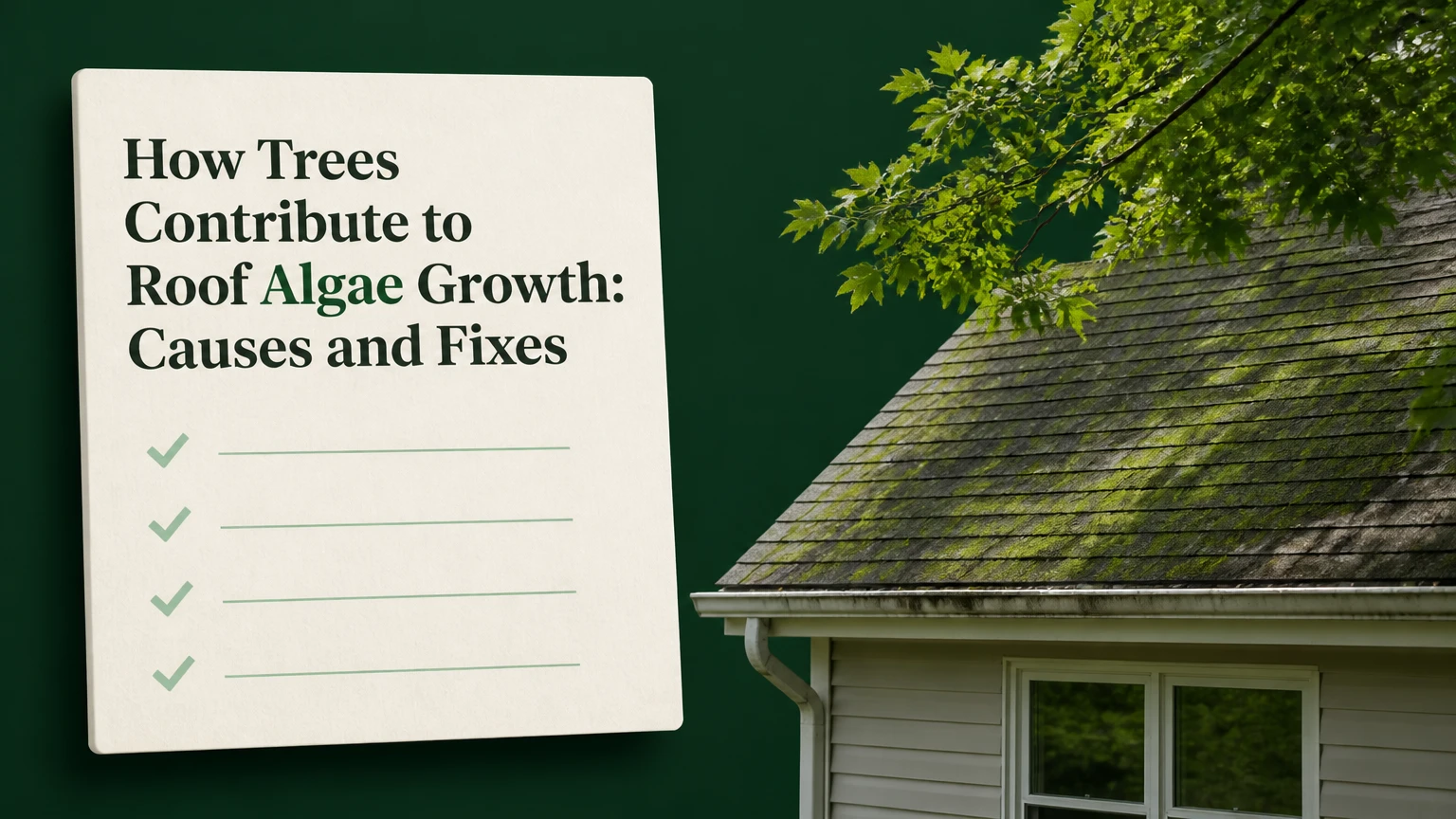
Trees contribute to roof algae growth by shading roofing, reducing wind-driven drying, dropping moisture-holding debris, and helping airborne or waterborne cells reach shingles. Trees do not create Gloeocapsa magma, the cyanobacterium commonly called roof algae, but nearby canopies can extend surface wetness long enough for colonies to establish and form dark runoff streaks.
Key Facts at a Glance
- Roof algae is commonly associated with Gloeocapsa magma, a photosynthetic cyanobacterium that can form dark protective pigments.
- Tree shade matters because a damp roof with less ultraviolet exposure dries more slowly than an exposed roof.
- Leaves, needles, pollen, sap, and twigs can hold water against mineral granules and obstruct gutters.
- Branches within roughly 6-10 feet of a roof commonly create the strongest combination of shade, debris, and restricted airflow.
- Roof cleaning removes existing growth, but pruning and debris control address the conditions that cause rapid recurrence.
- Soft washing is safer for asphalt shingles than high-pressure washing, which can remove granules and shorten shingle life.
What Grows on a Roof Under Trees?
Roof “algae” usually means a dark cyanobacterial growth associated with Gloeocapsa magma, although the visible roof community can also include green algae, fungi, moss, and lichen. The organism attaches to asphalt shingle surfaces and produces pigments that shield cells from intense light, creating gray, brown, or black discoloration.
The roofing industry uses algae as a practical description because homeowners see a stain rather than a laboratory culture. The American Society for Microbiology and roofing-industry guidance distinguish cyanobacteria from true algae, but the maintenance response remains similar: reduce persistent moisture, remove organic accumulation, and use a compatible treatment.
Dark streaks often begin as scattered spots on the northern or shaded slope. Rain then carries suspended biomass and dissolved dirt downward, creating vertical bands that follow laps and drainage paths. A roof valley, wall intersection, or low-slope section can therefore look worse than a nearby field of shingles under the same tree.
Algae, moss, and lichen are different
Algae forms flat films or streaks and usually does not raise shingle edges. Moss is a leafy, moisture-dependent plant that can hold water and lift or separate shingles. Lichen combines a fungus with a photosynthetic partner and may attach more firmly to the granule surface.
| Growth type | Typical appearance | Common roof effect | Typical response |
|---|---|---|---|
| Cyanobacteria or roof algae | Gray-black streaks, flat films | Cosmetic staining, possible accelerated aging | Low-pressure compatible biocide |
| Green algae | Green film or scattered green patches | Surface discoloration | Moisture reduction and soft washing |
| Moss | Green cushions, tufts, raised mats | Granule displacement and lifted edges | Professional removal and moisture control |
| Lichen | White, silver, orange, or crusted patches | Firm attachment to granules | Gentle treatment, no scraping |
How Do Trees Contribute to Roof Algae Growth?
Trees contribute to roof algae growth through four linked pathways: canopy shade, reduced air movement, organic debris, and inoculation from foliage or branches. The strongest risk occurs when these pathways overlap on a roof section that already has a north-facing orientation, low pitch, heavy dew, or poor drainage.
The central variable is time of wetness, meaning how long the shingle surface remains damp after dew, rain, fog, or condensation. A tree does not need to touch the roof to change that variable. A dense canopy can reduce solar heating and wind exchange across the roof, while leaves and needles create small wet pockets that dry later than exposed granules.
A practical diagnosis should separate cause from coincidence. If a roof has algae only beneath one canopy, while an exposed slope remains clean, the tree is probably modifying the local microclimate. If every slope has similar staining, regional humidity, roof age, airborne deposition, and shingle formulation may matter more than one tree.
Why do shade and blocked wind matter?
Shade reduces direct solar radiation, while dense foliage slows air movement at the roof surface. The combination can delay evaporation after rainfall and dew, especially where branches sit above the roof plane or where a nearby wall already blocks prevailing wind.
A shaded roof is not automatically an algae-prone roof. A steep, well-ventilated roof in a dry climate may dry quickly despite shade. Conversely, a low-slope roof beneath evergreen branches can stay damp through much of the morning because the canopy blocks both sunlight and moving air.
The frequently repeated claim that shaded roof areas are always 15-20°C cooler is not a dependable field rule. Temperature depends on shingle color, orientation, wind, humidity, season, and canopy density. Moisture duration is the more useful homeowner measurement.
Do leaves and needles feed roof algae?
Leaves and needles can support roof algae indirectly by holding moisture, trapping dust, and decomposing into fine organic residue. They are not necessarily a complete food source for Gloeocapsa magma, because photosynthetic cyanobacteria obtain energy from light and carbon dioxide, but debris changes the surface conditions that help a colony persist.
Sap and pollen create sticky deposits that bind dust to mineral granules. Fine dust can retain a thin water film after the surrounding shingle appears dry. Small twigs also bridge shingle courses and divert runoff, creating narrow damp tracks.
Deciduous trees create seasonal pulses of leaf litter. Conifers can create a more continuous supply of needles, resin, and shaded moisture. A gutter clogged with leaves adds another risk because backed-up water can wet the lower shingle courses and fascia repeatedly.
Can branches spread algae onto shingles?
Branches can increase inoculation by collecting airborne dust, biological particles, and moisture, then releasing material during rain, wind, or branch movement. The exact contribution is difficult to measure at a residential roof, but physical contact and overhanging foliage clearly increase deposition compared with a tree several yards away.
Rain splash is more important near low branches and roof edges. Water moving from a branch onto shingles may carry concentrated organic material, while falling leaves create repeated landing points. Branches that rub against shingles also disturb granules and can create an attachment site for moisture and debris.
Tree distance is therefore a risk factor, not a biological cutoff. A branch 8 feet away can cast shade onto a roof in winter when the sun is low, while a taller tree 30 feet away can still shade a large slope during summer afternoons.
How Fast Does Tree-Associated Algae Spread?
Visible roof algae commonly develops over months to several years, but no reliable universal schedule exists. In a humid, shaded setting, early speckling may appear within one growing season, while continuous black streaks can take two or more years; dry climates and frequently washed roofs may take longer.
A fixed sequence such as six months for establishment, twelve months for pigmentation, and thirty-six months for mature streaks is too precise for most homes. Roof age, local spore load, shingle texture, rainfall, dew, slope, and cleaning history alter the timeline.
| Stage | Typical field timing | Visible sign | Main controlling factor |
|---|---|---|---|
| Deposition | Days to several months | No reliable visible change | Moisture and airborne particles |
| Early establishment | One season to 12 months | Fine gray speckling | Surface wetness and granule texture |
| Expanding colony | 12-24 months | Brown or dark connected spots | Repeated wetting and runoff |
| Mature streaking | 24-48 months | Black vertical bands | Persistent shade, debris, and water paths |
These ranges are typical residential observations, not laboratory growth milestones. A roof that develops stains three months after cleaning was likely recolonized quickly or incompletely treated, rather than following a predictable biological calendar.
Which Roofs Face the Greatest Risk?
Asphalt shingles with mineral granules usually show the most noticeable algae staining, particularly on older, weathered surfaces. Wood shakes, concrete tile, clay tile, and metal roofing can also support biological films, but their moisture behavior, coatings, and cleaning limits differ.
| Roof material | Tree-related vulnerability | Frequent symptom | Key limitation |
|---|---|---|---|
| Asphalt shingle | High on shaded, weathered slopes | Black streaks and granule discoloration | Pressure washing removes granules |
| Wood shake | High where debris stays wet | Moss, algae, and dark decay areas | Aggressive chemicals can dry or damage wood |
| Concrete tile | Moderate, with porous surfaces | Algae, moss, and lichen in overlaps | Broken tiles and foot traffic require control |
| Clay tile | Moderate on shaded, damp roofs | Surface film and lichen | Acidic or abrasive cleaning can damage finish |
| Painted metal | Low to moderate | Green film at laps and edges | Coating, fasteners, and runoff compatibility matter |
Algae-resistant asphalt shingles contain copper-containing granules or another manufacturer-approved technology. They reduce staining risk, but they do not eliminate debris, moss, lichen, or moisture problems. A tree canopy can still shorten the clean appearance of a roof with algae-resistant granules.
How Much Tree Clearance Is Practical?
Maintain roughly 6-10 feet of clearance between roof surfaces and tree branches when site conditions permit, while prioritizing structural pruning over indiscriminate canopy removal. The correct distance depends on mature branch movement, tree species, roof orientation, utility lines, and the amount of shade reaching the shingles.
The 8-10-foot figure is a practical maintenance target rather than a universal scientific threshold. A certified arborist may recommend less or more clearance when branch structure, storm exposure, habitat value, or tree health changes the risk.
Pruning should remove contact points, thin selected limbs, and open airflow without stripping the tree. Many arborists avoid removing more than about 25% of a mature tree’s live crown in one operation, although the safe amount varies by species, age, season, and condition.
Do not cut large limbs from a ladder or work near utility lines. A roof-cleaning contractor is not automatically qualified to prune trees, and an arborist is not automatically qualified to clean roofing.
Which Prevention Method Fits the Problem?
Pruning is usually the best first intervention when a tree is touching the roof or creating a dense shaded pocket. Cleaning is necessary when visible growth already exists, while metal strips and algae-resistant shingles provide supplementary protection under appropriate installation conditions.
| Method | Typical U.S. cost | Service or effect period | Best use | Main limitation |
|---|---|---|---|---|
| Branch pruning | $300-$1,500 | 1-3 years before reassessment | Contact, shade, and debris reduction | Requires arborist access and repeat work |
| Professional soft wash | $400-$800 | 1-3 years, highly variable | Existing algae and light lichen | Does not remove the moisture source |
| Zinc or copper flashing | $200-$600 | 5-10 years, site-dependent | Supplemental runoff protection | Protects only the downstream roof area |
| Algae-resistant shingles | Roof replacement premium varies | 10-20 year stain warranty may apply | New roof installation | Cannot justify replacement by itself |
Metal strips
Copper and zinc strips release ions into rainwater that flows down the roof, inhibiting susceptible organisms in the treated drainage path. The effect is strongest below the strip, not across the entire roof, and heavy sap, dust, oxidation, or leaf cover can reduce contact with rainwater.
Metal strips are not a substitute for pruning when branches deposit debris directly on shingles. They also cannot correct a clogged valley or gutter. Roof pitch, rainfall intensity, strip width, fastener details, and manufacturer instructions determine performance, so a universal 2:12 pitch rule should not be treated as guaranteed.
Copper generally costs more than zinc but is often selected for longer-lasting runoff protection. Neither metal should be installed casually above sensitive ponds, vegetable beds, or waterways because dissolved metals can affect aquatic organisms and plants.
Algae-resistant shingles
Algae-resistant shingles are most practical during planned reroofing. Copper-containing granules can reduce visible algae staining, but the warranty language may cover appearance rather than structural performance and may exclude severe shade, improper cleaning, or installation outside the manufacturer’s instructions.
Do not replace a sound roof solely because a canopy causes staining. A roof with active leaks, severe granule loss, moss-lifted shingles, or an approaching replacement age may justify combining reroofing with canopy correction.
What Is the Safest Treatment Sequence?
The safest sequence is inspection, debris removal, tree correction, compatible chemical treatment, and runoff control. For asphalt shingles, avoid high-pressure washing because concentrated water can dislodge ceramic granules, expose asphalt, damage flashing, and create warranty disputes.
- Inspect the roof from the ground and attic. Record roof material, slope, orientation, streak location, moss, lichen, granule loss, leaks, and gutter blockage. Do not walk a fragile or steep roof without suitable training and fall protection.
- Remove branches and loose debris. Hire an arborist for limbs near power lines or large overhanging branches. Clear gutters and valleys so water can leave the roof rather than wetting the lower courses.
- Correct the moisture source. Trim contact branches, improve airflow where possible, repair overflowing gutters, and investigate attic condensation if the roof remains damp without rain.
- Apply a roof-compatible soft-wash treatment. Follow the shingle manufacturer’s instructions, product label, dilution, dwell time, and plant-protection requirements. Sodium hypochlorite solutions can work, but concentration, surfactant selection, corrosion control, and runoff management determine safety.
- Allow dead growth to release naturally. Do not scrape firmly attached lichen or use a pressure washer to accelerate cosmetic results. Several rain events may be needed for dead material to detach.
- Recheck after the next wet season. Compare the formerly shaded slope with exposed areas, inspect gutters, and look for rapid recurrence beneath remaining foliage.
A successful treatment leaves intact granules, clean drainage paths, protected landscaping, and no immediate return of dark growth. A roof that looks clean but has exposed asphalt or damaged flashing has not been successfully maintained.
Why Does Roof Algae Return After Cleaning?
Roof algae returns when treatment removes visible staining without changing persistent wetness, debris accumulation, or runoff conditions. Rapid recurrence within three to six months usually indicates reinoculation, incomplete treatment, heavy shade, clogged drainage, or a surface that remained damp after cleaning.
| Recurrence pattern | Most likely cause | Inspection point | Corrective action |
|---|---|---|---|
| Streaks below one tree | Overhanging debris and shade | Branch clearance and drip points | Prune, clean, then retreat |
| Growth at lower edges | Gutter overflow or leaf blockage | Gutter slope and downspout outlet | Clear and repair drainage |
| White or silver crusts | Lichen with fungal structure | Firm attachment to granules | Soft treatment, no scraping |
| Growth below metal strip | Covered or oxidized strip, poor runoff | Strip exposure and roof pitch | Clean or replace per roofer |
| All slopes stain equally | Regional humidity or aged shingles | Roof age, orientation, granule loss | Assess replacement and ventilation |
A chemical wash cannot repair granule loss, shingle blistering, leaks, or structural decay. If staining returns despite adequate clearance and drainage, test whether the roof itself has reached the point where replacement is more economical than repeated cleaning.
Does Roof Algae Cause Physical Damage?
Roof algae is usually a cosmetic problem at first, but prolonged moisture and associated organisms can accelerate surface aging and increase the risk of moss or lichen-related damage. The cyanobacterium alone is not equivalent to a roof leak, and dark streaks do not prove that shingles have lost structural function.
Moss presents the greater immediate mechanical risk because its growth retains water and can lift shingle edges. Lichen can attach strongly to granules, so scraping it may remove the protective surface that the homeowner is trying to preserve.
The National Roofing Contractors Association recommends following the roofing manufacturer’s maintenance instructions because cleaning methods and warranty terms differ by product. A roof inspection should prioritize missing tabs, exposed asphalt, cracked tiles, rusted fasteners, soft decking, and active leaks over color uniformity.
How Do Climate and Roof Orientation Change the Answer?
Humid climates, frequent rainfall, morning dew, coastal fog, and low winter sun increase the opportunity for tree-associated roof algae. North-facing slopes in the Northern Hemisphere often receive less direct sun, while east-facing slopes may remain damp after morning dew beneath a dense canopy.
| Site condition | Typical effect on drying | Recommended priority |
|---|---|---|
| Dense evergreen canopy | Persistent shade and needle deposition | Prune, clear gutters, inspect seasonally |
| Deciduous canopy | Seasonal leaf loading | Clear after leaf fall and spring storms |
| Coastal fog | Repeated surface wetting | Improve airflow and monitor recurrence |
| Dry inland climate | Fast exposed-surface evaporation | Focus on debris pockets and irrigation overspray |
| Low-slope roof | Slower runoff and longer wetness | Repair drainage before chemical treatment |
Irrigation can mimic a tree problem. Sprinklers that wet shingles, walls, or roof-edge vegetation every morning may create more persistent moisture than a distant tree. Air-conditioning discharge, plumbing leaks, and attic condensation deserve the same inspection.
What Should Homeowners Inspect First?
Start with the roof section showing the darkest streaks, then trace shade, debris, water movement, and drainage upward and outward. The inspection should identify the condition that keeps the surface wet, not merely confirm that algae is present.
Use this sequence:
- Photograph each roof slope from the ground before cleaning.
- Mark north, south, east, and west orientations.
- Measure the nearest branch distance from the roof edge and roof plane.
- Note whether branches touch shingles during normal or windy conditions.
- Check valleys, wall intersections, skylights, and lower courses for debris.
- Inspect gutters and downspouts for leaf dams, overflow marks, and disconnected outlets.
- Look for moss, lichen, cracked tiles, lifted shingles, exposed asphalt, and granule piles.
- Ask for the roof’s installation date, shingle brand, warranty terms, and previous cleaning method.
- Check whether sprinklers, fog, condensation, or leaking gutters add water.
- Obtain separate estimates for arborist work and roof treatment.
The inspection result should produce one of three decisions: correct trees and drainage first, clean and then prevent recurrence, or obtain a roof replacement assessment because surface damage exceeds a cosmetic maintenance problem.
What Do Pruning and Treatment Cost?
Typical U.S. residential costs range from $300-$1,500 for tree pruning, $400-$800 for professional soft washing, and $200-$600 for zinc or copper flashing installation. Actual pricing changes with roof pitch, access, tree height, power-line proximity, roof size, chemical controls, and regional labor rates.
| Work item | Typical duration | Typical cost | Main price variable |
|---|---|---|---|
| Small branch clearance | 2-4 hours | $300-$600 | Ladder access and disposal |
| Large-tree pruning | 4-8 hours | $800-$1,500 | Height, rigging, and utility lines |
| Asphalt-shingle soft wash | 3-5 hours | $400-$800 | Area, pitch, and plant protection |
| Metal-strip installation | 1-3 hours | $200-$600 | Roof access and flashing length |
| Roof inspection | 1-2 hours | $150-$400 | Written report and attic access |
These are typical planning ranges, not bids. A quote that excludes landscaping protection, gutter cleaning, or runoff containment may appear inexpensive while transferring risk to the homeowner.
Expert Rules That Prevent Expensive Mistakes
Treat recurrence as a moisture diagnosis. Repeated cleaning without canopy and drainage correction is a maintenance loop. The second treatment should begin with an explanation of why the first result failed.
Do not use a fixed temperature or humidity threshold as a guarantee. Roof algae responds to cumulative wetness, light, surface texture, and nutrients. A handheld surface thermometer cannot predict growth from one reading.
Prune for airflow and contact control, not maximum sunlight. Removing a healthy tree crown can damage tree structure and increase storm exposure, while selective thinning may improve drying without eliminating all shade.
Protect the roof’s granules during every cleaning decision. Granules provide much of an asphalt shingle’s weather and ultraviolet resistance. Cosmetic improvement is a poor trade if the method strips that layer.
Frequently Asked Questions
Do trees cause black streaks on every roof?
No. Trees increase risk, but black streaks also depend on regional humidity, rainfall, roof orientation, shingle age, surface texture, and airborne biological material. An exposed roof in a wet climate can stain, while a shaded roof in an arid climate may remain clean if it dries rapidly and receives little debris.
Can I remove roof algae with household vinegar?
Vinegar is not a reliable universal roof treatment, and acidic runoff may affect metals, masonry, plants, or nearby water. Use a product labeled for the specific roofing material or hire a contractor who follows the manufacturer’s cleaning instructions. Never mix vinegar with bleach or other cleaning chemicals.
Should gutters be cleaned before or after roof washing?
Clean and inspect gutters before roof washing, then check them again afterward. Removing leaf dams first allows treatment water and loosened debris to drain correctly, while a final inspection catches granules, dead growth, or remaining blockages that could cause overflow.
Will cutting down the tree stop roof algae permanently?
Removing one tree may improve light and airflow, but it cannot guarantee permanent prevention. Nearby vegetation, regional humidity, roof age, irrigation, gutters, and airborne cells can still support growth. Selective pruning usually addresses the roof condition with less ecological and structural impact than tree removal.
Are copper strips safe around gardens and ponds?
Copper runoff can harm aquatic organisms at sufficient concentrations and may affect sensitive plants or soil conditions. Keep runoff away from ponds, streams, edible gardens, and storm drains where possible, and follow local requirements and the roofing product instructions before installing copper.
Can roof algae indicate an attic ventilation problem?
Roof algae does not prove an attic ventilation defect, because exterior shade and rainfall can explain the pattern. However, interior condensation, damp insulation, mold odor, or winter frost in the attic warrants a ventilation and moisture investigation in addition to exterior tree management.
The Bottom Line
How trees contribute to roof algae growth is best understood as an environmental chain: canopies reduce sun and wind, debris holds water and dust, branches increase deposition, and gutters can prolong wetness at the roof edge. The most durable response is to inspect drainage and roof condition, prune strategically, remove debris, and use material-compatible soft washing rather than pressure washing.
A practical 8-10-foot branch clearance target helps many homes, but site conditions determine the final pruning plan. Metal strips and algae-resistant shingles can supplement prevention, while neither option replaces sound drainage and responsible canopy management. Solving the moisture pattern is more effective than repeatedly erasing the stain.