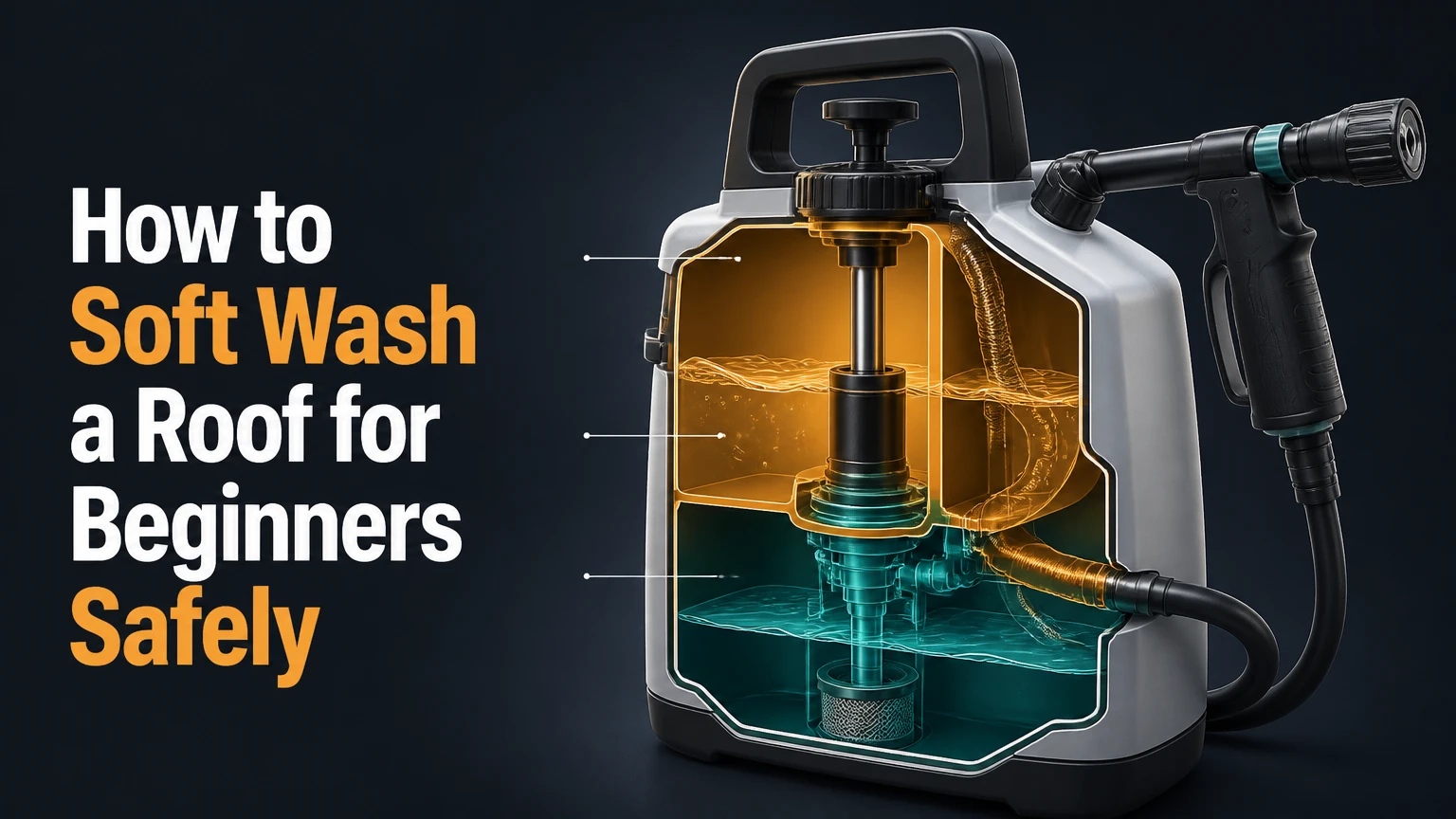
Soft washing a roof uses a low-pressure application of a labeled cleaning solution to kill roof algae, moss, and lichen without blasting away shingle granules. Beginners should remain on the ground whenever possible, protect landscaping and drainage, avoid chemical mixing errors, and hire a professional when roof access or runoff control is unsafe.
At a Glance
- Soft washing uses chemical action rather than high-pressure force to remove organic roof growth.
- Asphalt shingles usually receive a labeled solution and are not pressure-rinsed.
- A 10-15-minute dwell time is typical, but the solution must not dry on the roof.
- Roof pitch, material, age, weather, landscaping, and runoff determine whether the job is suitable for a beginner.
- Never mix sodium hypochlorite with acids, ammonia, or other cleaners.
- A professional is the safer choice when roof access requires walking, climbing, or fall protection.
What Is Soft Washing, and How Does It Differ From Pressure Washing?
Soft washing applies a cleaning chemical at low pressure, while pressure washing uses force to strip contamination from a surface. Roof soft washing is generally better for asphalt shingles because high pressure can dislodge protective granules, force water beneath shingles, and damage flashing or sealant.
| Method | Main action | Typical roof risk | Best use |
|---|---|---|---|
| Soft washing | Chemical treatment | Low when controlled | Algae, moss, and lichen |
| Garden-hose rinsing | Water flow | Low to moderate | Plant protection and cleanup |
| Pressure washing | Mechanical force | High on shingles | Usually unsuitable for asphalt roofs |
Roof algae often appears as dark streaks caused by organisms such as Gloeocapsa magma. Moss and lichen behave differently because moss holds moisture and lichen attaches more firmly to the surface. Chemical treatment may kill all three, but dead growth can remain visible for weeks.
The surprising professional rule is simple: a roof does not need to look bare immediately after treatment. Removing every visible trace in one visit often tempts people to scrape or pressure-wash shingles.
Is Roof Soft Washing Safe for Beginners?
Roof soft washing is safe for a beginner only when the application can be completed from the ground or a stable low-risk platform, using a labeled product and controlled runoff. A steep, fragile, wet, or complicated roof should be handled by a trained roof-cleaning professional.
A homeowner can usually perform limited ground-based treatment on a low-slope, one-story roof if the homeowner can reach the roof plane without climbing onto shingles. A ladder is not a substitute for fall-protection training. OSHA identifies falls as a major source of construction fatalities, and roof work adds chemical exposure and slippery surfaces to that hazard.
Stop the project if any of these conditions apply:
- The roof is steep, wet, brittle, or visibly sagging.
- The roof is more than one story above ground.
- Walking is required to reach stained areas.
- Wind can carry spray toward people, vehicles, or neighboring property.
- Downspouts discharge near ponds, storm drains, or edible gardens.
- The roof contains unknown materials, damaged asbestos cement, or fragile slate.
What Equipment Does a Beginner Need?
A beginner needs a ground-based low-pressure sprayer, chemical-resistant hose, wide-fan nozzle, plant-protection supplies, and personal protective equipment. Equipment specifications should follow the product label and system manufacturer rather than a universal pressure target.
| Equipment | Practical specification | Reason |
|---|---|---|
| Chemical pump | 12-volt system, often 5-6 GPM | Delivers solution over distance |
| Hose | Chemical-resistant, 1/2-inch, 100-200 feet | Reaches roof edges from the ground |
| Nozzle | 25-40-degree fan pattern | Reduces concentrated spray |
| Water supply | Garden hose with reliable flow | Pre-wetting and rinsing |
| Eye protection | Chemical splash goggles | Protects against mist and splashes |
| Footwear | Slip-resistant rubber soles | Safer around wet ground |
| Respiratory protection | Only equipment selected under the SDS | Prevents incorrect respirator use |
A low-pressure roof system does not mean harmless spray. Sodium hypochlorite mist can irritate skin, eyes, and airways, while wet shingles can become extremely slippery. Chemical-resistant gloves, long sleeves, eye protection, and a clean-water rinse source are minimum practical controls.
Do not choose a nozzle by pressure alone. A wide fan pattern and coarse droplets reduce drift more effectively than an atomizing tip.
What Cleaner Should Be Used on Roof Shingles?
For many asphalt-shingle algae treatments, the active cleaner is sodium hypochlorite in a labeled roof-cleaning product, often combined with a compatible surfactant. Beginners should buy a ready-to-use or professionally specified product instead of improvising a concentrated bleach mixture.
Commercial pool sodium hypochlorite may be sold at approximately 10%-12.5% concentration, but its strength declines with heat, sunlight, and storage time. Grocery bleach may be weaker and may contain additives that are unsuitable for roof application. Product labels and safety data sheets determine acceptable dilution, dwell time, and rinsing requirements.
Never combine sodium hypochlorite with:
- Acids, including muriatic acid or acidic toilet cleaners
- Ammonia or ammonia-containing products
- Other household cleaners
- Unknown additives or unapproved detergents
Sodium hypochlorite can damage plants, fabrics, metals, painted surfaces, and aquatic life. The National Association of Insurance Commissioners and roofing manufacturers commonly emphasize following the roof system manufacturer’s maintenance instructions because warranty requirements differ.
A surfactant can improve cling, but more foam is not automatically better. Excess soap increases runoff and may leave residue on siding.
How Strong Should the Roof-Cleaning Solution Be?
A typical practitioner range for asphalt-shingle algae treatment is approximately 2%-4% active sodium hypochlorite at the roof surface, but the correct strength depends on the labeled product, organism load, temperature, and roof material. Beginners should not increase concentration by guesswork when a treatment appears slow.
A common calculation is:
Stock volume = target concentration × final batch volume ÷ stock concentration
For example, a 20-gallon batch targeting 3% from 12.5% stock would calculate as 4.8 gallons of stock, with water and approved additives making up the remaining volume. The calculation is only valid when the stated stock concentration is accurate and the final batch volume includes every ingredient.
| Roof condition | Typical approach | Rinse expectation |
|---|---|---|
| Light algae on asphalt | Lower labeled strength | Follow label |
| Heavy algae on asphalt | Moderate labeled strength | Usually no pressure rinse |
| Painted metal | Mild labeled strength | Thorough fresh-water rinse |
| Bare Galvalume | Avoid unapproved SH | Consult manufacturer |
| Clay tile | Material-specific product | Avoid foot traffic |
| Slate | Professional assessment | Avoid chemical guesswork |
The 14-gallon-stock, 36-gallon-water example sometimes circulated online does not equal a 50-gallon final batch after surfactant is added, and it produces a different concentration than many beginners assume. Measure carefully.
How Do You Prepare the Property Before Spraying?
Prepare the property by inspecting the roof, wetting vegetation, controlling downspouts, closing windows, and removing or covering vulnerable objects. Preparation prevents more damage than spraying technique alone.
- Photograph existing roof, siding, gutter, and plant conditions.
- Identify roof material, approximate age, damaged areas, skylights, vents, and solar equipment.
- Wet grass, shrubs, trees, and flowerbeds with clean water.
- Move furniture, toys, vehicles, and fabric items away from the work zone.
- Close windows and doors, then notify occupants and neighbors.
- Route downspouts into a safe collection or discharge area where permitted.
- Keep a second hose available for immediate rinsing.
- Assign a helper to monitor plants, overspray, and runoff.
Pre-wetting reduces plant uptake, but it does not neutralize bleach. Maintain clean-water rinsing during application and afterward. Do not allow contaminated water to enter ponds, streams, storm drains, or rain barrels.
Protecting aluminum gutters requires attention because concentrated solution can discolor or oxidize exposed metal if allowed to dry.
What Are the Steps for Applying the Solution?
Apply the roof treatment from the ground in controlled passes, starting at the lower roof edge and stopping whenever the solution approaches drying or uncontrolled runoff. The safest beginner process is:
- Check weather. Choose a cool, calm period with no immediate rain forecast.
- Test a small area. Confirm the product does not discolor the roof, flashing, siding, or painted metal.
- Pre-wet surroundings. Saturate plants and keep a helper on rinse duty.
- Apply a coarse fan spray. Use overlapping horizontal passes from the lower edge upward.
- Maintain control. Keep the nozzle aimed at the roof, not into vents, windows, or gaps.
- Observe dwell. Allow the labeled contact time, commonly 10-15 minutes.
- Prevent drying. Lightly reapply only where the product label permits.
- Finish cleanup. Rinse gutters, siding, windows, equipment, and plants as directed.
Do not scrape live moss aggressively. Do not climb onto wet shingles to inspect progress. A color change indicates chemical activity, not permission to walk across the roof.
How Long Should the Solution Stay on the Roof?
A typical roof-cleaning solution dwells for 10-15 minutes, but the product label controls the actual contact time. The solution should remain wet long enough to work and should never dry completely on asphalt shingles, siding, windows, or metal components.
Hot sun, low humidity, and wind shorten effective dwell time. At temperatures above approximately 85°F, a roof surface can dry rapidly, so early morning or shaded conditions are safer. Wind above roughly 10 MPH can carry droplets beyond the intended roof plane, although the acceptable limit depends on nozzle, terrain, and local conditions.
| Condition | Recommended response |
|---|---|
| Cool and overcast | Use labeled dwell time |
| Hot, sunny surface | Delay or work in shade |
| Windy conditions | Stop if spray drift is uncontrolled |
| Light rain during dwell | Follow product label |
| Solution drying quickly | Stop, reassess, and avoid stronger guessing |
Black algae may fade quickly, while moss can remain attached after death. Visible improvement and complete physical disappearance do not occur on the same schedule.
Should Asphalt Shingles Be Rinsed After Treatment?
Asphalt shingles should generally not receive aggressive rinsing after a properly applied treatment, unless the product label or roofing manufacturer requires rinsing. Natural rain can remove dead organic growth over subsequent weeks, while pressure rinsing can strip granules.
A gentle garden-hose rinse may be appropriate for nearby siding, gutters, windows, and plants, especially when runoff contains chemical residue. The rinse should not drive water under shingles or scour the roof surface.
Metal roofing is different. Painted metal normally requires a thorough fresh-water rinse after the labeled dwell period, and bare Galvalume requires manufacturer-specific guidance because sodium hypochlorite can discolor or attack the finish. Tile and slate also need material-specific instructions.
Dead moss may turn white or pale and remain physically attached for 2-8 weeks. That result does not necessarily indicate failure. Wind, rain, and gradual root decay often remove the remaining material without disturbing shingle granules.
How Do Roof Materials Change the Method?
Roof material changes the cleaner, concentration, dwell time, walking rules, and rinsing requirement. Asphalt shingles are not interchangeable with metal, tile, slate, or bare Galvalume.
| Material | Main concern | Beginner guidance |
|---|---|---|
| Asphalt shingles | Granule loss and water intrusion | Use low pressure and avoid foot traffic |
| Painted metal | Finish damage and corrosion | Use mild labeled treatment and rinse |
| Bare Galvalume | Permanent discoloration | Obtain manufacturer guidance first |
| Clay tile | Cracking under body weight | Work from ground or platform |
| Slate | Breakage and hidden deterioration | Use a roof specialist |
| Wood shakes | Moisture and material sensitivity | Follow manufacturer instructions |
Tile can tolerate some chemical treatments, but tile strength varies with age, porosity, and firing quality. Slate is especially deceptive because a surface can look sound while breaking under a person’s weight.
Solar panels, copper components, zinc strips, and recently painted surfaces require separate compatibility checks. Do not assume that a formula safe for shingles is safe for every roof accessory.
What Should You Do About Heavy Moss, Heat, Wind, or Runoff?
Heavy moss, extreme heat, wind, and uncontrolled runoff require stopping the standard process and changing the plan. Chemical treatment alone may not penetrate a moss cushion thicker than approximately 1/4 inch, while harsh scraping can damage the roof.
| Problem | Why it occurs | Safer response |
|---|---|---|
| Thick moss | Chemical cannot reach the base | Hire a specialist for gentle removal |
| Drying solution | Heat, sun, or wind removes moisture | Stop and reschedule |
| Spray drift | Wind carries fine droplets | Stop until conditions improve |
| Green runoff | Organic debris and cleaner flow downhill | Control discharge and rinse safely |
| Streaks remain | Uneven coverage or insufficient contact | Do not immediately increase strength |
Do not add more sodium hypochlorite to a failing batch without confirming stock strength and label instructions. Old chemical may have degraded, but stronger chemical can also damage roofing, plants, and metals.
Pump systems should be flushed with clean water according to the manufacturer’s procedure. A typical 3-5-minute flush may be appropriate for some 12-volt systems, but the pump manual controls the duration.
How Much Does Professional Roof Soft Washing Cost?
Professional roof soft washing commonly costs about $300-$1,000 for a typical residential roof, while large, steep, heavily soiled, or difficult-access roofs can cost more. Local labor rates, roof size, material, access, plant protection, and wastewater controls determine the final price.
| Project type | Typical price range | Main price driver |
|---|---|---|
| Small, one-story asphalt roof | $300-$500 | Limited access and light growth |
| Average residential roof | $450-$800 | Roof size and landscaping |
| Large or steep roof | $700-$1,500+ | Fall protection and labor |
| Tile or slate roof | $800-$2,000+ | Fragile material and specialist skill |
| Heavy moss remediation | $600-$1,500+ | Manual preparation and cleanup |
These are typical market ranges, not a guaranteed quote. A legitimate estimate should identify the roof material, treatment product, plant protections, access method, runoff plan, and warranty terms.
The cheapest quote may omit fall protection, careful plant rinsing, or post-treatment inspection. Ask whether the contractor carries liability insurance and whether the contractor follows the roofing manufacturer’s cleaning guidance.
How Often Should a Roof Be Soft Washed?
A roof typically needs cleaning only when algae, moss, or lichen becomes established, often every 2-5 years in humid or shaded areas. A fixed annual schedule is unnecessary for many roofs and can increase chemical exposure and maintenance cost.
Inspect the roof from the ground twice each year, especially after winter storms or periods of heavy rain. Look for dark streaks, moss at shaded edges, lifted shingles, overflowing gutters, and blocked drainage.
| Location or condition | Typical inspection interval | Cleaning likelihood |
|---|---|---|
| Sunny, dry roof | 12 months | Lower |
| Shaded, humid roof | 6 months | Higher |
| Dense tree cover | 6 months | Higher |
| Coastal or wet climate | 6-12 months | Variable |
| Roof with active moss | After 3-6 months | Reassess promptly |
Trimming branches, improving roof ventilation, clearing gutters, and reducing persistent shade can slow regrowth. Zinc or copper strips may help in some installations, but compatibility and runoff effects should be reviewed before installation.
What Alternatives Work When Bleach Is Unsuitable?
When sodium hypochlorite is unsuitable, alternatives include manufacturer-approved roof cleaners, hydrogen-peroxide-based products, and mechanical prevention measures, but alternatives may work more slowly or require repeat applications. No alternative makes a steep or fragile roof safe to walk on.
Hydrogen-peroxide products can be appropriate for some surfaces, especially where label restrictions limit chlorine products. Biocidal products should be used only according to the label, including required protective equipment, dwell time, and disposal instructions.
Low-chemical prevention can include:
- Removing overhanging branches
- Improving sunlight and airflow
- Cleaning gutters
- Repairing leaks
- Installing compatible metal-control strips
Eco-friendly does not mean harmless. Runoff from any biocidal cleaner can affect plants and aquatic life, and a product marketed as green may still require gloves, eye protection, and controlled discharge.
For bare Galvalume, historic slate, wood shakes, asbestos-containing materials, or unknown roof coatings, obtain material-specific guidance before choosing a cleaner.
When Should a Beginner Stop and Hire a Professional?
A beginner should hire a professional when the roof requires walking, has a steep pitch, contains fragile materials, or creates uncontrolled chemical exposure or runoff. Professional help is also appropriate when the roof has structural damage, unknown coatings, solar equipment, or extensive moss.
The project should stop immediately if a person develops eye irritation, breathing difficulty, dizziness, or chemical burns. Move to fresh air, rinse exposed skin or eyes with clean water, and contact poison-control or emergency services according to the product label.
A contractor should provide:
- Proof of insurance
- A written scope of work
- Product and safety information
- A plant and runoff protection plan
- Roof-material compatibility confirmation
- A clear policy for pre-existing damage
Do not allow a contractor to pressure-wash asphalt shingles simply because the roof looks cleaner immediately afterward. Immediate visual results can conceal granule loss and shortened roof life.
What Mistakes Damage Roofs During Soft Washing?
The most damaging mistakes are using high pressure, walking on wet shingles, allowing chemicals to dry, ignoring runoff, and treating every roofing material identically. Chemical strength is only one part of the risk.
Common failures include:
- Using a pressure-washer tip: Concentrated force can remove granules and damage flashing.
- Applying in direct midday sun: The solution dries before completing its contact time.
- Skipping plant pre-wetting: Dry foliage absorbs more contaminated runoff.
- Using household dish soap: Residue can cling to siding and increase cleanup.
- Relying on a respirator without fit testing: Incorrect equipment creates false confidence.
- Ignoring downspouts: Concentrated discharge can harm plants and contaminate drainage.
- Scraping dead moss aggressively: Tools can tear granules from shingles.
- Mixing chemicals by volume alone: Actual stock strength may have degraded.
The professional rule is conservative: protect the roof, people, and drainage system first, then pursue cosmetic improvement.
The Bottom Line
Soft washing a roof for beginners means applying a compatible, labeled cleaner at low pressure while avoiding roof traffic, chemical mixing errors, and uncontrolled runoff. Asphalt shingles generally should not be pressure-rinsed, and a 10-15-minute wet dwell is typical. Roof material, pitch, weather, and access determine whether a homeowner can safely proceed. When the roof is steep, fragile, high, or chemically difficult to control, hiring a qualified professional is the correct method.