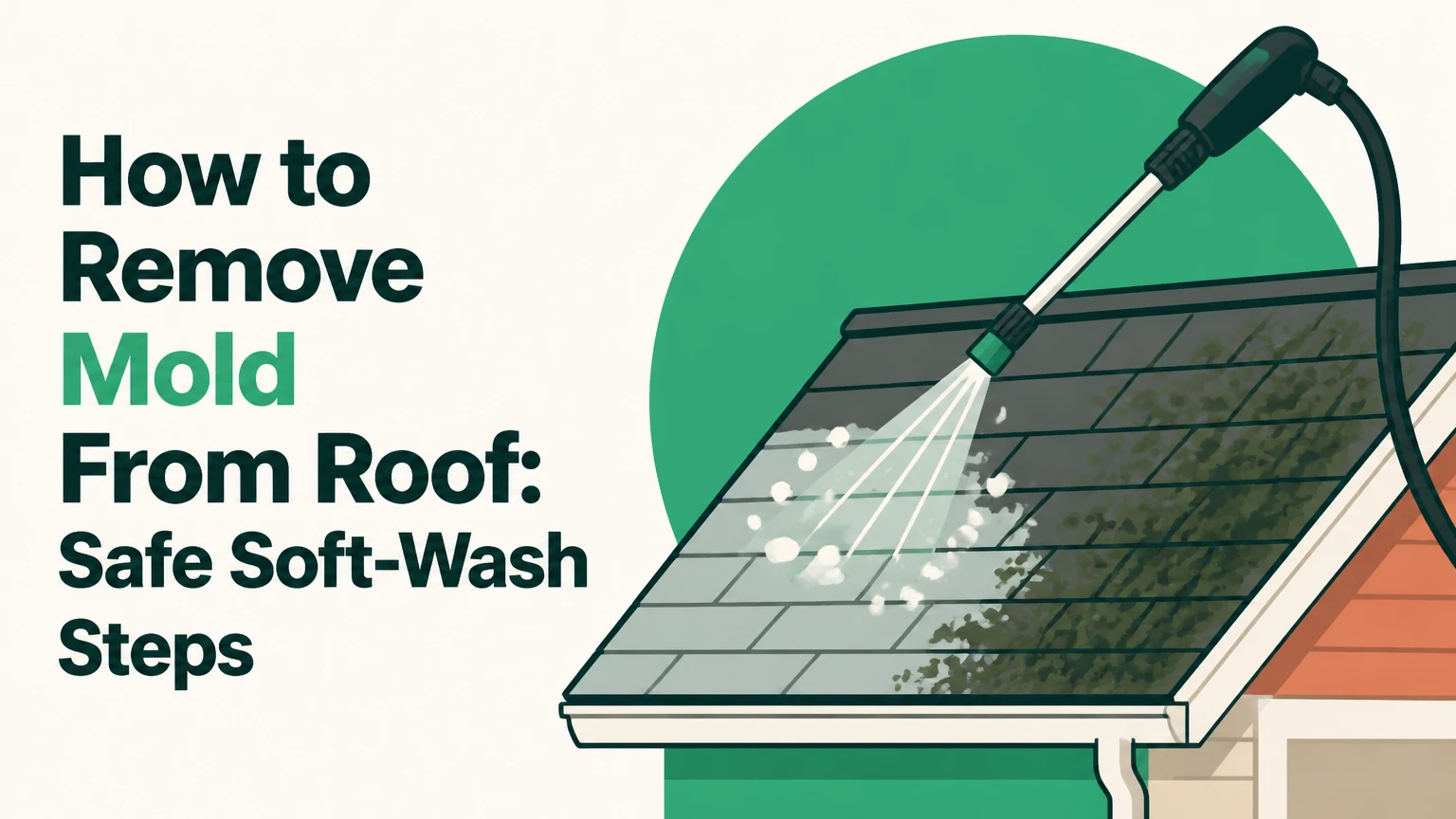
To remove mold from a roof, first identify whether the growth is mold, algae, moss, or lichen, then correct moisture problems and apply a roof-compatible cleaner at low pressure. Protect landscaping, follow the product label, rinse downward, and avoid climbing steep or fragile roofs. The roof material determines the safest treatment.
Key facts at a glance
- Black roof streaks are often algae, especially Gloeocapsa magma, rather than confirmed mold.
- High-pressure washing can remove asphalt-shingle granules and force water beneath laps, flashings, and tiles.
- A roof cleaner must remain wet for its label-specified dwell time, commonly 10-30 minutes.
- Household bleach has no universal safe dilution for every roof; concentration, roof material, temperature, and runoff controls matter.
- Roof cleaning cannot cure a roof leak, rotten decking, failed flashing, or persistent attic condensation.
- A steep, wet, multi-story, fragile, or visibly damaged roof is usually a professional-cleaning job.
What Roof Mold Is, and How to Identify It
Roof mold is fungal growth associated with persistent moisture, shade, organic debris, and poor drying. However, dark roof discoloration is more commonly algae or cyanobacteria, while moss and lichen are larger organisms that physically attach to the surface. Correct identification prevents unnecessary chemical use and helps reveal the underlying moisture source.
Roof algae often appears as black, gray, or blue-green streaks that run downward from the ridge. Gloeocapsa magma is a commonly cited cause on asphalt shingles. Moss forms raised green cushions or mats, while lichen produces pale, crusty, branching patches. Mold may appear as irregular dark, brown, or green colonies, particularly where leaves, bird droppings, or damp debris remain.
The U.S. Environmental Protection Agency states that mold control depends on controlling moisture, not merely killing surface growth. That principle matters on roofs because a cleaner can remove staining while shade, clogged gutters, overhanging branches, or a roof leak continues to wet the same area.
Is roof mold dangerous?
Surface roof growth is usually more damaging to roofing materials than to occupants, but disturbed spores and cleaning chemicals can affect sensitive people. The risk rises when mold has entered the attic, insulation, ceiling cavities, or HVAC system. People with asthma, severe allergies, immune suppression, or respiratory disease should avoid roof-cleaning work.
Roof mold is not the same remediation problem as indoor mold. Do not use a roof-cleaning project to disturb contaminated attic insulation or remove indoor colonies. Arrange an inspection if you see mold on roof decking, attic framing, ceiling drywall, or insulation, or if occupants experience symptoms that improve away from the home.
Before You Start: Safety, Tools, and Conditions
A typical small asphalt-shingle cleaning takes 3-6 hours of active work, costs approximately $50-$250 for cleaner and disposable protection, and requires dry weather, calm wind, safe access, and a roof that can support foot traffic. The highest-risk factor is falling, not the cleaning chemistry.
Use this preparation list:
- Roof-safe cleaning product, used according to its current label
- Low-pressure pump sprayer or dedicated soft-wash equipment
- Garden hose with an adjustable, non-pulsing nozzle
- Chemical-resistant gloves, eye protection, long sleeves, and slip-resistant footwear
- Extension ladder with level feet, stabilizer, and a second person present
- Drop cloths or temporary covers for sensitive landscaping
- Clean water for pre-wetting and post-rinsing plants
- Gutter protection or a plan to capture and flush concentrated runoff
- Manufacturer installation and cleaning instructions for the roof
Do not climb during rain, frost, high wind, lightning, or intense heat that causes solution to dry immediately. Stop if shingles feel loose, tiles crack under light contact, the roof flexes, algae conceals the walking surface, or the pitch requires unsafe movement. A harness is not a substitute for a properly designed fall-protection system.
Never mix sodium hypochlorite with ammonia, acids, vinegar, toilet cleaner, or other chemicals. These combinations can generate toxic gases. Keep children and pets away from the work zone, and prevent runoff from entering ponds, storm drains, vegetable gardens, or neighboring property.
How to Remove Mold From Roof Safely
The safest general sequence is inspect, protect, apply a compatible cleaner, allow controlled dwell time, and rinse at low pressure. The cleaner does most of the biological work; aggressive brushing or concentrated water creates avoidable roof damage.
Step 1: Inspect the Roof and Control Runoff
Inspect from the ground first, then use a roof-access method appropriate to the pitch and material. Look for broken or missing shingles, exposed underlayment, lifted flashing, cracked tiles, rust holes, blocked valleys, overflowing gutters, and growth concentrated around penetrations.
Document the roof with photographs before applying chemicals. Check the roof age and warranty documents because some manufacturers specify approved cleaners and prohibit certain methods. If the roof is near the end of its expected service life, cleaning may expose granule loss, brittleness, or failed seal strips that need repair rather than cosmetic treatment.
Wet plants and grass thoroughly before applying cleaner. Cover delicate plants temporarily, but do not leave plastic over foliage in hot sun. Move outdoor furniture, toys, and pet bowls, then disconnect or protect rainwater harvesting systems.
You will know Step 1 is complete when the roof material, damaged areas, runoff path, weather, and access method are all known.
Common mistake: beginning at the ridge and allowing concentrated solution to run across untreated, dry landscaping. Start with runoff control and work in small sections.
Step 2: Select and Prepare the Cleaning Solution
Choose a product labeled for the specific roof material instead of copying a generic bleach ratio. Sodium hypochlorite can rapidly remove algae and organic staining, but the working strength varies by product, dilution, surface condition, temperature, and application equipment. A 1:1 household-bleach-to-water mixture is not a universal maximum or a safe recommendation for every roof.
Oxygen-based cleaners, commonly based on sodium percarbonate, are less aggressive toward many plants and metals but often work more slowly and may require agitation. They are not automatically harmless: concentrated powders can irritate eyes and skin, and runoff can still affect aquatic life or soil chemistry.
Mix only the amount needed for the day. Use a clean, chemical-compatible sprayer and never reuse a container that held incompatible products. Follow the label for dilution, personal protective equipment, contact time, temperature, disposal, and prohibited surfaces.
You will know Step 2 is complete when the product label confirms roof compatibility, the dilution is measured, and no incompatible chemical has been added.
Common mistake: adding dish soap, acids, or mystery “boosters.” Surfactants can improve wetting, but unapproved additives can increase runoff, corrosion, or warranty problems.
Step 3: Apply the Cleaner in Manageable Sections
Apply the solution to a small test area first, preferably on an inconspicuous section. Use enough product to wet the growth without creating uncontrolled runoff. Apply from the lower edge toward the ridge when practical, while keeping the spray directed onto the roof rather than beneath shingle courses or tile overlaps.
Allow the label-specified dwell time, commonly 10-30 minutes. Keep the surface damp if the label requires wet contact, but do not keep adding concentrated chemical simply because staining remains visible. Biological growth can die before its pigment disappears, and some discoloration fades over several rain events.
Avoid scrubbing asphalt shingles. If a compatible roof product specifically permits light agitation, use a soft brush with minimal pressure and never pull upward against shingle tabs. Work in sections so no area dries unpredictably and runoff can be rinsed promptly.
You will know Step 3 is working when the growth loses color, softens, or releases without force. Remaining black pigment does not necessarily mean living growth remains.
Common mistake: treating in direct sun or strong wind. Rapid drying shortens contact time and can leave uneven marks or concentrated chemical residue.
Step 4: Rinse Downward and Complete Cleanup
Rinse with a garden hose or equipment operating at the lowest effective pressure. Direct water downward, parallel with the roof’s drainage path, so water does not enter beneath shingle edges, tile laps, flashing, ridge vents, or membrane seams.
Do not use a pressure-washer nozzle on asphalt shingles. The Asphalt Roofing Manufacturers Association, in its homeowner guidance, warns against power washing because it can remove granules and damage shingles. A specific pressure number such as 300 PSI is not a universal safe limit: nozzle type, distance, flow, roof condition, and material matter more than the gauge reading.
Rinse gutters, downspouts, walls, windows, siding, and plants with clean water. Remove covers promptly and inspect for trapped leaves or concentrated residue. Collect or divert runoff when local rules, sensitive vegetation, private wells, ponds, or storm drains make discharge a concern.
You will know Step 4 is complete when water runs clear, no cleaner remains on adjacent surfaces, gutters flow freely, and loose dead growth is no longer accumulating in valleys.
Common mistake: spraying upward under shingle courses. Upward pressure can lift edges and drive water into the roof assembly.
Which Roof Cleaning Method Fits the Material?
Roof material determines the acceptable chemical, agitation, pressure, and access method. Asphalt shingles generally tolerate chemical soft washing, while wood, tile, metal, rubber, and coatings require product-specific instructions.
| Roof material | Typical safe approach | Main restriction | When to stop |
|---|---|---|---|
| Asphalt shingles | Label-approved biocide or diluted cleaner, low-pressure rinse | No aggressive brushing or pressure washing | Granules shed, shingles lift, or seal strips fail |
| Concrete tile | Compatible cleaner, gentle rinse, stepping only on supported areas | Avoid cracked tiles and concentrated impact | Tiles crack, shift, or expose underlayment |
| Clay tile | Manufacturer-approved cleaner, low-pressure rinse | Fragile edges and porous surfaces | Any cracking, powdering, or glaze damage appears |
| Painted metal | Mild compatible cleaner, controlled rinse | Avoid corrosive bleach concentration and abrasive pads | Paint chalks, rust expands, or fasteners leak |
| Wood shakes | Specialist assessment, low-pressure treatment | Excess water and aggressive cleaning split wood | Shakes curl, soften, or lose surface fibers |
| EPDM or membrane | Manufacturer-approved cleaner and soft tools | Solvents, incompatible oxidizers, and seam damage | Membrane blisters, seams lift, or surface coating changes |
What cleaner kills roof mold best?
A labeled biocidal roof cleaner is generally the most predictable option for killing biological growth, but sodium hypochlorite acts faster while oxygen-based products usually require more time. Neither cleaner repairs damaged roofing, and neither product is automatically suitable for every membrane, coating, metal finish, plant bed, or wastewater pathway.
Copper or zinc strips can slow new algae and moss growth when installed near the ridge, because rain carries small amounts of metal down the roof. Metal strips are preventive aids, not substitutes for cleaning, and they do not correct shade, clogged gutters, roof leaks, or persistent condensation. Confirm compatibility with metal flashing and local environmental requirements.
Why High Pressure Damages Roofing
High-pressure washing damages roofs by stripping protective granules, eroding aged surfaces, lifting shingle edges, breaking tile, and driving water into laps and flashings. A low-pressure rinse is safer because chemical contact removes much of the growth without relying on mechanical force.
The common “300 PSI maximum” claim should not be treated as a universal standard. Asphalt shingle manufacturers and roofing associations generally focus on avoiding damaging pressure and abrasive technique, while professional soft-wash equipment often uses low pressure with higher water volume. The correct setting is the lowest one that rinses residue without disturbing the surface.
A pressure washer can also create delayed damage. Water forced beneath shingles may not leak immediately, yet wet underlayment or decking can support rot later. Pressure cleaning is particularly unsuitable for brittle shingles, loose tiles, wood shakes, and roofs with known flashing defects.
Roof Mold, Algae, Moss, and Lichen: Quick Comparison
| Growth | Visual clue | Surface behavior | Treatment priority |
|---|---|---|---|
| Algae or cyanobacteria | Black or blue-gray streaks | Usually surface staining | Biocide, moisture control, preventive strip |
| Mold | Irregular dark or green colonies | Fungal growth in damp debris | Remove moisture source and use compatible cleaner |
| Moss | Raised green mats | Holds water and lifts edges | Manual removal only when safe, then treatment |
| Lichen | Pale crusty or branching patches | Anchors tightly to the surface | Slow treatment, no forceful scraping |
| Dirt or soot | Uniform gray film | No biological attachment | Detergent or ordinary low-pressure rinsing |
Moss and lichen require more patience than algae. Pulling attached growth from shingles can remove granules or break the weathering layer, so chemical softening and gradual weather exposure are safer than immediate scraping.
Common Mistakes and How to Fix Them
| Failure mode | Likely consequence | Recovery action | Prevention |
|---|---|---|---|
| Pressure washing shingles | Granule loss and lifted tabs | Stop, photograph damage, arrange roofer inspection | Use low-pressure rinsing |
| Cleaner dries on the roof | Streaks and residue | Re-wet according to label, then rinse thoroughly | Work in shaded sections |
| Bleach reaches plants | Leaf burn or plant death | Rinse foliage and soil with clean water immediately | Pre-wet, cover briefly, and control runoff |
| Upward spraying | Water beneath roofing layers | Inspect attic and flashing if leaks appear | Spray downward only |
| Scrubbing moss aggressively | Shingle or tile damage | Remove loose debris gently and assess surface | Let treatment weaken attachment |
| Cleaning over a leak | Hidden decking rot worsens | Repair the leak before treatment | Inspect flashing, valleys, and penetrations |
A counterintuitive practitioner rule is that a roof can look darker immediately after cleaning because dead algae remains wet. Judge the result after the surface dries and after several rain events, not while the roof is saturated.
Another useful rule is to treat the drainage system as part of the roof. Concentrated cleaner in a gutter can damage metal, contaminate runoff, and remain active longer than the thin film on the roof surface.
Clean, Repair, or Replace the Roof?
Cleaning is appropriate when the roof remains structurally sound, the growth is superficial, and shingles or tiles retain their protective surface. Repair is necessary when growth accompanies a leak, damaged flashing, cracked tile, missing shingles, exposed underlayment, or localized decking deterioration.
Replacement becomes more plausible when an older asphalt roof has widespread granule loss, brittle tabs, recurring leaks, sagging decking, or growth embedded beneath failing shingles. Cleaning a roof with advanced deterioration can remove the remaining surface protection and make the owner believe the underlying problem has been solved.
Ask a roofer to inspect rather than clean first when:
- The roof is near the end of its manufacturer-rated life.
- Black growth surrounds vents, chimneys, skylights, or valleys.
- The attic contains damp insulation, mold, or visible daylight.
- Shingles break when touched or show bald patches.
- The roof pitch, height, or access makes a fall plausible.
- A previous cleaning caused leaks or chemical staining.
DIY or Professional Soft Washing?
DIY cleaning is reasonable only for a low, gently pitched, sound roof that can be treated from a ladder or safely accessed without walking on fragile materials. Professional soft washing is the better choice for steep roofs, multi-story homes, large growth areas, fragile coverings, complex drainage, or uncertain chemical compatibility.
Typical North American residential pricing ranges from about $250-$1,000 for professional roof cleaning, with larger, steeper, or heavily soiled roofs costing more. The BDT 35,000-95,000 figures sometimes quoted online are regional estimates, not globally transferable prices. Request a written scope that identifies the cleaner, pressure method, plant protection, runoff handling, repairs excluded, and any retreatment warranty.
| Situation | DIY suitability | Typical duration | Better decision |
|---|---|---|---|
| One-story, low-slope asphalt roof | Moderate | 3-6 hours | DIY only with safe access |
| Two-story asphalt roof | Low | 2-5 hours professionally | Hire a trained cleaner |
| Moss on fragile clay tile | Very low | 4-8 hours professionally | Obtain tile specialist |
| Small algae area reachable from ladder | Moderate | 1-3 hours | Spot treatment may suffice |
| Growth with attic moisture | None until inspected | 1-3 days for diagnosis | Roofer or building professional |
| Large commercial or flat membrane roof | Low | 1-2 days | Use a qualified contractor |
A contractor should not promise that every stain disappears immediately or that one treatment prevents recurrence for a fixed number of years. Results depend on climate, shade, roof age, nearby trees, rainfall, and whether the moisture source changes.
How to Prevent Roof Mold From Returning
Prevention requires faster drying and fewer organic deposits. Trim branches that shade the roof, clean gutters at least twice yearly or more often beneath dense trees, remove leaf piles from valleys, and repair leaks around penetrations and flashing.
Inspect the attic for blocked soffit vents, missing insulation, bathroom exhaust terminating indoors, and condensation on roof decking. Bathroom and kitchen exhaust should discharge outdoors through properly flashed vents, not into the attic. Persistent indoor humidity can keep roof components damp even when exterior weather is dry.
A post-cleaning maintenance schedule can include:
- Ground-level visual inspection every spring and autumn
- Gutter and valley cleaning after major leaf fall
- Flashing and seal inspection after severe storms
- Branch trimming when vegetation contacts or heavily shades the roof
- Attic inspection when odors, staining, frost, or damp insulation appear
- Professional roof assessment after any unexplained interior leak
Zinc or copper strips may reduce new algae in rainfall-exposed areas, but they cannot protect shaded sections that receive little runoff. Metal treatment also does not remove existing stains or replace proper ventilation.
Situational Variations for Difficult Roofs
How should you clean a roof in a humid climate?
In humid climates, schedule cleaning during a calm period with enough drying time, then prioritize shade reduction, gutter maintenance, and ventilation. Humidity makes recurrence more likely because wet surfaces remain biologically active for longer, while heavy rain can spread untreated runoff across walls and planting beds.
Can you clean a roof during cold weather?
Many cleaners become less effective below the temperature stated on their labels, and frozen water creates a major fall hazard. Do not treat icy, frosted, or rapidly freezing roofs. Wait for the manufacturer’s minimum temperature and a dry period that allows controlled rinsing.
What if the roof has solar panels?
Do not spray cleaner onto solar modules unless the panel manufacturer permits it. Protect electrical equipment, ask the solar installer about access and shutdown procedures, and keep runoff away from rooftop wiring, inverters, and penetrations. A roofing or solar professional should handle systems that obstruct safe access.
Cost, Time, and Expected Results
| Project type | Typical cost range | Active time | Result expectation |
|---|---|---|---|
| Small DIY spot treatment | $25-$100 | 1-3 hours | Local improvement after drying |
| Full DIY low-slope roof | $50-$250 | 3-6 hours | Often 1-3 years, climate dependent |
| Professional one-story roof | $250-$600 | 2-4 hours | Often 2-4 years with maintenance |
| Steep or multi-story roof | $500-$1,500+ | 3-8 hours | Depends on access and roof condition |
| Repair before cleaning | $150-$2,000+ | 1 day to several days | Prevents immediate recurrence |
These are typical planning ranges, not quotations. Roof size, regional labor rates, access, growth thickness, material, water restrictions, and repair requirements can change the total substantially.
Frequently Asked Questions
Will roof mold come back after cleaning?
Roof mold or algae can return within months or several years when shade, moisture, leaves, and poor drainage remain. Cleaning removes existing growth, but prevention requires repairing leaks, improving attic ventilation, trimming vegetation, and maintaining gutters. A preventive zinc or copper strip may slow recurrence without eliminating the underlying cause.
Can I use vinegar to remove mold from roof shingles?
Vinegar is not a dependable primary treatment for roof algae, moss, or mold, and its acidity may affect nearby metals, plants, sealants, or runoff pathways. Use a product labeled for asphalt shingles instead. Never combine vinegar with bleach because the reaction can release chlorine gas.
Should I brush mold off roof shingles?
Do not aggressively brush asphalt shingles because the bristles can dislodge protective granules and shorten roof life. If the manufacturer-approved method permits agitation, use a soft brush with minimal pressure after chemical treatment has weakened the growth. Attached moss and lichen are especially easy to tear away with the shingle surface.
Does roof cleaning void a shingle warranty?
A cleaning method can create warranty problems when it violates the shingle manufacturer’s instructions, uses prohibited chemicals, or causes physical damage. Check the warranty and installation documents before treatment, photograph the roof condition, and retain the cleaner label and contractor scope. Warranty terms differ by manufacturer and product line.
How do I know whether black roof stains are mold?
Black streaks are commonly algae or cyanobacteria, especially when they form narrow downward trails on asphalt shingles. Mold identification requires more than color because dirt, soot, algae, and lichen can look similar. A roofing professional or environmental assessor can evaluate uncertain growth, especially when attic mold or moisture damage is present.
Is roof mold removal covered by homeowners insurance?
Homeowners insurance commonly excludes gradual wear, maintenance issues, and long-term biological growth, although a covered storm-related leak may be treated differently under a policy. Coverage varies by insurer, cause, exclusions, and documentation. Contact the insurer before cleaning if growth follows a recent covered event or an active roof leak.
The Bottom Line
The safest way to remove mold from roof surfaces is to identify the growth, inspect for leaks and material damage, use a roof-compatible cleaner at label-directed strength, allow controlled dwell time, and rinse downward with low pressure. Do not treat a steep, fragile, damaged, or multi-story roof as a routine DIY project. Roof cleaning removes growth; moisture control prevents its return.