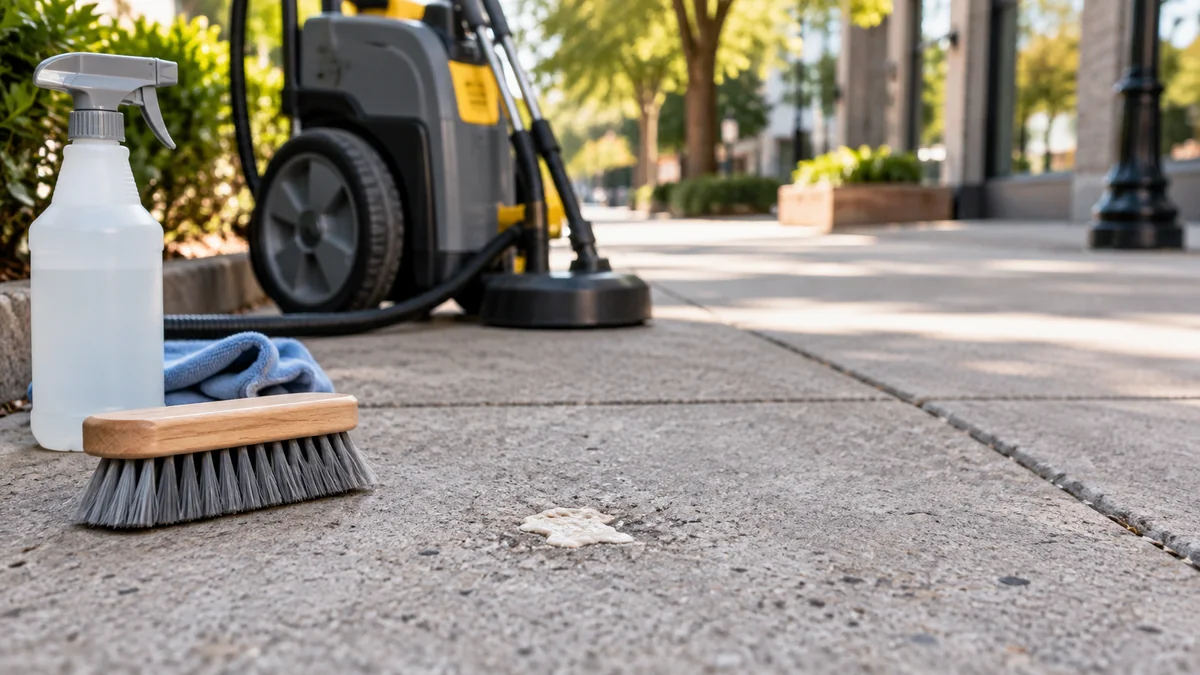
To remove dried chewing gum from concrete sidewalks, harden the gum with freeze spray, break it away with a scraper held nearly flat, then clean the remaining residue with mild detergent. One spot usually takes 2-5 minutes. For dozens of spots, a commercial hot-water pressure washer is faster, but excessive pressure can permanently etch concrete.
Key Facts at a Glance
- Freeze spray is the safest first choice for one to five gum spots on ordinary or decorative concrete.
- A plastic scraper or stiff putty knife held at roughly 10-20 degrees reduces gouging.
- Typical freeze-removal cost is $10-$25 for a small aerosol can and basic scraper.
- Hot-water pressure washing removes many spots quickly, but cold water alone often smears gum.
- Solvents can remove oily residue, but every solvent requires a hidden-area patch test.
- A dark ring after removal is usually plasticizer residue, not remaining chewing gum.
Before You Start
Gather the tools before touching the gum. Freeze spray works only while the gum remains brittle, so searching for a scraper after cooling wastes the treatment cycle.
| Item | Typical quantity or specification | Purpose |
|---|---|---|
| Commercial gum freeze spray | 1 can, 8-16 ounces | Hardens the gum |
| Plastic scraper | 1, 1-2 inches wide | Reduces scratches and gouges |
| Metal putty knife | 1, flexible, 1-2 inches wide | Removes stubborn fragments |
| Nylon brush | 1, medium or stiff | Cleans residue |
| Dish detergent | 1-2 teaspoons per quart of water | Removes loose oils and dirt |
| Absorbent towels | 2-4 | Collects softened residue |
| Eye protection and gloves | 1 set per user | Protects against fragments and solvent |
What time, cost, and difficulty should you expect?
A single dried gum spot usually takes 2-5 minutes and costs approximately $1-$3 in consumables. A small residential job with five spots generally takes 10-20 minutes and costs $10-$30 if you need to buy freeze spray, a scraper, detergent, and gloves.
| Job size | Typical time | Typical DIY cost | Recommended method |
|---|---|---|---|
| 1-5 spots | 10-25 minutes | $10-$30 | Freeze spray |
| 6-25 spots | 30-90 minutes | $20-$60 | Freeze spray or rental equipment |
| 26-100 spots | 1-3 hours | $75-$300 | Hot-water pressure washing |
| 100+ spots | 2-6 hours | $150-$600 professional service | Commercial hot-water cleaning |
These are typical working ranges, not fixed prices. Local rental rates, gum size, access to water, and surface condition can change the final cost substantially.
Which Gum-Removal Method Should You Use?
Freeze removal is best for a few spots, decorative concrete, and homeowners without commercial equipment. Hot-water pressure washing is better for large sidewalks with many spots, while solvent treatment is primarily a secondary step for oily shadows and residue in textured concrete.
| Method | Best quantity | Typical time per spot | Typical cost | Main risk |
|---|---|---|---|---|
| Freeze spray | 1-10 spots | 2-5 minutes | $10-$25 supplies | Flying fragments |
| Dry ice | 1-20 spots | 2-4 minutes | $15-$40 supplies | Cold burns and condensation |
| Hot-water pressure washer | 25+ spots | 10-30 seconds | $150-$300 rental | Etching or splashback |
| Citrus solvent | Residue and shadows | 10-30 minutes | $15-$50 product | Discoloration and runoff |
| Professional steam or hot-water service | 50+ spots | Site-dependent | $0.20-$0.45 per square foot | Service minimums |
Why does dried gum stick so firmly?
Dried chewing gum contains a rubbery gum base, resins, plasticizers, sweeteners, and flavor compounds. Weather removes moisture and volatile components, while foot traffic presses the remaining polymer into small concrete pores. The result is a hard surface mass with a mechanically locked residue underneath.
Freezing makes the polymer brittle enough to fracture. Heat softens it enough to lift or flush it away. Neither process repairs concrete that has already been gouged, polished, or stained.
Step 1: Inspect and Prepare the Concrete
Remove loose grit, leaves, and pebbles from around the gum, then inspect the surface finish. Use freeze spray first on standard gray broom-finished concrete, sealed concrete, colored concrete, stamped concrete, and small areas where appearance matters.
Check for cracks, flaking, exposed aggregate, or failing sealer. A scraper can lift weak sealer even when the concrete beneath is sound.
How should you test a decorative surface?
Test the freeze spray and any solvent in an inconspicuous area measuring at least 1 inch square. Wait 10 minutes after the test, then check for whitening, gloss loss, color transfer, or softened sealer.
Do not begin with a wire brush on colored or stamped concrete. A brass or steel brush can leave scratches and expose lighter aggregate, especially on a worn decorative coating.
Step 2: Freeze the Gum Completely
Hold the freeze-spray nozzle approximately 2-3 inches from the gum and apply a continuous stream for 30-60 seconds. For thick gum, use two 20-30 second applications rather than one excessively long application, allowing the surface to refreeze between cycles.
The gum should appear pale, frosted, and hard across its entire thickness. A cold surface alone is not enough; the center must also become brittle.
You will know the step worked when the gum no longer looks glossy or flexible and a scraper edge produces a crisp crack instead of a smear.
Common mistake: Applying spray from too far away. The spray evaporates before enough cooling reaches the gum, leaving the center soft.
Can dry ice replace freeze spray?
Dry ice can work, but it requires more care and is less convenient for most homeowners. Place a small piece on the gum for approximately 30-60 seconds using insulated gloves and eye protection, then remove it before scraping.
Never hold dry ice with bare skin, store it in an airtight container, or use it in a poorly ventilated enclosed area. Carbon dioxide released during sublimation can accumulate indoors.
Step 3: Lift the Brittle Gum
Place a plastic scraper or flexible putty knife nearly flat against the concrete, with the edge at roughly 10-20 degrees. Tap the scraper lightly around the gum’s perimeter, then slide underneath the weakened edge using short strokes.
Work from the outside toward the center. Large downward blows transfer force into the slab and can chip the cement paste or remove the finished surface.
You will know the step worked when the gum breaks into dry flakes or firm chunks that can be swept away without stretching.
Common mistake: Using a sharp blade at 45 degrees. A steep angle concentrates force on a narrow line and can leave a permanent groove.
Step 4: Re-Freeze Any Smear
Stop immediately if the gum becomes glossy, stringy, or adhesive. Remove loose material, reapply freeze spray for 20-45 seconds, and use a clean scraper edge for rapid, short lifts.
Do not spread the smear with a rag. Warm wiping drives softened gum into a wider area and can create a thin film that is harder to remove than the original spot.
You will know the recovery worked when the remaining material fractures instead of stretching. Several short freeze cycles are safer than forcing a half-soft mass.
Step 5: Wash the Residue
Mix 1-2 teaspoons of dish detergent with 1 quart of warm water. Apply the solution with a nylon brush, scrub the area for 30-60 seconds, and collect the dirty water with absorbent towels rather than directing it toward a storm drain.
Rinse with a small amount of clean water and blot or vacuum the runoff. On a sloped public sidewalk, place absorbent socks or towels downhill before washing.
You will know the surface is clean when loose grit no longer sticks to the area and the concrete feels similar to the surrounding surface when dry.
Common mistake: Rinsing solvent, gum fragments, or oily water into a storm drain. Storm drains commonly discharge without wastewater treatment, and local rules may prohibit contaminated runoff.
When Is Hot-Water Pressure Washing Better?
Hot-water pressure washing is better when a sidewalk contains dozens of gum spots or when a maintenance crew must restore a large commercial frontage quickly. Typical professional equipment delivers water near 180-200°F and adjustable pressure, but the operator should begin with the lowest effective pressure.
| Operating factor | Starting range | Adjustment rule |
|---|---|---|
| Water temperature | 180-200°F | Increase only if gum remains firm |
| Pressure | 1,500-2,500 PSI | Increase gradually on sound gray concrete |
| Nozzle | 25-degree fan | Avoid a zero-degree tip |
| Distance | 8-12 inches | Move farther if surface changes |
| Spray angle | Approximately 30-45 degrees | Avoid driving water straight down |
| Pass duration | 1-3 seconds | Keep the wand moving |
These figures are practical starting ranges, not universal settings. A pressure washer rated at 4,000 PSI can damage weak, scaled, or decorative concrete before the gum releases.
How do you pressure-wash gum without etching concrete?
Preheat the machine, use a wide fan nozzle, keep the wand moving, and soften one spot briefly rather than concentrating the jet in one place. Lift softened gum with a scraper or flush it toward a controlled collection area.
Cold-water pressure washing alone is often a poor first choice. High pressure can remove the concrete’s weak surface paste while leaving a smeared polymer film behind, particularly when the gum has been embedded by foot traffic.
Hot-water equipment also creates burn, splash, electrical, and traffic hazards. Commercial sidewalk work should use barricades, protective clothing, and a wastewater recovery plan.
Can Solvent Remove Gum From Concrete?
Citrus-based d-limonene, adhesive removers, and some alkaline degreasers can soften gum residue, but solvent is usually better for the remaining oily shadow than for a thick intact lump. Solvent can discolor sealer, spread plasticizer, or carry contamination into porous concrete.
Apply a small amount to a cloth or nylon brush rather than flooding the sidewalk. Allow approximately 5-15 minutes of dwell time while keeping the area controlled, then scrub and absorb the residue.
| Product category | Typical dwell time | Suitable surface | Main limitation |
|---|---|---|---|
| Dish detergent | 2-5 minutes | Unsealed gray concrete | Weak on old oil shadows |
| Citrus d-limonene | 5-15 minutes | Test-approved concrete | Can discolor sealer |
| Alkaline degreaser | 5-20 minutes | Sound unsealed concrete | May lighten colored surfaces |
| Adhesive remover | 3-10 minutes | Small tested areas | Solvent odor and residue |
| Poultice compound | 8-24 hours | Deep oil shadow | Slow and labor-intensive |
Never mix solvents, bleach, acids, or ammonia. Use the product label’s ventilation, glove, and disposal instructions, and prevent liquid from reaching vegetation, drains, or waterways.
How Do You Remove a Dark Shadow After the Gum Is Gone?
A dark shadow usually requires oil and plasticizer extraction rather than more scraping. Apply a concrete-safe degreaser, cover it with an absorbent powder or commercial poultice, keep it damp according to the label, and remove the dried material as solid waste.
For a small spot, a practical poultice can use a labeled degreaser with an absorbent material such as powdered clay or an approved absorbent compound. Test first because some powders and cleaners can lighten colored concrete.
Expect one to three treatments for an old shadow. Deeply absorbed plasticizer may fade without disappearing completely, especially in unsealed concrete that has weathered for years.
What Changes for Stamped, Colored, or Sealed Concrete?
Decorative concrete requires lower mechanical force and a patch test before any solvent or heated water. Freeze spray is usually the least abrasive approach, but it can still affect a weak sealer or coating.
| Surface | First choice | Avoid initially | Inspection point |
|---|---|---|---|
| Gray broom finish | Freeze spray | Zero-degree pressure tip | Surface paste |
| Stamped concrete | Freeze spray and plastic scraper | Wire brush and high heat | Sealer gloss |
| Integral colored concrete | Freeze spray | Strong solvent | Color consistency |
| Acrylic-sealed concrete | Tested freeze spray | Unapproved solvent | Whitening or softening |
| Exposed aggregate | Freeze spray, gentle wash | Aggressive turbo nozzle | Loose aggregate |
| Flaking concrete | Professional assessment | Any forceful scraping | Delamination |
A sealed surface may retain a visible ring even after the gum has been removed because the surrounding sealer has weathered differently. Cleaning cannot restore a coating that has already degraded.
Common Mistakes and How to Fix Them
Using a cold pressure washer at maximum pressure
Failure: The gum smears while the concrete surface turns lighter or rougher.
Fix: Stop washing, let the area dry, and use freeze spray. Do not attempt to polish away the etched ring.
Scraping before the gum is brittle
Failure: The gum stretches and spreads.
Fix: Remove loose fragments, refreeze the remaining material, and use a flatter scraper angle.
Applying solvent without a patch test
Failure: The cleaned area becomes lighter, glossy, or sticky.
Fix: Blot up excess product, rinse according to the label, and stop using that chemical on the surface.
Leaving fragments in the sun
Failure: Pieces soften and adhere again to shoes or nearby concrete.
Fix: Sweep or vacuum fragments immediately after each freeze cycle.
Ignoring traffic
Failure: Pedestrians track softened gum or solvent across the sidewalk.
Fix: Use cones or barricades and keep the area closed until the surface is dry and non-slip.
Expecting one treatment to remove a decade-old shadow
Failure: The gum disappears but the stain remains.
Fix: Treat the shadow separately with a tested degreaser or poultice, and accept that deeply absorbed oil may not fully reverse.
Variations for Common Situations
Removing one spot without chemicals
Place a bag of ice over the gum for several minutes, then use a plastic scraper. Ice is slower and less effective than freeze spray because it cools the surface indirectly, but it avoids aerosol solvents and is suitable for a small fresh spot.
Cleaning a large commercial sidewalk
Map the work area, remove loose debris, isolate pedestrian traffic, and use a hot-water machine with wastewater recovery. Treat the densest gum deposits first, then perform a low-pressure general rinse after all polymer material has been collected.
Cleaning gum during hot weather
Work in shade whenever possible. A concrete surface heated by direct sun can shorten the brittle window, so use smaller sections, keep the spray can cool according to its label, and scrape immediately after frosting.
Cleaning gum during freezing weather
Avoid soaking porous concrete unnecessarily. Water can freeze in cracks and create slip hazards, while freeze spray may have less practical benefit when the gum is already cold but remains mechanically embedded.
How Can You Prevent Repeat Gum Stains?
Remove fresh gum as soon as staff notice it, because foot traffic presses soft material deeper into concrete pores. A daily inspection near entrances, benches, bus stops, and vending areas usually costs less than periodic large-scale restoration.
A penetrating concrete sealer can reduce absorption, but sealer does not make gum non-stick. Film-forming coatings may simplify cleaning while introducing peeling, gloss, and color-matching problems.
Use a maintenance log that records the date, location, removal method, and surface reaction. Repeated discoloration in one zone may indicate a vending area, transit stop, or property-design issue rather than a cleaning failure.
How Much Does Professional Gum Removal Cost?
Professional gum removal commonly costs approximately $0.20-$0.45 per square foot for larger commercial cleaning areas, while small visits may be governed by minimum charges of roughly $150-$300. Per-spot pricing varies because access, traffic control, water recovery, and stain treatment add labor.
| Service situation | Typical price range | Typical duration | Cost driver |
|---|---|---|---|
| Small residential visit | $100-$250 | 30-90 minutes | Minimum service charge |
| 25-100 commercial spots | $150-$400 | 1-3 hours | Spot density and access |
| Large sidewalk cleaning | $0.20-$0.45/sq. ft. | 2-6 hours | Area and wastewater control |
| Shadow removal add-on | $25-$100 per area | 30-120 minutes | Depth of oil absorption |
| Decorative concrete treatment | $200-$600 | 1-4 hours | Testing and low-impact work |
Request a written scope that distinguishes gum removal from oil-shadow treatment. A low quote may include only hot-water cleaning and exclude traffic control, runoff recovery, sealing, or stain correction.
Expert Rules for Better Results
- Treat polymer and stain as separate problems. Removing the solid gum first prevents solvent from spreading the contaminant over a larger area.
- Use the least aggressive effective force. Heat and chemistry change the gum, while pressure only transfers force into the concrete; excessive pressure cannot compensate for poor softening.
- Judge success after drying. Wet concrete often hides a remaining shadow and makes clean areas appear darker, so inspect after the surface has dried completely.
- The scraper angle matters more than scraper strength. A flat edge lifts material; a steep edge cuts the cement paste.
- Old gum is not always harder to remove with stronger chemicals. Long-aged plasticizer can be deeply absorbed, and aggressive solvent may enlarge the stain rather than extract it.
FAQ
Will vinegar dissolve dried chewing gum on concrete?
Vinegar is not a reliable gum remover. Household vinegar may clean light mineral or food residue, but its acidity does not efficiently soften the synthetic rubber base found in most modern chewing gum. Freeze spray, controlled heat, or a labeled adhesive product is more appropriate.
Can WD-40 remove gum from a sidewalk?
WD-40 may soften gum, but it adds petroleum residue and can create a larger dark stain in porous concrete. If used at all, test a hidden area, apply a minimal amount, collect the residue, and follow with a suitable degreaser. Freezing is usually cleaner for a small sidewalk spot.
Is a wire brush safe for concrete gum removal?
A nylon brush is the safer default. Brass or steel wire can scratch sealed concrete, remove color, expose aggregate, or leave metallic marks. Use a wire brush only on tested, unsealed concrete when softer methods cannot remove a thin residue.
Can a pressure washer remove gum without hot water?
A pressure washer can remove fresh or partly detached gum with cold water, but dried gum commonly smears unless heat or chemical softening changes its texture. High cold-water pressure also increases the risk of surface paste loss, especially on aged or decorative slabs.
How long should gum removal take after freezing?
Most small spots release within 2-5 minutes, including preparation, a 30-60 second freeze cycle, scraping, and cleanup. Thick deposits, heavily trafficked pores, cold weather, or repeated freeze cycles can extend the time to 8-10 minutes per spot.
Should concrete be resealed after gum removal?
Resealing is optional and depends on the condition of the whole slab, not one cleaned spot. Consider it when unsealed concrete absorbs water unevenly or repeated staining is a maintenance problem. Clean, dry, and assess the complete surface before applying a compatible sealer.
The Bottom Line
For how to remove dried chewing gum from concrete sidewalks, start with freeze spray, a nearly flat plastic scraper, and immediate fragment collection. Use hot-water pressure washing only when the number of spots justifies commercial equipment, and use solvent primarily for residual oil shadows after patch testing. The safest successful method is the least aggressive one that fully changes the gum’s physical state without damaging the concrete surface.