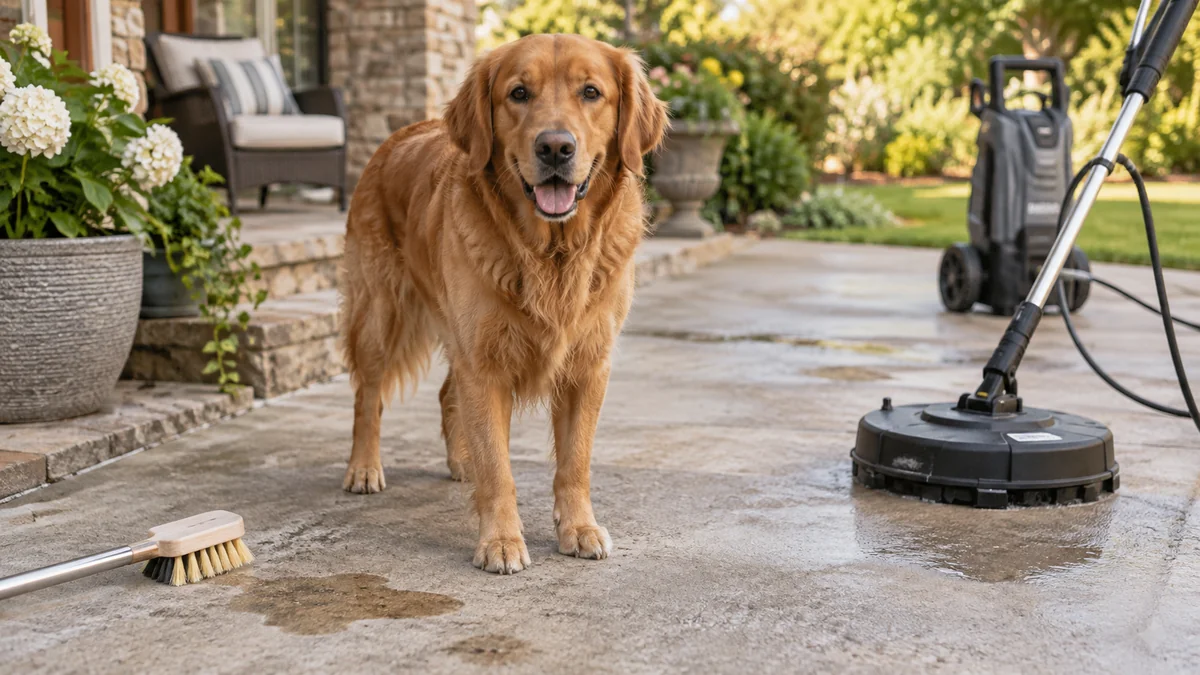
To remove dog urine odor from outdoor concrete patios, saturate the affected concrete with a labeled outdoor enzymatic or biological urine cleaner, keep it wet for the product’s full dwell time, scrub, rinse or extract the residue, and let the slab dry completely before judging the result. Deep or repeated contamination usually requires two treatments, while a sealer can reduce future absorption after cleaning.
Key Facts at a Glance
- Concrete absorbs urine through pores, cracks, joints, and unfinished edges, but the penetration depth varies substantially by slab condition.
- A hose rinse removes surface liquid but usually does not dissolve dried urine salts inside porous concrete.
- Enzyme or bacterial cleaners work best when the patio remains wet for several hours and no incompatible disinfectant residue is present.
- A water-drop test identifies water repellency, but it does not prove that every part of the patio has the same sealer coverage.
- Vinegar, baking soda, perfume, and bleach are poor choices for established urine odor and may create safety or material problems.
- Penetrating sealer helps prevent new urine from soaking in, but it does not reliably destroy odor already trapped below the surface.
Why Does Concrete Keep Smelling Like Dog Urine?
Dog urine odor returns because dissolved urine components enter concrete pores and later become concentrated residues as water evaporates. When rain, humidity, cleaning water, or condensation rehydrates those residues, volatile odor compounds become noticeable again.
Concrete is not uniformly porous. A smooth, dense, troweled slab may absorb slowly, while weathered concrete, broom-finished concrete, control joints, cracks, and exposed aggregate can hold considerably more liquid. Urine may also collect at the patio edge or migrate beneath outdoor mats, planters, fencing, and kennel panels.
Uric acid is only one part of the residue. Urine also contains urea, salts, creatinine, proteins, and minerals. Bacterial activity during drying and rewetting can contribute to ammonia-like odor. The practical consequence is straightforward: a successful treatment must reach the contaminated zone and remove or transform residue rather than merely perfume the surface.
How deep does dog urine penetrate concrete?
Dog urine penetration can range from the surface film to several millimeters or more, depending on porosity, contact time, temperature, and repeated wetting. A fixed depth such as 1/4 or 1/2 inch should not be treated as a universal measurement.
The strongest odor often appears near joints and cracks because those features act as reservoirs. Treating only the visible yellow mark also fails when repeated accidents have spread beyond the obvious spot. Include a surrounding margin of at least 12-24 inches, then expand the treatment if odor remains after drying.
What Cleaner Removes Dog Urine Odor From Concrete?
A purpose-made outdoor enzymatic or biological urine cleaner is usually the best first choice for unsealed residential concrete. Choose a product whose label specifically permits concrete, outdoor use, and prolonged wet contact, then apply enough solution to wet the entire contaminated zone rather than misting only the stain.
Enzyme products vary. Some rely on enzymes, some contain odor-eating microorganisms, and others combine biological ingredients with surfactants that help wet concrete. Biological products may perform poorly after bleach, quaternary disinfectants, strong acids, or aggressive alkaline cleaners have been used, because those residues can damage the organisms or alter the surface chemistry.
A cleaner should not be judged by fragrance strength. A heavily scented product can make the patio smell better for an hour while leaving the underlying residue untouched. Read the label for dilution, coverage, dwell time, temperature limits, and plant warnings.
Which patio-cleaning method should you choose?
| Method | Typical material cost | Typical dwell or cure time | Best use | Main limitation |
|---|---|---|---|---|
| Outdoor enzyme or biological cleaner | $15-$50 per gallon | 2-12 hours | Repeated urine odor on unsealed concrete | Requires wet contact and patience |
| Oxygen-based oxidizer | $10-$30 per container | 15-60 minutes | Surface odor and organic staining | May not reach deep reservoirs |
| Neutral concrete detergent | $10-$25 per gallon | 5-15 minutes | Dirt, dust, and light film | Does not reliably remove dried urine salts |
| TSP substitute or strong degreaser | $10-$30 per container | 10-30 minutes | Grease-bound soil and heavy grime | Caustic runoff and limited urine specificity |
| Vinegar solution | Under $10 | 5-15 minutes | Small, fresh surface accident | Weak for established porous contamination |
| Penetrating sealer | $35-$100 per gallon | 24-72 hours | Reducing future absorption | Not a substitute for odor removal |
Before You Start
A moderate patio treatment normally takes 4-8 hours of active and waiting time, plus 24-48 hours for drying. Severe contamination may require a second treatment and several additional days before sealing.
| Requirement | Typical specification |
|---|---|
| Cleaner quantity | 1-2 gallons per 100 square feet, depending on porosity |
| Scrub brush | Stiff nylon deck brush, 12-18 inches wide |
| Sprayer | Low-pressure pump sprayer or watering can |
| Extraction | Wet/dry vacuum with 2-5 gallon capacity |
| Protective equipment | Chemical-resistant gloves, eye protection, washable footwear |
| Weather window | 12-24 hours without heavy rain |
| Dog exclusion | At least 12 hours, or the full label dwell period |
| Optional cover | Clean plastic sheeting, weighted at the edges without sealing in runoff |
Keep children and pets away from the treatment area. Cover nearby furniture and move absorbent mats, toys, beds, and planters so they do not retain odor or block the cleaner.
Step 1: Map and Prepare the Contaminated Area
Sweep the patio, remove solid waste, and identify every place where odor is strongest. Do not begin with a high-pressure wash, because blasting an untreated deposit can spread contaminated liquid into joints, cracks, nearby soil, and porous walls.
A useful field test is to inspect the patio after light rain or a controlled rinse. Mark areas that smell stronger when wet. Include the perimeter around those marks, since odor often extends beyond the visible urine stain.
Remove loose dirt with a broom. If mud or heavy soil covers the slab, rinse gently with a hose and let the surface reach a damp, non-puddled condition before applying the urine cleaner.
You will know preparation is complete when: the surface has no loose debris, the drainage path is clear, and the suspected treatment zone is visibly larger than the single stain.
Common mistake: treating only the yellow spot while ignoring grout-like joints, cracks, slab edges, and the underside of outdoor mats.
Step 2: Test Whether the Concrete Is Sealed
Place several teaspoon-sized drops of water on clean areas of the patio and observe them for 30-60 seconds. Rapid absorption suggests open concrete, while persistent beading suggests a sealer, paint, coating, or unusually dense finish.
The test is directional, not definitive. A patio can have worn traffic lanes, sealed edges, patched sections, and unsealed cracks in the same area. Test at least three locations, including one close to the odor source.
If water absorbs, a biological cleaner can usually be applied directly. If water beads, the cleaner may remain on the surface instead of reaching the contaminated layer. Do not automatically strip a sound coating; first check the coating manufacturer’s cleaning instructions and test a small hidden area.
You will know the test is useful when: water behaves consistently across the treatment zone and you have identified any visibly coated sections.
Common mistake: assuming a single beaded drop proves the whole patio is sealed.
Step 3: Saturate the Patio With Urine Cleaner
Apply the cleaner at dawn, dusk, or during cool overcast weather. Follow the product label for dilution and coverage, then use a watering can or low-pressure sprayer to wet the entire affected area and its margin.
Light misting is usually inadequate. The concrete should remain visibly wet without creating uncontrolled runoff. Work in sections of roughly 25-50 square feet so each section receives sufficient product before the liquid drains away.
Protect plants by placing absorbent towels or temporary plastic barriers at the patio edge. Keep rinse water away from storm drains, vegetable beds, ponds, and sensitive landscaping unless the product label permits that discharge.
You will know application is sufficient when: the surface remains evenly wet for several minutes and no dry halos appear around cracks or slab edges.
Common mistake: diluting the product below its labeled strength because the patio appears large. Use additional product or work in smaller sections instead.
Step 4: Keep the Cleaner Wet for the Full Dwell Time
Maintain wet contact for the cleaner’s labeled period, commonly 2-12 hours for biological formulas. Old, repeated contamination often benefits from the longer end of the range, but a longer dwell does not override the manufacturer’s safety instructions.
Covering can slow evaporation during dry weather. Lay clean plastic sheeting loosely over the treated area and weight the edges outside the contaminated zone. Do not create a sealed pond, allow runoff to collect against walls, or cover the patio when strong wind could spread chemical liquid.
Rewet drying sections with the same cleaner when the label allows it. Plain water may dilute the treatment and reduce contact with the residue. Odor can become stronger when old deposits are rehydrated, but that change is not proof that the treatment has succeeded.
You will know dwell time is complete when: the labeled contact period has passed and the surface has remained wet without uncontrolled pooling.
Common mistake: allowing the cleaner to dry after 20 minutes, then concluding that the formula failed.
Step 5: Scrub and Extract the Residue
Scrub the wet surface with a stiff nylon deck brush, concentrating on joints, cracks, rough texture, and slab edges. Use overlapping passes rather than a single aggressive stroke, because mechanical action helps dislodge softened residue from the upper pores.
Where practical, remove the dirty liquid with a wet/dry vacuum. Extraction is especially useful on covered patios, balconies, and areas near walls where contaminated rinse water cannot safely spread. Empty the vacuum according to its instructions and disinfect washable components afterward.
If extraction is not possible, rinse with a controlled, low-pressure flow toward an approved drainage area. Do not send concentrated cleaner or urine residue into a storm drain, pond, food garden, or neighboring property.
You will know scrubbing worked when: the rinse water becomes less dirty with each pass and odor does not intensify at untreated edges.
Common mistake: using a pressure washer at the beginning of the job. Pressure washing can spread contamination before the residue has been chemically softened.
Step 6: Dry Completely and Repeat if Necessary
Allow the patio to dry fully before evaluating odor. Drying can take 24-48 hours in shaded or humid conditions and less time in warm, breezy weather. Do not judge the result while the concrete is still saturated.
After drying, smell the patio at several locations and lightly dampen small test areas with clean water. A strong odor that returns only at one joint or crack identifies the next treatment target. A broad odor pattern indicates that the original treatment area was too small or too lightly saturated.
Repeat the cleaner, dwell, scrub, and extraction cycle once if odor remains. Multiple light rinses without another dwell cycle rarely solve deep contamination because rinsing alone does not provide enough contact time.
You will know treatment is working when: the patio remains neutral after drying and after a small controlled rewetting test.
Common mistake: sealing immediately after the first treatment. A sealer can make later remediation harder if residue remains below the surface.
Step 7: Seal the Clean, Dry Concrete
Apply a compatible penetrating sealer only after the odor has been removed and the slab has dried to the product’s specified moisture condition. Silane-siloxane products reduce water absorption while preserving much of the concrete’s appearance; silicate products densify the surface but are not interchangeable with water-repellent sealers.
A sealer reduces future penetration but does not permanently destroy every molecule already trapped in concrete. Some coatings can also alter slip resistance, color, vapor transmission, or future repair options. Confirm compatibility with decorative finishes, paint, existing sealer, and local building requirements.
Keep dogs off the patio for the full cure period, commonly 24-72 hours. Apply a small test patch first and check for darkening, whitening, peeling, or uneven absorption before treating the entire slab.
You will know sealing is complete when: the cured test area shows consistent water repellency and the product has reached its stated cure time.
Common mistake: using a film-forming acrylic over an odor problem that has not been remediated. A surface film may trap moisture or complicate future cleaning.
What Are the Best Alternatives for Fresh or Light Odor?
Fresh urine should be blotted or absorbed promptly, followed by a water rinse and a compatible outdoor cleaner. Speed matters because less liquid has time to migrate into pores, joints, and cracks.
| Situation | Recommended first action | Typical time | Avoid |
|---|---|---|---|
| Fresh accident on unsealed concrete | Absorb, rinse lightly, apply labeled cleaner | 15-60 minutes | Letting urine dry in full sun |
| Small odor on sealed concrete | Use coating-compatible cleaner and wipe residue | 20-45 minutes | Abrasive grinding without a test |
| Repeated dog-run contamination | Saturation treatment with two possible cycles | 1-3 days | Surface fragrance only |
| Greasy kennel or patio edge | Remove grease first, then use urine cleaner | 1-2 days | Mixing degreaser and biological cleaner |
| Odor beside lawn or garden | Use barriers and controlled extraction | 4-12 hours | Uncontrolled runoff |
| Odor in cracks or joints | Flood narrow features and brush directly | 12-48 hours | Treating only flat slab areas |
Vinegar can reduce some fresh surface odor, but vinegar and baking soda used together largely neutralize one another into a weak salt solution and carbon dioxide. The foaming action may look active without providing deep remediation. Neither ingredient is a dependable solution for repeated urine absorbed into concrete.
Bleach is unsuitable for this task. Bleach can disinfect some surfaces, but it does not provide a reliable uric-acid remediation method, and bleach contacting ammonia-containing urine can produce hazardous chloramine gases. Never mix bleach with urine, ammonia, acids, vinegar, or other cleaners.
How Much Does Patio Odor Removal Cost?
Typical do-it-yourself costs range from $20-$100 for cleaner, tools, and protective supplies. Professional treatment commonly costs more because contractors may use extraction equipment, coating removal, odor testing, and specialized sealers.
| Project type | Typical area | DIY material cost | Professional range | Typical duration |
|---|---|---|---|---|
| Fresh isolated accident | 10-25 sq. ft. | $5-$20 | $75-$200 | 1-3 hours |
| Moderate patio odor | 50-150 sq. ft. | $25-$80 | $200-$600 | 1-2 days |
| Multi-dog run | 150-400 sq. ft. | $60-$180 | $500-$1,500 | 2-4 days |
| Sealed or painted patio | 50-200 sq. ft. | $50-$250 | $400-$1,500 | 2-5 days |
| Severe cracks and repeated saturation | 100-400 sq. ft. | $80-$300 | $800-$3,000 or more | 3-7 days |
These are typical planning ranges, not fixed prices. Local labor rates, access, wastewater rules, coating thickness, and whether the concrete must be ground or resurfaced can change the final amount substantially.
Common Mistakes and How to Fix Them
The patio smells worse during treatment
Rehydration can release odor from dried residue before the cleaner has completed its work. Continue the labeled dwell period, ventilate the area, and keep people and animals away from concentrated odor.
If the smell remains strong after complete drying, repeat the treatment or inspect adjacent soil, drains, mats, walls, and cracks. A temporary increase during wetting is not a reliable success signal.
The smell returns after rain
Rain may be reaching untreated residue below the original application zone. Expand the treatment perimeter, concentrate on joints and cracks, and repeat the full dwell and extraction process after the slab dries.
Rain can also carry odor from contaminated soil against the patio edge. Treating concrete alone will not solve a soil reservoir.
The cleaner does not sink into the concrete
Beading indicates a coating, sealer, wax, grease film, or dense concrete surface. Confirm the finish before using a stripper, because removing a coating may damage decorative color or expose a surface that later requires refinishing.
A professional may use mechanical abrasion, diamond grinding, or coating-compatible remediation. Grinding creates dust and should not be attempted without appropriate controls.
The patio has nearby grass or plants
Use barriers, small work sections, controlled rinsing, and extraction where possible. Check the cleaner’s plant-safety instructions rather than assuming that “natural” or “biological” means harmless at concentrated strength.
Do not discharge concentrated cleaner into storm drains or garden beds. Local wastewater rules may apply to large commercial or kennel cleanups.
A pressure washer is the only available tool
Use it after the chemical treatment has softened the residue, not as the first response. Select the lowest effective pressure, keep the nozzle moving, and direct runoff toward an approved drainage route.
Pressure washing may remove surface grime while leaving odor below. It is a mechanical rinse, not a substitute for a urine-specific dwell treatment.
When Should You Hire a Professional?
Professional help is appropriate when odor covers several hundred square feet, returns after two complete treatments, comes from a painted or sealed surface, affects neighboring property, or creates wastewater-management problems. A contractor can identify coating layers, extract contaminated liquid, and determine whether grinding or resurfacing is more practical.
Replacement is rarely the first option for ordinary patio odor. Resurfacing or slab removal becomes more reasonable when concrete is badly cracked, structurally damaged, saturated through repeated commercial kennel use, or covered by a failing coating that cannot be safely removed.
Ask the contractor what cleaner will be used, how runoff will be contained, whether extraction is included, how pets will be excluded, and what the sealer warranty actually covers. A promise to “seal the smell in forever” is not a substitute for a documented remediation process.
FAQ
Can I use dish soap to remove dog urine odor from concrete?
Dish soap can remove surface oils and dirt, but it is not a dedicated treatment for dried urine residue inside porous concrete. Use a small amount only for general cleaning, rinse thoroughly, and follow with a compatible urine-specific cleaner when odor remains.
How long should I wait before letting my dog back on the patio?
Keep the dog away during application, the full labeled dwell period, rinsing, and drying. For a typical biological treatment, that means at least 12-24 hours; after sealing, use the sealer’s stated cure time, often 24-72 hours.
Does hot water remove urine smell better than cold water?
Hot water can loosen surface grime, but heat alone does not remove deep urine residue and may increase odor release. Follow the cleaner label, because some biological formulas perform best within a moderate temperature range rather than with very hot water.
Can dog urine damage a concrete patio?
Repeated urine can discolor concrete, leave deposits, corrode nearby metal, and produce persistent odor, especially in cracks and joints. Urine odor alone does not prove structural damage, but widespread cracking, spalling, or surface softening warrants a concrete inspection.
Why does only one spot smell after I cleaned the patio?
The remaining odor usually identifies an untreated reservoir, such as a crack, joint, patio edge, drain, mat underside, or nearby soil. Lightly rewet separate areas to map the source, then target the strongest location with another properly timed treatment.
Will a concrete sealer stop my dog’s urine from soaking in?
A compatible penetrating sealer can reduce absorption and make prompt cleanup easier, but it is not completely urine-proof and does not eliminate existing odor. Reapply according to the manufacturer’s maintenance interval and remove fresh accidents quickly.
The Bottom Line
The reliable way to remove dog urine odor from outdoor concrete patios is to locate the full contaminated zone, use a concrete-safe urine cleaner, saturate the porous surface, maintain the labeled dwell time, scrub, extract or rinse responsibly, and evaluate the slab only after complete drying. Treat cracks and edges separately, repeat the process when necessary, and seal only clean, dry concrete. This approach solves the source rather than masking it with fragrance or spreading it with an uncontrolled hose rinse.