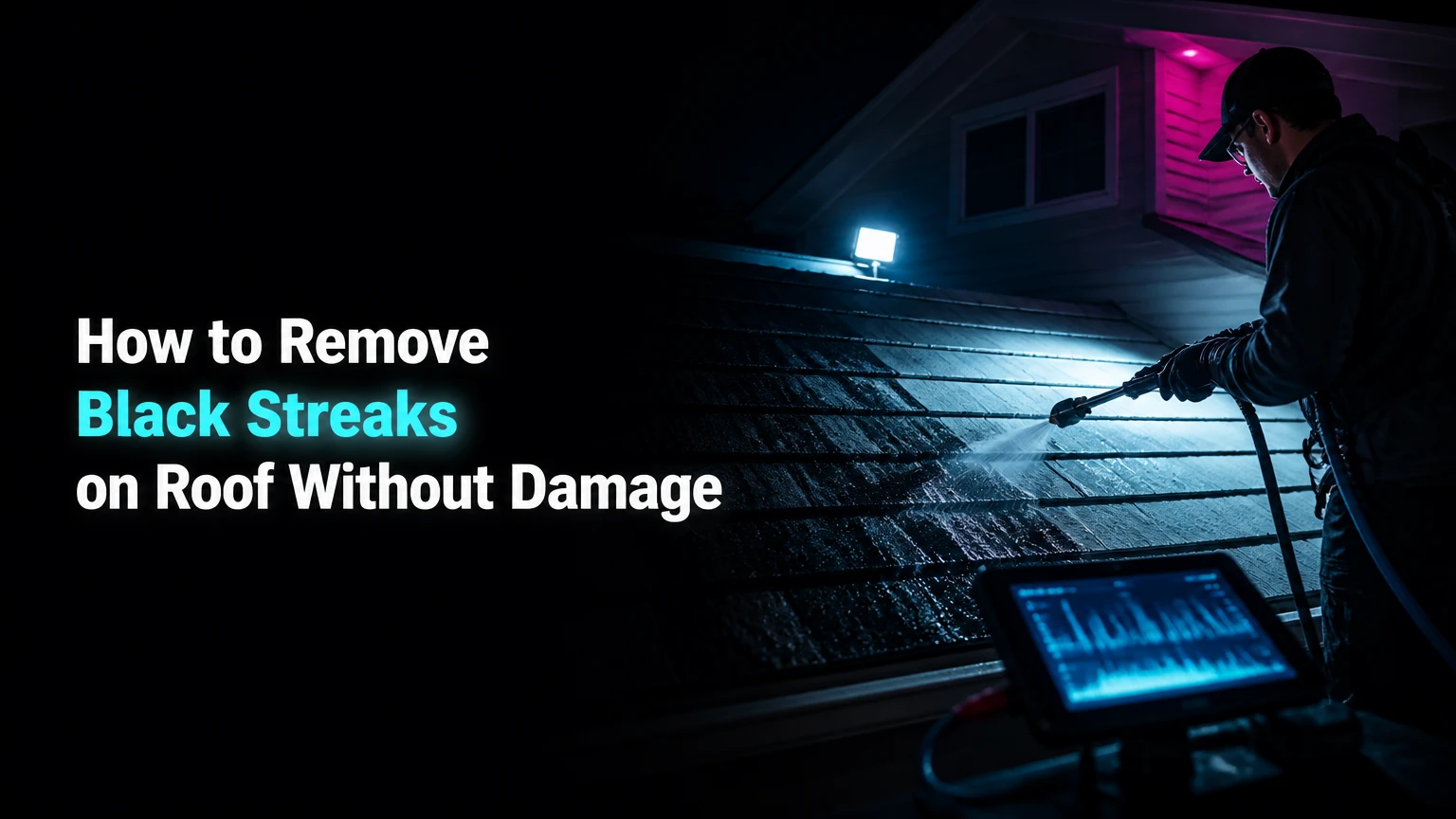
Black streaks on an asphalt-shingle roof are usually caused by the blue-green alga Gloeocapsa magma. Remove them with a manufacturer-compatible, low-pressure chemical treatment, not a pressure washer or aggressive scrubbing. Protect plants and metal, keep the solution from drying, rinse runoff carefully, and hire a professional when roof access is hazardous.
Key Facts at a Glance
- Gloeocapsa magma commonly creates black, vertical streaks on asphalt shingles, especially on shaded and moisture-prone roof slopes.
- Low-pressure chemical application removes algae without stripping the ceramic granules that protect asphalt shingles from ultraviolet light.
- A typical sodium hypochlorite treatment remains wet for approximately 15-20 minutes, but the product label controls the final dilution and contact time.
- Never mix bleach with ammonia, acids, or unverified detergents; dangerous chlorine or chloramine gases can form.
- Dead algae may remain visibly attached for several weeks after treatment and usually weather away through rain.
- Roof cleaning cannot repair missing granules, cracked shingles, leaks, failed flashing, or a roof near the end of its service life.
What Are the Black Streaks on a Roof?
Black roof streaks are usually colonies of Gloeocapsa magma, a blue-green alga that produces dark ultraviolet-protective pigments. The organism spreads through airborne spores and grows where shingles stay damp, including north-facing slopes, roof sections beneath trees, and areas with poor ventilation.
The streak pattern helps with identification. Algae typically appears as thin black or blue-black vertical trails that follow water runoff. Moss forms raised green cushions, while lichen creates pale gray or yellow-green crusts attached to the shingle surface. Mold, soot, rust, and roof debris can imitate algae, so a visual inspection matters before applying chemicals.
Modern asphalt shingles contain mineral filler and ceramic granules. Algae can use mineral components and retain moisture against the surface, but the dark color does not mean the organism has penetrated deeply into the structural roof deck. Physical damage usually comes from improper cleaning, long-term moisture, or granule loss rather than from a thin stain alone.
Does black algae damage asphalt shingles?
Black algae is primarily an appearance problem during its early stages, but persistent moisture and repeated growth can shorten the useful life of vulnerable shingles. Algae can retain water, obscure damaged areas, and encourage moss or lichen to establish where the roof remains shaded.
A black streak is not proof that a roof needs replacement. Look for exposed asphalt, bald patches, curled tabs, cracked shingles, sagging decking, attic leaks, and deteriorated flashing. Those conditions require roof repair or replacement evaluation, not a stronger cleaning chemical.
Why Does Algae Grow on Some Roofs?
Algae grows when moisture, shade, airborne spores, and a compatible surface occur together. Roof orientation matters, but overhanging branches, clogged gutters, mossy surroundings, and inadequate attic ventilation often determine how long shingles remain wet after rain.
The first affected areas are commonly north and east slopes because they receive less direct afternoon sun. Roof valleys, areas below plumbing penetrations, and sections near tree canopies can also develop streaks regardless of compass direction.
What should you inspect before cleaning?
Inspect the roof from the ground with binoculars before climbing. Record the roof material, approximate age, pitch, visible granule loss, moss or lichen growth, skylights, solar panels, nearby vegetation, and the location of gutters and downspouts.
Do not walk on brittle, wet, steep, or damaged shingles. A roof that looks acceptable from the ground may contain weak tabs or concealed deck damage. If the roof is more than one story high, has a pitch above approximately 4:12, or requires unsafe ladder positioning, obtain a professional inspection and cleaning quote.
How to Remove Black Streaks on Roof
The safest general process uses inspection, plant protection, label-directed chemical application, a controlled dwell period, and gentle rinsing when the product requires it. For an average 2,000-square-foot asphalt-shingle roof, a typical DIY project takes 3-6 hours including setup and cleanup, although roof height and landscaping can extend the work.
Before You Start
| Item | Typical requirement | Important limit |
|---|---|---|
| Project time | 3-6 hours | Excludes major moss removal or repairs |
| Chemical dwell | 15-20 minutes for many chlorine treatments | Prevent complete drying |
| Pump sprayer | 1-2 gallon capacity | Use chemical-compatible seals |
| Garden hose | 50-100 feet | Use ordinary hose pressure |
| Protective eyewear | 1 pair | Chemical splash protection required |
| Chemical-resistant gloves | 1 pair | Check compatibility with the label |
| Plant watering | 10-20 minutes before and after | More water may be needed in hot weather |
| Typical DIY materials cost | $30-$100 | Excludes fall-protection equipment |
Use the roof-shingle manufacturer’s maintenance instructions when available. Asphalt Roofing Manufacturers Association guidance supports non-abrasive, low-pressure cleaning approaches, but a product label, local environmental rule, and shingle warranty can impose stricter requirements.
Step 1: Confirm the roof condition
Remove loose debris from gutters and inspect the roof from a safe position. Photograph questionable areas before cleaning, because a chemical treatment can reveal pre-existing granule loss or discoloration that was difficult to see under the stain.
You will know this step worked when the cleaning area, roof material, runoff path, and damaged sections are documented. The common mistake is treating a roof leak as a cleaning problem.
Step 2: Choose a compatible treatment
Select a commercial roof-algae product or a sodium hypochlorite solution specifically permitted for the roof material. A commonly used chlorine approach achieves approximately 3%-5% active sodium hypochlorite on the roof, but concentration depends on the strength of the starting product.
Do not automatically add dish soap. Some detergents contain ammonia or other incompatible ingredients, and bleach must never be mixed with ammonia, acids, vinegar, or toilet-bowl cleaners. If a surfactant is needed, use only a product whose label confirms compatibility with sodium hypochlorite.
You will know this step worked when the label identifies the roof material, dilution, contact time, personal protective equipment, and disposal instructions. The common mistake is treating a stronger mixture as a faster or safer mixture.
Step 3: Protect plants, people, pets, and metal
Wet all plants beneath the roofline thoroughly before application. Cover sensitive plants temporarily with breathable protective material, move outdoor furniture, keep children and pets away, and protect painted surfaces, vehicles, copper gutters, aluminum fixtures, and electrical equipment from overspray.
Disconnect or shield rain barrels and prevent concentrated runoff from entering ponds, storm drains, or neighboring property. Keep a hose available for immediate dilution of accidental splashes. Chemical-resistant gloves, eye protection, protective clothing, and footwear with reliable traction are minimum precautions, not a substitute for fall protection.
You will know this step worked when every runoff path has a dilution plan and no person is beneath the work area. The common mistake is covering plants without wetting the soil and foliage first, which allows concentrated runoff to burn leaves and roots.
Step 4: Apply the solution at low pressure
Use a pump sprayer or professional low-pressure delivery system. Start at the lower roof edge and work upward so the solution reaches each stained section without repeatedly sending concentrated chemical over already treated areas.
Saturate the black streaks without flooding the roof. Keep the spray away from vents, open windows, unprotected metals, and roof fixtures. Never use a pressure washer on asphalt shingles: concentrated water can dislodge ceramic granules, damage shingle edges, force water beneath laps, and accelerate ultraviolet deterioration.
You will know this step worked when the stained areas are evenly wet and no bare shingle patches appear. The common mistake is using a narrow, forceful nozzle that creates a jet rather than a controlled fan.
Step 5: Maintain the dwell time
Allow the product to remain wet for the label-directed contact time. Many chlorine-based treatments use approximately 15-20 minutes, while oxygen-bleach products may require 30-45 minutes and quaternary ammonium products may continue working for weeks.
Shade and mild temperatures slow drying. If the solution begins drying before the required contact time, apply a light mist of water or additional correctly mixed solution, provided the label permits it. Do not allow concentrated chemical to pool in gutters or dry on painted metal.
You will know this step worked when the streaks turn brown, gray, or lighter and the solution has remained wet for the full contact period. The common mistake is judging failure before the chemical has completed its dwell time.
Step 6: Rinse or leave the treatment according to the label
Rinse chlorine and other products that require rinsing with a garden hose from the ridge downward. Avoid directing water under shingle laps, around flashing, or toward attic vents. Continue until visible residue has cleared, then flush gutters and downspouts with clean water.
Some quaternary ammonium “spray and leave” products are designed to weather away without rinsing. Rinsing such a product prematurely can reduce residual performance, while failing to rinse a chlorine product can damage nearby metals or plants.
You will know this step worked when runoff is diluted, gutters are clear, and no chemical film remains on adjacent surfaces. The common mistake is rinsing upward, which can drive water beneath shingle courses.
Step 7: Clean up and inspect
Remove plant coverings after the final rinse and water vegetation again. Wash sprayers and hoses according to the chemical label, store products securely, and never pour leftover concentrate into soil, drains, or waterways.
Inspect the roof from the ground after the surface dries. Dead algae may remain as pale or brown residue for two to six weeks, particularly where the original growth was thick. Rain and normal weathering often remove the remaining discoloration.
Which Treatment Works Best?
Sodium hypochlorite generally provides the fastest visible result on black algae, while oxygen bleach reduces chlorine-related plant and metal risks and quaternary ammonium products prioritize residual action over immediate appearance. No treatment is universally best because roof material, runoff sensitivity, stain thickness, and required speed change the decision.
| Treatment | Typical contact time | Visible result | Main risk or limitation |
|---|---|---|---|
| Sodium hypochlorite | 15-20 minutes | Same-day color change | Plant, metal, and clothing damage |
| Sodium percarbonate | 30-45 minutes | Gradual lightening | Often needs gentle agitation |
| Quaternary ammonium | 1-3 months | Slow weathering removal | Rain-dependent and label-specific |
| Commercial roof cleaner | 10 minutes to 3 months | Product-dependent | Formula and dilution vary widely |
Sodium hypochlorite
Chlorine-based treatment oxidizes algae rapidly and is commonly used by professional soft-wash contractors. It is practical for heavy black streaking when the operator can control runoff and protect vegetation.
Sodium hypochlorite is not environmentally harmless. It can bleach foliage, corrode untreated metal, discolor fabrics, and irritate skin or lungs. Pool chlorine and household bleach differ in concentration, additives, and shelf life, so use the actual label concentration rather than assuming a fixed recipe.
Sodium percarbonate
Sodium percarbonate releases hydrogen peroxide and sodium carbonate when dissolved in water. It is a useful lower-chlorine alternative for light algae and some organic staining, but it can require longer contact and gentle brushing with a soft tool.
Oxygen bleach is not automatically suitable for every roof. Test a small inconspicuous area, prevent powder from entering eyes or lungs, and follow the product instructions. Aggressive brushing remains capable of removing granules even when the chemical itself is mild.
Quaternary ammonium compounds
Quaternary ammonium roof treatments are residual biocides that can continue acting as rain and weathering remove dead growth. They suit homeowners who prioritize reduced labor and can tolerate a slow visual change.
These products are not instant stain removers. Their environmental handling rules vary, and runoff restrictions may apply. A “spray and leave” label does not permit application before rain, near waterways, or on an incompatible material.
How Should the Method Change by Roof Material?
Asphalt shingles tolerate different cleaners than painted metal, clay tile, concrete tile, wood shakes, or synthetic roofing. Apply an asphalt-shingle chlorine recipe to another material only when the manufacturer and chemical label expressly permit it.
| Roof material | Typical cleaning approach | Pressure guidance | Primary caution |
|---|---|---|---|
| Asphalt shingles | Low-pressure labeled algaecide | Under 100 PSI at surface | Granule loss and runoff |
| Painted metal | Manufacturer-approved cleaner | Low pressure only | Paint oxidation and corrosion |
| Clay tile | Mild labeled cleaner | Low pressure | Cracking and displaced tiles |
| Concrete tile | Low-pressure biological cleaner | Low pressure | Porosity and surface erosion |
| Cedar shakes | Wood-specific cleaner | Gentle rinse | Fiber damage and moisture retention |
| Synthetic slate | Manufacturer-approved product | Low pressure | Warranty-specific chemical limits |
Metal roofs may show black organic film, oxidation, or failed paint rather than algae alone. Clay and concrete tiles can crack under foot traffic, while cedar shakes require attention to moisture, splitting, and preservative condition. Obtain written material-specific instructions before cleaning an unfamiliar roof.
Why Is Pressure Washing a Bad Idea?
Pressure washing is a poor choice for asphalt shingles because the water jet can remove protective granules and force water beneath shingle seals. Granule loss exposes asphalt to sunlight, reduces weather resistance, and can create a defect that cleaning cannot reverse.
The “soft wash” label does not guarantee safety. Ask the contractor what pressure reaches the roof surface, what chemical is used, how runoff is controlled, and whether workers carry liability and workers’ compensation insurance. A low-pressure pump with an aggressive chemical can still damage landscaping or metal if operated carelessly.
What mistakes cause the most damage?
- Scrubbing dry streaks: Dry abrasion removes granules. Use chemistry and weathering instead.
- Applying bleach on a hot, windy day: Rapid drying reduces contact time and increases overspray.
- Using ammonia-containing detergent: Bleach and ammonia can produce toxic chloramine gas.
- Ignoring roof age: Brittle shingles may break under normal access pressure.
- Covering plants too long: Heat buildup beneath plastic can damage foliage even without chemical exposure.
- Cleaning before rain: Rain can spread concentrated runoff across landscaping and neighboring surfaces.
What If the Streaks Do Not Disappear?
Brown or white streaks after treatment usually indicate dead algae, not treatment failure. Allow two to six weeks of weathering before considering a second application, and do not scrape the residue from the shingle surface.
If the streaks look unchanged, check four variables: product concentration, surface wetness, temperature, and coverage. A weak solution, dried chemical, shaded heavy growth, or missed runoff channels can produce an uneven result. Do not simply increase concentration beyond the label.
Moss and lichen require different expectations. Chemical treatment can kill them, but their attachment structures and accumulated material may remain for months. Pulling moss from shingles can remove granules and loosen tabs; a professional should handle thick growth, damaged shingles, or areas around flashing.
Some stains are not algae. Rust from fasteners, soot from a chimney, tree sap, hard-water deposits, and deteriorated shingle color require different diagnosis. A roof inspector can distinguish a biological stain from material failure before repeated chemical applications create additional damage.
When Is DIY Roof Cleaning Unsafe?
DIY roof cleaning is unsafe when the roof is steep, wet, brittle, high, damaged, or surrounded by fragile landscaping and electrical hazards. A homeowner should hire a qualified professional for a roof above one story, a pitch that cannot be walked comfortably, extensive moss, solar panels, skylights, or any condition requiring unstable ladder placement.
Fall protection must connect to an appropriate anchor and be used by someone trained in its operation. A respirator is not a substitute for ventilation, correct chemical handling, or fall protection. Never work alone, and never carry an open chemical container while climbing.
What should a professional quote include?
| Quote element | Minimum useful detail | Why it matters |
|---|---|---|
| Cleaning method | Low-pressure application and product name | Reveals whether the process suits shingles |
| Chemical specification | Concentration or label dilution | Allows safety comparison |
| Runoff plan | Plant wetting, collection, and final flushing | Limits landscape and waterway damage |
| Labor scope | Roof, gutters, downspouts, and cleanup | Prevents surprise charges |
| Insurance | Current liability and workers’ compensation | Reduces homeowner exposure |
| Warranty language | Written exclusions and guarantees | Avoids unsupported roof-life promises |
Typical professional roof-cleaning prices range from $300-$800 for many residential projects, with difficult access, steep pitch, large roofs, and heavy growth increasing the price. Typical DIY materials cost $30-$100, but fall-protection equipment can exceed that amount and should not be omitted from the budget.
How Can You Prevent the Streaks?
Prevention works by reducing moisture, shade, and spore accumulation, although no method permanently prevents airborne algae in a favorable climate. Trim branches away from the roof, clean gutters, correct persistent drainage, and improve attic ventilation where condensation contributes to damp shingles.
Zinc or copper strips installed near the ridge can release metal ions during rainfall and inhibit new growth on roof areas below the strip. Strips do not clean existing stains, do not reach every roof plane, and may be unsuitable near certain gutters, runoff-sensitive surfaces, or incompatible metals. Follow the roofing manufacturer’s fastening and flashing requirements.
| Prevention action | Typical timing | Expected benefit | Limitation |
|---|---|---|---|
| Gutter cleaning | 2 times per year | Reduces retained moisture | Does not kill existing algae |
| Tree trimming | Every 1-3 years | Increases drying and sunlight | Requires safe pruning |
| Roof inspection | Annually | Finds leaks and granule loss | Ground inspection misses hidden defects |
| Zinc or copper strip inspection | Annually | Limits new growth below ridge | Does not cover every roof slope |
| Repeat cleaning | Every 2-5 years typically | Restores appearance | Climate and shade alter timing |
Schedule cleaning during a cool, overcast, calm period with no immediate rain forecast. Repeated cleaning every year may signal excessive shade, poor drainage, or a roof nearing replacement rather than a need for stronger chemicals.
What Does Roof Cleaning Cost and Take?
Cost depends more on access, pitch, height, and runoff complexity than on stain color. Typical DIY work requires 3-6 hours for a 2,000-square-foot roof, while a professional crew may complete the application in 1.5-3 hours after setup.
| Project condition | Typical DIY range | Typical professional range | Typical time |
|---|---|---|---|
| Small, single-story, light algae | $30-$60 | $250-$450 | 2-4 hours |
| 2,000-square-foot asphalt roof | $50-$100 | $300-$800 | 3-6 hours DIY |
| Steep or two-story roof | Not recommended | $600-$1,200 | 2-5 hours |
| Heavy moss or lichen | $60-$150 | $700-$1,500 | 4-8 hours |
| Metal or tile roof | $40-$120 | $400-$1,200 | 3-6 hours |
These are typical planning ranges, not guaranteed market prices. Local labor costs, roof geometry, regional regulations, product selection, and whether gutter cleaning is included can change the final quote substantially.
Frequently Asked Questions
Are black roof streaks mold?
Black roof streaks are usually algae, especially Gloeocapsa magma, rather than household mold. Mold, soot, rust, and lichen can produce similar discoloration, so streak shape, texture, roof material, and nearby sources should be checked before treatment.
Can rain remove black algae from shingles?
Rain can remove dead algae after chemical treatment, but ordinary rain rarely eliminates an established colony by itself. Shaded roofs may retain residue for several weeks, and recurring growth usually requires moisture reduction, branch trimming, or periodic treatment.
Can I use household bleach on roof shingles?
Household bleach may be chemically similar to sodium hypochlorite, but concentration and additives vary by product. Use only a label-directed roof treatment or a verified dilution compatible with the shingle manufacturer’s instructions, and never mix bleach with ammonia, acids, or unapproved detergents.
Will roof cleaning remove black streaks permanently?
Roof cleaning removes current growth but cannot permanently prevent airborne spores from recolonizing shingles. In many climates, retreatment may be needed every 2-5 years, with faster recurrence on shaded, humid roofs beneath dense tree cover.
Should I replace a roof with black streaks?
Black streaks alone do not justify roof replacement. Replace or repair only when inspection also finds widespread granule loss, curling, cracking, leaks, structural damage, failed flashing, or a roof near the end of its expected service life.
Can I clean a roof with solar panels?
Do not spray roof chemicals onto solar panels, wiring, mounts, or collection systems unless the solar and roofing manufacturers approve the procedure. Use a qualified contractor who can isolate the panels, control runoff, and protect electrical components.
The Bottom Line
To remove black streaks on roof shingles, first confirm that the discoloration is algae, inspect for roof damage, protect plants and metal, and apply a compatible treatment at low pressure. Keep the solution wet for its label-directed dwell time, rinse only when required, and allow dead residue to weather away rather than scrubbing it.
Sodium hypochlorite usually provides the fastest result, oxygen bleach offers a lower-chlorine alternative, and quaternary ammonium products work gradually. Avoid pressure washing, unsafe chemical combinations, and roof access that exceeds your training or fall-protection setup. Regular gutter cleaning, tree trimming, and properly installed zinc or copper strips can reduce recurrence, but no treatment replaces a roof-condition inspection when shingles are failing.