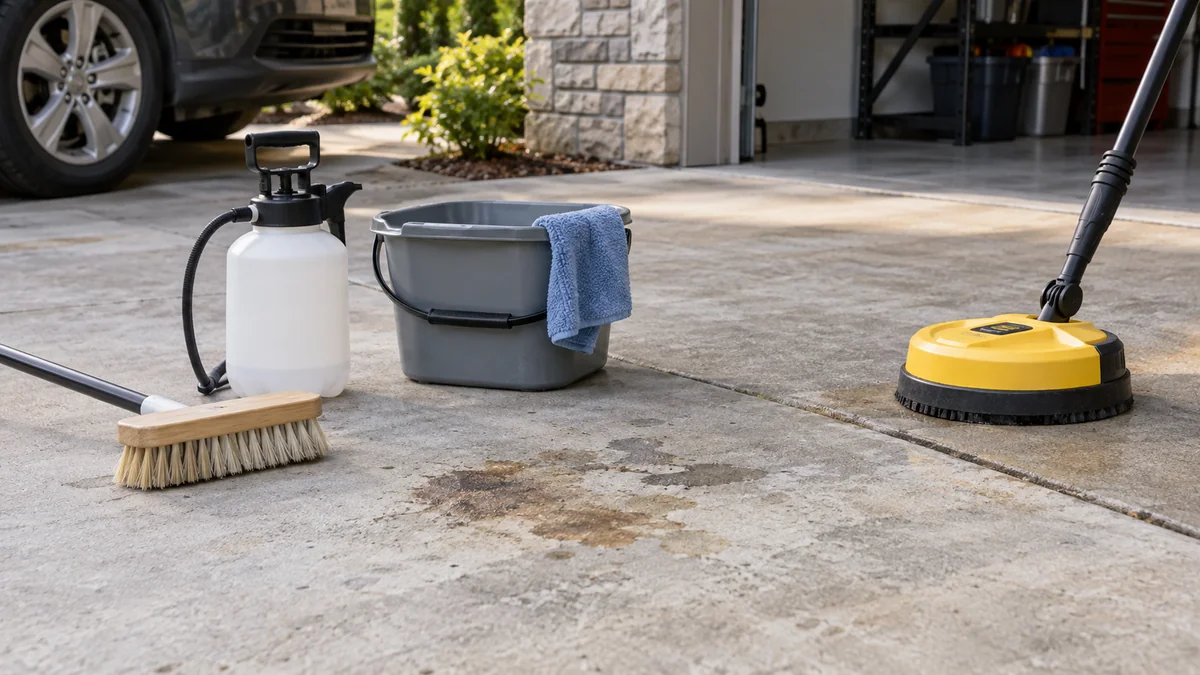
To remove battery acid stains from concrete, first neutralize any active lead-acid electrolyte with sodium bicarbonate, rinse without spreading the contamination, and let the slab dry. Treat remaining orange discoloration as iron staining or acid damage: use a concrete-safe iron remover on a test area, while etched or pitted concrete requires blending, patching, grinding, or professional restoration.
Key Facts at a Glance
- Lead-acid battery electrolyte is typically sulfuric acid diluted with water; a lithium-ion battery does not contain the same liquid electrolyte spill.
- Sodium bicarbonate neutralizes residual sulfuric acid, but neutralization does not rebuild concrete paste already dissolved by the spill.
- Orange or reddish-brown color can be iron staining, exposed aggregate, or both.
- Muriatic acid usually worsens a battery-acid mark because it removes additional cement paste from the surrounding slab.
- Bleach can lighten organic discoloration, but it does not reliably remove iron oxide or reverse acid etching.
- A typical DIY treatment costs $20-$120; professional cosmetic restoration commonly costs about $150-$500 or more.
What Is a Battery Acid Stain?
A battery acid stain on concrete is usually a combination of chemical etching and iron discoloration, not a conventional dirt mark. Sulfuric acid from a flooded lead-acid battery reacts with the alkaline cement paste, dissolves part of the surface, and can expose or discolor iron-bearing particles.
The visible result varies. A fresh spill may look wet, pale, or chalky before turning orange, while an older spill may leave a rust-colored halo, rough texture, white patch, or shallow depression. Battery acid from an automotive, golf-cart, marine, forklift, or lawn-tractor battery is generally associated with lead-acid chemistry.
Battery identification matters. A damaged lithium-ion pack, alkaline household battery, or nickel-metal hydride battery requires a different spill response and should not automatically be treated as sulfuric acid. Do not puncture, open, or handle a swollen lithium-ion battery; isolate it and contact local hazardous-waste or fire-safety authorities.
Why Does Battery Acid Turn Concrete Orange?
Battery acid can turn concrete orange because the acid removes cement paste and exposes iron-bearing minerals that oxidize into reddish-brown compounds. The color may also come from rust already present in the battery tray, vehicle frame, metal tools, or concrete aggregate.
The acid does not manufacture rust from nothing. It creates conditions that expose, dissolve, or mobilize minerals and metal contamination. That distinction affects the remedy: an iron stain may respond to a chelating cleaner, but a lost cream layer cannot be chemically restored.
Is Battery Acid Still Dangerous After It Dries?
Dried battery acid residue can remain corrosive until it has been neutralized and rinsed away. A dry-looking spot should therefore be treated as potentially contaminated, particularly around vehicle batteries, golf-cart charging areas, workshops, and enclosed garages.
Wear chemical-resistant gloves, splash goggles, long sleeves, and closed shoes. Keep children and pets away. Prevent wash water from entering storm drains, ponds, and waterways, and follow the product Safety Data Sheet and local disposal rules. The U.S. Environmental Protection Agency states, “The label is the law,” so a commercial cleaner must be used according to its label rather than an improvised dilution.
Do not mix acid residue with ammonia, bleach, toilet cleaner, or another acid. Ammonia can create hazardous conditions when mixed with acidic or oxidizing chemicals, and bleach can release toxic chlorine-containing gases when combined with acids.
Before You Start
| Requirement | Typical amount or value | Why it matters |
|---|---|---|
| Initial cleanup time | 30-90 minutes | Covers neutralization, scrubbing, and rinsing |
| Drying time before stain treatment | 10-24 hours | Reveals the true color and prevents diluted cleaner |
| DIY material cost | $20-$120 | Depends on cleaner, PPE, and repair supplies |
| Protective gloves | 1 chemical-resistant pair | Prevents skin contact during wet cleanup |
| Sodium bicarbonate | 1-5 pounds | Quantity depends on spill size and acid strength |
| Nylon deck brush | 1 brush, 12-18 inches | Agitates without shedding rustable metal |
| Absorbent material | 1-2 bags or several pads | Controls a spill before broad rinsing |
| Garden hose | Low-pressure flow | Rinses neutralized residue without unnecessary spread |
| pH strips | Range approximately 1-14 | Helps confirm that runoff is no longer strongly acidic |
Work outdoors when possible. Cover nearby metal, painted surfaces, and vulnerable masonry with plastic only if the covering will not trap liquid against the concrete.
Step 1: Identify the Battery and Stop the Spill
Move the leaking battery away from the concrete only if it can be handled without skin contact, sparks, tipping, or opening the casing. For a vehicle battery, switch off the vehicle and isolate the area; for a damaged lithium-ion pack, do not use the sulfuric-acid procedure.
Use absorbent pads, clay absorbent, or dry sand to stop a fresh liquid spill from spreading. Do not wipe acid with cloth barehanded, and do not begin with a pressure washer. High-pressure water can enlarge the contaminated area and propel droplets onto skin, vehicles, plants, and nearby drains.
You will know the containment step worked when the wet edge stops advancing and the absorbent material has captured the liquid. The common mistake is treating every battery leak as identical; battery chemistry determines the hazard and cleanup method.
Step 2: Apply Sodium Bicarbonate to Neutralize Acid
Spread dry baking soda or sodium bicarbonate over the wet residue until the surface is covered, then add small amounts of water only if needed to form a controllable paste. A practical starting quantity is about 1 pound of baking soda per square foot for a visibly wet, concentrated spill, with additional material added until fizzing subsides.
The fizzing reaction indicates acid is reacting with bicarbonate. It does not prove that every pore is neutral. Apply more bicarbonate to any area that continues to fizz, allow the reaction to slow, and work the paste with a stiff nylon brush.
Never pour ammonia onto a suspected acid spill. The safer sequence is one neutralizer, controlled agitation, collection of the slurry, and thorough rinsing. Do not mix neutralizers or add bleach.
You will know this step is near completion when fresh bicarbonate no longer produces sustained bubbling across the affected area. The common mistake is rinsing while vigorous fizzing continues, which can carry active acid farther across the slab.
Step 3: Collect the Neutralized Slurry and Rinse
Scoop or absorb the reacted paste rather than pushing it across an entire driveway. Place contaminated solids in a compatible container and consult local household-hazardous-waste guidance before disposal; neutralization does not automatically make every contaminated material suitable for a drain or trash bin.
Rinse with a garden hose at low pressure after the strongest reaction has stopped. Direct the water away from storm drains, landscaping, ponds, and unprotected metal. Repeat the rinse several times while checking runoff with pH strips when available.
A runoff reading near neutral is a useful screening result, but pH paper cannot identify every contaminant. You will know the rinse is adequate when no visible slurry remains and the runoff is not strongly acidic. The common mistake is using a narrow pressure-washer jet before collecting the residue.
When Can You Use a Pressure Washer?
A pressure washer can remove loose neutralized residue, but it cannot repair acid-etched concrete or reliably remove deep iron staining. Use a wide fan tip, moderate pressure, and a distance that does not cut the surface; avoid turbo nozzles and concentrated jets.
Pressure washing should follow neutralization, collection, and initial rinsing. For ordinary residential concrete, a typical starting range is 1,500-2,500 psi with a 25-40 degree nozzle, but the correct setting depends on slab strength, finish, age, and equipment. Test an inconspicuous area first.
Step 4: Let the Concrete Dry and Assess the Damage
Allow the concrete to dry for 10-24 hours before choosing a stain treatment. Wet concrete hides pale etching, darkens the surrounding slab, and makes a rust remover appear more effective than it is.
Assess four separate conditions:
- Residual surface residue: A removable film or powder remains.
- Iron discoloration: Orange or brown color remains, but the surface texture is intact.
- Etching: The affected area is lighter, rougher, or more porous than surrounding concrete.
- Pitting: The spill has created divots, grooves, or measurable material loss.
Run a clean plastic scraper across the area without gouging it. Compare the texture and sheen under dry light. If the orange color follows a rough depression, cleaning alone will not restore the original appearance.
Which Cleaner Is Best for Orange Battery Discoloration?
A concrete-labeled iron remover or chelating rust treatment is generally the best first option for orange discoloration on sound, unsealed exterior concrete. Oxalic-acid products can help with mild surface rust, while muriatic acid and household bleach are poor first choices for most battery-acid marks.
| Option | Typical cost | Typical dwell | Best use | Main limitation |
|---|---|---|---|---|
| Concrete-safe chelator | $50-$100 per gallon | 10-15 minutes | Orange iron staining on sound concrete | Requires strict label compliance |
| Oxalic-acid cleaner | $15-$30 | 5-20 minutes | Mild-to-moderate rust discoloration | May need repeated applications |
| Muriatic acid | $10-$20 per gallon | 1-5 minutes | Controlled professional etching only | Removes cement paste and creates pale patches |
| Household bleach | $5-$10 per gallon | 10-15 minutes | Organic films and some dark residue | Does not repair iron staining or etching |
| Alkaline degreaser | $15-$40 | 5-15 minutes | Oil mixed with battery residue | Does not dissolve iron oxide reliably |
How Should You Use a Chelating Rust Remover?
Apply a concrete-safe chelating or iron-removal product to a dry test patch, follow the label dilution, keep the surface wet for the stated dwell time, agitate with synthetic bristles, and rinse thoroughly. A typical restoration cleaner may react within minutes, but reaction speed depends on concentration, temperature, porosity, and iron loading.
Treat a defined section or the entire visually connected panel rather than creating a small bright spot surrounded by weathered concrete. Many products produce foam or color change as they react with iron, but foam is not a universal measure of cleaning success.
Use a 1-square-foot test area first. Record the dilution, dwell time, and appearance after drying. If the test patch lightens without roughening the surface, repeat the same process across the affected section. Do not let the cleaner dry unless its label specifically permits it.
The common mistake is extending dwell time because the first application did not remove a chemically etched color. Extra dwell can damage sound cement paste without restoring material already lost.
Is Oxalic Acid Safe for Concrete?
Oxalic acid can remove some iron discoloration from concrete, but it is still an acid and requires gloves, goggles, ventilation, controlled dilution, and a test patch. Use a product labeled for concrete and follow its instructions rather than mixing an unmeasured powder solution.
Oxalic acid is more appropriate for light-to-moderate rust staining than for deep battery burns with texture loss. It may need two or more applications separated by complete rinsing and drying. Do not combine it with bleach, ammonia, muriatic acid, or another cleaner.
Bar Keepers Friend and similar products may contain oxalic acid, but a household formulation is not automatically suitable for large outdoor slabs, sealed concrete, or polished floors. Check the ingredients, surface directions, and disposal instructions.
Why Is Muriatic Acid Usually a Bad First Choice?
Muriatic acid, or hydrochloric acid, can remove a battery mark by dissolving the surrounding cement paste, but that mechanism often enlarges the cosmetic damage. The treated area may become lighter, rougher, more porous, or visibly different from the rest of the driveway.
Professionals sometimes use controlled acid washing to create uniform texture across an entire slab, not to erase one isolated spot. That approach requires protection of metals, plants, masonry, and drainage systems, followed by neutralization and extensive rinsing.
Muriatic acid is therefore not a precision stain remover. It is a surface-etching chemical. Use it only when a trained concrete professional has selected it for a broader resurfacing or uniform-etching plan.
Can Bleach, Vinegar, or Hydrogen Peroxide Remove the Mark?
Household bleach, vinegar, and hydrogen peroxide are unreliable solutions for a battery-acid mark. Bleach can lighten organic discoloration, vinegar can react with alkaline residue, and peroxide may oxidize some surface contaminants, but none reliably replaces dissolved cement paste or removes every iron compound.
| Household product | Likely effect | Suitable use | Risk or limitation |
|---|---|---|---|
| Chlorine bleach | Lightens organic residue | Mold, algae, dark biological film | Can damage plants and does not fix rust |
| White vinegar | Mild acid reaction | Small alkaline deposits after safe testing | Can worsen etching and is weak on deep iron burns |
| Hydrogen peroxide | Oxidizes some organic material | Small biological stains | Limited evidence for battery-acid damage |
| Dish detergent | Lifts oily film | Battery residue mixed with oil | Does not neutralize acid or remove rust |
| Cola or carbonated drinks | Minimal cleaning effect | None recommended | Sticky residue and no reliable restoration |
Never mix bleach with acids or ammonia. Rinse one product completely before considering another, and do not stack chemicals in an attempt to accelerate the reaction.
What If the Concrete Is Etched or Pitted?
Etched concrete cannot be restored to its original surface by stain remover alone. A pale, rough, or depressed patch indicates loss of cement paste, so the repair must either blend the surrounding surface or add compatible repair material.
| Damage condition | Recommended response | Typical time | Typical cost |
|---|---|---|---|
| Color only, sound texture | Chelating cleaner and controlled rinse | 1-2 days | $20-$120 DIY |
| Light etching | Test cleaner, then color-matched sealer | 2-4 days | $75-$300 DIY |
| Deep roughness | Diamond grinding or resurfacing | 1-3 days | $300-$1,500 professional |
| Small divot under 1/4 inch | Vinyl concrete patch | 1-2 days | $20-$60 DIY |
| Broad structural loss | Slab repair or replacement assessment | Several days | $500-$5,000+ typical |
For a small divot, remove loose material, clean the cavity, apply a compatible concrete-repair product, and cure it according to the manufacturer’s directions. Dry cement brushed into a hole is not a durable repair because it lacks proper bonding, water control, and curing.
A color-matched acrylic or penetrating sealer can reduce contrast, but sealing does not rebuild a weakened surface. On decorative or exposed-aggregate concrete, resurfacing the entire panel may produce a better visual result than spot patching.
Surface-Specific Recommendations
Standard Brushed Driveway
A brushed driveway is the most forgiving surface for DIY treatment. Neutralize first, use a synthetic brush, test an iron remover, and accept that weathering differences may remain after the orange color fades.
Garage Floor With Sealer
A sealed garage floor may resist penetration, leaving residue on top rather than deep within the slab. Confirm cleaner compatibility with the sealer, avoid aggressive acids, and test whether the product dulls the gloss or softens the coating.
Polished Concrete
Do not use muriatic acid, oxalic acid, bleach, or an untested rust remover on polished concrete. Acid can permanently dull the polish and alter the exposed aggregate profile; a polished-concrete restoration contractor may need to diamond-grind, re-densify, and re-polish the area.
Decorative or Colored Concrete
Acid treatment can change pigment, sealer appearance, and aggregate contrast. A contractor should test the exact cleaner on a hidden location, because a chemically clean patch may be more visible than the original stain.
Common Mistakes and How to Fix Them
Cleaning Before Neutralizing
Failure: The spill spreads and the orange halo grows.
Fix: Stop active liquid, apply sodium bicarbonate, collect the reaction, then rinse at low pressure.
Using Ammonia on Acid
Failure: The operator creates an unsafe chemical mixture.
Fix: Do not use ammonia. Use one approved neutralizer, rinse thoroughly, and follow the product SDS.
Using a Wire Brush
Failure: Steel fragments remain in pores and later rust into new spots.
Fix: Use nylon, polypropylene, or another nonmetallic brush.
Treating Only the Brightest Orange Center
Failure: A pale, clean-looking circle contrasts sharply with the surrounding slab.
Fix: Test and treat the complete affected panel or use a compatible sealer to blend the appearance.
Leaving Cleaner to Dry
Failure: Concentrated chemistry creates a second etched outline.
Fix: Keep the surface within the labeled wet dwell period and rinse before drying.
Expecting Cleaning to Repair Missing Concrete
Failure: Repeated chemicals roughen the slab without removing the depression.
Fix: Stop chemical treatment and evaluate patching, grinding, resurfacing, or replacement.
How Long Does the Process Take?
A fresh, small spill can usually be contained and neutralized in 30-90 minutes, but the slab should dry for 10-24 hours before stain treatment. An orange surface stain may need one or two treatment cycles, each typically taking 30-60 minutes including dwell and rinsing.
A typical schedule is:
- Day 1: Contain, neutralize, collect, rinse, and protect drainage.
- Day 2: Inspect the dry surface and perform a 1-square-foot cleaner test.
- Day 2 or 3: Treat the affected panel, rinse, and allow it to dry.
- After 24 hours: Decide whether color blending, sealing, patching, or professional work is necessary.
Weather changes the schedule. Cold temperatures, shade, high humidity, and low slab porosity extend drying time. Do not apply a sealer while the concrete remains visibly damp or while the product manufacturer’s moisture limit has not been met.
How Much Does Battery-Acid Stain Removal Cost?
DIY cleanup typically costs $20-$120, including bicarbonate, gloves, goggles, a synthetic brush, pH strips, and a concrete-safe stain remover. A simple fresh spill costs less than an old stain requiring specialized chelator, sealer, patching compound, and replacement PPE.
Professional cleaning or restoration commonly costs $150-$500 for a localized outdoor area, while polished-concrete restoration, broad resurfacing, or slab repair can exceed $1,000. Square footage, access, chemical severity, surface finish, and the need to protect landscaping determine the final estimate.
Ask a contractor whether the quote includes neutralization, runoff control, stain treatment, sealing, patching, and disposal. A low quote that includes only pressure washing may leave the chemical damage untreated.
Troubleshooting Persistent Problems
The Orange Color Returns After Drying
Recurring color usually indicates iron residue, moisture movement, or exposed iron-bearing aggregate rather than active acid alone. Repeat the process only after confirming the surface is neutral and dry; if the color reappears after rain, professional testing may be needed.
The Area Turns White
A white patch often indicates acid etching, mineral residue, or efflorescence. Rinse and dry the surface, then compare texture. If the patch is rougher or more porous, stop using acids and consider blending or resurfacing.
The Cleaner Does Nothing
The stain may be embedded beneath a sealer, chemically altered concrete, or exposed aggregate rather than removable iron residue. Do not increase concentration blindly. Examine a cross-section of the damage, test the sealer compatibility, or obtain a restoration assessment.
The Concrete Feels Soft
Soft, friable concrete indicates substantial paste loss or an already weak slab. Chemical cleaning cannot restore compressive strength. Keep vehicles and heavy loads away until a concrete professional evaluates the affected area.
FAQ
Can baking soda completely remove a battery acid stain?
Baking soda can neutralize residual sulfuric acid and reduce ongoing chemical damage, but it cannot reliably remove an established orange stain or rebuild dissolved concrete. After neutralization, dry the slab and test a concrete-safe iron remover only if the surface remains structurally sound.
Can I use a battery terminal cleaner on concrete?
Battery terminal cleaner is not automatically suitable for concrete. Some products contain acids or solvents intended for metal, and they may worsen etching, discolor sealers, or create hazardous runoff. Use a product specifically labeled for concrete, rust, or iron staining instead.
Should I seal concrete after removing the stain?
Seal concrete only after neutralization, rinsing, complete drying, and stain treatment. A sealer can reduce moisture entry and color contrast, but it cannot conceal major pits reliably. Test the sealer on a hidden area because sheen and color can change.
Will rain remove battery acid from a driveway?
Rain may dilute surface residue, but it does not reliably neutralize acid trapped in pores or remove iron discoloration. Rain can also spread contaminated runoff into soil and drains. Neutralize and control the cleanup rather than waiting for weather to wash the area away.
Can I remove the stain without damaging surrounding concrete?
The risk is lowest when the slab is neutralized first and a concrete-safe chelating cleaner is tested on a small area. No chemical can guarantee an invisible repair when acid has dissolved the cement paste, so uniform treatment or cosmetic blending may be necessary.
When should I hire a professional?
Hire a professional when the spill covers a large area, reaches a storm drain, affects polished or decorative concrete, creates pits, returns after drying, or involves an unknown battery chemistry. Professional restoration is also appropriate when preserving a uniform finish matters more than minimizing the initial cost.
The Bottom Line
To remove battery acid stains from concrete, neutralize the spill with sodium bicarbonate, collect the residue, rinse carefully, and wait for the slab to dry. Use a concrete-labeled chelating or iron-stain product for remaining orange discoloration, but do not expect cleaning chemicals to replace concrete paste lost through etching. Avoid muriatic acid, bleach mixtures, ammonia, wire brushes, and early pressure washing. For polished, decorative, pitted, or repeatedly discolored surfaces, professional restoration is the safer path.