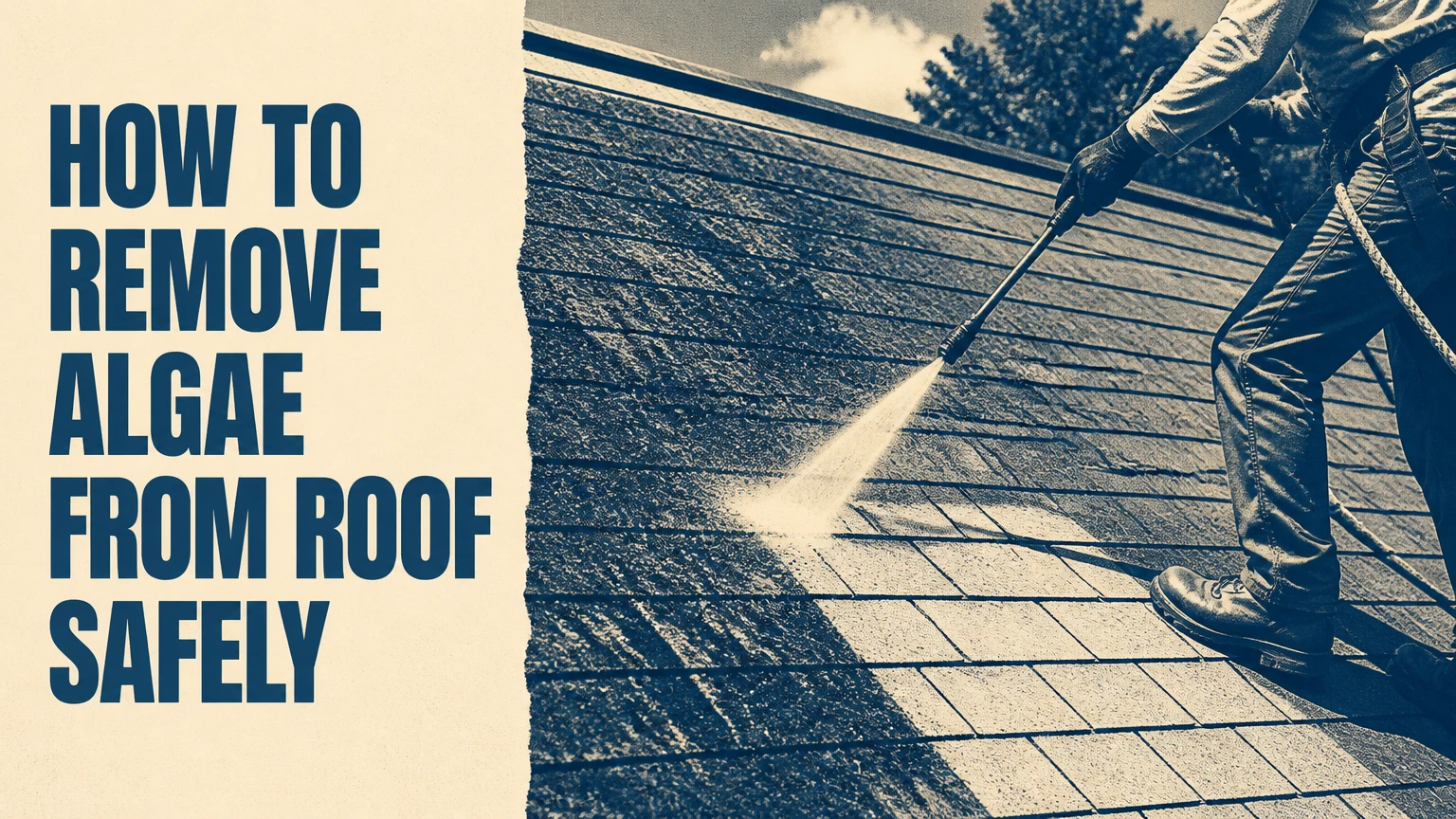
To remove algae from a roof, identify the growth, protect people and landscaping, apply a manufacturer-approved roof cleaner at low pressure, allow the specified dwell time, and rinse gently or let rainfall remove the residue. Asphalt shingles usually need chemical treatment rather than scrubbing, because pressure washing and abrasive brushes can remove protective granules.
Key Facts at a Glance
- Black streaks on asphalt shingles are commonly caused by the cyanobacterium Gloeocapsa magma, although moss, lichen, dirt, and roof-shadowing can look similar.
- A low-pressure chemical treatment is safer for asphalt shingles than pressure washing, scraping, or stiff-bristle brushing.
- Roof-cleaning chemicals require label-specific dilution, ventilation, runoff control, and plant protection; never mix bleach with ammonia, acids, or other cleaners.
- Dead algae may remain visibly brown or gray for several weeks after treatment, especially when the roof has textured granules.
- Copper or zinc strips can reduce new growth below the roof edge, but they do not clean existing stains and are not permanent prevention.
- A typical professional roof-cleaning service costs about $300-$1,200 for an accessible residential roof in the United States.
What Is Growing on the Roof?
Black streaks on asphalt shingles usually indicate algae-like cyanobacterial growth, while green mats, raised tufts, or branching patches more often indicate moss or lichen. Gloeocapsa magma is widely associated with dark roof streaks because the organism forms pigmented colonies that collect on shaded, damp shingle surfaces.
Algae generally creates discoloration without immediately lifting shingles. Moss is more damaging because its rhizoids can push beneath shingle edges and retain water. Lichen attaches more firmly and can leave pale circular marks or crusts after the living growth dies.
How can you distinguish algae from moss and lichen?
| Roof symptom | Likely growth | Physical clue | Recommended response |
|---|---|---|---|
| Black or blue-gray streaks | Cyanobacteria or algae-like staining | Flat discoloration, no thick texture | Label-approved chemical treatment |
| Green fuzzy patches | Moss | Raised, soft, water-retaining growth | Chemical treatment, then gentle removal |
| White, yellow, or gray crusts | Lichen | Firm disks or branching crust | Professional treatment may be safer |
| Brown leaf-shaped marks | Organic debris | Pattern follows trapped leaves | Remove debris and inspect shingles |
| Rust-orange streaks | Metal runoff | Begins below flashing or fasteners | Inspect metal, gutters, and flashing |
| Broad dark areas | Persistent dampness or dirt | Follows shade or drainage path | Correct moisture source before cleaning |
A roof inspection matters before selecting a cleaner. Stains below a chimney, valley, satellite mount, or rusting fastener may be water-related rather than biological. Cleaning the surface will not repair a leak.
How Does Roof-Algae Treatment Work?
Roof-algae treatment uses either an active chemical or weather-activated cleaner to damage the organism, loosen its attachment, and allow water or rainfall to remove the residue. The treatment does not usually erase every stain immediately, because pigment and dead cellular material can remain inside the rough shingle surface.
Chlorine-based products act quickly but can harm plants, corrode some metals, and discolor exterior materials if misapplied. Hydrogen-peroxide or proprietary oxygen-based products generally work more slowly and may reduce some runoff risks, but “non-bleach” does not mean automatically harmless.
Copper and zinc work differently. Rainwater carries small amounts of metal ions down the roof, where they inhibit new biological growth. Metal strips cannot remove established algae, and their effectiveness decreases where roof geometry prevents rainwater from reaching lower courses.
The Asphalt Roofing Manufacturers Association warns homeowners to “never use a power washer on an asphalt shingle roof,” because concentrated water can dislodge granules and damage the shingle surface.
What Should You Do Before Cleaning?
Before cleaning, confirm the roof material, inspect its condition from the ground, check the weather, and prepare a safe method for working from a ladder or from the ground. A typical small asphalt-shingle treatment takes 2-4 hours of preparation and application, but the visual cleanup can continue for days or weeks.
Before-you-start checklist
| Requirement | Typical value | Why it matters |
|---|---|---|
| Weather window | 24 hours without heavy rain | Prevents immediate dilution and runoff |
| Air temperature | 45-85°F, or product-label range | Supports predictable chemical action |
| Wind | Below 10 mph | Reduces overspray and plant exposure |
| Treatment time | 30-90 minutes | Includes setup, application, and rinsing |
| DIY material cost | $40-$150 | Depends on cleaner, PPE, and protection |
| Roof access | Ground or secured ladder preferred | Reduces fall exposure |
| Water supply | 50-100 feet of hose | Reaches landscaping and roof edges |
| PPE | Goggles, chemical gloves, non-slip footwear | Limits splash and contact injury |
Do not work on wet, icy, steep, brittle, or visibly damaged roofing. A roof with loose shingles, exposed underlayment, severe granule loss, or active leaks should receive a roofer’s inspection first.
Protect shrubs, flowers, grass, painted siding, outdoor furniture, pets, and fish ponds. Water plants thoroughly before treatment, move movable items, use compatible coverings without trapping heat, and plan where runoff will go. Never allow concentrated cleaner to enter a storm drain.
How to Remove Algae From Roof, Step by Step
The safest general method for asphalt shingles is a labeled roof-cleaning solution applied at low pressure, followed by the label-required rinse or natural weathering. Six steps determine the result: inspect, prepare, protect, apply, dwell, and rinse or monitor.
Step 1: Confirm the roof material and condition
Read the shingle, tile, metal, or membrane manufacturer’s maintenance instructions before choosing a chemical. Asphalt shingles, painted metal, concrete tile, clay tile, cedar, and single-ply membranes have different tolerances for cleaners and water pressure.
Take photographs of existing damage. Check gutters, downspouts, flashing, ridge caps, solar equipment, skylights, and sealant joints. Do not step on brittle shingles merely to reach a stain.
Success checkpoint: The roof type, cleaner compatibility, access method, and runoff route are known before chemicals are opened.
Common mistake: Treating every dark roof mark as algae. Rust, soot, dirt, and failed flashing need different remedies.
Step 2: Remove loose debris without scraping
Use a leaf blower from a stable location or a soft broom from a ladder position, moving from the ridge toward the eaves. Do not drag tools across granules, lift shingle tabs, or pull moss that has grown beneath overlapping courses.
Clean gutters before treatment if they contain decomposed leaves. Keep downspouts directed away from foundations and collect or dilute runoff according to local rules and the product label.
Success checkpoint: Leaves, twigs, and loose organic material are removed while shingle granules remain intact.
Common mistake: Scrubbing black streaks with a wire brush. Abrasion removes granules and may shorten the roof’s service life.
Step 3: Wet and protect surrounding surfaces
Pre-wet plants, siding, gutters, and nearby hardscape with clean water. Cover sensitive plants temporarily, but remove coverings promptly if sunlight or heat could damage them.
Close windows and doors near the work area. Keep children and pets away until the roof, ground, gutters, and equipment are thoroughly rinsed.
Success checkpoint: All exposed landscaping has been watered, chemical contact points are identified, and no person or pet can enter the runoff area.
Common mistake: Protecting plants only after spraying. Dry vegetation can receive a concentrated first dose from overspray or runoff.
Step 4: Mix and apply the approved cleaner
Use a commercial roof cleaner or a solution specifically permitted by the roofing manufacturer. Follow the product label exactly, including dilution, application method, dwell time, and whether rinsing is required.
A pump sprayer with a fan tip can apply solution at low pressure from a ladder or ground position. Saturate stained areas evenly without forcing liquid beneath shingle edges, into attic vents, behind flashing, or into electrical equipment.
Do not assume a 50:50 household-bleach mixture is suitable for every roof. Bleach concentration varies by product, TSP is not universally required, and adding TSP can increase environmental and runoff concerns. Never mix sodium hypochlorite with ammonia, acids, vinegar, or other cleaners, because dangerous gases can form.
Success checkpoint: The surface is evenly wet, adjacent materials remain protected, and the chemical has not entered gutters in an uncontrolled stream.
Common mistake: Increasing chemical strength to speed up results. Stronger mixtures increase plant, metal, sealant, and worker risks without guaranteeing better stain removal.
Step 5: Maintain the labeled dwell time
Keep the treatment wet for the time stated on the label, commonly 10-30 minutes for fast-acting products. Do not let a chemical dry into a concentrated film on shingles, siding, windows, or plants.
Observe the reaction from a safe position. Algae may fade, change from black to brown, or lose its green color before visible residue disappears. Do not scrub to force an immediate cosmetic result.
Success checkpoint: The biological growth has changed color or loosened, and the surface has remained within the specified dwell period.
Common mistake: Cleaning in hot, direct sun. Rapid evaporation creates uneven treatment and can leave concentrated residue.
Step 6: Rinse gently or follow a no-rinse label
Rinse from the ridge toward the eaves with a garden hose and a broad spray pattern when the product requires rinsing. Use only enough flow to remove residue; do not direct a concentrated jet under shingle laps or upward against flashing.
Some weather-activated products are designed to remain on the roof and disappear through repeated rainfall. Rinsing such products prematurely can reduce performance. The label controls.
Rinse plants, siding, gutters, and hardscape again. Check the ground for chemical pooling and flush affected surfaces with clean water.
Success checkpoint: No visible cleaner remains on adjacent surfaces, runoff is diluted and controlled, and the roof has no loosened shingle tabs or exposed underlayment.
Common mistake: Using a pressure washer because a garden hose appears slow. Pressure can remove granules even when the roof looks cleaner.
Which Roof-Algae Removal Method Should You Choose?
For asphalt shingles, a labeled low-pressure chemical treatment is usually the most balanced option. Chlorine-based cleaners provide faster visual change, peroxide-based products may suit owners prioritizing lower odor and plant sensitivity, and professional soft washing reduces access risk.
| Method | Visible result | Typical DIY cost | Main risk | Best use |
|---|---|---|---|---|
| Labeled chlorine cleaner | 10-30 minutes to begin fading | $25-$80 | Plant injury and metal corrosion | Heavy black streaks on compatible asphalt |
| Peroxide or oxygen cleaner | 1-14 days | $40-$120 | Slower or incomplete removal | Light-to-moderate staining near sensitive landscaping |
| Weather-activated treatment | 2-12 weeks | $30-$100 | Slow cosmetic improvement | Low-access roofs with suitable weather |
| Zinc or copper strip | No existing-stain removal | $50-$300 in materials | Runoff discoloration or corrosion | Long-term inhibition below ridges |
| Professional soft wash | Same day to several weeks | $300-$1,200 | Contractor quality and chemical runoff | Steep, high, fragile, or complex roofs |
Is bleach safe for asphalt shingles?
Bleach can be compatible with some asphalt-shingle cleaning procedures when the roofing manufacturer and product label permit it, but household bleach is not automatically safe at every concentration. Bleach can damage landscaping, corrode aluminum, fade painted surfaces, and harm aquatic life when runoff is uncontrolled.
Use a roof-specific product whenever possible. Confirm the active ingredient and dilution, protect all runoff paths, and stop if granules, sealants, flashing, or adjacent finishes show damage. TSP should not be added unless the selected procedure specifically requires it.
Can you use vinegar, baking soda, or dish soap?
Vinegar and baking soda are poor general choices for established roof algae because their effectiveness is inconsistent and their use can create unnecessary runoff or surface interactions. Dish soap may improve wetting but does not reliably kill colonies and can increase the amount of surfactant entering soil and drains.
Household remedies also create a compatibility problem. A roof cleaner selected for a particular shingle or tile material gives more predictable results than an improvised kitchen mixture.
How Do Different Roof Materials Change the Method?
Roof material determines the allowable chemical, water pressure, brushing method, and acceptable dwell time. Asphalt shingles require the most caution because their mineral granules protect the underlying asphalt and fiberglass mat.
| Roof material | Suitable approach | Avoid | Inspection priority |
|---|---|---|---|
| Asphalt shingle | Label-approved low-pressure cleaner | Pressure washing and wire brushing | Granule loss and lifted tabs |
| Painted metal | Mild compatible cleaner and low-pressure rinse | Abrasive pads and incompatible bleach | Coating failure and rust |
| Clay tile | Tile-approved cleaner and controlled rinse | Walking on unsupported tile | Cracks, slipped tiles, and mortar |
| Concrete tile | Low-pressure compatible treatment | High-pressure edge cleaning | Porosity, cracks, and broken corners |
| Cedar shake | Manufacturer-approved treatment | Strong oxidizers and aggressive scraping | Splits, decay, and trapped moisture |
| EPDM or TPO membrane | Membrane-approved cleaner | Solvents and unapproved oxidizers | Seams, punctures, and flashing |
How do you clean a metal roof?
Clean a metal roof with a manufacturer-approved mild cleaner, a soft brush only where permitted, and low-pressure water directed down the panel profile. Painted metal can lose its finish through abrasive cleaning, while bare steel or aluminum can corrode when exposed to incompatible chemicals.
Test a small hidden area first. Do not allow cleaner to dry on panels, fasteners, skylight seals, or gutters. Rust streaks require source correction, not repeated algae treatment.
When should you avoid DIY cleaning?
Avoid DIY roof cleaning when the roof is steep, higher than one story, wet, fragile, older than about 20 years, or surrounded by delicate landscaping and complicated drainage. Solar panels, skylights, dormers, brittle tiles, and overhead electrical lines increase the consequences of a mistake.
A professional should provide proof of insurance, explain the chemical and dilution, describe runoff controls, and state whether the service includes a roof-condition inspection. “Soft wash” describes a method, not a guarantee of safe workmanship.
How Much Does Roof-Algae Removal Cost?
Typical DIY roof-algae treatment costs $40-$150, while professional cleaning commonly costs $300-$1,200 for an accessible United States residential roof. Steep pitches, multiple roof levels, tile, solar panels, difficult water access, extensive moss, and regional labor rates can raise the total substantially.
| Cost item | Typical range | Time requirement | Price driver |
|---|---|---|---|
| Roof-cleaner concentrate | $25-$100 | 30-90 minutes | Active ingredient and coverage |
| PPE and sprayer | $30-$120 | Reusable | Roof height and chemical type |
| Plant and runoff protection | $10-$75 | 30-60 minutes | Landscaping density |
| Zinc or copper material | $50-$300 | 1-4 hours | Ridge length and access |
| Professional asphalt cleaning | $300-$900 | 2-6 hours | Area, pitch, and condition |
| Professional tile or complex-roof cleaning | $600-$1,500 | 4-10 hours | Fragility and access |
A low quote that omits runoff management, roof inspection, or plant protection may not represent the final cost. Ask whether retreatment, gutter cleaning, and damage documentation are included.
Why Does Algae Return After Cleaning?
Algae returns when moisture, shade, airborne spores, and roof debris recreate favorable conditions; chemical cleaning removes the current colony but does not sterilize the neighborhood or permanently alter the roof surface. Overhanging branches, clogged gutters, poor ventilation, and north-facing slopes often explain recurrence within six months.
Troubleshoot these common outcomes
- Streaks turn brown or yellow: The growth may be dead, while pigment and residue remain. Follow the product’s wait period before considering a lighter retreatment.
- Stains remain unchanged: The material may be rust, soot, lichen, or embedded dirt. Recheck the diagnosis before increasing chemical strength.
- Growth returns quickly: Remove leaf accumulation, trim branches where appropriate, improve gutter drainage, and inspect shaded roof sections.
- Plants wilt after treatment: Rinse foliage and soil immediately with clean water, remove contaminated coverings, and contact local horticultural or poison-control services if exposure was significant.
- Granules appear in gutters: Stop cleaning and document the condition. Granules may indicate pre-existing aging or damage caused by excessive water or abrasion.
- Metal gutters discolor: Flush them with clean water and inspect for chemical corrosion. Repeated chlorine exposure can accelerate damage to some aluminum finishes.
How Can You Prevent Future Roof Algae?
Prevention works best when it reduces moisture and shade while adding a compatible metal-ion barrier where appropriate. Zinc or copper strips should be installed near the ridge so rainwater can carry ions down the roof, but strips cannot protect areas that rain does not reach.
Keep gutters flowing, remove leaf piles, and trim branches that continuously shade the roof without compromising tree health or roof safety. Algae-resistant asphalt shingles use copper-containing granules and can delay staining, but they are not immune to growth.
Metal strips have limits. They may last roughly 5-15 years depending on exposure and material, cannot reverse existing discoloration, and may contribute to metal runoff. Confirm local environmental requirements and avoid installing copper above ponds, edible gardens, or sensitive drainage areas without professional advice.
Common Roof-Cleaning Mistakes and Fixes
Pressure washing the shingles
Pressure washing can remove mineral granules, force water beneath laps, and damage flashing or sealants. If pressure damage has occurred, stop immediately, photograph the roof, clean gutters of loose granules, and arrange a roofer’s inspection.
Scraping or brushing aggressively
Scraping can tear shingle surfaces and detach moss-bearing tabs. Use chemical treatment first, then remove only loose residue with a permitted soft method from a stable position.
Mixing incompatible chemicals
Bleach combined with ammonia, acids, or vinegar can generate hazardous gases. Use one labeled product at a time, keep the original container available, and rinse equipment according to the label.
Ignoring roof drainage
A clean roof still leaks if valleys, flashing, gutters, or penetrations fail. Cleaning should include a visual drainage inspection, not merely cosmetic stain removal.
Working from an unsecured ladder
Roof chemicals make surfaces slippery, and a ladder can shift on wet ground. Use a properly secured ladder, maintain three points of contact, and choose ground-based application or a professional crew when roof access is unsafe.
Frequently Asked Questions
Does roof algae damage asphalt shingles?
Roof algae usually causes cosmetic staining before it causes structural damage, but persistent moisture, moss, and debris can accelerate shingle aging. Moss is more concerning than flat black algae because it lifts edges and retains water. Inspect for granule loss, curling, cracked seal strips, and damp underlayment rather than judging damage by color alone.
Will rain remove dead algae from the roof?
Rain can gradually remove dead algae and loosened residue, especially after a weather-activated treatment. Rain will not reliably remove thick moss, lichen, or embedded staining. A roof may look darker or brown immediately after treatment and improve over several rainfall cycles, depending on texture, slope, shade, and product instructions.
How often should a roof be cleaned?
Many roofs need treatment every 2-5 years, but the interval depends on shade, humidity, tree cover, roof orientation, and shingle type. Algae-resistant shingles and effective drainage can extend the interval, while a damp north-facing roof beneath trees may need attention sooner. Annual visual inspections are more useful than an automatic cleaning schedule.
Can roof algae spread to siding?
Roof algae can spread visually through runoff and may contribute to staining on siding, gutters, and masonry, although the organisms do not usually “infect” siding in the same way as a plant disease. Clean the roof drainage path and nearby surfaces together, or new streaks may appear below a recently treated roof.
Should I clean the roof before selling a house?
Cleaning can improve curb appeal when the roof is structurally sound and the stains are biological, but it should not conceal defects or substitute for a roof inspection. Document the roof’s condition before treatment, disclose known leaks or damage, and avoid aggressive cleaning that creates fresh granule loss before a sale.
The Bottom Line
The safest answer to how to remove algae from roof surfaces is to diagnose the growth, use a manufacturer-approved low-pressure treatment, protect landscaping and drainage, and avoid pressure washing or abrasive scrubbing. A DIY treatment suits a low, sound, accessible asphalt-shingle roof; steep, fragile, complex, or solar-equipped roofs warrant a qualified professional. Prevention requires moisture control and realistic expectations, because zinc or copper strips inhibit new growth but do not permanently clean existing stains.