Roof algae is removed by applying a manufacturer-approved low-pressure roof treatment, allowing the labeled dwell time, and rinsing gently without walking unnecessarily on the shingles. For most asphalt-shingle roofs, sodium-hypochlorite soft washing works fastest, while peroxide or “spray-and-leave” products reduce chemical and runoff concerns but usually take longer.
Key Facts at a Glance
- Black roof streaks are commonly caused by the cyanobacterium Gloeocapsa magma, not ordinary dirt.
- A pressure washer can dislodge asphalt-shingle granules and damage seals, mats, flashing, and underlayment.
- Roof algae treatment works best below approximately 80°F, in low wind, and without direct midday sun.
- Copper or zinc strips can inhibit new growth, but they do not remove established stains.
- A typical DIY treatment costs $30-$150 in materials; professional soft washing commonly costs $250-$1,000 or more.
- Moss and lichen require different handling because their physical growth can lift shingle edges and retain moisture.
What Roof Algae Is and Why It Appears
Roof algae is usually a surface colony of blue-green cyanobacteria that spreads as dark streaks on moisture-retaining roof areas. The organism commonly identified on asphalt shingles is Gloeocapsa magma, which can use mineral filler exposed at the shingle surface as a nutrient source.
Algae usually appears first on north-facing or shaded slopes, beneath trees, and where poor ventilation or debris keeps shingles damp. Black streaks do not automatically mean the roof is failing, but heavy biological growth can obscure damaged shingles and signal persistent moisture.
| Roof growth | Typical appearance | Main concern | Removal approach |
|---|---|---|---|
| Algae | Black, blue-black, or brown vertical streaks | Appearance and surface colonization | Chemical treatment and gentle rinsing |
| Moss | Green, raised, cushion-like clumps | Lifted edges and trapped moisture | Controlled treatment, then gentle removal |
| Lichen | Gray-green crust with branching growth | Root-like attachment and surface damage | Repeated treatment, no forceful scraping |
| Mold or mildew | Patchy green, gray, or black spots | Moisture source and indoor or exterior contamination | Identify moisture cause and use labeled cleaner |
| Dirt or soot | Uniform gray or brown film | Cosmetic staining | Low-pressure cleaning after testing |
Algae stains usually run downward because rain transports cells and nutrients along shingle courses. A roof with similar streaks may instead have tree sap, rust from fasteners, chimney soot, or deteriorated shingle surfaces, so test a small area before treating the entire slope.
How Does Algae Treatment Work?
Algae treatment works through chemical contact, not force. An algaecide damages or deactivates the colony, after which rain and gentle rinsing remove the loosened residue; metal ions from copper or zinc can then suppress new growth on downstream shingle areas.
Sodium hypochlorite solutions provide rapid visual change, but concentration, dwell time, temperature, roof condition, and runoff control determine the result. Hydrogen-peroxide products generally act more slowly and may be preferable near sensitive landscaping, metal components, pets, or storm drains.
The Asphalt Roofing Manufacturers Association, or ARMA, advises against power washing asphalt shingles and recommends following the shingle manufacturer’s cleaning instructions. That guidance matters because a cleaning method can improve appearance while reducing the roof’s remaining service life.
Which Cleaner Should You Use?
The best cleaner depends on roof material, stain type, plant proximity, roof age, and the product label. Use a roof-specific product with a complete label rather than copying an online bleach recipe, because household bleach strength varies and improvised additives can increase corrosion and runoff risk.
Never mix bleach with ammonia, acids, vinegar, toilet cleaner, or other household chemicals. Toxic gases can result. Use only the dilution, application method, contact time, and disposal directions printed on the selected product.
| Treatment | Typical visible result | Typical dwell or wait | Typical DIY material cost | Main limitation |
|---|---|---|---|---|
| Sodium-hypochlorite roof cleaner | Same day to several days | 10-20 minutes | $30-$100 | Plant, metal, and runoff sensitivity |
| Hydrogen-peroxide cleaner | Several days to 2 weeks | Label-dependent | $40-$150 | Higher price and slower appearance change |
| Surfactant “spray-and-leave” product | Gradual fading | 1-12 weeks | $35-$120 | Requires rain and patience |
| Zinc or copper strip | Preventive only | Months of rainfall | $50-$300 | Does not clean existing algae |
| Professional soft wash | Same day to several days | 10-30 minutes onsite | $250-$1,000+ | Labor cost and contractor quality |
Before You Start
A small, accessible asphalt-shingle roof typically requires 2-5 hours of preparation, treatment, rinsing, and cleanup, although the roof may continue lightening for days afterward. Difficulty is moderate on the ground and high on the roof; the safest plan is to work from a ladder, lift, or ground-based extension system rather than walk on wet shingles.
Before-you-start checklist
- Time: 2-5 hours onsite, plus 1-14 days for full visual improvement.
- Cost: $30-$150 for a typical DIY treatment, excluding access equipment.
- People: One person on the ground for hose control and one trained worker only when roof access is unavoidable.
- Tools: Garden hose, low-pressure pump sprayer, soft-bristle brush for gutters only, ladder stabilizer, buckets, plastic sheeting, warning signs, and a runoff collection or diversion plan.
- PPE: Chemical-resistant gloves, eye protection, long sleeves, long trousers, slip-resistant footwear, and product-specific respiratory protection when the label requires it.
- Prerequisites: Confirm roof material, inspect the roof from the ground, read the warranty and cleaner label, check the weather, and move pets and children away.
Do not clean a roof with brittle shingles, exposed underlayment, active leaks, loose flashing, missing tabs, severe granule loss, or visible structural sagging. A cleaner cannot repair those defects. Photograph existing damage before treatment so later granule loss or discoloration is not confused with cleaning damage.
How to Remove Algae From a Roof
Use the following sequence for a typical asphalt-shingle roof. The most important success factor is controlled chemical contact with adequate wet dwell time, not stronger spray pressure.
Step 1: Inspect the Roof and Choose Safe Access
Inspect the roof from the ground and from the attic before applying water or chemicals. Look for loose shingles, exposed nails, cracked seal strips, damaged flashing, sagging decking, power lines, skylights, solar equipment, and blocked gutters.
Avoid roof work during rain, frost, high wind, or temperatures that make shingles unusually hot. A calm, overcast period below about 80°F is typically easier to control, but the product label takes priority.
Success checkpoint: The roof has no obvious structural or electrical hazard, and every roof penetration is identified.
Common mistake: Treating a leak as an algae problem. Water stains in an attic require roof diagnosis before cleaning.
Step 2: Protect Plants, Metal, and Drainage Paths
Water grass, shrubs, trees, and garden beds thoroughly before treatment, then cover delicate plants with breathable protection that can be removed promptly. Protect or pre-wet painted surfaces, aluminum gutters, downspouts, outdoor furniture, and nearby masonry when the cleaner label requires it.
Disconnect or divert downspouts if the product label permits and local rules allow it. Do not send concentrated chemical runoff into ponds, streams, storm drains, vegetable gardens, or a neighbor’s property.
Success checkpoint: A second person can identify where every gallon of rinse water will travel.
Common mistake: Covering plants and leaving plastic in hot weather. Plastic can trap heat and injure foliage even when chemicals are controlled.
Step 3: Remove Loose Debris Without Scraping
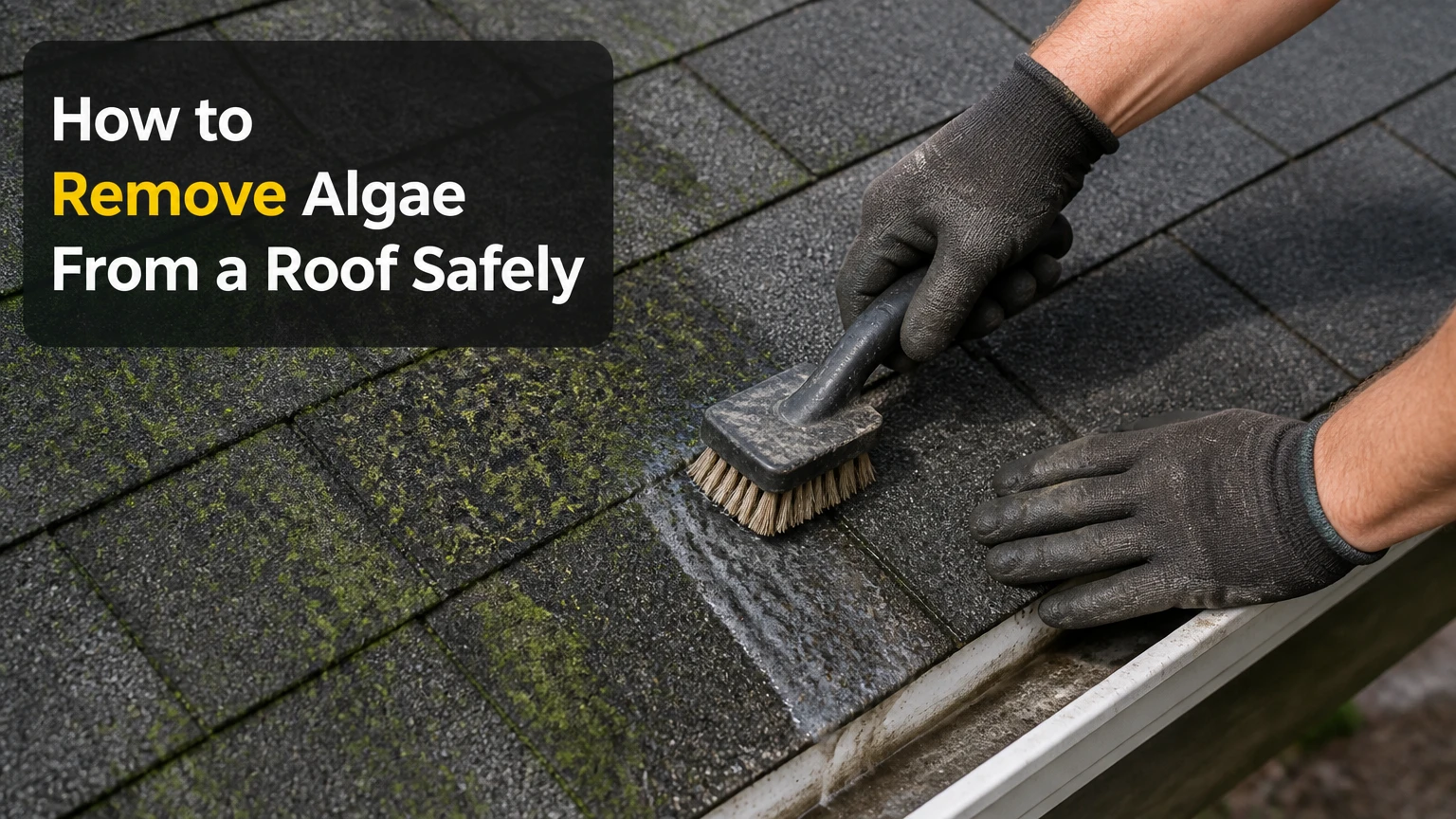
Clear leaves, twigs, pine needles, and loose organic debris from gutters and roof valleys using a blower or soft tool from a safe position. Do not pull moss clumps, scrape lichen, or drag tools across asphalt shingles because attached growth can remove granules or break shingle seals.
If moss is thick enough to conceal shingle edges, stop and arrange a professional assessment. Chemical treatment can kill the moss, but dead material may remain attached and should not be ripped away.
Success checkpoint: Valleys, gutters, and downspouts are clear enough to drain diluted rinse water.
Common mistake: Starting with a stiff brush. Mechanical abrasion often creates more roof damage than algae does.
Step 4: Pre-Wet the Surface and Test a Patch
Pre-wet the roof and nearby surfaces with clean water when the cleaner instructions call for it. Apply the product to a small, inconspicuous test area, then observe color change, granule condition, painted metal, and runoff for the full labeled period.
Do not assume a product safe for asphalt shingles is safe for clay tile, slate, wood shakes, synthetic roofing, EPDM, PVC, or coated metal. Each material has different chemical and abrasion tolerances.
Success checkpoint: The test area shows no unusual bleaching, coating failure, granule release, or metal discoloration.
Common mistake: Skipping the test because a neighbor used the same cleaner. Roof age, coating, paint, and local water chemistry can differ substantially.
Step 5: Apply the Roof Cleaner at Low Pressure
Mix and apply the roof cleaner exactly as its label specifies. Use a pump sprayer or soft-wash system that distributes liquid without forcing water beneath shingle laps; never improvise a bleach-and-TSP formula when the roof manufacturer or product label provides different instructions.
Start at the ridge or highest practical point and work in manageable sections. Saturate the stained surface evenly, but avoid flooding valleys, vents, skylights, and wall junctions. Keep the solution wet for the labeled dwell time, commonly 10-20 minutes for fast-acting products.
Success checkpoint: The algae changes color or begins releasing without granules visibly washing away.
Common mistake: Applying a stronger mixture to compensate for poor coverage. Uneven saturation produces patchy results and increases chemical exposure.
Step 6: Rinse From the Ridge Down
Rinse with a normal garden hose or the lowest-pressure setting specified by the product manufacturer. Work downward so rinse water flows over treated areas rather than beneath shingle courses, and keep the nozzle pointed down the slope.
Use only enough water to remove residue. A pressure washer can strip ceramic granules, damage seal strips, force water under shingles, and shorten service life. ARMA’s roof-care guidance specifically warns homeowners not to power wash asphalt shingles.
Success checkpoint: The rinse water runs clear enough that no concentrated cleaner remains on plants, siding, gutters, or roof fixtures.
Common mistake: Rinsing upward or from the eaves. Water can enter laps and create leaks that were absent before cleaning.
Step 7: Neutralize Runoff and Recheck the Roof
Rinse landscaping, siding, gutters, and hardscape again after the roof is clean. Remove protective coverings while plants are still wet, and follow the product label for neutralization, collection, or disposal.
Inspect the ground for dead vegetation, fish exposure, unusual runoff color, and loose shingle granules. Take after-treatment photographs from the same locations as the initial inspection.
Success checkpoint: No concentrated residue remains, drainage is open, and the roof has no newly exposed mat or missing shingle sections.
Common mistake: Judging the final result immediately. Dead algae often fades over several days or after repeated rainfall.
Which Roof Materials Can Be Cleaned?
Asphalt shingles usually tolerate labeled soft-wash products, but the exact shingle manufacturer’s instructions control. Metal roofs, tile, slate, wood shakes, and synthetic membranes need separate methods because coatings, porosity, fasteners, and breakage risks differ.
| Roofing material | Safer general approach | Avoid | Typical professional price |
|---|---|---|---|
| Asphalt shingles | Labeled low-pressure chemical wash | Pressure washing and scraping | $250-$1,000 |
| Painted metal | Manufacturer-approved cleaner and low-pressure rinse | Chlorine left on coatings or fasteners | $300-$1,200 |
| Clay or concrete tile | Low-pressure treatment and careful inspection | Walking on unsupported tile | $400-$1,500 |
| Slate | Specialist inspection and gentle treatment | Generic bleach recipes and foot traffic | $600-$2,000 |
| Wood shakes | Specialist-approved treatment and moisture assessment | Aggressive washing and prolonged wetting | $500-$1,800 |
| EPDM or PVC membrane | Membrane-compatible cleaner and soft rinse | Solvents, abrasives, and incompatible oxidizers | $400-$1,500 |
Solar panels should be treated as separate equipment. Cover or isolate them according to the panel and cleaner instructions, and do not spray chemicals into panel edges, electrical connectors, inverters, or roof-mounted batteries.
Which Removal Method Is Best for Your Situation?
Chemical soft washing is usually the best choice for established algae on asphalt shingles because it kills the colony without relying on abrasion. Peroxide and leave-on products are reasonable alternatives near sensitive landscaping, while metal strips are preventive rather than restorative.
| Situation | Preferred method | Typical time to visible improvement | Why |
|---|---|---|---|
| Heavy black streaks on asphalt shingles | Labeled sodium-hypochlorite soft wash | Same day to 7 days | Fast biological control |
| Garden beds directly below eaves | Peroxide or controlled professional treatment | 2-14 days | Lower chlorine exposure |
| Light recurring algae on a sound roof | Leave-on surfactant | 1-12 weeks | Minimal roof contact |
| Existing moss or lichen | Professional treatment and inspection | 1-8 weeks | Growth may be attached to shingle edges |
| New roof with algae-resistant granules | Manufacturer-approved maintenance | 1-7 days | Warranty and coating compatibility matter |
| Long-term recurrence on a shaded roof | Treatment plus moisture and shade correction | 1-4 weeks initially | Cleaning alone does not remove the cause |
Copper and zinc strips work by releasing metal ions during rainfall. Install them near the ridge, where rain can wash ions over the affected slope, but do not expect a strip to erase current stains. Copper can stain light-colored materials, and metal runoff may affect plants, fish, or sensitive drainage systems.
What Does Professional Roof Cleaning Cost?
Professional roof cleaning typically costs $250-$1,000 for an average asphalt-shingle home in the United States, with steep roofs, multiple stories, heavy moss, difficult access, and regional labor rates pushing the total above $1,500. DIY costs are lower, but safe access equipment can eliminate the apparent savings.
Typical cost components include inspection, labor, chemical, plant protection, gutter cleanup, access equipment, and insurance overhead. Request a written scope that states the roof material, treatment chemistry, pressure method, runoff controls, warranty limitations, and whether follow-up treatment is included.
| Project condition | Typical area or complexity | DIY material range | Professional range |
|---|---|---|---|
| Small, single-story roof | 1,000-1,500 square feet | $30-$90 | $250-$500 |
| Average two-story roof | 1,500-2,500 square feet | $50-$150 | $400-$900 |
| Steep or obstructed roof | 2,000-3,000 square feet | $100-$300 | $800-$1,500+ |
| Heavy moss and lichen | Multiple treatment visits | $100-$250 | $900-$2,000+ |
A contractor should carry liability insurance and workers’ compensation where applicable. Low prices that exclude plant protection, access controls, or cleanup are not comparable with a complete soft-wash proposal.
Common Mistakes and How to Fix Them
Pressure washing the shingles
Problem: High pressure removes protective granules and can drive water beneath shingle courses.
Fix: Stop immediately, photograph damaged areas, and have a roofer inspect exposed mat, seals, and flashing.
Using an unverified bleach recipe
Problem: Equal-parts recipes ignore bleach concentration, roof age, runoff, and manufacturer instructions. TSP can also increase environmental and surface risks.
Fix: Use a labeled roof product or a trained contractor who can document dilution and application rates.
Scrubbing algae until it disappears
Problem: A clean-looking patch may have lost granules and seal integrity.
Fix: Use chemical dwell time; reserve gentle brushing for loose debris on compatible surfaces.
Cleaning in wind or intense sun
Problem: Wind creates drift, while hot shingles dry treatment before adequate contact.
Fix: Choose a cool, calm, cloudy period and divide the roof into small wet sections.
Treating moss like algae
Problem: Moss can lift tabs and hide decay, so pulling it can remove shingle material.
Fix: Photograph the growth, apply only an approved treatment, and arrange inspection when growth is thick.
Ignoring roof age
Problem: Cleaning a roof near the end of its service life can reveal granule loss, brittle tabs, or hidden leaks.
Fix: If shingles are approximately 15-25 years old, obtain a roof condition assessment before spending on cosmetic treatment.
Why Did the Algae Come Back?
Algae commonly returns because the roof remains shaded and damp, nearby trees deposit organic material, or the first application did not reach every stained area. A treatment can kill visible colonies without changing the moisture conditions that support new spores.
Trim branches where safe, keep valleys and gutters clear, improve attic ventilation when a roofing professional identifies a ventilation defect, and correct plumbing or flashing leaks. Do not remove healthy trees solely because of roof staining; targeted canopy management often provides adequate drying.
If stains return within six months, inspect for incomplete coverage, persistent shade, clogged drainage, contaminated siding or gutters, and a different organism such as lichen. Repeated chemical treatment without diagnosis can accelerate surface wear and increase runoff.
When Should You Hire a Professional?
Hire a professional when the roof is steep, high, fragile, heavily moss-covered, difficult to access, close to power lines, or adjacent to sensitive water features. Professional service is also the safer choice when the roof contains slate, wood shakes, clay tile, unusual coatings, solar equipment, or active leaks.
A qualified contractor should explain the treatment chemistry, pressure range, dwell time, plant protections, waste-water controls, and post-cleaning inspection. Ask whether the contractor will walk on the roof, because unnecessary foot traffic can damage brittle shingles and tile.
Roof cleaning is the wrong solution when shingles are missing, curled, severely cracked, delaminated, or losing granules across broad areas. Replacement or repair may cost more initially, but cleaning a failing roof can postpone the correct diagnosis while leaving water intrusion unresolved.
FAQ
Can I remove roof algae with vinegar?
Vinegar is not a dependable roof-algae treatment and can affect some metals, coatings, plants, and masonry. Its acidity may loosen surface contamination without reliably controlling an established colony. Use a roof-specific product whose label identifies the roofing material and provides application and runoff instructions.
Does rain remove roof algae naturally?
Rain can gradually wash away dead residue, but rain alone rarely eliminates an established algae colony. Rainfall can also spread spores and nutrients across shaded slopes. Chemical treatment followed by natural weathering is more reliable than waiting for storms, especially where black streaks cover multiple shingle courses.
How long does roof algae treatment last?
A typical treatment remains visually effective for approximately 1-3 years, but the interval varies with shade, humidity, tree cover, roof orientation, and product. Copper or zinc strips may reduce recurrence for several years, yet they require correct ridge placement and cannot compensate for persistent leaks or heavy debris.
Can roof algae damage asphalt shingles?
Algae primarily creates staining and surface colonization, while moss and lichen pose greater direct risks because they retain moisture and can lift shingle edges. Heavy algae can still conceal granule loss, cracked tabs, or leaks. Inspect the roof rather than assuming every black streak represents structural damage.
Is roof algae harmful to people or pets?
Roof algae itself is usually a cosmetic exterior concern, but roof-cleaning chemicals can irritate skin, eyes, lungs, plants, and aquatic life. Keep people and pets away during application, follow the product label, prevent concentrated runoff, and never mix cleaning chemicals.
Should I install zinc strips after cleaning?
Zinc strips can help prevent new algae on the slope below them, so installation after cleaning is logical when the roof is sound and the material is compatible. Strips do not repair existing stains, and copper or zinc runoff can discolor light surfaces or affect sensitive landscaping and water features.