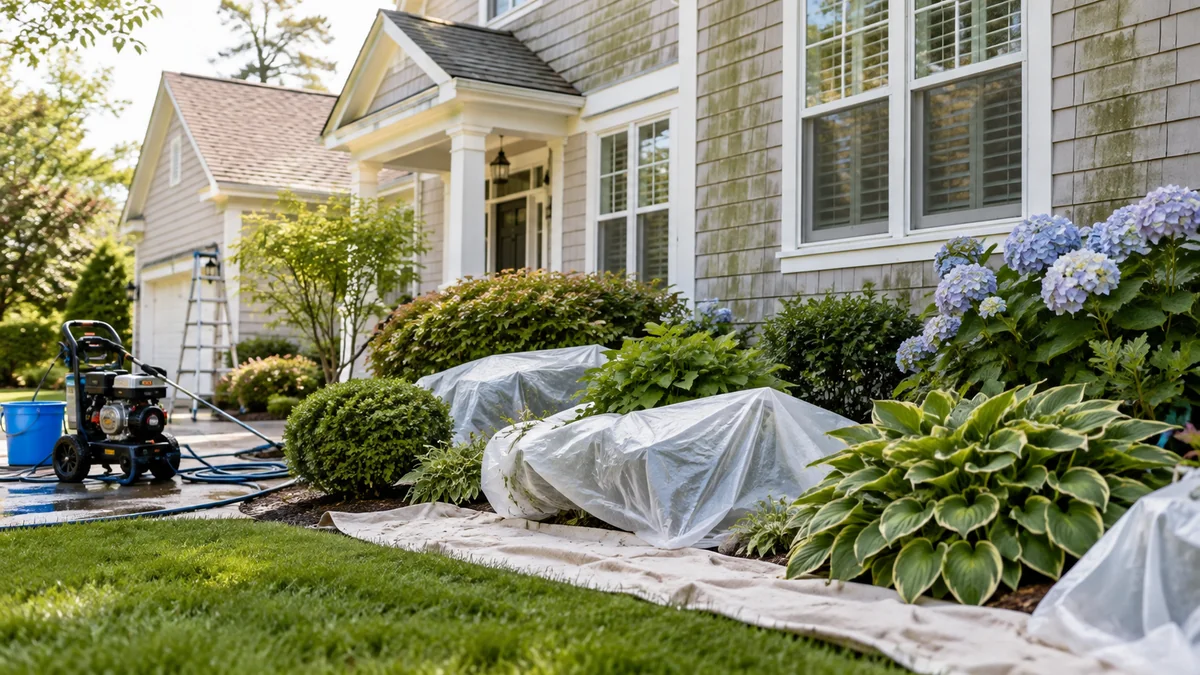
To protect landscaping and plants during exterior house washing, move portable plants, pre-rinse foliage and soil, shield delicate vegetation, control runoff, and rinse continuously during and after cleaning. The safest process uses low-pressure application, label-compliant detergent dilution, weather controls, and immediate freshwater flushing when overspray contacts leaves.
Key facts
Pre-wetting reduces chemical concentration on leaves and soil, but it does not make plants chemically impervious.
Sodium hypochlorite can burn foliage when concentration, contact time, sunlight, or plant sensitivity is excessive.
Breathable fabric is safer than plastic in sunlight, but no cover replaces moving a plant outside the spray and runoff zone.
A garden hose is usually more important for plant protection than higher-pressure equipment.
Never direct concentrated wash water into a planting bed, storm drain, pond, or vegetable garden.
Professional plant protection is a process, not a single application of water or neutralizer.
What Does Plant Protection During House Washing Include?
Plant protection during house washing is the planned control of spray, drift, contact time, and runoff around vegetation. A complete mitigation plan starts before detergent application, continues while the wall is wet, and ends only after nearby leaves, soil, hardscape, and drainage paths have been inspected.
Exterior cleaners commonly use water, surfactants, and sometimes sodium hypochlorite to remove algae, mildew, mold, and organic staining. Sodium hypochlorite is an oxidizing disinfectant. It can injure leaves when wet solution remains on foliage, reaches a high concentration, or dries in warm sunlight.
The often-repeated explanation that saturated plants “block” chemicals through osmosis is too absolute. Pre-wetting mainly dilutes accidental contact and reduces the amount of dry surface available to retain detergent. It does not stop every chemical from entering leaf tissue, and wet soil does not neutralize sodium hypochlorite.
Why Do Plants Get Damaged?
Plant injury usually results from one of four pathways:
- Direct leaf contact: Fine droplets settle on foliage and dry into a concentrated residue.
- Root-zone exposure: Runoff carries detergent into mulch or soil around shallow roots.
- Heat and confinement: Plastic coverings trap heat and humidity around leaves.
- Physical impact: High-pressure water tears leaves, strips bark, or breaks stems.
Damage may appear immediately as pale spots, brown margins, curled leaves, or a bleach-like discoloration. Some injury develops over 24-72 hours, particularly after exposure followed by strong sunlight.
The National Pesticide Information Center explains that pesticide exposure risk depends on the product, dose, route, and duration of contact. That principle also applies to cleaning chemicals: reducing concentration and contact time is more reliable than assuming a product is harmless because it was diluted.
What Should You Do Before Washing the House?
Before washing, identify every route by which water or spray can reach plants. Walk the full foundation, inspect downspouts, note prevailing wind, and mark delicate or edible plants before connecting the hose.
Step 1: Move and Map the Drop Zone
Move hanging baskets, planters, herb pots, outdoor furniture, toys, and removable trellises at least 10 feet from the wall when space allows. Do not place them beneath a roof edge, gutter outlet, or the opposite side of a temporary screen where runoff can collect.
Mark these higher-risk areas:
- Japanese maple, laceleaf maple, hydrangea, fern, rose, and young citrus
- Newly planted shrubs with shallow or disturbed roots
- Annual flower beds and tender vegetable crops
- Plants showing drought stress, wilt, disease, or recent transplant shock
- Fish ponds, rain barrels, wells, and pet drinking-water stations
Disconnect or cover outdoor electrical equipment according to its manufacturer’s instructions. Do not seal electrical fixtures with wet plastic if the covering can trap water against the fixture.
Step 2: Pre-Rinse Leaves, Soil, and Hardscape
Use clean municipal or well water from a hose with a broad spray pattern. Wet the upper and lower leaf surfaces, stems, mulch, soil, edging, and adjacent walkways until water begins to move across the surface.
A typical residential sequence takes 10-20 minutes for a foundation bed and longer for mature landscaping. Saturate the immediate root zone and the likely runoff path, but do not create standing water around plants that are sensitive to saturated soil.
Pre-rinsing is a dilution barrier, not a chemical shield. Keep the hose available because the bed may need another rinse while the cleaner works on a different wall.
How Should You Cover Plants?
Cover only plants that cannot be moved and that need protection from direct spray. Use breathable landscape fabric, canvas, or a purpose-made plant cover supported above the foliage; avoid laying heavy material directly on stems and leaves.
| Covering method | Best use | Maximum typical duration | Main risk |
|---|---|---|---|
| Breathable plant fabric | Delicate shrubs during active spraying | 30-90 minutes | Heat or abrasion if unsupported |
| Canvas drop cloth | Temporary physical splash protection | 15-45 minutes | Weight and crushed stems |
| Clear plastic sheet | Short, shaded splash barrier only | 5-15 minutes | Heat buildup and condensation |
| Temporary mesh screen | Drift reduction in breezy conditions | 1-3 hours | Does not stop liquid runoff |
Plastic is especially hazardous in direct sun. A sealed plastic sheet can raise temperature around leaves quickly, while condensation keeps chemicals in contact with the foliage. If plastic is the only available material, use it as a temporary overhead or side shield in shade, keep it off the plant, and remove it as soon as direct spraying ends.
Covers do not protect roots from gutter discharge or pooled detergent. Runoff control remains necessary.
How Do You Wash Around Landscaping Safely?
Wash from the least exposed area toward the most exposed area, keep the nozzle aimed at the wall, and use the lowest pressure that removes the soil or detergent. A second person should rinse nearby vegetation when the wall is being treated with a chemical solution.
Step 3: Control Spray Pressure and Direction
Use a wide fan pattern rather than a concentrated jet. Near plants, siding, painted surfaces, windows, and caulk, low-pressure chemical application is generally safer than high-pressure blasting.
| Task | Typical pressure range | Nozzle or method | Plant-protection rule |
|---|---|---|---|
| Chemical application on siding | 50-300 PSI | Low-pressure fan system | Keep wand aimed at the wall |
| Rinsing nearby foliage | 20-60 PSI | Garden hose or soft fan | Use enough flow without shredding leaves |
| General vinyl siding rinse | 500-1,000 PSI | 25-40 degree fan | Increase distance near beds |
| Concrete or masonry cleaning | 1,000-3,000 PSI | Surface-appropriate tip | Prevent rebound into vegetation |
Pressure ratings vary by equipment and nozzle. A machine’s advertised PSI does not tell you the pressure reaching a leaf at a particular distance. Never use a zero-degree nozzle or turbo nozzle on plants, bark, tender stems, or mulch.
Keep the spray fan moving. A stationary stream can strip waxy leaf surfaces, break stems, and drive contaminated water into the soil.
Step 4: Keep Vegetation Wet During Chemical Contact
Start the plant-rinsing hose before applying detergent to the wall. Re-wet nearby leaves whenever they begin to lose their sheen, when wind shifts, or when the cleaner moves to another elevation.
A practical two-person workflow is:
- Cleaner applies solution to a manageable wall section.
- Rinse operator wets the adjacent bed and watches for drift.
- Cleaner rinses the wall before the solution dries.
- Rinse operator floods any contacted foliage immediately.
- Both workers inspect the ground before moving to the next section.
Do not assume a single initial watering protects a two-hour job. Hot, dry, windy conditions can dry leaves and exposed mulch within minutes.
How Should You Manage Gutter and Roof-Wash Runoff?
Roof and gutter runoff requires separate control because it can carry a larger volume of cleaning solution than siding overspray. Extend downspouts to a safe, planted-free discharge area or collect flow temporarily only when the container can safely handle the volume.
Do not use a thin trash bag as an unattended downspout reservoir. Water weighs approximately 8.3 pounds per gallon, so a bag holding 10 gallons carries about 83 pounds before accounting for movement, sharp edges, or failure.
Safer options include:
- Flexible downspout extensions leading to an approved discharge area
- A temporary berm that redirects water away from beds
- A large, stable collection container monitored continuously
- A wet vacuum for small, controlled volumes on hardscape
- Stopping the wash when runoff cannot be safely contained
Never send contaminated wash water toward a storm drain, pond, stream, septic area, private well, or neighboring property. Local wastewater rules differ, and sodium hypochlorite labels may restrict discharge methods.
What About Neutralizers?
Sodium thiosulfate can reduce residual oxidizing chlorine, but it is not a universal substitute for freshwater rinsing. Use a commercial neutralizer only according to its label and safety data sheet, with attention to mixing instructions, application rate, storage, and wastewater disposal.
A neutralizer applied to a puddle does not make every associated contaminant safe for roots, fish, or soil organisms. Freshwater dilution and physical removal remain the primary response to accidental overspray.
Which Protection Method Should You Choose?
The best method depends on plant sensitivity, exposure route, weather, and whether the work involves a roof or only low siding. No single method performs well against direct spray, heat, and contaminated runoff at the same time.
| Situation | Preferred protection | Avoid | Typical labor impact |
|---|---|---|---|
| Shrubs beside vinyl siding | Pre-rinse plus active hose rinsing | High-pressure wand | 15-30 minutes |
| Mature Japanese maple near wall | Moveable screen, pre-rinse, hand rinse | Plastic wrapped around canopy | 30-60 minutes |
| Vegetable garden below eaves | Physical relocation or runoff diversion | Roof wash without containment | 30-90 minutes |
| Roof cleaning above foundation beds | Downspout extension plus continuous rinse | Open discharge into mulch | 45-120 minutes |
| Drought-stressed annuals | Professional cleaning or full isolation | Chemical spray in hot sun | Site-specific |
| Small, sturdy lawn away from wall | Pre-rinse and post-rinse | Direct detergent pooling | 10-20 minutes |
Is Soft Washing Better Than Pressure Washing for Plants?
Soft washing is usually better for reducing physical plant damage because it applies detergent at low pressure, but chemical exposure still requires mitigation. High pressure can shred foliage and force dirty water into soil, while soft washing can burn leaves if the solution drifts or remains wet too long.
The deciding factors are solution strength, spray direction, contact time, wind, and rinsing discipline. A careless low-pressure operator can harm a garden more severely than a careful operator using water-only cleaning at a controlled distance.
What Weather Is Safest for Exterior Cleaning?
Cool, overcast, calm conditions provide the largest safety margin, although weather alone cannot make an unsuitable chemical application safe. Avoid washing during gusty wind, extreme heat, intense sunlight, or conditions that prevent the wall from being rinsed promptly.
| Weather condition | Practical decision | Reason |
|---|---|---|
| Calm wind under 5 mph | Generally workable | Low drift potential |
| Wind 5-10 mph | Use screens and smaller sections | Drift becomes harder to control |
| Gusts above 10 mph | Delay chemical washing | Direction and distance change rapidly |
| Full sun above 85°F | Prefer delay or water-only work | Faster drying and heat stress |
| Light overcast, 55-80°F | Usually favorable | Slower evaporation |
| Rain during work | Stop and reassess | Dilution and runoff become unpredictable |
These are practitioner planning thresholds, not universal legal limits. Product labels, local regulations, and site-specific hazards take priority.
What Are the Costs and Time Requirements?
A basic DIY plant-protection setup typically costs $25-$100, excluding a pressure washer or chemical. Professional exterior washing commonly ranges from $200-$600 for a small to average home, while roof access, heavy staining, difficult drainage, and high-value landscaping can increase the price.
| Item | Typical quantity | Typical cost | Planning time |
|---|---|---|---|
| Garden hose and fan nozzle | 1 set | $20-$60 | 10-20 minutes setup |
| Breathable plant fabric | 1-3 rolls or covers | $15-$60 | 15-30 minutes |
| Downspout extensions | 2-6 pieces | $20-$80 | 20-45 minutes |
| Commercial neutralizer | 1 container | $20-$70 | 10-20 minutes |
| DIY protection labor | 1-2 people | $0 labor cost | 30-120 minutes |
| Professional mitigation | 1 crew | Often included or $50-$200 add-on | 30-90 minutes |
Prices are typical planning ranges in the United States, not fixed market rates. Ask a contractor whether plant protection, runoff control, and post-wash inspection are included rather than comparing only the advertised washing price.
What Should You Do If Chemical Hits a Plant?
If cleaning solution contacts a plant, stop application and flood the foliage with clean water immediately. Rinse both leaf surfaces, stems, surrounding mulch, and hardscape for several minutes, then prevent additional contaminated water from reaching the root zone.
Use this response sequence:
- Stop the chemical application.
- Move the hose close enough to produce a broad, gentle flow.
- Rinse from the top of the plant downward.
- Lift leaves and rinse undersides.
- Flush nearby mulch and hardscape without creating a concentrated pool.
- Divert remaining runoff away from the plant.
- Photograph symptoms and record the product and dilution.
- Contact a local extension office or qualified horticulturist if discoloration develops.
Do not scrub leaves, apply fertilizer, prune immediately, or add household vinegar. Fertilizer can increase stress, and improvised acid mixtures can create hazardous reactions or additional root injury.
Common Mistakes and How to Fix Them
Covering Plants With Sealed Plastic
Remove plastic immediately when sunlight or heat is present. Replace it with breathable fabric held above the canopy, or move the plant outside the work zone.
Using a Fixed Dilution for Every Job
A claim such as “10 parts water to 1 part detergent” cannot guarantee plant safety because commercial products vary in sodium hypochlorite concentration, surfactants, pH, and intended use. Follow the product label and use the weakest effective solution.
Letting Roof Water Drain Into Mulch
Stop the work, redirect the downspout, and remove pooled water from hardscape where practical. Do not deliberately push concentrated runoff deeper into soil, because that moves the contaminant toward roots rather than removing it.
Rinsing Only Once
Assign one person to monitor leaves throughout chemical application. Re-rinse after each wall section and again when the entire job ends.
Washing in Wind
Pause chemical application when drift reaches plants outside the planned zone. Screens help with light movement, but they do not make strong gusts manageable.
Ignoring Edible Crops
Treat vegetables, herbs, and fruit as higher-consequence plants. Move containers, isolate garden beds, prevent roof runoff, and follow any product label restrictions about food-contact areas and re-entry.
DIY or Professional House Washing?
DIY washing is reasonable when the house is low, the siding is accessible, plants can be moved, and the work can be completed with water and controlled low-pressure methods. Professional service is the safer choice when a roof, second story, strong chemical treatment, extensive mature landscaping, or complex drainage is involved.
Ask a contractor these specific questions:
- What chemical product and concentration will you use?
- How will you protect plants beside the wall?
- Who monitors vegetation during application?
- How will you control gutter and roof runoff?
- What happens if overspray reaches a plant?
- Is plant mitigation included in the written price?
- Are you insured, and will you follow the product safety data sheet?
A contractor who promises that pre-wetting makes plants “immune” to chemicals is giving an inaccurate explanation. A competent operator should describe dilution, contact-time control, rinsing, runoff management, and weather limits.
FAQ
Can house-washing chemicals kill grass?
House-washing chemicals can injure or kill grass when concentrated solution pools, runoff remains on blades, or repeated exposure occurs. Pre-wet the turf, prevent pooling, redirect downspouts, and rinse after work. Grass farther from the wall usually faces less risk than shallow-rooted ornamental plants directly beneath roof drainage.
How long should I wait before washing after planting shrubs?
Wait until newly planted shrubs are adequately watered and stabilized, often at least several days for container plants and longer for transplanted mature specimens. Delay chemical washing when plants are wilted, drought-stressed, or recently disturbed. Moving the work to a cooler period is safer than relying on extra detergent dilution.
Can I use vinegar to neutralize bleach on plants?
Do not mix vinegar with bleach or sodium hypochlorite. Acidifying hypochlorite can release toxic chlorine gas. Use clean water first, then use a labeled neutralizer only when the product instructions support that application and the rinse water can be managed safely.
Should I water plants after exterior house washing?
Yes, rinse nearby foliage and the exposed soil surface after washing, especially when detergent or roof runoff could have reached the landscape. Post-washing irrigation should dilute residual contamination without creating runoff toward drains, ponds, wells, or neighboring properties.
What plants are most sensitive to house washing?
Tender annuals, ferns, Japanese maples, hydrangeas, roses, young citrus, fresh transplants, and edible crops generally deserve extra protection. Sensitivity varies with cultivar, health, weather, and chemical exposure, so physical relocation is safer than attempting to calculate a universally harmless concentration.
Is plant damage covered by a pressure-washing company?
Coverage depends on the service agreement, insurance policy, documented pre-existing conditions, and the contractor’s negligence. Photograph the landscaping before work, request written mitigation procedures, and confirm liability coverage before washing begins. Damage claims become harder to evaluate when no baseline record exists.
The Bottom Line
Protecting landscaping and plants during exterior house washing requires more than wetting a garden once. Move portable plants, pre-rinse foliage and soil, use breathable shielding where needed, control downspout discharge, rinse during chemical contact, and flush every exposed surface afterward. The safest answer to how to protect landscaping and plants during exterior house washing is a coordinated mitigation plan matched to the plant, chemical, weather, siding, and runoff path.