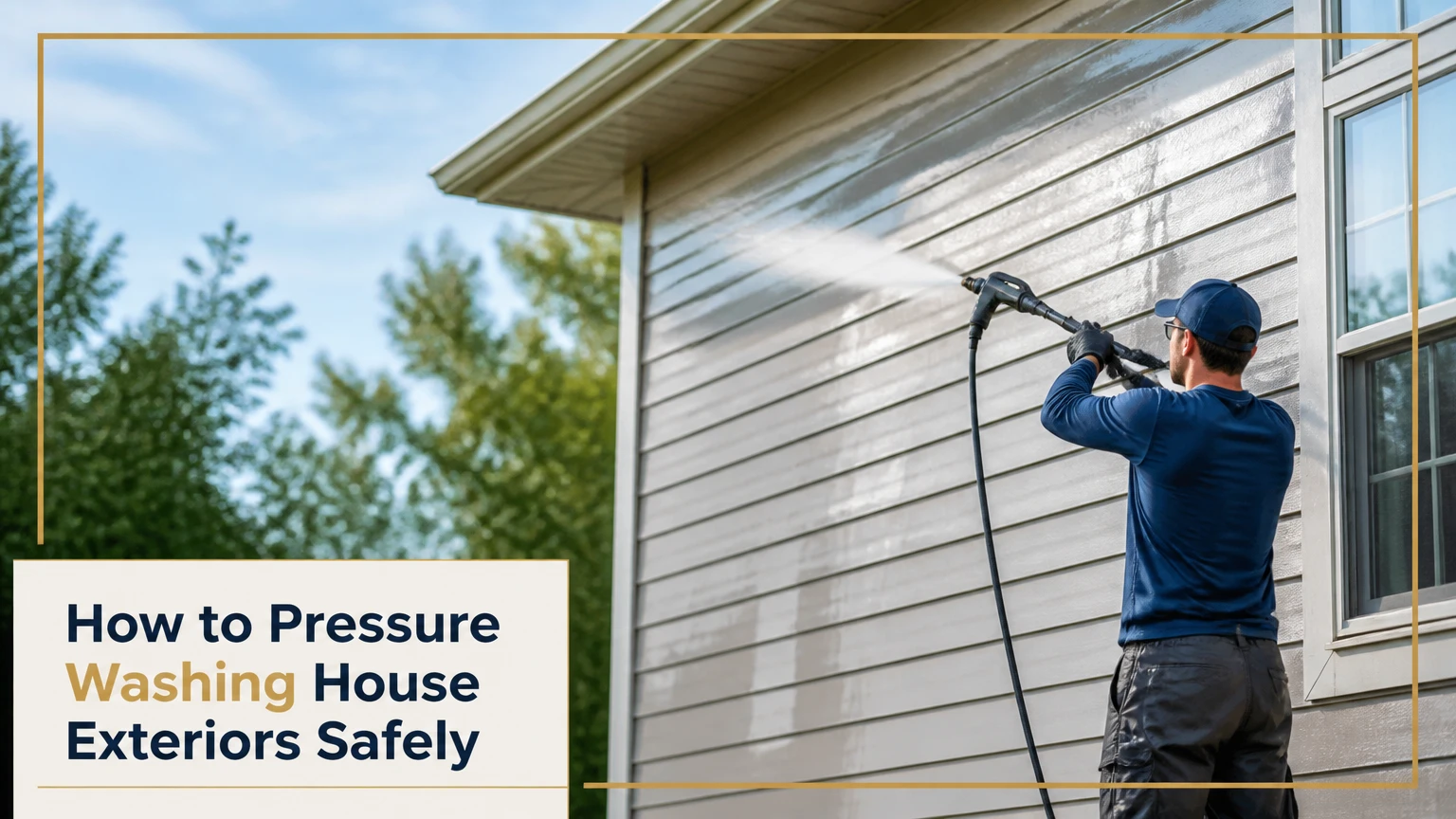
To pressure wash a house, protect openings and plants, apply exterior detergent at low pressure, rinse from the top downward with the correct nozzle, and keep the spray away from siding seams and fragile surfaces. A typical single-story home takes 2-4 hours, but the siding material and control of water pressure determine whether cleaning improves the exterior or causes damage.
Key Facts at a Glance
- A 1,500-2,000 PSI electric pressure washer with 1.2-1.8 GPM is usually sufficient for a small, single-story vinyl-sided house.
- Pressure washing is appropriate for concrete, sound brick, and durable masonry, while stucco, aged wood, historic mortar, and asphalt shingles usually require low-pressure soft washing.
- Start 18-24 inches from siding and move closer only after testing an inconspicuous area.
- Use detergent at low pressure, allow 5-10 minutes of dwell time, and prevent the solution from drying.
- Spray downward and never aim upward behind vinyl, aluminum, wood siding, trim, soffits, or flashing.
- Never use a ladder while operating a pressure washer; recoil and wet footing can cause a fall.
What Does Pressure Washing a House Do?
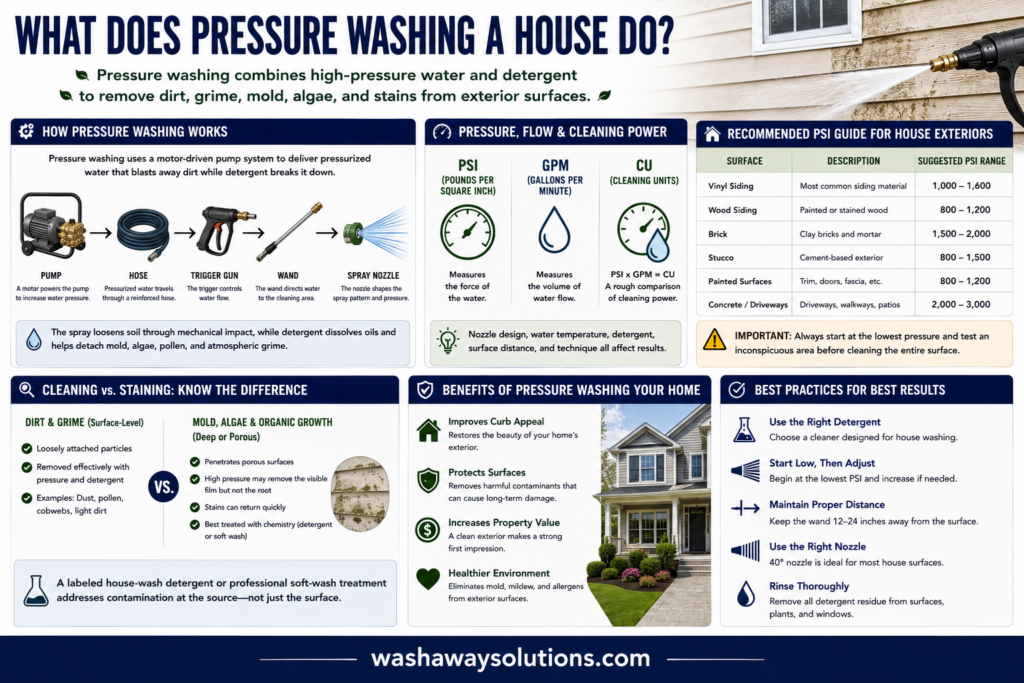
Pressure washing uses a motor-driven pump to increase water pressure, then sends that water through a reinforced hose, trigger gun, wand, and spray nozzle. The spray loosens soil through mechanical impact, while detergent dissolves oils and helps detach mold, algae, pollen, and atmospheric grime.
Pressure does not equal cleaning performance by itself. PSI, or pounds per square inch, describes force; GPM, or gallons per minute, describes water volume. Cleaning units, calculated as PSI multiplied by GPM, provide a rough comparison, although nozzle design, water temperature, detergent, surface distance, and operator technique also affect the result.
Organic staining requires special care. A strong stream may remove the visible film while leaving biological growth in porous material, so stains can return quickly. A labeled house-wash detergent or professional soft-wash treatment addresses the contamination with chemistry rather than relying on impact alone.
Which Pressure Washer Should You Use?
A small electric machine is the safest starting point for most homeowners washing low, accessible siding. Gas equipment increases flow and mobility, but its noise, exhaust, fuel, vibration, and greater output increase the consequences of poor technique.
| Use case | Typical PSI | Typical GPM | Practical choice |
|---|---|---|---|
| Small vinyl siding | 1,500-2,000 | 1.2-1.8 | Electric washer |
| Large vinyl exterior | 2,000-2,800 | 1.8-2.5 | Electric or gas washer |
| Sound brick and masonry | 2,000-3,000 | 2.0-3.0 | Gas washer with wide tip |
| Concrete walkway | 2,500-3,500 | 2.3-3.5 | Gas washer or surface cleaner |
| Stucco, aged wood, historic mortar | 500-1,500 at the surface | 2.0-5.0 | Soft-wash system or professional service |
The figures are typical operating ranges, not universal requirements. Read the pressure-washer manual, confirm the machine’s actual output, and follow the siding or coating manufacturer’s care instructions. More PSI is not automatically better because excessive impact can remove paint, scar wood fibers, open mortar joints, or drive water behind cladding.
Which Nozzle Should You Use?
Use the widest effective spray pattern and the lowest pressure that removes the soil. Nozzle colors are common conventions, but color coding can vary by manufacturer, so verify the angle printed on the tip or in the manual.
| Nozzle angle | Common color | Appropriate use | House-washing caution |
|---|---|---|---|
| 0 degrees | Red | Specialized stripping on durable material | Do not use on siding, glass, wood, or people |
| 15 degrees | Yellow | Heavy soil on sound concrete or bare masonry | Can etch surfaces and remove coatings |
| 25 degrees | Green | Rinsing sound brick, concrete, and masonry | Test aged mortar before broad use |
| 40 degrees | White | Vinyl, painted wood, and general exterior rinsing | Maintain distance and spray downward |
| 65 degrees | Black | Low-pressure detergent application | Usually needed for injector-based soap delivery |
A 25-degree tip can damage soft brick or deteriorated mortar when held too close. A 40-degree tip can still strip loose paint if the operator moves slowly across a weak coating. The nozzle, machine output, distance, angle, dwell time, and surface condition work together.
Before You Start
A typical house wash requires 2-4 hours for a single-story home, $20-$50 in detergent and protective supplies, and a functioning outdoor water connection. The work is moderate in difficulty because the operator must control runoff, spray direction, chemical exposure, and changing surface conditions.
Preparation checklist
Gather the following:
- Pressure washer with a 25- or 40-degree tip and low-pressure detergent tip
- 25-50 feet of reinforced garden hose, without kinks
- 25-50 feet of high-pressure hose
- Exterior house-wash detergent, mixed according to its label
- Safety glasses, waterproof footwear, gloves, and hearing protection for gas machines
- Plastic sheeting or tarps for delicate plants
- Soft brush, bucket, and garden hose for spot cleaning
- Extension wand for safe second-story reach, if approved for the machine
Inspect the siding before connecting equipment. Mark loose panels, cracked caulk, failing paint, open soffits, damaged window seals, exposed insulation, and holes around pipes. Pressure washing cannot repair these defects, and spraying them can turn a minor maintenance problem into interior water damage.
Do not use a household extension cord with an electric washer unless the manufacturer specifically permits it. When an extension cord is unavoidable, use the gauge, length, and ground-fault protection specified in the manual.
Step 1: Protect the House and Work Area
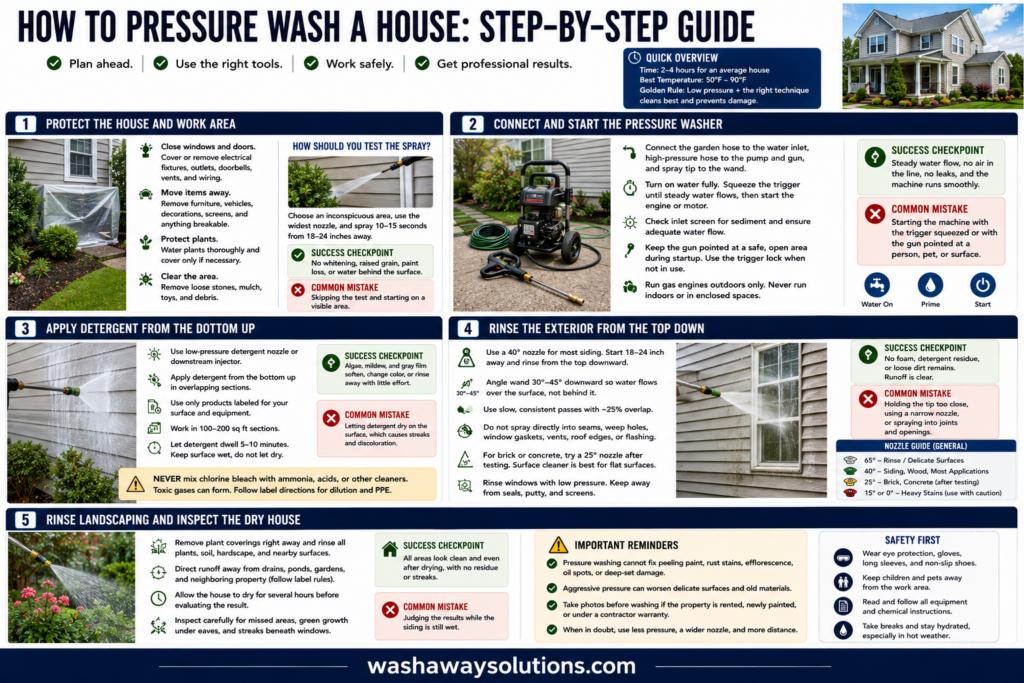
Close every window and door, move furniture and vehicles outside the splash zone, and cover vulnerable electrical fixtures before starting the pressure washer. Remove loose objects from the ground because pressurized spray can turn small stones, mulch, and broken coating fragments into projectiles.
Switch off power to exterior fixtures only when the home’s electrical layout permits safe isolation. Cover outlets, doorbells, light fittings, vents, and low-mounted wiring with plastic, but do not seal a gas appliance vent in a way that prevents safe operation. Never spray directly into an outlet, vent, camera, speaker, or light fixture.
Water nearby plants, shrubs, and lawn thoroughly before applying detergent. Pre-wetted foliage absorbs less diluted cleaning solution, but plastic coverings should be temporary because heat can damage leaves. Move window screens, flags, hanging baskets, and removable decorations away from the wall.
How should you test the spray?
Choose an inconspicuous area behind a shrub or near a corner, set the widest nozzle, and spray for 10-15 seconds from 18-24 inches away. Inspect for whitening, raised grain, paint loss, water behind a panel, or altered texture before continuing.
A test patch is especially important on chalky paint, cedar, fiber-cement board, old aluminum siding, and repaired masonry. If the test causes damage, stop and change the method rather than reducing the distance by trial and error.
Step 2: Connect and Start the Pressure Washer
Connect the garden hose to the water inlet, high-pressure hose to the pump and gun, and spray tip to the wand. Turn on the water fully, then squeeze the trigger until air leaves the system and water flows steadily before starting a gas engine or electric motor.
Check the inlet screen for sediment and confirm that the household supply provides enough water for the pump. A restricted garden hose or low-flow spigot can cause pressure fluctuation, pump cavitation, and premature equipment wear.
Keep the gun pointed toward a safe, open area during startup. Engage the trigger lock whenever the wand is not in hand. Gas machines must operate outdoors, away from doors, windows, and air intakes, because carbon monoxide can accumulate indoors or in partially enclosed spaces.
Step 3: Apply Detergent From the Bottom Up
Select the low-pressure detergent nozzle or approved downstream injector, then apply house-wash solution in overlapping sections from the bottom upward. Bottom-up application reduces visible streaks because detergent does not repeatedly run over already-drying lower sections.
Use only a product labeled for the surface and equipment. Follow the product’s dilution, contact-time, personal-protection, and runoff instructions rather than copying a generic bleach ratio from the internet. Never mix chlorine bleach with ammonia, acids, or other cleaners; the CDC warns that such combinations can produce toxic gases.
Work in sections of approximately 100-200 square feet. Let detergent dwell for 5-10 minutes while the surface remains visibly wet. A shaded wall may need the full dwell period, whereas direct sun and wind may require smaller sections and periodic misting.
You will know the detergent is working when algae, mildew, and gray film soften, change color, or rinse away with little mechanical force. If the solution dries, stop applying detergent, re-wet the area, and rinse before continuing. Dried detergent can leave streaks and discoloration.
Step 4: Rinse the Exterior From the Top Down
Switch to a 40-degree nozzle for most siding, stand 18-24 inches away for the first pass, and rinse from the highest cleaned section downward. Keep the wand angled approximately 30-45 degrees downward so water travels over the surface instead of behind overlapping panels.
Use slow, consistent passes with about 25 percent overlap. Hold the spray perpendicular enough to clean evenly, but do not direct a concentrated stream into seams, weep holes, window gaskets, door thresholds, soffit vents, roof edges, or flashing.
For sound brick or concrete, a 25-degree nozzle may be appropriate after testing. Keep the tip farther away from old mortar and move continuously. A surface cleaner is often safer and more uniform than a narrow wand on horizontal concrete because its rotating jets reduce striping.
Rinse windows with a broad, low-pressure spray or garden hose. Do not concentrate high pressure on insulated-glass edges, putty, screens, or damaged seals. Pressure washing glass is a separate skill, and a clean window is not worth risking a failed seal.
You will know rinsing is complete when no foam, detergent sheen, or loosened soil remains and runoff runs clear. Inspect overlaps, corners, undersides of trim, and areas behind downspouts before moving to the next section.
Step 5: Rinse Landscaping and Inspect the Dry House
Remove temporary plant coverings immediately after the chemical work, then rinse foliage, soil, hardscape, and nearby exterior surfaces with clean water. Direct runoff away from storm drains, ponds, vegetable gardens, and neighboring property whenever the detergent label requires controlled disposal.
Allow the house to dry for several hours before judging the result. Damp siding can hide missed mildew, uneven cleaning, and water marks. Look for remaining green growth under eaves, dark lines beneath windows, and streaks caused by detergent drying.
Do not expect pressure washing to remove every paint failure, rust stain, efflorescence deposit, or deep oil mark. Those conditions need separate treatments, and aggressive pressure often worsens them. Photograph damaged areas before washing if the property is rented, recently painted, or under a contractor warranty.
Is Soft Washing Better Than Pressure Washing?
Soft washing is usually better for stucco, asphalt shingles, aged wood, painted surfaces, and biological growth because it uses detergent and low surface pressure rather than impact alone. Pressure washing is usually better for sound concrete, durable brick, and hardscape where mechanical soil removal is appropriate.
“Soft wash” does not identify one universal PSI range. Commercial systems may apply chemical solution at very low pressure, while some contractors use pressure-washer equipment with a downstream injector and a wide fan. The defining feature is low-impact application combined with appropriate chemistry, not a single number.
| Factor | Pressure washing | Soft washing |
|---|---|---|
| Main cleaning action | Water impact and rinsing | Detergent treatment and low-pressure rinse |
| Typical surface use | Concrete, sound brick, durable masonry | Stucco, vinyl, wood, painted cladding |
| Biological staining | May remove visible film temporarily | Chemical treatment can address organic growth |
| Damage risk | Higher on fragile coatings and joints | Lower impact, but chemical damage remains possible |
| Plant protection | Needed with detergent | Especially important with stronger biocides |
| Best operator choice | Experienced DIYer on durable surfaces | Trained professional for complex or delicate exteriors |
A low-pressure method is not risk-free. Incorrect chemical concentration can burn foliage, discolor siding, corrode metal, or harm nearby waterways. Professionals should explain their detergent, runoff controls, insurance, and surface-specific pressure rather than using “soft wash” as a vague guarantee.
Surface-Specific Variations
How do you pressure wash vinyl siding?
Use a 40-degree tip, low-to-moderate pressure, and a downward spray direction for vinyl siding. Keep the wand at least 18 inches away initially, avoid forcing water behind laps, and use detergent for mildew instead of increasing pressure.
Vinyl siding can admit water through seams, J-channels, utility penetrations, and damaged corners. Clean one wall section at a time, and rinse before detergent dries. Avoid spraying upward under horizontal courses, especially beneath windows and at the bottom of the wall.
How do you wash brick and mortar?
Use detergent first, then a 25- or 40-degree nozzle on sound brick after testing a hidden area. Keep pressure moderate and protect mortar joints because old, soft, or already eroded mortar can be removed faster than the brick itself.
White haze may be efflorescence rather than dirt. Pressure alone may not remove it, and acidic masonry cleaners can damage surrounding materials if misapplied. Identify the deposit before selecting a chemical.
Can you pressure wash stucco and wood?
Stucco and wood should generally receive low-pressure cleaning, not a close-range high-pressure stream. Stucco can develop pitting and cracks, while wood can show raised fibers, gouges, and stripped paint after excessive impact.
For painted wood, test for chalking and loose coating. For cedar shingles, historic siding, and lime mortar, professional assessment is safer because the surface may require preservation rather than aggressive cleaning.
Common Mistakes and How to Fix Them
| Mistake | Likely result | Recovery |
|---|---|---|
| Starting with a red tip | Gouged wood, etched concrete, stripped paint | Stop, document damage, switch to a wider tip |
| Spraying upward | Water behind siding and trim | Stop, allow the wall to dry, inspect interior areas |
| Letting detergent dry | Streaks, residue, uneven color | Re-wet and rinse the entire affected section |
| Working too close | Surface scars or paint removal | Increase distance and reduce pressure |
| Ignoring loose paint | Larger peeling areas | Scrape or repaint after complete drying |
| Skipping plant rinsing | Leaf burn or discoloration | Flood foliage and soil with clean water promptly |
The most common professional error is choosing pressure before diagnosing the stain. Mud, algae, oxidation, soot, and efflorescence respond to different methods, so escalating force can create damage without solving the underlying problem.
A second expert rule is to manage drying time rather than chase maximum speed. Shade, wind, wall orientation, humidity, and detergent concentration determine the workable section size. Smaller sections produce a more even result than covering an entire sunny elevation at once.
A third rule is to treat water intrusion as a greater risk than visible surface dirt. Spray direction matters more than a machine’s advertised PSI around windows, siding laps, vents, and trim.
Why Is the Pressure Washer Losing Pressure?
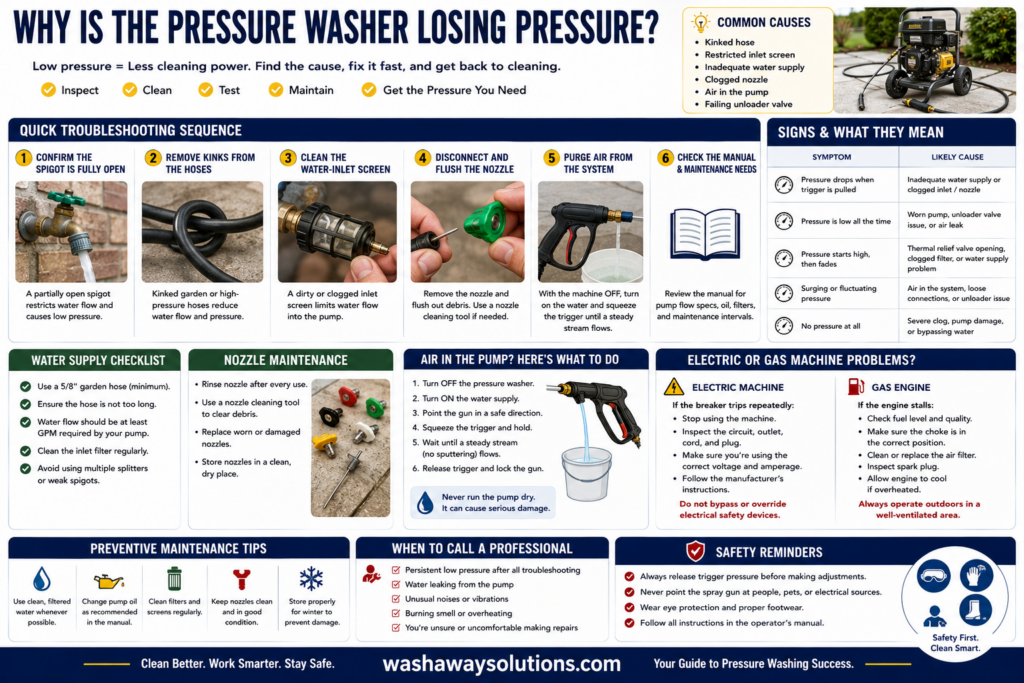
A pressure washer that loses pressure usually has a kinked hose, restricted inlet screen, inadequate water supply, clogged nozzle, air in the pump, or a failing unloader valve. Turn off the machine, release trigger pressure, inspect the inlet and hose, and clean the nozzle before testing again.
Use this sequence:
- Confirm the spigot is fully open.
- Remove kinks from the garden and high-pressure hoses.
- Clean the water-inlet screen.
- Disconnect and flush the nozzle.
- Run water through the gun with the machine off to purge air.
- Check the manual for pump-flow and maintenance requirements.
If an electric machine repeatedly trips its breaker, stop using it and inspect the circuit, cord, plug, and motor according to the manufacturer’s instructions. If a gas engine stalls, release trigger pressure and check fuel, oil level, choke position, and the air filter. Do not bypass safety controls.
Why is the detergent not being drawn?
Detergent usually fails to draw because the wrong nozzle is installed, the injector is set for a different flow rate, the pickup tube is blocked, or the solution is too thick. Install the manufacturer-approved low-pressure tip and verify that the siphon tube reaches the diluted solution.
Many injector systems do not draw chemical at high pressure. If the soap stops when a narrow tip is fitted, that behavior may be normal rather than a pump failure. A downstream injector and a dedicated soft-wash pump also have different operating requirements, so do not interchange their chemical ratios.
How Much Does House Washing Cost?
Typical DIY house washing costs $20-$50 for detergent and protective supplies, $80-$120 for a one-day gas-machine rental, or $100-$600 to purchase a residential electric or gas washer. Professional exterior cleaning commonly costs $300-$700, with square footage, stories, access, surface condition, and local labor rates controlling the final price.
| Approach | Typical equipment cost | Consumables | Typical time |
|---|---|---|---|
| Existing electric washer | $20-$50 | $20-$50 | 2-4 hours |
| Electric washer purchase | $100-$250 | $20-$50 | 2-4 hours |
| Gas washer rental | $80-$120 per day | $20-$50 | 3-6 hours |
| Residential gas washer purchase | $300-$600 | $20-$50 | 2-4 hours |
| Professional service | $300-$700 | Usually included | 1.5-3 hours |
Published service estimates often use wall-area or package pricing, but a quote based only on house floor area can mislead because a two-story home has less accessible wall perimeter yet more height and setup risk. Ask whether gutters, soffits, porches, detached structures, stain treatment, and plant protection are included.
When Should You Hire a Professional?
Hire an insured exterior-cleaning professional for stucco, historic masonry, steep or high elevations, extensive mold, lead-painted surfaces, fragile coatings, roof cleaning, or any home with known water-intrusion defects. Professional equipment can improve productivity, but training and surface diagnosis matter more than machine size.
A professional quote should identify the cleaning method, approximate pressure at the surface, detergent or biocide category, plant protection, runoff controls, access equipment, and repair responsibility. Verify insurance and local licensing requirements before work begins.
DIY cleaning is reasonable for a sound, one-story vinyl exterior with accessible water, limited staining, and no loose panels or damaged seals. It is a poor choice when the operator would need a ladder, spray near overhead electrical lines, or work around unknown chemical contamination.
FAQ
How often should a house be pressure washed?
Most homes need exterior washing every 1-3 years, but local humidity, tree cover, road dust, coastal salt, and shaded elevations change the interval. Clean when organic growth or heavy soil appears, rather than using a fixed calendar. Frequent high-pressure cleaning can shorten coating life on painted wood and aged siding.
Can pressure washing remove mold permanently?
Pressure washing can remove visible mold and mildew, but it may not prevent recurrence when moisture and shade remain. Detergent or soft-wash treatment is more appropriate for organic growth because it addresses contamination with chemistry. Repair leaking gutters, improve drainage, and trim vegetation if the same area repeatedly turns green.
Can you pressure wash a roof?
Do not pressure wash asphalt shingles, slate, or fragile roofing. High-pressure water can dislodge granules, damage laps, and force water beneath roofing materials. Roof cleaning normally uses a manufacturer-compatible low-pressure method, controlled runoff, and safe access equipment handled by a trained contractor.
Can you use bleach when washing a house?
A labeled exterior cleaner may contain sodium hypochlorite, but dilution, contact time, ventilation, plant protection, and runoff control must follow the product label. Never mix bleach with ammonia, acids, or other cleaners. Pre-wet plants, protect sensitive materials, rinse thoroughly, and keep chemical solution away from ponds and edible gardens.
Can pressure washing remove peeling paint?
Pressure washing can remove loose paint, but it does not create a sound repainting surface by itself. The wall must dry fully, remaining loose coating must be scraped, edges feathered, and the substrate primed according to the paint manufacturer’s instructions. High pressure can expose bare wood and worsen adhesion problems.
Is a garden hose enough to wash a house?
A garden hose can remove loose dust and rinse detergent, but it usually lacks the impact needed for embedded soil on masonry or heavily oxidized siding. A low-pressure detergent application followed by hose rinsing is appropriate for light maintenance, while stubborn buildup may require controlled pressure or professional soft washing.
The Bottom Line
How to pressure washing house work safely depends on surface diagnosis, low-pressure detergent application, controlled rinsing, and protection of openings and landscaping. Use a wide nozzle, begin 18-24 inches away, spray downward, and avoid ladders. For sound vinyl, brick, and concrete, careful DIY washing can be practical; for stucco, wood, roofs, historic mortar, and elevated access, soft washing or professional service is the safer decision.