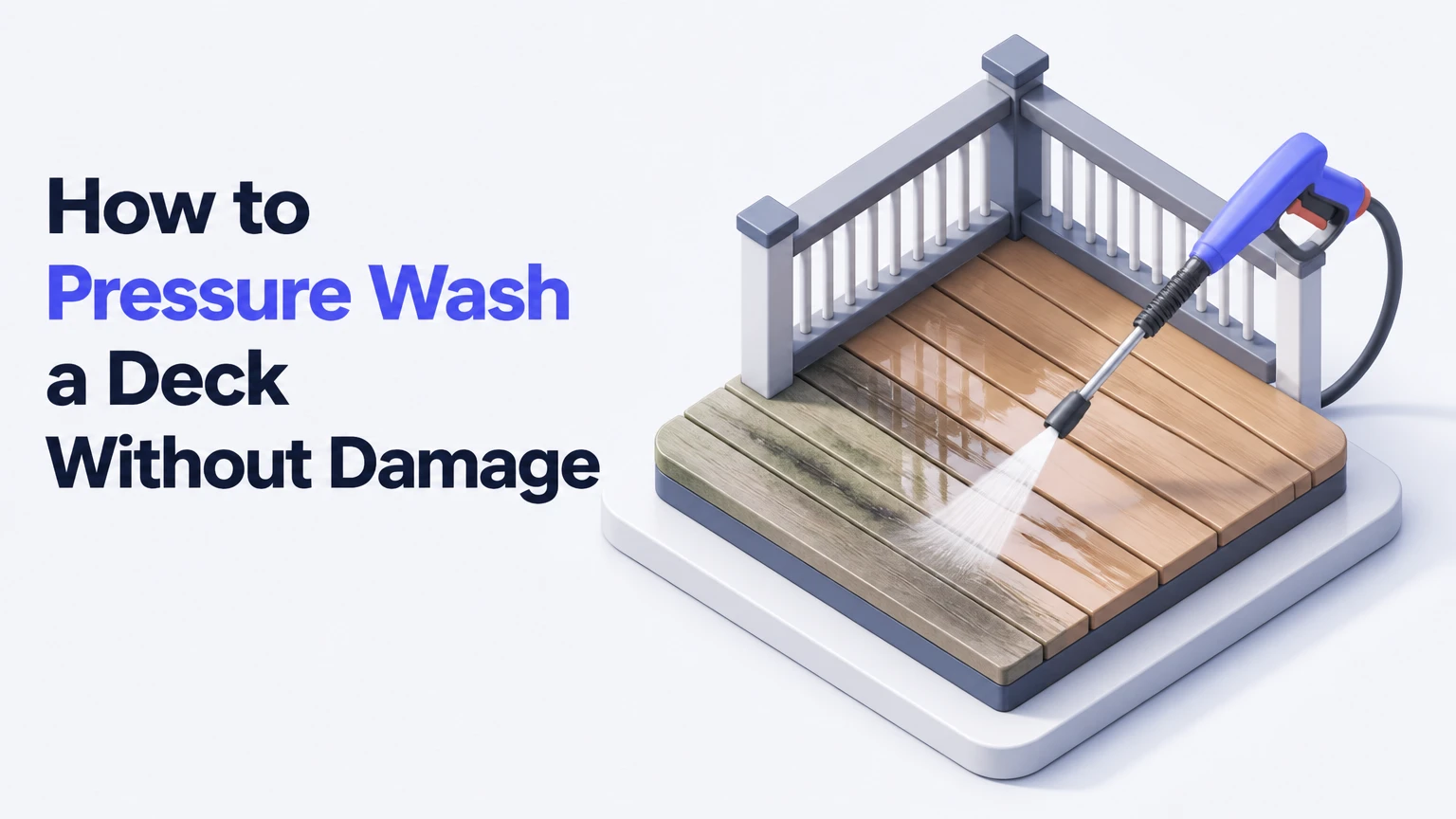
Pressure washing a deck safely requires a low-to-moderate pressure setting, a wide spray nozzle, wood cleaner, and controlled passes along the grain. Remove furniture, test a hidden area, clean in sections, rinse thoroughly, apply brightener when compatible, and let the deck dry for 48-72 hours before sanding or staining.
Key Facts at a Glance
- A typical wood deck can often be cleaned with 1,200-1,500 PSI, but soft cedar and redwood may require less.
- A 25-degree or 40-degree nozzle is generally safer for wood than a narrow 0-degree or 15-degree tip.
- Keep the wand moving, maintain a consistent 12-18 inch distance, and follow the grain.
- Deck cleaner should remain wet during its typical 10-15 minute dwell time.
- Wood should dry for at least 48 hours before coating, with longer drying needed in cool or humid weather.
- Pressure washing removes surface contamination and some failing finishes, but it does not repair rot, loose boards, or structural defects.
Before You Start
A small to medium deck usually takes 4-8 hours of hands-on work, excluding drying time. The safest setup is an electric pressure washer, a wood-specific cleaner, a wide nozzle, protective equipment, and a test area that confirms the pressure will not scar the boards.
Tools, materials, and prerequisites
| Item | Typical specification or quantity | Purpose |
|---|---|---|
| Pressure washer | 1,300-2,300 PSI electric unit | Cleaning a 100-300-square-foot deck |
| Wood cleaner | 1 gallon per 300-500 square feet | Loosening dirt, algae, and gray surface deposits |
| Nozzle | 25-degree and 40-degree tips | Controlled cleaning and rinsing |
| Pump sprayer | 1-2 gallons | Applying cleaner evenly |
| PPE | Eye protection, waterproof boots, chemical-resistant gloves | Protecting eyes, skin, and feet |
| Garden hose | 25-50 feet | Water supply and final rinsing |
| Brightener | 1 gallon per 300-500 square feet | Restoring pH and wood color after alkaline cleaner |
| Moisture meter | Wood setting, optional | Confirming readiness for stain or sealer |
Inspect the deck before connecting the machine. Replace rotten boards, secure loose railings, reset protruding nails, tighten screws, and remove splinters that could become larger under water pressure. Do not pressure wash a deck with active structural movement or severely deteriorated wood.
Check the weather forecast. Choose a mild day with no rain expected for at least 24 hours, moderate temperatures, and limited direct midday sun. Strong wind spreads cleaner onto windows, siding, people, and neighboring property.
How Does Pressure Washing Clean Wood?
A pressure washer combines water flow and pump pressure to separate dirt, organic growth, oxidized wood fibers, and failing coatings from the deck surface. PSI measures pressure, while GPM measures water volume; cleaning speed depends on both, although excessive PSI causes damage before higher flow provides a benefit.
Pressure is not the same as cleaning quality. A 2,000-PSI machine with 1.2 GPM may clean more slowly than a 1,500-PSI machine with 2.0 GPM, while the higher-pressure unit can leave deeper marks if the operator holds the wand too close.
Wood grain, moisture content, age, species, and coating condition change the safe operating range. The familiar “green nozzle equals deck cleaning” rule is only a starting point because nozzle orifice size, machine output, and wand distance also affect impact force.
Practitioner rule: begin with the lowest effective pressure, not the maximum pressure printed on the machine. Increase force only after a test patch proves that the wood can tolerate it.
Which Pressure Washer and Nozzle Should You Use?
An electric pressure washer is usually the best choice for a homeowner cleaning one deck because it is lighter, quieter, and easier to control. Gas equipment becomes useful for large decks or frequent work, but its higher output increases the consequence of poor distance and spray control.
| Equipment choice | Typical output | Suitable situation | Main limitation |
|---|---|---|---|
| Compact electric washer | 1,300-1,800 PSI, 1.2-1.6 GPM | Cedar, redwood, light dirt, small decks | Slower rinsing |
| Mid-range electric washer | 1,500-2,300 PSI, 1.5-2.0 GPM | Pressure-treated pine, mildew, 100-300 square feet | Requires an outdoor power outlet |
| Gas homeowner washer | 2,400-3,200 PSI, 2.0-2.8 GPM | Large decks and stubborn buildup | Heavy, loud, and easy to overuse |
| Commercial gas washer | 3,000-4,000+ PSI, 3.0-4.0+ GPM | Professional crews and large properties | Poor choice for inexperienced operators |
Nozzle angles and practical uses
| Spray angle | Common color | Deck use | Recommended starting distance |
|---|---|---|---|
| 0 degrees | Red | Do not use on wood | More than 24 inches is still unsafe |
| 15 degrees | Yellow | Limited spot work by experienced operators | 18-24 inches |
| 25 degrees | Green | General wood cleaning after testing | 12-18 inches |
| 40 degrees | White | Gentle rinsing and soft wood | 12-18 inches |
| 65 degrees | Black | Applying detergent at low pressure | 6-12 inches |
Color codes are common but not universal. Read the washer manual and inspect the angle stamped on the nozzle before use. Never use a rotating turbo nozzle, 0-degree tip, or surface cleaner attachment on a wood deck unless the equipment manufacturer specifically approves that combination.
Step 1: Clear, Sweep, and Protect the Deck
Remove furniture, rugs, planters, grills, toys, and loose decorations before washing. Sweep the deck boards, stairs, and gaps with a stiff outdoor broom, then protect nearby electrical outlets, delicate plants, painted surfaces, and open doors from spray and runoff.
Move plants away when possible rather than covering them for the entire cleaning period. If plastic sheeting is necessary, use it temporarily and rinse foliage with clean water before and after applying cleaner.
Inspect fasteners and boards while the surface is dry. Mark rotten areas with chalk, because pressure washing can make weak wood appear cleaner without making it structurally sound.
You will know Step 1 worked when: no loose debris remains, water can drain freely between boards, and every damaged fastener or board has been identified.
Common mistake: sealing off drainage gaps with plastic. Contained runoff can carry alkaline cleaner into the house foundation, garden soil, or a neighboring property.
Step 2: Test the Pressure and Spray Pattern
Attach the widest suitable nozzle, keep the trigger released while connecting the water supply, and run the machine briefly to remove air. Test a hidden board or the underside of a stair tread using a 40-degree nozzle from 18 inches away.
Make one pass along the grain, then inspect the wet and drying surface. If the test leaves a visible groove, pale stripe, lifted fiber, or rough texture, move farther away or reduce pressure. A clean test patch should have no sharp edge between treated and untreated areas.
For most pressure-treated pine, start around 1,200-1,500 PSI. Start lower on cedar, redwood, aged boards, and soft end grain. Manufacturer guidance for the machine and the deck coating takes priority over generic internet settings.
You will know Step 2 worked when: the test removes loose soil without exposing a gouge, fuzzy patch, or color change caused by impact.
Common mistake: beginning in the center of the deck. Start in an inconspicuous corner so an incorrect setting does not create the most visible damage.
Step 3: Apply a Wood-Safe Cleaner
Apply a deck cleaner with a pump sprayer or the pressure washer’s low-pressure detergent nozzle. Use the product label for dilution, because sodium percarbonate cleaners, alkaline detergents, and specialty mildew products have different concentrations and dwell times.
Work in sections of approximately 25-50 square feet. Keep the cleaner wet for the label’s dwell period, commonly 10-15 minutes, and mist additional water over drying areas. Do not mix products unless the label explicitly permits it.
Sodium percarbonate products release oxygen in water and are often used for organic soil and gray surface oxidation. Chlorine bleach can kill surface algae, but concentrated or repeated exposure may harm adjacent plants, discolor wood, and degrade some coatings. The U.S. Environmental Protection Agency’s pesticide-label guidance uses the direct rule, “The label is the law,” so follow the product label for application, protective equipment, and disposal.
You will know Step 3 worked when: dirt loosens into a gray or brown suspension and mildew becomes easier to remove without aggressive pressure.
Common mistake: allowing cleaner to dry. Dried detergent can leave pale patches and force the operator to increase pressure during rinsing.
Step 4: Pressure Wash Along the Grain
Set the machine to the lowest pressure that removes the loosened soil and use a 25-degree or 40-degree nozzle. Hold the wand 12-18 inches from the surface, squeeze the trigger before moving across a board, and sweep steadily in the direction of the grain.
Overlap passes by roughly 25-50 percent. Keep the nozzle moving at about 12-24 inches per second, depending on the wood condition and amount of soil. Release the trigger at the end of a board or in a gap, never while the spray is stationary on the middle of a board.
Clean one board length or small section at a time. Maintain the same distance, speed, angle, and direction across the entire area, because inconsistent technique creates stripes even when the pressure setting is correct.
You will know Step 4 worked when: the cleaned section has an even color, no visible wand tracks, and no raised fibers when lightly touched after rinsing.
Common mistake: tilting the wand so the spray cuts across the grain. Cross-grain impact can lift fibers and produce a rough surface that requires sanding.
Step 5: Rinse, Then Apply Brightener When Appropriate
Rinse from the house outward with a wide spray pattern until no foam, cleaner, or dirty runoff remains. If the cleaning product is alkaline and the label recommends brightening, apply a compatible wood brightener immediately after rinsing, allow its stated dwell time, and rinse again at low pressure.
Many wood brighteners contain oxalic acid or another acidifying ingredient. Brightener can reduce the dark or orange cast left by alkaline cleaners and help prepare wood for a penetrating stain, but it is not a substitute for removing failing paint or repairing damaged boards.
Keep acidic brightener away from masonry, metal furniture, glass, and sensitive plants unless the label provides protection instructions. Neutralization is a chemical process, not a reason to combine cleaner and brightener in the same sprayer.
You will know Step 5 worked when: the wood has an even appearance after rinsing and no slippery residue remains in board gaps or stair corners.
Common mistake: applying brightener over undiluted cleaner. Rinse the first product away; mixing acids with residues can create hazardous splashing and unpredictable results.
Step 6: Dry, Sand, and Protect the Deck
Allow the deck to dry for at least 48 hours in warm, dry weather and 72 hours or longer during cool, shaded, or humid conditions. Follow the stain manufacturer’s moisture limit, and use a moisture meter when the coating warranty specifies a maximum percentage.
After drying, inspect for raised grain, loose fibers, missed mildew, and remaining finish. Sand isolated fuzzy areas with 80-grit paper, then remove dust with a broom or manufacturer-approved method. Avoid aggressive sanding that creates depressions across otherwise sound boards.
Apply a compatible penetrating stain or sealer only when the wood, weather, and product label allow it. A coating applied to damp wood can blister, peel, or trap moisture; cleaning alone does not protect wood from ultraviolet exposure or repeated wetting.
You will know Step 6 worked when: the deck feels dry and stable, the surface accepts a small stain test evenly, and no dark damp patches remain in joints.
Common mistake: using a calendar deadline instead of checking the wood. Two sunny days may dry an exposed deck, while a shaded deck beside a wet foundation may need much longer.
Should You Pressure Wash or Soft Wash a Deck?
Pressure washing is preferable for loose dirt, gray oxidation, and failing stain that needs mechanical removal; soft washing is preferable for routine organic growth on sound wood and composite surfaces. Soft washing is not risk-free because chemical overspray, incorrect dilution, and runoff can damage plants, metals, coatings, and waterways.
| Situation | Pressure approach | Soft-wash approach | Better choice |
|---|---|---|---|
| Light dust on sound wood | 1,000-1,300 PSI, 40-degree tip | Mild cleaner, low-pressure rinse | Soft wash |
| Green algae on cedar | 800-1,200 PSI, wide tip | Oxygenated cleaner, gentle rinse | Soft wash |
| Gray weathered pine | 1,200-1,500 PSI, 25-degree tip | Cleaner followed by light agitation | Pressure-assisted wash |
| Peeling transparent stain | 1,300-1,800 PSI after testing | Chemical stripper, low-pressure rinse | Combined method |
| Solid paint removal | Controlled stripper and scraping | Low-pressure chemical removal | Professional assessment |
| Severely soft or rotten boards | Do not pressure wash | Do not chemically saturate | Repair or replace first |
Pressure washing also cannot guarantee removal of deep tannin stains, rust, old paint embedded in grain, or mildew roots inside decayed wood. A professional is the safer choice when the deck is elevated, boards are fragile, runoff cannot be contained, or a solid coating must be stripped without damaging surrounding siding.
How Does Deck Material Change the Method?
Deck material determines the safe pressure, cleaner, and finishing procedure. Cedar and redwood need gentler treatment than pressure-treated pine, while composite decking should follow the manufacturer’s cleaning instructions because heat, solvents, and concentrated chemicals can alter the surface.
| Deck material | Starting approach | Cleaner guidance | Important restriction |
|---|---|---|---|
| Cedar | 800-1,200 PSI, 40-degree tip | Oxygenated wood cleaner | Avoid close spray and aggressive sanding |
| Redwood | 800-1,200 PSI, 40-degree tip | Wood cleaner tested for tannins | Acid brightener may change color |
| Pressure-treated pine | 1,200-1,500 PSI, 25-degree tip | Alkaline or oxygenated deck wash | Check for loose fibers after drying |
| Ipe or dense hardwood | 1,000-1,500 PSI, wide tip | Product-approved hardwood cleaner | Avoid stripping natural oils unnecessarily |
| Composite decking | 800-1,200 PSI, 40-degree tip | Manufacturer-approved detergent | Avoid turbo nozzles, solvents, and heat |
| Painted deck | Test first, often chemical stripping | Coating-compatible stripper | Pressure alone can expose bare wood |
Composite boards are not wood, but they can still develop stripes, surface scuffing, and heat-related discoloration. Use the board manufacturer’s stated distance and pressure, and test beneath furniture before cleaning the visible field.
What Can Go Wrong, and How Do You Fix It?
Most deck-washing damage comes from excessive impact, inconsistent movement, incompatible chemicals, or coating the wood before it is dry. Stop washing when a problem appears, let the surface dry, and assess the entire board before attempting a cosmetic repair.
| Problem | Likely cause | Recovery |
|---|---|---|
| Fuzzy or raised fibers | Wand too close or pressure too high | Dry 48-72 hours, then sand affected areas with 80-grit paper |
| Dark or light stripes | Uneven distance, speed, or overlap | Reclean the whole board or section evenly |
| Circular marks | Turbo nozzle or stationary spray | Stop using the attachment; sand only after drying |
| Stain remains | Coating is sound or deeply embedded | Use a labeled stripper and scrape, or hire a specialist |
| Mildew returns quickly | Surface cleaning did not address persistent moisture | Improve drainage, shade, airflow, and use a labeled antimicrobial cleaner |
| White residue | Cleaner dried or rinse was incomplete | Rewet, lightly scrub, and rinse thoroughly |
Do not sand wet fuzz immediately. Wet fibers compress and can appear smooth until they dry, when the roughness returns. Do not increase pressure to solve a chemical problem, because more impact rarely removes a bonded coating evenly.
How Much Does Deck Washing Cost?
Typical DIY deck cleaning costs $65-$600 when equipment, cleaner, brightener, and finishing products are included. Professional service commonly costs $300-$800 for an average residential deck, with price affected by area, access, repairs, stain removal, elevation, and local labor rates.
| Cost category | Typical range | What changes the price |
|---|---|---|
| Electric washer rental | $40-$100 per day | Local rental market and machine output |
| Washer purchase | $150-$500 | PSI, GPM, hose length, and accessories |
| Deck cleaner | $15-$45 per gallon | Concentration and specialty formulation |
| Brightener | $15-$40 per gallon | Oxalic acid strength and coverage |
| Stain or sealer | $35-$90 per gallon | Product type and expected coverage |
| Professional cleaning | $300-$800 | Size, access, stripping, and repairs |
A 200-square-foot deck may require one rental day, two gallons of cleaner, one gallon of brightener, and one to two gallons of finish. Read coverage claims carefully because weathered wood absorbs more product than smooth, previously sealed boards.
How Often Should You Clean a Deck?
Most exposed wood decks benefit from inspection twice a year and cleaning every 12-24 months, while shaded or damp decks may need annual cleaning. Clean sooner when algae creates a slip hazard, leaves retain moisture, or dirt prevents a new stain from bonding.
Routine maintenance should begin with sweeping and drainage control rather than pressure. Keep gutters from discharging onto the deck, trim vegetation that blocks airflow, and remove wet leaves before organic growth becomes established.
Can You Pressure Wash a Deck Without a Machine?
A deck can be cleaned without a pressure washer using a garden hose, pump sprayer, stiff nylon brush, and labeled deck cleaner. Manual cleaning takes longer, but the lower impact is safer for fragile cedar, aged boards, painted surfaces, and areas where pressure could drive water behind siding.
Apply cleaner to a small section, scrub along the grain, and rinse from the house outward. Manual cleaning may not remove failing stain or heavy gray oxidation as quickly as controlled pressure, so a chemical stripper or professional service may be needed for restoration work.
Frequently Asked Questions
Can I use a 3,000-PSI pressure washer on a wood deck?
You can use a 3,000-PSI machine only if its pressure is reduced and the spray is tested on inconspicuous wood first. Keep the actual impact moderate by using a wide nozzle, sufficient distance, and continuous movement. The machine’s maximum rating is not a recommended deck setting.
Should I use bleach to clean a wooden deck?
Bleach can remove some surface algae, but it is not the default cleaner for every deck. Concentrated sodium hypochlorite may discolor wood, harm plants, corrode metal, and damage coatings. Choose a labeled deck product, protect runoff pathways, and never mix bleach with acids or ammonia.
Can pressure washing remove old deck stain?
Pressure washing can remove loose or failing stain, but it may not remove sound transparent stain, solid paint, or finish embedded in the grain. Use a compatible chemical stripper, scraping, and controlled rinsing when the coating does not lift during a low-pressure test.
How long after pressure washing can I stain my deck?
Wait at least 48 hours after pressure washing in warm, dry conditions, and wait 72 hours or longer in shade, humidity, or cool weather. The stain manufacturer’s moisture limit controls the final decision. Test the least visible board before coating the entire deck.
Why does my deck look worse after pressure washing?
Pressure washing can expose old oxidation, uneven stain, damaged fibers, and dirt that was masking color differences. Let the deck dry fully before judging it. Recleaning an isolated stripe often makes the contrast worse, so correct uneven sections across complete boards or defined areas.
Is a pressure washer safe for composite decking?
A pressure washer may be safe for some composite decking when used at low pressure with a wide nozzle and the manufacturer’s specified distance. Other products prohibit pressure washing or restrict it to particular settings. Follow the decking warranty instructions before cleaning, especially on older or capped boards.
The Bottom Line
To pressure wash a deck without damage, start with a test patch, use the lowest effective pressure, select a 25-degree or 40-degree nozzle, and keep the wand moving 12-18 inches above the boards. Clean with a compatible product, rinse completely, brighten when appropriate, and wait 48-72 hours before finishing. The safest method is controlled and material-specific, not the most powerful one.