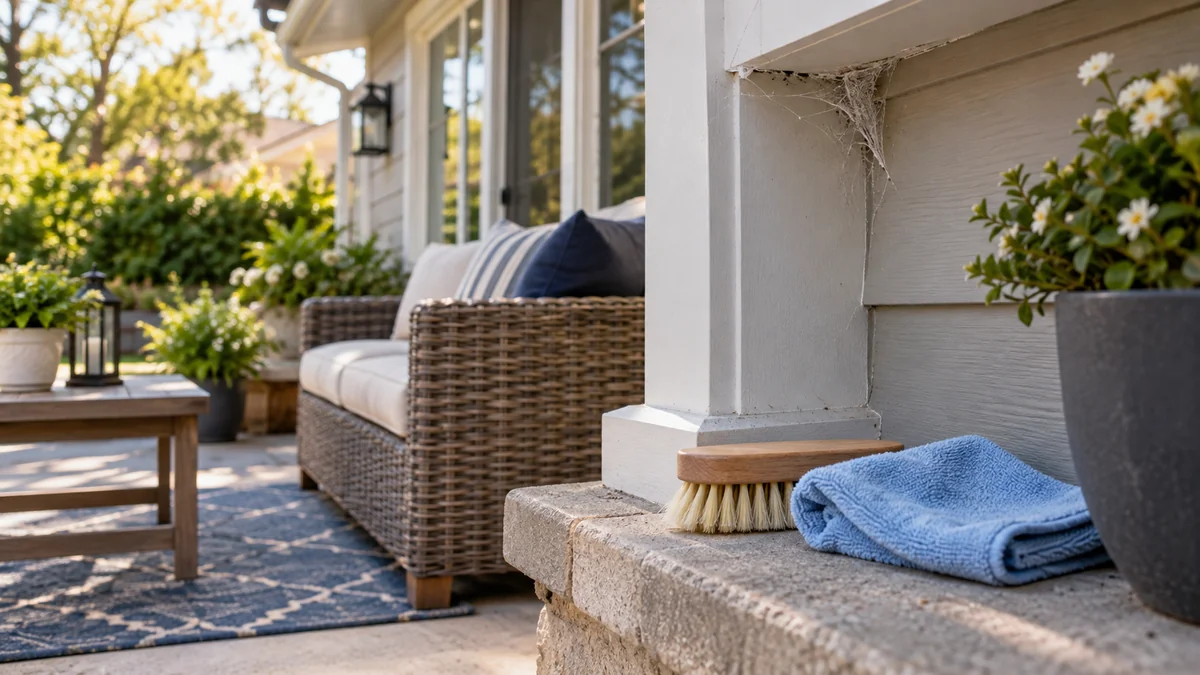
To keep spiders away from outside of house surfaces, remove webs, reduce the insects that attract them, trim vegetation, move sheltering clutter, seal genuine entry gaps, control exterior lighting, and apply only a label-approved perimeter treatment when needed. The most reliable results come from combining habitat modification with targeted exclusion rather than relying on a repellent spray alone.
Key facts at a glance
Spiders remain near houses mainly where prey insects, shelter, and undisturbed web sites are available.
Keep shrubs and branches about 12-24 inches from siding, windows, and foundations where practical.
Store firewood and dense yard clutter at least 20 feet from the house when space allows.
Essential-oil and vinegar sprays usually require reapplication after rain and do not provide a dependable long-term barrier.
Never seal brick weep holes, roof ventilation openings, or other drainage paths with caulk.
A typical DIY cleanup takes 30-90 minutes; professional exterior service commonly costs about $75-$200 per visit in the United States.
How Does Exterior Spider Control Work?
Exterior spider control works by breaking the conditions that support a spider population: food, shelter, attachment points, and access to the building. Spiders do not feed on siding or concrete, so persistent activity usually indicates nearby moths, flies, mosquitoes, beetles, or other arthropods.
A porch light can attract flying insects to a door. Those insects then provide food beside a sheltered eave, window frame, or railing. Removing webs without reducing insects often produces only temporary improvement.
The practical sequence is therefore:
- Remove existing webs and egg sacs.
- Reduce insects around doors, windows, and foundations.
- Eliminate vegetation and objects that create cover or bridges.
- Seal cracks around genuine entry points.
- Use a carefully selected barrier only where necessary.
Spiders also differ by species. Orb-weavers commonly build visible webs near lights and vegetation, while wolf spiders hunt across ground surfaces and may enter through door gaps. Black widows often prefer dark, sheltered clutter. A single treatment cannot address all three behaviors equally well.
What Should You Do First?
The following seven-step process is the most useful starting point for most detached homes, patios, garages, and porches. A basic cleanup usually takes 30-90 minutes, while sealing and treatment can extend the project to 2-4 hours.
Before You Start
| Requirement | Typical amount or specification |
|---|---|
| Time | 30-90 minutes for cleanup; 2-4 hours with sealing |
| Cost | $10-$35 for basic tools; $30-$80 with treatment |
| Tools | Cobweb duster, gloves, flashlight, caulk gun, garden hose |
| Materials | Exterior silicone or polyurethane caulk, door sweep, trash bags |
| Safety | Closed shoes, eye protection, labeled pesticide PPE if required |
| Weather | Dry conditions with 4-24 hours before likely rain |
Step 1: Remove Webs and Egg Sacs
Sweep webs from eaves, soffits, shutters, window corners, railings, light fixtures, and foundation ledges with a cobweb duster or soft broom. Remove visible egg sacs into a sealed bag, because leaving them attached allows the next generation to emerge near the same structure.
Use a garden hose at low or moderate pressure on washable masonry and siding when brushing is impractical. Avoid directing high-pressure water into soffit vents, window seals, electrical fixtures, mortar joints, or painted surfaces.
You will know this step worked when no fresh webbing remains in the target areas and the surrounding corners can be inspected clearly. Repeat weekly for two to three weeks during heavy activity.
Common mistake: spraying insecticide directly onto every web. Web removal physically disrupts the site, while many residual products work poorly on spiders because spiders may contact treated surfaces only briefly.
Step 2: Create a Vegetation Buffer
Trim branches, vines, shrubs, and tall grass so they do not touch siding, roof edges, windows, or doors. A 12-24-inch separation is a useful working target, although mature trees and fire-safety requirements may require a wider gap.
Vegetation creates two problems. It gives spiders protected travel routes onto the structure, and it supports insects that become prey. Prioritize plants beside porch lights, basement windows, garage doors, and shaded walls.
You will know this step worked when a person can walk around the foundation without brushing against foliage and no branch forms a direct bridge to the roof or eaves.
Common mistake: cutting plants but leaving dense mulch, leaf litter, or irrigation against the foundation. Those materials can continue supporting insects at ground level.
Step 3: Move Ground Clutter and Firewood
Move firewood, bricks, cardboard, unused pots, lumber, tarps, leaf piles, and dense yard waste away from the house. A 20-foot separation is a practical target for firewood and substantial clutter when the property permits it.
Keep necessary firewood on a raised rack rather than directly on soil. Wear gloves and closed shoes when moving stored materials, and inspect the underside of objects before lifting them. Dark, undisturbed spaces can shelter black widows, scorpions, centipedes, and stinging insects.
You will know this step worked when the foundation perimeter is visible and dry, with no object resting against siding or blocking inspection.
Common mistake: moving clutter only 2-3 feet away. That may improve access but still leaves a nearby refuge and can allow spiders to recolonize the wall quickly.
Step 4: Seal Real Entry Gaps
Seal cracks around door frames, window frames, utility penetrations, and siding transitions with an exterior-rated sealant. Install or replace door sweeps and weatherstripping when daylight is visible beneath or around a closed door.
Inspect basement windows, garage thresholds, foundation penetrations, vents, and pipe openings. Use metal mesh or an appropriately sized vent screen where a screened opening is designed to block insects.
Do not caulk brick weep holes, soffit ventilation, roof vents, or drainage openings. Weep holes release water from masonry cavities, and blocking them can trap moisture and damage the wall. This is an important correction to generic spider-control advice.
You will know this step worked when a flashlight inspection shows no continuous crack or daylight-sized gap at accessible doors and windows.
Common mistake: sealing a gap without fixing the door or window alignment that created it. A replacement sweep or adjustment may work better than repeated caulking.
Step 5: Reduce Insects Around the House
Reduce standing water, overflowing gutters, damp leaf litter, and overripe fruit that support flies or mosquitoes. Repair leaking outdoor taps and remove water from saucers, buckets, toys, and unused containers.
Do not spray the entire lawn simply because spiders are visible near the building. Targeting the foundation edge, cracks, entry points, and insect-producing problem areas usually uses less product and reduces exposure to non-target organisms.
Keep trash lids closed and clean spilled food near outdoor dining areas. If webs return beside a light, inspect the light’s insect activity before assuming the spider itself is the primary problem.
You will know this step worked when fewer moths, flies, and mosquitoes gather around doors and windows after sunset.
Step 6: Change Exterior Lighting
Use warm-colored bulbs, commonly around 2,200-3,000 Kelvin, instead of bright cool-white lighting where appropriate. Motion sensors, timers, shielding, and lower-wattage bulbs can reduce the time and intensity of illumination near entryways.
Yellow “bug” bulbs may reduce some insect attraction, but they are not insect-proof. Light color, brightness, fixture design, nearby vegetation, and local insect species all affect the result.
Aim fixtures downward and away from walls when security requirements permit. A wall-washing light can turn siding and eaves into a highly attractive insect-hunting zone.
You will know this step worked when fewer flying insects circle the fixture and fewer fresh webs appear beside it over the next one to two weeks.
Step 7: Apply a Targeted Perimeter Treatment
Use an outdoor pesticide only if sanitation, exclusion, lighting, and web removal do not control the problem. Select a product registered for the intended site and pest in your country, then follow its label for dilution, application rate, re-entry interval, protective equipment, waterways, edible plants, pets, and rain restrictions.
Common active ingredients in consumer and professional products include pyrethroids such as bifenthrin, deltamethrin, lambda-cyhalothrin, and cyfluthrin. Product performance depends on formulation, surface, weather, and application quality. A microencapsulated or polymer-stabilized formulation may persist longer than an unprotected spray, but no product remains equally effective on every surface.
Apply only to labeled foundation bands, cracks, door and window surrounds, eaves, or other approved sites. Keep spray away from ponds, drains, flowering plants, pollinators, and food-contact surfaces.
You will know the treatment was applied correctly when the surface is treated according to the label, allowed to dry fully, and not visibly dripping or pooling.
Common mistake: applying a stronger concentration than the label permits. More pesticide does not reliably produce better spider control and can increase risk to people, pets, plants, aquatic life, and beneficial insects.
Which Spider-Control Option Is Best?
The best option depends on whether the priority is low chemical exposure, long residual action, or professional identification. Environmental modification is the foundation for every property, while natural sprays offer convenience but usually have shorter persistence.
| Option | Typical cost | Typical persistence | Best use | Main limitation |
|---|---|---|---|---|
| Web removal and cleanup | $0-$25 | 3-14 days before repeat inspection | Visible webs and egg sacs | Does not remove nearby prey |
| Peppermint or eucalyptus spray | $5-$20 per batch | Hours to several days | Localized doors and patio furniture | Rain and sunlight reduce effect |
| Vinegar solution | $3-$10 | Short, usually days | Hard-surface spot treatment | Odor, surface compatibility, limited residual |
| DIY residual insecticide | $30-$80 initial kit | Often 30-90 days, label-dependent | Foundation and entry-point treatment | Handling and runoff risks |
| Diatomaceous earth | $10-$25 | Until wet or contaminated | Dry cracks and protected voids | Poor performance when damp |
| Professional service | $75-$200 per visit | Commonly 60-90 days, service-dependent | Recurrent or difficult infestations | Recurring cost and pesticide exposure |
Do Essential Oils or Vinegar Keep Spiders Away?
Peppermint, eucalyptus, tea tree, citrus oils, and vinegar may discourage activity temporarily on small, hard surfaces, but they are not dependable substitutes for exclusion and prey reduction. A commonly used household spray contains 15-20 drops of essential oil in 500 milliliters of water with a small amount of soap to disperse the oil.
The mixture must be shaken frequently because oil and water separate. Test it on an inconspicuous surface first, especially painted siding, natural stone, finished wood, and plastics. Reapply after rain and whenever the odor disappears.
Essential oils are not automatically safe. Concentrated oils can irritate skin, harm cats and other animals if misused, and contaminate surfaces. Vinegar can damage some stone, grout, metals, and plant tissue. These methods are most reasonable for limited, non-structural areas, not for a severe infestation or venomous-spider habitat.
When Is Diatomaceous Earth Appropriate?
Diatomaceous earth works through physical abrasion and desiccation, not through a volatile smell. It performs best as a thin, dry layer in sheltered cracks and voids, and it loses effectiveness after rain, condensation, or heavy dust accumulation.
Use only a product labeled for pest control, avoid creating airborne dust, and follow the package directions. Food-grade labeling alone does not make unrestricted outdoor application appropriate. Do not dust flowering plants, open paths, children’s play areas, or locations where pets inhale loose material.
How Much Does Exterior Spider Control Cost?
Typical United States costs range from $10-$35 for basic cleanup materials, $30-$80 for a DIY treatment setup, and $75-$200 for a single professional exterior visit. Annual professional programs commonly range from $200-$800, depending on property size, region, pest pressure, and service frequency.
| Approach | Initial time | Typical cost | Repeat interval |
|---|---|---|---|
| Cleanup only | 30-60 minutes | $0-$25 | Weekly inspection initially |
| Cleanup plus sealing | 1-4 hours | $15-$150 | Inspect each season |
| DIY labeled spray | 30-60 minutes | $30-$80 | Label-dependent, often 30-90 days |
| Professional treatment | 45-90 minutes | $75-$200 | Often 60-90 days |
| Annual maintenance plan | 2-6 visits yearly | $200-$800 | Monthly, bimonthly, or quarterly |
Prices vary substantially by location. A large home with detached garages, crawl spaces, roof access, or severe outdoor clutter requires more labor than a small townhouse entryway.
What Safety Rules Matter Around Pets and Children?
Keep children and pets away from wet pesticide and treated surfaces until the product label permits re-entry. Remove toys, food bowls, bedding, and outdoor dishes before application, and never spray an animal with a product intended for walls or foundations.
Natural products also require restraint. Tea tree, eucalyptus, peppermint, and concentrated citrus oils can irritate or poison animals when swallowed or applied improperly. Ask a veterinarian about species-specific risks, particularly for cats, birds, and small mammals.
For chemical treatments, record the product name, active ingredient, application date, and treated areas. Store concentrates in the original container, locked away from food and animal supplies.
Why Do Spiders Return After Spraying?
Spiders usually return after spraying because the underlying food source, shelter, or access route remains. Reappearance does not automatically mean that the pesticide failed.
| Observation | Likely cause | Corrective action |
|---|---|---|
| Webs return beside one light | Flying insects gather there | Use warmer, shielded, timed lighting |
| Spiders appear at garage threshold | Door sweep or frame gap | Repair the sweep and seal the frame |
| Activity follows rain | Repellent washed away or prey emerged | Reinspect, remove webs, follow label timing |
| Spiders remain in woodpile | Nearby protected refuge | Relocate and raise firewood |
| Many insects cover the siding | Food source remains | Address gutters, moisture, trash, or plants |
| Activity continues indoors | Structural entry route | Inspect windows, vents, doors, and foundation gaps |
A counterintuitive practitioner rule is that repeated web removal can outperform repeated spraying beside an untreated light. If the light continues attracting prey every night, a fresh spider may rebuild the web within hours.
Do not apply another pesticide immediately after a disappointing treatment. First check weather, surface preparation, dilution, target site, application coverage, and whether the product was labeled for spiders or merely for another outdoor pest.
When Should You Call a Pest Professional?
Call a licensed pest professional when spiders are numerous across several structures, identification is uncertain, occupants have been bitten, or black widow, brown recluse, funnel-web, or other medically significant species may be involved. Professionals can inspect harborage sites, identify species, and combine exclusion with targeted treatment.
Do not handle suspected venomous spiders or reach blindly into woodpiles, meter boxes, roof voids, or dense storage. Photograph the spider from a safe distance if identification is needed.
A professional visit should include more than spraying. Ask whether the service covers web removal, entry-point inspection, moisture and lighting advice, treatment boundaries, product names, re-entry instructions, and follow-up criteria. A contract that repeatedly sprays without addressing clutter, prey, or gaps may provide short-term reduction but poor long-term control.
Seasonal Maintenance Schedule
Exterior spider pressure often rises when warm weather increases insect activity, although timing varies by climate and species. A seasonal inspection prevents small harborage problems from becoming persistent infestations.
| Season | Priority inspection | Practical action |
|---|---|---|
| Spring | Eaves, lights, shrubs, stored materials | Remove overwintered webs and trim growth |
| Summer | Porch lights, irrigation, doors, shaded walls | Reduce insects and inspect weekly |
| Autumn | Firewood, leaf piles, garages, foundations | Move clutter and seal entry gaps |
| Winter | Indoor edges and sheltered storage | Inspect before moving boxes or firewood indoors |
Use a flashlight after dark to identify where insects gather. That simple observation often reveals whether the main problem is a light, a damp area, a plant, or a structural gap.
FAQ
Does turning off porch lights stop spiders?
Turning off porch lights can reduce spider activity when the fixture attracts moths, flies, or mosquitoes. It will not remove spiders already sheltering in cracks or vegetation. Motion sensors, warm low-intensity bulbs, downward shielding, and clearing webs around the fixture provide better control when the light must remain available.
Can I spray spiders directly outside?
Direct spraying may kill an exposed spider if the product label permits that use, but it does not prevent replacement spiders from arriving. Targeted web removal, prey reduction, exclusion, and a labeled residual treatment on approved structural surfaces usually provide better lasting control than repeatedly spraying individual spiders.
How often should I remove outdoor spider webs?
Inspect high-activity areas weekly for two to three weeks, then adjust to every two to four weeks according to the season. Remove webs promptly from lights, doors, windows, and eaves. Frequent web removal is particularly useful when combined with reduced lighting and vegetation clearance.
Are brown recluses found outside homes?
Brown recluse spiders can occur in sheltered storage areas, garages, sheds, and wall voids in parts of the central and southern United States. Correct identification matters because many brown spiders are harmless species. Avoid handling suspected specimens and seek local extension or pest-professional identification.
Will cedar mulch keep spiders away?
Cedar mulch is not a dependable spider barrier. Mulch can still retain moisture and shelter insects, and the effect of its odor declines outdoors. Keep mulch below siding, maintain a visible foundation edge, correct drainage, and focus on prey reduction and exclusion rather than relying on mulch type.
The Bottom Line
The most reliable answer to how to keep spiders away from outside of house areas is integrated prevention: remove webs, reduce insects, separate vegetation and clutter from the structure, preserve proper ventilation, seal genuine gaps, adjust lighting, and use labeled pesticide treatments only when necessary. Start with cleanup and habitat changes, then diagnose the specific location before spending money on stronger products.