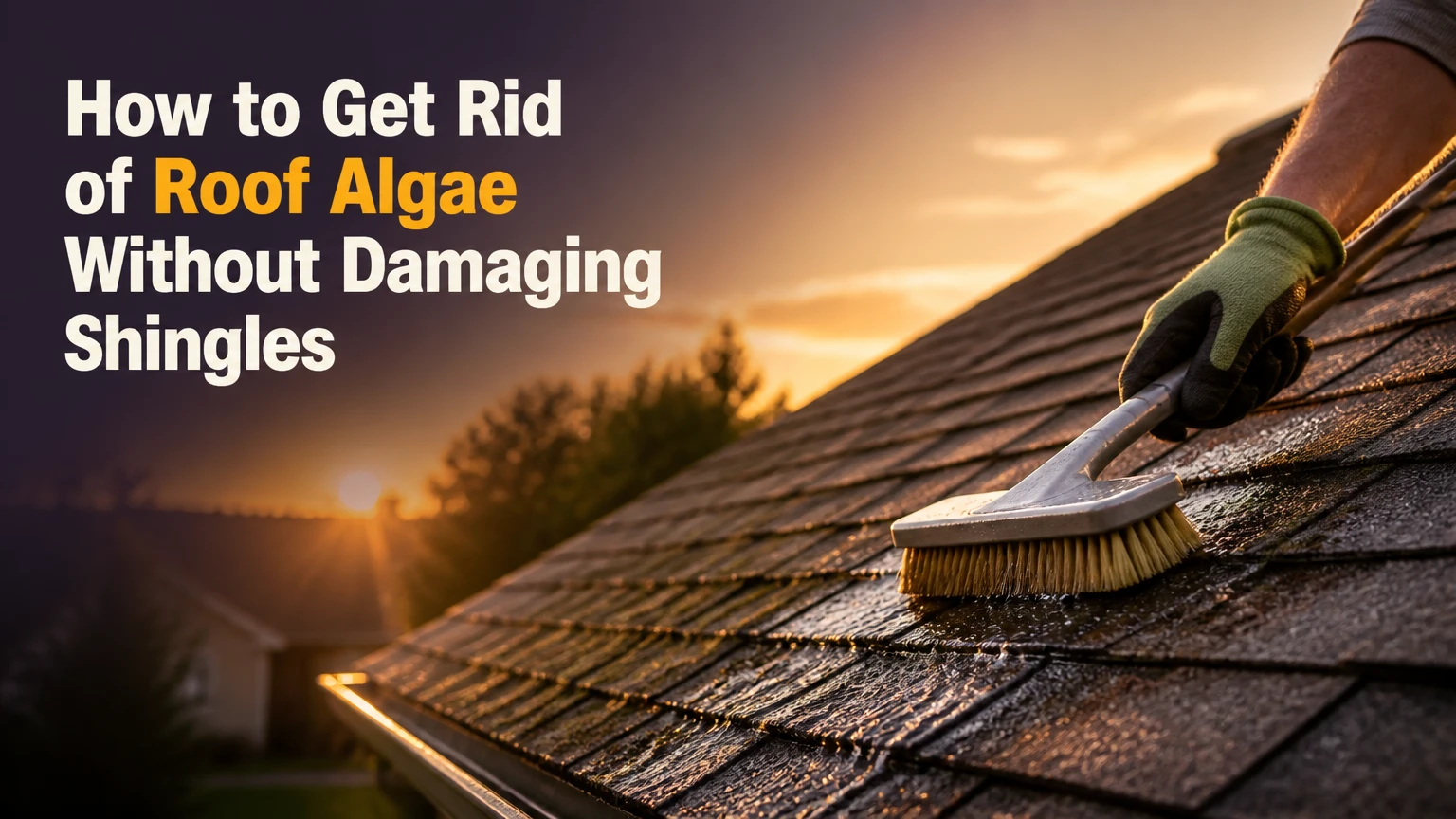
To get rid of roof algae, apply a roof-safe chemical treatment with a pump sprayer, allow the labeled dwell time, and rinse gently down the shingle slope. Avoid pressure washing, scrubbing, and upward spraying under shingle laps. The safest method depends on roof material, pitch, roof age, landscaping, and whether the algae has already damaged the shingles.
Key Facts at a Glance
- Dark roof streaks usually come from the cyanobacterium Gloeocapsa magma, not ordinary dirt.
- Asphalt shingle cleaning should use chemical treatment and low-pressure rinsing, not high-pressure washing.
- A typical bleach soft wash uses a diluted sodium hypochlorite solution, but the product label and shingle manufacturer take priority.
- Dead algae can remain visibly attached for 1-4 weeks after treatment while rain and weather remove the staining.
- Zinc or copper strips may slow regrowth, but they cannot restore lost granules or repair leaking shingles.
- A steep, wet, fragile, or multi-story roof is a professional-cleaning job rather than a suitable DIY project.
What Roof Algae Is and Why It Forms
Roof algae is usually a photosynthetic cyanobacterium called Gloeocapsa magma. Wind carries microscopic cells or spores to roofing surfaces, where repeated moisture, shade, and airborne dust allow colonies to develop, especially on north-facing slopes and beneath trees.
The familiar black streak is a protective pigment layer. The organism uses the surface environment for moisture and can interact with limestone filler in asphalt shingles, while trapped moisture and repeated biological growth contribute to granule loss and surface deterioration.
Roof algae differs from other roof growth. Algae creates flat black, blue-green, or brown discoloration. Moss forms raised green cushions and can lift shingle edges. Lichen appears as crusty gray, yellow, or pale green patches with root-like structures. Mold and mildew usually occur where organic debris and persistent dampness accumulate, often around shaded roof details.
Why Black Streaks Damage Asphalt Shingles
Black streaks do not always mean that a roof needs replacement, but long-term biological growth can shorten shingle life. Algae can retain moisture and make the roof surface darker, which increases solar heat absorption; moss and lichen create a more direct risk by lifting edges and working beneath the shingle surface.
The Asphalt Roofing Manufacturers Association, commonly called ARMA, recommends “the use of a non-pressure chemical cleaning method” for asphalt roofing products. That guidance matters because granules provide ultraviolet protection, and aggressive cleaning can remove the same granules that protect the asphalt binder.
Cleaning cannot reverse brittle matting, exposed fiberglass, widespread granule loss, curled tabs, or active leaks. A roof inspection should precede treatment when shingles are older than about 15-20 years, damage is visible from the ground, or the roof has leaked.
Before You Start: Safety, Weather, and Materials
A typical single-story asphalt roof takes 3-6 hours for preparation, treatment, rinsing, and cleanup. The work requires a dry forecast, low wind, safe ground access, and enough time to keep the solution from drying on the shingles.
DIY Preparation Checklist
| Requirement | Typical specification | Why it matters |
|---|---|---|
| Weather window | 24 hours without heavy rain | Prevents immediate dilution and runoff |
| Air temperature | 50-85°F | Supports predictable chemical action |
| Wind | Below 10 mph preferred | Limits plant and siding overspray |
| Pump sprayer | 1-2 gallon, chemical-resistant | Delivers controlled low-pressure coverage |
| Rinse equipment | Garden hose, fan nozzle | Removes residue without granule stripping |
| Protective equipment | Goggles, chemical gloves, non-slip footwear | Limits eye, skin, and fall exposure |
| Roof access | Single-story, low-to-moderate slope | Keeps ladder and fall risk manageable |
Read the roofing warranty and cleaner label before mixing anything. Some manufacturers publish approved cleaning formulas, while others restrict chlorine, solvents, abrasive tools, or certain metal treatments. Never combine bleach with ammonia, acids, vinegar, toilet cleaner, or other household chemicals because the mixture can release toxic gases.
A roof is not safe simply because the pitch looks moderate from the ground. Wet algae, surfactant, and chemical residue can make shingles extremely slick. Use a qualified professional when fall protection, roof anchors, or a ladder setup cannot be established safely.
Step 1: Protect Landscaping, Walls, and Drainage
Wet all plants beneath the roofline with clean water before applying cleaner. Saturated foliage absorbs less diluted chemical runoff, and a second rinse immediately after treatment reduces residue on leaves and soil.
Cover delicate plants temporarily with breathable fabric or plastic that can be removed quickly. Do not seal plants under plastic in direct sun. Move outdoor furniture, toys, grills, and uncovered rain barrels away from the runoff zone.
Disconnect or redirect downspouts if treatment water would enter a fish pond, storm drain, vegetable garden, or neighboring property. Collecting the first flush may be appropriate where local rules or sensitive waterways require it.
You will know Step 1 worked when: foliage is thoroughly wet, downspouts are controlled, and no people, pets, or uncovered objects remain in the runoff path.
Common mistake: soaking plants once and then leaving concentrated runoff on them. Keep a hose available throughout application and rinse again after the roof is complete.
Step 2: Choose and Dilute the Roof Cleaner
For heavy black staining on compatible asphalt shingles, a diluted sodium hypochlorite solution is commonly the fastest option. Household bleach is often sold at approximately 5-6% sodium hypochlorite, but concentrations vary, so calculate from the product label rather than assuming every jug has the same strength.
A practical starting point for a compatible asphalt roof is a weaker test mixture, followed by adjustment only if the label or roofing manufacturer allows it. Many professional cleaners use a stronger roof-washing solution than ordinary household cleaning, but a universal 50/50 bleach-and-water formula is not appropriate for every roof, plant setting, or product concentration.
| Cleaning approach | Typical action time | Main advantage | Main limitation |
|---|---|---|---|
| Diluted sodium hypochlorite | 10-20 minutes | Fast pigment and organism breakdown | Plant, metal, and runoff risk |
| Quaternary ammonium cleaner | 30 minutes to several hours | Lower immediate odor and slow residual action | Rain and weather may need weeks to clear stains |
| Sodium percarbonate | 15-30 minutes | Oxygen-based, useful near sensitive areas | Often needs repeated treatment or gentle brushing |
| Manufacturer-approved roof product | Label-specific | Warranty and material compatibility | Higher product cost or slower results |
Use a roof-cleaning surfactant only when the product label permits it. Dish soap can create excessive foam, interfere with runoff control, and increase plant exposure, so it is not automatically a safe substitute for a professional surfactant.
Test the solution on a small, inconspicuous section. Check the result after the label’s contact time and inspect nearby painted metal, gutters, flashing, siding, and plants before treating the full roof.
You will know Step 2 worked when: the test patch lightens without discoloring adjacent materials, and the solution remains wet for the planned dwell period.
Common mistake: increasing chemical strength because a stain does not disappear immediately. Dead algae may remain attached and weather away later.
Step 3: Apply the Solution With Low Pressure
Apply the cleaner with a pump sprayer or low-pressure soft-wash system, starting at the eaves and working toward the ridge. Lightly wet the shingles without flooding them, and keep the spray directed onto the roof rather than beneath shingle edges.
The bottom-up sequence helps prevent dirty chemical runoff from flowing over dry sections and reduces the tendency to push liquid under overlapping tabs. Use a broad fan pattern rather than a narrow jet. Do not use a pressure-washer tip, turbo nozzle, rotating surface cleaner, or abrasive brush on asphalt shingles.
Overlap each pass enough to avoid untreated vertical stripes. Treat one manageable roof section at a time, especially when sun, wind, or high temperature could dry the chemical before it acts.
You will know Step 3 worked when: the roof surface is evenly wet, black pigment begins to fade, and no chemical is entering attic vents, open windows, gutters, or wall cavities.
Common mistake: spraying upward into shingle laps. Water and chemical forced beneath the laps can wet underlayment, decking, insulation, or wall assemblies.
Step 4: Maintain the Labeled Dwell Time
Allow the cleaner to remain wet for the product’s stated contact time, often 10-20 minutes for a compatible sodium hypochlorite treatment. Re-mist drying areas lightly; do not apply a second heavy coat simply because some sections still look dark.
Chemical action and cosmetic removal are different events. The treatment can kill the algae quickly while the dark organic residue remains physically attached to the granules. Rain, wind, and several additional weather cycles may remove the remaining film.
Avoid walking on the treated roof. If a section dries unevenly, work from a ladder or ground-based system rather than crossing wet, slippery shingles.
You will know Step 4 worked when: the black color fades to gray, tan, or pale yellow and the surface remains wet without pooling.
Common mistake: extending dwell time indefinitely. A dry chemical film can leave residue, stress nearby finishes, and provide little extra biological benefit.
Step 5: Rinse Gently Down the Roof
Rinse from the ridge toward the eaves with a normal garden hose or another low-pressure system. Keep the water aligned with the shingle slope and never drive spray upward beneath the laps.
Flush gutters, downspouts, fascia, siding, windows, flashing, and plants after the roof section is complete. Work in sections so runoff does not dry on lower surfaces. Remove temporary plant coverings before heat accumulates beneath them.
A clean appearance immediately after rinsing is not the only success measure. The roof should have intact granules, no visible chemical residue, no new water entry, and no concentrated runoff left on vegetation or metal.
You will know Step 5 worked when: water runs clear from the eaves, the roof has no slippery residue, and plants and exterior walls have received a final clean-water rinse.
Common mistake: using a high-pressure washer because the first rinse leaves pale staining. Pressure may improve appearance for a day while removing protective granules permanently.
Which Roof Algae Cleaner Works Best?
Diluted sodium hypochlorite usually produces the fastest visible result on black algae staining, while quaternary ammonium and oxygen-based products reduce some runoff or odor concerns but often act more slowly. The best cleaner is the strongest product approved for the roof material and surrounding environment, not the strongest formula available.
| Decision factor | Sodium hypochlorite | Quaternary ammonium | Sodium percarbonate | Professional labeled product |
|---|---|---|---|---|
| Visible result | Minutes to hours | Days to 12 weeks | Hours to several days | Label-specific |
| Typical retail cost | $10-$25 per gallon | $30-$45 per gallon concentrate | $25-$40 per 5 pounds | Included in service |
| Plant sensitivity | High without rinsing | Moderate | Lower, label-dependent | Managed by trained crew |
| Manual scrubbing | Usually unnecessary | Usually unnecessary | Often helpful | Usually unnecessary |
| Heavy black streaks | Strong option | Moderate option | Variable option | Strong option |
| Material compatibility | Must be checked | Must be checked | Must be checked | Contractor responsibility |
No-rinse products can be useful where rinsing is difficult, but “no-rinse” does not mean risk-free. Runoff, wind drift, incompatible surfaces, and delayed stain removal still require management. Oxygen bleach is a reasonable alternative near gardens, yet “plant-safe” claims depend on concentration, exposure, and the specific plant.
When Should You Use a Professional Roof Cleaner?
Hire a professional when the roof is two or more stories, steep, fragile, wet, heavily moss-covered, or surrounded by sensitive landscaping. Professional pricing commonly falls around $300-$900 for a typical residential roof, with pitch, access, roof size, material, and regional labor rates causing substantial variation.
| Project condition | Typical service time | Typical cost range | Better choice |
|---|---|---|---|
| 1,500-2,000 sq. ft., single-story asphalt | 2-4 hours | $300-$650 | DIY or professional |
| Steep two-story asphalt roof | 3-6 hours | $500-$1,000 | Professional |
| Clay or concrete tile roof | 3-8 hours | $600-$1,500 | Material-trained professional |
| Metal roof with oxidation or coatings | 2-5 hours | $400-$1,200 | Roof-specific contractor |
| Moss, lichen, and damaged shingles | Inspection first | Cleaning plus repairs | Roofing contractor |
Ask for proof of general liability and workers’ compensation insurance. Request the cleaning method in writing, including chemical type, pressure approach, plant protection, runoff handling, and damage documentation.
A contractor who promises to make an old roof look new without inspecting granule loss is presenting a cosmetic promise, not a roof-maintenance plan. Photograph the roof before work and retain the invoice for warranty records.
How Much Does Roof Algae Removal Cost?
DIY treatment typically costs $75-$250 for cleaner, sprayer, gloves, eye protection, hose accessories, and plant protection. Professional roof cleaning commonly costs $300-$900 for an ordinary asphalt roof, although large, steep, tiled, or difficult-to-access roofs can exceed that range.
The square-foot price alone is a weak comparison. A small three-story roof may cost more than a large ranch roof because fall protection, hose reach, setup, and cleanup require more labor. Repairs, gutter cleaning, shingle replacement, and attic inspection are separate services.
Do not select the lowest quote if it includes pressure washing, vague chemical descriptions, no plant protection, or no written warranty limitation. A lower initial price can become expensive if granules are stripped or water is driven beneath the shingles.
Common Mistakes and How to Fix Them
Pressure Washing the Shingles
Pressure washing can remove mineral granules and expose the asphalt substrate. If a pressure washer was used, inspect gutters for unusual granule accumulation, check shingles for bald patches, and arrange a roofing inspection before applying more chemicals.
Mixing Incompatible Chemicals
Bleach mixed with ammonia, acids, or acidic roof products can produce dangerous gases. Stop immediately, leave the area, and contact emergency services or poison control if fumes, breathing difficulty, or eye exposure occurs.
Treating Moss as Algae
Chemical treatment may kill moss, but dead moss can remain attached and continue lifting shingle edges. Do not yank it off. Have a roofer assess whether the growth has penetrated or displaced shingles.
Cleaning a Roof With Active Leaks
Algae removal does not repair flashing, pipe boots, valleys, cracked tiles, or deteriorated underlayment. Identify and repair the leak first, because rinsing can reveal or worsen an existing pathway into the roof assembly.
Letting Runoff Reach Sensitive Areas
Bleach and other cleaners can injure foliage, corrode metals, and harm aquatic environments. Redirect downspouts, pre-wet and post-rinse plants, and follow local disposal requirements for concentrated runoff.
Why Did the Stains Return?
Roof algae can return within 6-24 months when shade, humidity, leaf litter, and moisture remain unchanged. A treatment kills existing growth but does not remove airborne spores or alter the roof’s exposure conditions.
Trim branches that shade the roof, keep gutters flowing, remove leaf piles, and correct plumbing or ventilation sources that keep sections damp. A practical goal is to reduce persistent shade and maintain clear drainage, rather than trying to create a precise clearance distance that every property cannot achieve.
Zinc or copper strips installed beneath the ridge-cap course can release metal ions during rain and slow biological regrowth on downstream shingles. Metal strips do not clean existing stains, repair leaks, or protect areas that rainwater cannot reach. Copper runoff can also affect aquatic life and some metal components, so installation requires material and drainage review.
When reroofing, ask about algae-resistant shingles containing copper or other manufacturer-approved protective granules. Their protection is designed into the shingle and can last for much of the product’s stated service life, but it is not a guarantee against all staining in heavily shaded environments.
Roof-Material and Situation Variations
Asphalt Shingles
Use a manufacturer-approved non-pressure chemical method and avoid brushing, scraping, and concentrated jets. Older shingles can lose granules during ordinary handling, so a roof inspection is more important than chemical selection.
Clay and Concrete Tile
Tile can tolerate different cleaning methods than asphalt, but brittle tiles, cracked edges, porous surfaces, and aging coatings remain vulnerable. Never assume a tile roof can receive the same bleach concentration or rinsing force used on asphalt.
Metal Roofing
Metal panels may tolerate low-pressure washing, but coatings, fasteners, sealants, oxidation, and adjacent plants can react to cleaners. Avoid leaving chemical solution on exposed fasteners, painted finishes, or unprotected aluminum.
Low-Slope Roofs
Low-slope membrane roofs require specialized drainage and material guidance. Standing water and chemical residue create different risks than on steep shingle roofs, and a roofing contractor should identify the membrane before treatment.
Dense Gardens or Fish Ponds
Choose a label-approved lower-risk product or hire a contractor who can control runoff. Covering a fish pond is not enough if contaminated water can still enter through gutters, soil, or overflow channels.
FAQ
Can I Remove Roof Algae With Vinegar?
Vinegar is not a dependable roof-algae treatment and can affect metal, sealants, plants, and surrounding soil. A manufacturer-approved roof cleaner provides more predictable biological control. Never combine vinegar or another acid with chlorine bleach because the reaction can release chlorine gas.
How Long Does Roof Algae Take to Disappear After Cleaning?
A chemically treated roof may lighten within minutes, but attached dead staining commonly takes 1-4 weeks of rain and weather to disappear. Persistent pale residue after that period can indicate mineral deposits, incomplete rinsing, lichen, or granule discoloration rather than living algae.
Should I Replace Shingles With Black Streaks?
Black streaks alone usually do not require shingle replacement. Replacement becomes more reasonable when inspection finds widespread granule loss, cracking, curling, exposed asphalt, lifted tabs, repeated leaks, or a roof near the end of its expected service life.
Does Rain Wash Away Roof Algae?
Rain can remove dead algae after treatment, but ordinary rain rarely eliminates an established colony by itself. Rainwater flowing over zinc or copper can slow regrowth, while shaded roofs with persistent moisture may develop new staining despite frequent rainfall.
Can I Clean Roof Algae From the Ground?
Ground-based cleaning is safer than walking on shingles, but the sprayer must still deliver even coverage without forcing solution beneath laps or onto plants. Extended wands can reduce fall exposure, although roof edges, dormers, valleys, and hidden areas may remain untreated.
How Often Should a Roof Be Cleaned?
There is no universal cleaning interval. Inspect the roof annually and treat when staining begins, while correcting shade and debris conditions that promote regrowth. Repeated annual chemical cleaning can be unnecessary or harmful if the roof is aging, so evaluate the surface condition before every treatment.
The Bottom Line
To get rid of roof algae safely, identify the growth, verify the roofing material, protect landscaping, apply an approved chemical with low pressure, maintain the labeled dwell time, and rinse down the slope with a garden hose. Do not pressure wash asphalt shingles or scrub away granules. For a steep, fragile, multi-story, tiled, or leaking roof, use a properly insured roof-cleaning or roofing professional. Prevention through shade reduction, clean drainage, and compatible zinc, copper, or algae-resistant shingle options usually lasts longer than repeated aggressive cleaning.