To get poop smell out of leather car seats, remove all solid and liquid residue first, then use a leather-safe enzymatic cleaner sparingly, dry the seat completely, and adsorb remaining odor with charcoal. The decisive factor is contamination depth: surface residue can often be treated in one session, while liquid inside perforations, seams, or foam usually requires professional extraction.
Key Facts
Leather-safe enzymatic cleaner removes organic residue; baking soda and charcoal mainly reduce residual odor.
Never pour cleaner directly onto a leather car seat, especially a perforated seat.
Fresh fecal contamination usually takes 30-60 minutes of active work plus 12-24 hours of drying.
Returning odor during hot or humid weather often indicates contamination below the leather surface.
Bleach, ammonia, undiluted vinegar, and household disinfectants can damage automotive leather coatings.
Professional seat treatment typically costs about $150-$400, with disassembly costing more.
Why Does Poop Smell Stay in Leather Car Seats?
Fecal odor stays in leather car seats when volatile organic compounds and microscopic organic residue remain in the grain, seams, perforations, or seat cushion. Compounds associated with fecal odor include indole, skatole, sulfur compounds, and ammonia-related gases. Warm, humid conditions increase evaporation, so a seat may smell clean when cool and foul again after the vehicle heats up.
Automotive “leather” is commonly coated leather or a leather-and-polyurethane construction rather than untreated hide. The protective finish limits absorption, but it does not make the seat impermeable. Liquid can travel through stitching and perforations into polyurethane foam, where surface wiping cannot reach it.
The source matters more than the fragrance. A scented spray may mask odor for several hours, but it does not remove fecal proteins, fats, or contaminated moisture. Enzymatic cleaners can help digest organic residue, but they are not magic products: they work poorly on a dry, clean surface where the remaining odor has already migrated into foam.
Smooth, perforated, and synthetic leather differences
| Seat surface | Main risk | Safe treatment approach | Escalation signal |
|---|---|---|---|
| Smooth coated leather | Finish discoloration from chemicals | Damp cloth, small cleaner amount, immediate drying | Odor returns after 24 hours |
| Perforated leather | Liquid and powder entering holes | Foam or cloth application, no saturation | Smell returns with seat ventilation |
| Leatherette vinyl | Finish dulling or sticky residue | Manufacturer-approved interior cleaner | Surface becomes tacky |
| Suede or Alcantara inserts | Permanent water rings and matting | Fabric-specific cleaner only | Any visible dye or texture change |
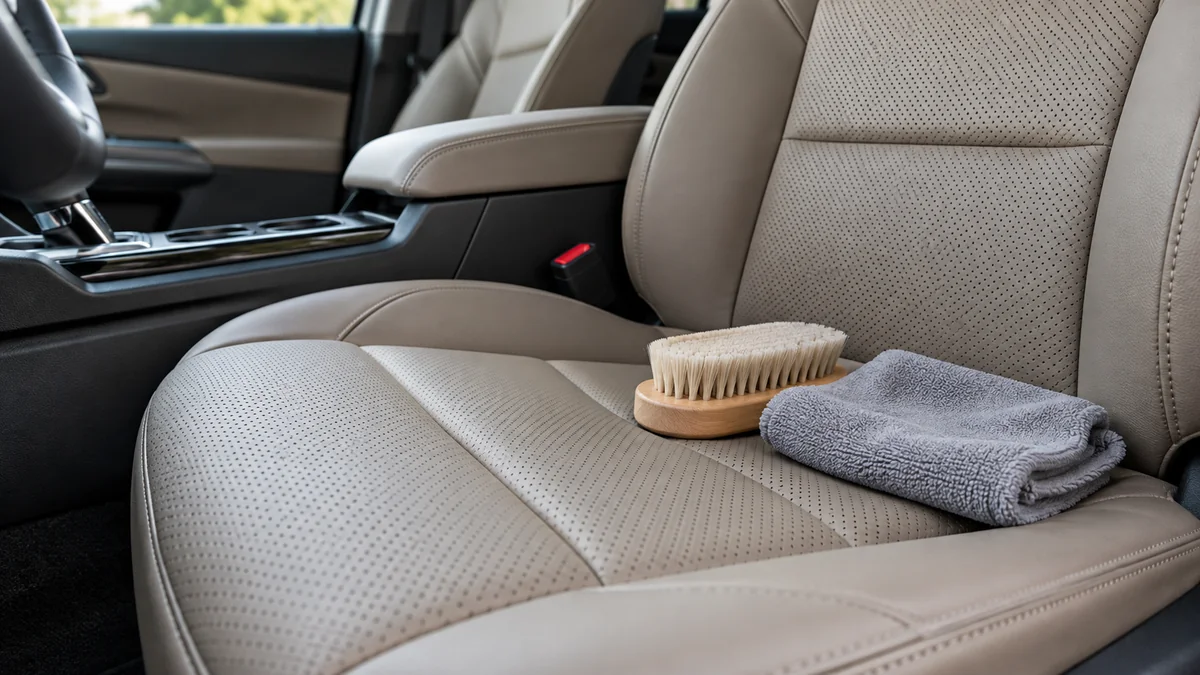
A perforated seat needs more restraint, not more liquid. Seat cooling and heating systems can pull contamination toward the foam and ventilation channels, while a wet brush can push it downward.
What Should You Prepare Before Cleaning?
Prepare nitrile gloves, disposable absorbent towels, a soft vacuum brush, white microfiber cloths, a leather-safe enzymatic cleaner, a pH-balanced leather cleaner, distilled water, a soft detailing brush, and activated-charcoal bags. Expect 30-60 minutes of active work, 12-24 hours of drying, and a typical DIY cost of $20-$60.
Park outdoors or in a well-ventilated garage. Switch off seat heating and cooling, remove keys from the vehicle, and keep children and pets away from contaminated materials. If the waste is human and someone involved has an infectious illness, follow local public-health guidance for contaminated waste and hand hygiene.
| Item | Typical quantity | Typical cost | Purpose |
|---|---|---|---|
| Nitrile gloves | 2-4 pairs | $3-$8 | Protect hands during removal |
| White microfiber cloths | 6-10 | $8-$20 | Blotting and dye-transfer checks |
| Leather-safe enzyme cleaner | 250-500 ml | $12-$25 | Organic-residue treatment |
| Distilled water | 500 ml | $1-$2 | Controlled damp wiping |
| Soft detailing brush | 1 | $6-$15 | Seams and textured surfaces |
| Activated charcoal bags | 2-4 bags | $10-$25 | Passive odor adsorption |
| Leather conditioner | 100-250 ml | $10-$25 | Post-cleaning finish care |
Read the product label before using any enzyme cleaner. Some products are intended for fabric, carpet, or hard surfaces and may contain solvents or alkaline builders that are unsuitable for coated leather.
How Do You Get Poop Smell Out of Leather Car Seats?
The complete method has six stages: remove solids, lift dry residue, blot moisture, apply a leather-safe enzyme cleaner, dry fully, and adsorb remaining odor. Treating one seat usually takes 30-60 active minutes, but the seat should remain unused for 12-24 hours when possible.
Step 1: Remove solid waste without rubbing
Put on gloves and lift solid material with disposable paper towels, a plastic scraper, or stiff cardboard. Work from the outside edge toward the center, and place contaminated material directly into a sealable waste bag.
Do not scrub fresh feces into the leather grain. Do not use a household vacuum on wet waste because the hose and canister can become contaminated.
You will know this step worked when: no visible solids remain and the seat surface has not been spread beyond the original area.
Common mistake: pressing down with a towel. Replace pressing with lifting and folding the towel inward after each pass.
Step 2: Remove dry particles and inspect the seat
Allow only a thin surface film to dry if the material is already semi-dry. Use a vacuum with a soft brush attachment, holding the nozzle slightly above smooth leather rather than grinding it against the finish.
For perforated leather, vacuum gently across the surface. Avoid directing strong suction into individual holes, because suction can pull loosened debris deeper into the cushion or distort fragile perforation edges.
Inspect the seat with a bright light. Check the seat belt buckle area, piping, seams, adjustment controls, child-seat contact points, and the floor beneath the seat. Odor often remains in a missed seam rather than on the obvious stain.
You will know this step worked when: loose particles are gone and the remaining mark is a thin residue or discoloration.
Common mistake: using a stiff household brush. Hard bristles can polish or scratch the clear protective coating.
Step 3: Blot contamination with controlled moisture
Dampen a white microfiber cloth with distilled water and wring it until no water drips. Fold the cloth into a small pad and blot the contaminated area from the perimeter inward.
Use separate cloth sections for each pass. Rinse or replace the cloth when it becomes visibly dirty. Do not make the leather visibly wet, and do not push water into perforations, stitching, or seat-control gaps.
Distilled water is useful because it reduces mineral residue, but it is not a disinfectant and will not neutralize fecal odor by itself. The purpose of this stage is controlled transfer, not soaking.
You will know this step worked when: the cloth picks up less residue and the leather feels only slightly damp.
Common mistake: pouring water on the seat to “flush” it. Flushing can move contamination into foam and electrical components.
Step 4: Apply a leather-safe enzymatic cleaner
Test the cleaner on a hidden section, such as the lower rear edge of the seat. Wait at least 5-10 minutes, then inspect the white cloth for dye transfer, sticky residue, finish change, or darkening.
Apply the cleaner to a microfiber cloth or soft brush, not directly to the seat. Treat an area about 10 by 10 centimeters at a time. Use enough product to dampen the cloth and surface lightly, then allow the label-specified dwell time, commonly 5-15 minutes.
Work gently along the leather grain and across seams. On perforated seats, use a small amount of foam on the surface and remove it promptly. Do not force liquid through the holes with a brush.
After dwell time, wipe with a clean, barely damp cloth and then towel-dry. Enzyme activity depends on contact with organic residue, but excessive liquid increases the chance of foam contamination.
You will know this step worked when: visible residue is gone and the odor is weaker while the seat remains structurally dry.
Common mistake: repeating applications immediately. Allow the seat to dry first, because repeated wetting can create a deeper problem than the original odor.
Step 5: Dry the seat completely
Blot the treated area with a dry towel, open the vehicle doors, and use ambient airflow. A fan outside the vehicle can shorten drying time, but do not use a heat gun, hair dryer on high heat, or heated seat function.
Drying commonly takes 2-8 hours for a lightly treated smooth seat and up to 24 hours when seams or perforations were involved. Humidity, temperature, foam thickness, and product quantity control the actual time.
You will know this step worked when: the seat matches the surrounding leather temperature and texture, feels dry at seams, and produces no damp smell.
Common mistake: closing the car immediately. Trapped humidity can preserve odor and slow evaporation.
Step 6: Adsorb residual odor after drying
Place two or more activated-charcoal bags on or near the affected seat for 24-72 hours. Charcoal is preferable to loose powder on perforated leather because it cannot fall through the holes.
Baking soda can help on smooth, dry, coated leather, but use a thin layer and remove it with a soft brush vacuum. Do not spread loose baking soda over perforated seats, seat ventilation openings, or seams.
Adsorbents capture some airborne and surface odor molecules; they do not remove fecal material hidden in foam. If the smell returns strongly after charcoal treatment, repeat cleaning only after locating the source.
You will know this step worked when: the cabin smells neutral after sitting closed for several hours, including when the seat is warm.
Common mistake: using fragrance as the final treatment. Fragrance can combine with fecal odor and make diagnosis harder.
Which Odor Treatment Works Best?
A leather-safe enzymatic cleaner is the best first choice when organic residue remains on the surface. Activated charcoal is better for lingering airborne odor, while baking soda is a limited supplementary option. Chlorine dioxide and ozone treatments should not replace physical removal or be used casually inside an occupied vehicle.
| Method | Best use | Typical time | Main limitation |
|---|---|---|---|
| Enzymatic leather-safe cleaner | Surface fecal residue | 5-15 minute dwell | Can damage leather if oversaturated |
| Activated charcoal | Residual cabin odor | 24-72 hours | Does not remove hidden residue |
| Baking soda | Dry, smooth surface odor | 8-24 hours | Enters perforations and creates dust |
| Chlorine dioxide service | Severe cabin odor after cleaning | 4-6 hours treatment | Vehicle must be vacant and ventilated |
| Ozone service | Professional post-cleaning deodorization | 1-3 hours typical | Can irritate lungs and damage some materials |
| Professional extraction | Foam or seam contamination | 1-3 days including drying | Costs more and may require seat removal |
An enzyme product is not a disinfectant unless its label specifically makes that claim and identifies an appropriate registration or use direction. Likewise, chlorine dioxide or ozone can neutralize some odor molecules but cannot collect solids or extract contaminated foam.
Should you use vinegar, bleach, or household cleaner?
Do not use bleach, ammonia, hydrogen peroxide mixtures, abrasive powders, or undiluted vinegar on automotive leather. These products can discolor pigment, weaken the finish, leave residues, or react dangerously when mixed with other cleaners.
A diluted vinegar solution is often suggested online, but acidity does not reliably remove fecal residue and can dull or dry some leather coatings. If a vehicle manufacturer permits a specific diluted product, follow the owner’s manual and product directions; otherwise, choose a cleaner labeled for automotive leather.
How Much Does Professional Leather Odor Removal Cost?
Professional interior odor removal typically costs $150-$400 for deep cleaning, while seat-cover removal, foam treatment, or replacement can raise the total above $500. Prices vary by region, contamination area, seat construction, and whether the shop must remove powered or ventilated seats.
| Service level | Typical price | Typical duration | Appropriate situation |
|---|---|---|---|
| Targeted leather cleaning | $75-$150 | 1-2 hours | Small surface accident |
| Full interior detail | $150-$300 | 3-6 hours | Seat, carpet, and trim odor |
| Foam or perforation treatment | $250-$500 | 1-2 days | Liquid entered cushion |
| Seat-cover removal | $400-$800+ | 1-3 days | Persistent deep contamination |
| Seat-cushion replacement | $500-$1,500+ | 1-3 days | Severe contamination or damaged foam |
Ask the detailer whether the quote includes the seat foam, seat rails, carpet beneath the seat, door pockets, and HVAC intake. A shop that only sprays deodorizer on the leather may reduce the smell temporarily without treating its source.
When Does a Leather Car Seat Need Professional Treatment?
Professional treatment is warranted when odor remains after one careful cleaning and complete drying, when contamination entered perforations, or when the smell becomes stronger as the cabin warms. Persistent odor usually means the source lies in foam, stitching, carpet, or an overlooked nearby surface.
Stop DIY treatment and arrange inspection if any of these conditions apply:
- Liquid visibly entered seat holes, seams, or adjustment gaps.
- The seat contains heating, cooling, massage, or powered ventilation hardware.
- The leather coating is peeling, cracked, sticky, or changing color.
- The odor remains after 24-48 hours of drying and charcoal adsorption.
- The smell returns every time the vehicle reaches approximately 25-30°C.
- A child, pet, or passenger may have contaminated the carpet under the seat.
- The accident involved diarrhea, blood, or a known infectious illness.
A professional can remove the seat, inspect the foam, extract contaminated material, and clean surfaces that cannot be reached through the leather. Seat removal should follow the vehicle manufacturer’s procedure because powered seats and airbags may contain electrical connectors.
What If the Seat Is Perforated?
For a perforated leather car seat, remove solids dry, apply cleaner to a cloth or controlled foam rather than spraying the holes, and remove residue before it migrates into the cushion. Never pour liquid or loose baking soda over a ventilated seat.
Use a soft vacuum across the surface, then inspect the holes under bright light. If dry baking soda has entered the perforations, use a narrow vacuum attachment held above the surface or short, low-pressure bursts of clean compressed air directed away from the seat. Avoid metal picks, which can enlarge holes and damage the backing.
Do not use the vehicle’s seat ventilation fan to dry or distribute cleaner. The fan may pull moisture and odor into internal channels. If odor increases when ventilation operates, stop using the feature and seek professional treatment.
Common Mistakes and How Do You Fix Them?
| Mistake | Result | Recovery |
|---|---|---|
| Saturating the seat | Contamination enters foam | Stop wet cleaning and dry completely |
| Using bleach or strong APC | Finish damage or discoloration | Wipe with manufacturer-approved cleaner |
| Applying steam early | Moisture and heat drive odor deeper | Cool and dry, then reassess source |
| Spraying fragrance first | Odors combine and become harder to identify | Ventilate and return to source removal |
| Scrubbing perforations | Debris moves into holes | Vacuum gently and inspect foam risk |
| Conditioning wet leather | Traps moisture under residue | Remove conditioner, then dry thoroughly |
Steam is not automatically harmful to every automotive interior, but it is a poor first response to fecal contamination on leather. Heat can spread moisture, soften coatings, and drive residue toward seams before the source has been removed.
Leather conditioner belongs after cleaning and drying, not before. Use a small amount of a product intended for coated automotive leather, and avoid conditioners that leave a greasy film because oily residue can retain dust and odor.
What Should You Do for Fresh, Dried, or Pet Accidents?
Fresh accidents require immediate solid removal and blotting, dried accidents require gentle particle removal before moisture, and pet accidents often require inspection of the carrier, blanket, floor mat, and door trim. The same cleaner is not equally appropriate for every situation.
| Situation | First priority | Treatment intensity | Likely next step |
|---|---|---|---|
| Fresh surface accident | Lift and blot | One controlled enzyme application | Dry and use charcoal |
| Dried residue | Vacuum particles | Two light passes if needed | Inspect seams and piping |
| Pet carrier accident | Clean seat and carrier | Clean nearby carpet and mat | Wash removable fabrics |
| Child-seat accident | Clean seat contact zone | Inspect buckle and creases | Clean child-seat cover separately |
| Perforated-seat accident | Prevent liquid migration | Minimal foam application | Professional inspection if odor returns |
| Repeated accidents | Identify broader source | Full interior inspection | Replace contaminated absorbent items |
For pet accidents, clean the carrier, blanket, harness, and floor mat separately. A seat can appear clean while the odor source remains in a fabric carrier positioned directly above it.
How Do You Know the Odor Is Gone?
A leather car seat is odor-free only when the smell remains absent after complete drying, a closed-car period, and moderate warming. Test the seat by closing the vehicle for 2-4 hours, then opening the door and checking the seat, floor, belt, and nearby trim separately.
Do not judge success immediately after applying a scented cleaner. Test again the next day with the air conditioning and seat ventilation switched off, then repeat with normal cabin airflow. Odor that appears only when the seat ventilation operates points toward internal contamination.
FAQ
Can I use an enzyme cleaner made for carpets on leather?
Use a carpet enzyme cleaner on leather only when the label explicitly permits leather and provides compatible directions. Carpet formulas may contain stronger surfactants, solvents, or alkaline ingredients. A product labeled for automotive leather and organic odors is the safer choice, applied to a cloth in a hidden-area test first.
How long should baking soda remain on a leather seat?
Leave a thin layer of baking soda on smooth, dry, coated leather for approximately 8-24 hours, then remove it with a soft vacuum brush. Avoid baking soda on perforated leather because powder can enter cooling holes and seams. Activated-charcoal bags provide a cleaner alternative for ventilated seats.
Will leather conditioner remove poop smell?
Leather conditioner will not remove poop smell because conditioner does not digest or extract fecal residue. Apply conditioner only after the seat has been cleaned and dried. Conditioner used too early can trap moisture, create a greasy film, and make later cleaning less effective.
Why does my car smell worse when the air conditioner runs?
The odor may be coming from the cabin air filter, HVAC evaporator, floor carpet, or seat ventilation channels rather than the visible leather. Compare the smell with seat ventilation off and inspect the carpet beneath the seat. Replace a contaminated cabin filter and request HVAC cleaning if the odor persists.
Can I drive the vehicle while charcoal bags are working?
You can drive with activated-charcoal bags in the vehicle when the bags are secured and do not interfere with pedals, airbags, seat controls, or visibility. Charcoal works passively over 24-72 hours. Do not drive with chlorine dioxide or ozone treatment equipment operating, and ventilate fully before occupancy.
When should I replace the seat foam?
Replace or professionally clean seat foam when fecal liquid has soaked deeply, odor returns after careful surface treatment, or contamination has reached internal ventilation channels. Foam replacement is not the first option for a small surface accident, but it can be more reliable than repeated wet cleaning of a persistently contaminated cushion.
The Bottom Line
To get poop smell out of leather car seats, remove solid residue, blot rather than flush, apply a leather-safe enzymatic cleaner sparingly, dry for up to 24 hours, and use activated charcoal for remaining odor. Smooth leather with surface contamination is often manageable at home. Perforations, seams, seat ventilation, and odor that returns in heat indicate contamination below the surface and justify professional foam treatment.