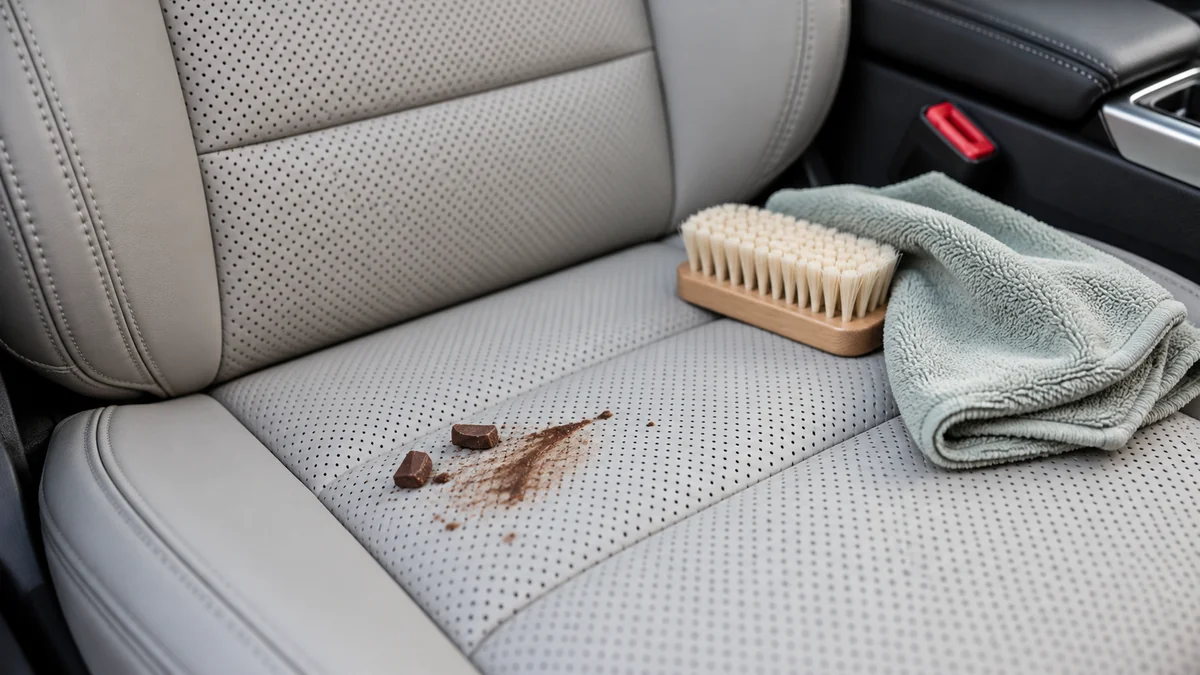
To get chocolate out of perforated leather seats, harden the residue with ice, lift it with a plastic scraper, vacuum the crumbs, then apply a small amount of foaming leather cleaner to a brush or cloth rather than directly to the seat. The process usually takes 20-40 minutes, and moisture control determines whether the stain lifts without reaching the seat foam or electronics.
Key Facts
Ice in a sealed bag hardens soft chocolate without heating or spreading its oils.
Plastic tools are safer than knives, needles, and metal picks around perforated leather.
Never pour or spray cleaner directly onto perforated seat upholstery.
A pH-balanced foaming leather cleaner is safer than an oily conditioner for chocolate residue.
Heated and ventilated seats should remain switched off until the seat is completely dry.
A strong chocolate odor after cleaning usually indicates contamination below the leather surface.
Before You Start
Gather the tools before touching the stain. Removing chocolate from perforated automotive leather is easier when dry debris, cleaner, and towels are ready in sequence.
| Item | Typical quantity or specification | Purpose |
|---|---|---|
| Ice cubes | 4-8 cubes in 1 sealed bag | Harden soft chocolate |
| Plastic scraper | 1 card, spoon, or plastic razor | Lift solid residue |
| Soft detailing brush | 1 horsehair or soft nylon brush | Clear perforations |
| Vacuum cleaner | 1 unit with soft brush nozzle | Remove crumbs and moisture |
| Microfiber towels | 4-6 clean towels | Blot cleaner and residue |
| Leather cleaner | 5-10 milliliters | Suspend fats and pigment |
| Distilled water | 100 milliliters | Emergency dilution |
| Clear mild dish soap | 1-2 drops | Budget emergency cleaner |
Typical time: 20-40 minutes for a small spill, excluding drying.
Difficulty: Moderate.
Typical DIY cost: $0-$25 if household tools are available.
Professional detailer cost: About $75-$200 for an isolated seat, with higher charges for cushion extraction or odor treatment.
Before cleaning, identify whether the seat is finished leather, coated leather, vinyl, synthetic leather, or perforated leather with a damaged topcoat. Most modern automotive leather has a protective coating, but that coating can be thin, cracked, dyed, or partially worn.
Check for seat heating, ventilation, occupancy sensors, and electrical connectors. Do not flood the seat, probe holes with metal, or operate heating or cooling functions to speed drying.
How Does Chocolate Behave in Perforated Leather?
Chocolate is a mixed residue containing cocoa solids, sugar, milk components, and fats. Heat softens the fat, allowing residue to spread across the protective coating and into the edges of perforation holes; aggressive wiping then pushes the softened material farther into the seat surface.
Perforations do not necessarily lead straight into an open ventilation duct. Depending on the seat design, holes may expose foam, a fabric scrim, a ventilation layer, or a channel connected to a fan. The correct cleaning goal is therefore controlled removal, not forcing liquid through every hole.
The most reliable sequence is cool, lift, vacuum, foam, blot, and dry. That sequence reduces both mechanical spreading and liquid migration.
Step 1: Harden the Chocolate With Ice
Place 4-8 ice cubes inside a sealed plastic bag and rest the bag on the chocolate for 3-5 minutes. Use a clean barrier between the bag and the leather if condensation forms, because water should not collect around the perforations.
Fresh melted chocolate may need 5-10 minutes of cooling. Do not press the bag hard against the seat, and do not use dry ice, freezer spray, or a can of compressed air held close to the leather. Those methods can create extreme temperature changes, brittle coatings, or frost-related moisture.
You will know it worked when: the chocolate feels firm and breaks rather than smearing under light contact.
Common mistake: testing softness by rubbing the residue. Lift the ice bag and touch the edge with a plastic scraper instead.
Step 2: Lift Solid Residue With Plastic
Hold a plastic card, plastic spoon, or plastic razor nearly flat against the leather. Work from the outside of the spill toward the center, lifting each piece onto a towel rather than dragging it across clean leather.
Use short strokes of approximately 1-2 centimeters. Clean the scraper after every few strokes so removed chocolate does not redeposit on the seat. A plastic detailing pick can help with a blocked hole, but it should loosen residue only while a vacuum removes it.
Do not use a knife, razor blade, pin, screwdriver, or metal dental pick. Perforated leather has narrow unsupported edges around each hole, and one sharp tool can enlarge or tear a hole permanently.
You will know it worked when: no raised chocolate remains and the remaining mark looks like a thin film or dark spot.
Common mistake: scraping vertically into the holes. Keep the tool almost flat and lift toward the vacuum or towel.
Step 3: Brush and Vacuum the Perforations
Use a clean, dry, soft-bristled brush at a shallow 30-45-degree angle. Brush across the holes with light flicking motions, not downward scrubbing, while holding the vacuum nozzle close enough to capture loosened crumbs.
A soft horsehair brush is preferable to a stiff toothbrush. If the vacuum nozzle is hard plastic, fit a soft brush attachment or wrap its edge with clean painter’s tape, leaving the suction opening unobstructed.
Work in an area no larger than 5 by 5 centimeters. Vacuum after each pass. Chocolate crumbs left on a warm seat can soften again and recreate the stain.
You will know it worked when: the hole openings look clear and the vacuum collects dry brown particles rather than wet smears.
Common mistake: pressing the vacuum nozzle firmly into the seat for a long period. Excessive suction can stress loose coating edges, so use short passes and reposition frequently.
Step 4: Apply Foaming Leather Cleaner Indirectly
Choose a pH-balanced cleaner labeled for automotive leather or coated leather. Dispense approximately 1-2 teaspoons onto a brush or microfiber towel, then work the product into a foam before it reaches the seat.
Apply foam to an area no larger than 5 by 5 centimeters. Use light multidirectional strokes for 10-15 seconds, then stop and allow 30-60 seconds of dwell time. The foam should remain controlled and thin; visible liquid pooling around the perforations means too much product has been used.
A product marketed for leather is not automatically suitable for every seat. Read the vehicle manufacturer’s care instructions, especially for synthetic leather, aniline leather, suede-like inserts, or seats with a failing coating. Always test an inconspicuous area first.
You will know it worked when: brown residue transfers to the towel and the foam remains on the surface instead of running into the holes.
Common mistake: spraying cleaner directly onto the seat. Spraying creates a larger wet zone and makes it difficult to control how much enters the perforations.
Step 5: Blot the Suspended Chocolate
Fold a clean microfiber towel into a thick pad and press it vertically onto the treated area. Hold the towel in place for 2-3 seconds, lift it, rotate to a clean section, and repeat.
Do not wipe side to side while the cleaner is wet. Horizontal wiping spreads dissolved cocoa fat and pigment across the coating, while repeated lifting transfers residue into the towel.
Use a separate towel for the final pass. If the towel still shows brown or oily transfer, repeat Step 4 once after the surface has returned to a nearly dry state.
You will know it worked when: the towel shows little or no brown transfer and the leather color appears even under bright, indirect light.
Common mistake: reusing one saturated towel. A dirty towel redistributes the stain and can leave a greasy film.
Step 6: Extract Moisture and Air-Dry the Seat
Hold a vacuum with a soft nozzle over the cleaned area for brief 2-3 second passes. Do not force the nozzle into individual holes, and do not use a wet extractor unless you understand the seat’s construction and can control extraction volume.
Leave the vehicle doors open or windows lowered in a dry, shaded location for at least 30-60 minutes. Keep seat heating, cooling, and massage functions switched off during drying. Manufacturer instructions take priority because some vehicles restrict operation of seat functions when moisture may be present.
Do not use a high-heat hairdryer. If airflow is necessary, use a fan or a hairdryer on its lowest, coolest setting from at least 30 centimeters away, moving continuously.
You will know it worked when: the leather feels dry, the perforations show no gloss or liquid, and no damp odor appears after the seat sits unused for several hours.
Common mistake: turning on seat heat to accelerate drying. Localized heat can dry the coating unevenly and may move residual fat deeper into the seat.
Which Cleaner Is Safest for Chocolate Residue?
A dedicated foaming leather cleaner is usually the best first choice because it combines controlled moisture with surfactants that suspend oily residue. A diluted mild dish-soap solution is a reasonable emergency substitute, but it requires more careful rinsing and can leave surfactant residue if overused.
| Cleaning option | Typical amount | Best use | Main limitation |
|---|---|---|---|
| Automotive foaming leather cleaner | 1-2 teaspoons per 5 x 5 cm area | Finished leather and small chocolate stains | Product compatibility varies |
| Distilled water plus clear dish soap | 100 ml water plus 1-2 drops soap | Same-day emergency cleaning | Excess soap leaves residue |
| Leather-safe interior cleaner | 5-10 ml on a brush | Larger coated-leather areas | Some formulas are too wet |
| Enzyme cleaner | Only as label directs | Protein or milk odor after residue removal | Not automatically safe for leather coatings |
| Baking soda | Dry, thin surface dusting only | Temporary absorption of surface oil | Can lodge in perforations and leave powder |
Do not assume an enzyme cleaner digests cocoa butter effectively. Enzymes target particular biological materials, and their compatibility with leather dyes, coatings, and adhesives depends on the formula. Use one only when the label specifically permits automotive leather or when a professional recommends it.
Avoid leather conditioners during stain removal. Many conditioners contain oils, waxes, or emulsions that can plug perforations and make later extraction harder.
Which Chocolate-Removal Method Should You Choose?
The ice, plastic-lift, foam, and blot method is the safest general approach for a small spill on coated perforated leather. Heat transfer may help with a thin surface smear, while professional extraction is better for saturated cushions, persistent odors, or contamination around seat electronics.
| Method | Typical time | Surface risk | Best situation | Avoid when |
|---|---|---|---|---|
| Ice, scrape, foam, blot | 20-40 minutes | Low when moisture is controlled | Fresh or dried surface residue | Leather is peeling or absorbent |
| Warm cloth transfer | 10-20 minutes | Medium to high | Thin residue on intact coated leather | Seat has cracks or electronics below |
| Steam cleaning | 15-30 minutes | High without training | Professional deep cleaning | Home users lack temperature control |
| Hot-water extraction | 20-45 minutes | Medium under trained control | Deep cushion contamination | Water cannot be fully recovered |
| Professional detailer | 1-3 hours | Lowest with proper equipment | Odor, large spill, or deep saturation | Minor dry crumbs only |
A warm cloth is not the preferred first step. Heat softens cocoa butter and can transfer some residue onto an absorbent cloth, but it can also spread the stain, soften adhesive, deform synthetic materials, or damage a worn clear coat.
Steam is particularly unsuitable for casual spot treatment. Steam temperature, dwell time, and moisture recovery must be controlled around perforations, stitching, seat heaters, and occupancy sensors.
What Should You Do for Different Stain Conditions?
The correct variation depends on whether the chocolate is fresh, dried, melted into the holes, or mixed with milk.
| Situation | First action | Cleaning limit | Escalation trigger |
|---|---|---|---|
| Fresh solid chocolate | Ice for 3-5 minutes | Two foam-and-blot cycles | Brown mark remains after drying |
| Melted chocolate | Stop rubbing, cool for 5-10 minutes | Small sections only | Oily film spreads beyond spill |
| Dried chocolate | Dry brush and vacuum first | No soaking | Crust remains below hole edges |
| Chocolate milk spill | Blot liquid immediately | Use minimal foam | Sour odor after 24 hours |
| Large cushion spill | Remove surface solids | Avoid home flooding | Odor or dampness persists |
| Cracked leather coating | Lift loose solids only | No aggressive agitation | Dye or foam becomes visible |
For light-colored seats, use a white or light microfiber towel so dye transfer is visible. For dark seats, inspect under neutral daylight because oily rings can be hidden by low cabin lighting.
For vegan leather or vinyl, use the same dry-removal sequence but test the cleaner carefully. Synthetic surfaces can have softer plasticized coatings that react poorly to solvents, alcohol, petroleum distillates, or excessive heat.
Common Mistakes and How to Fix Them
Rubbing a fresh stain
Rubbing spreads melted fat over a larger area and forces pigment toward perforation edges. Stop, cool the residue, and lift from the perimeter inward with plastic.
Pouring cleaner onto the seat
Direct application can wet the foam and electrical components. Blot excess product immediately, vacuum briefly, and allow extended ventilation; call a professional if the seat remains damp or functions abnormally.
Digging with a needle
A needle can cut the circular leather edge around a hole and create a permanent tear. Use a soft plastic pick or wooden toothpick while a vacuum captures loosened residue.
Using a greasy conditioner
Conditioner can seal chocolate into the perforations and create white or shiny plugs. Remove the residue first, then use only a manufacturer-approved, low-residue protectant after the seat is fully dry.
Applying baking soda paste
A wet paste can dry inside the holes and is difficult to remove without additional moisture. If used at all, apply a very small amount of dry powder to a surface-only oily mark, vacuum it thoroughly, and do not push it into perforations.
Using high heat
Heat can soften chocolate, but it can also shrink, warp, discolor, or crack leather and synthetic coatings. Use cool air and professional extraction instead.
How Do You Remove an Oily Ring After the Chocolate Is Gone?
An oily ring usually means cocoa butter remains on the protective coating, not that the leather is permanently stained. Apply a small amount of foaming leather cleaner to a brush, work only across the ring for 10-15 seconds, and blot repeatedly with clean microfiber.
Wait until the area dries before judging the result. A wet coating can look darker than the surrounding leather, and repeated cleaning before drying increases moisture exposure without improving removal.
If the ring remains after two controlled treatments, stop using household remedies. A detailer can identify whether the mark is surface oil, dye transfer, coating damage, or contamination beneath the leather.
How Do You Unclog Chocolate-Filled Holes?
Vacuum the area while gently brushing across the perforations, then loosen individual plugs with a soft plastic pick or wooden toothpick. Work from the surface and remove each loosened fragment; never push debris downward with a sharp tool.
Do not enlarge a hole to remove a stubborn plug. A perforation that has stretched or torn cannot be restored by cleaning, and the seat may require upholstery repair.
If several holes remain blocked after dry removal, professional cleaning is safer than repeated wet treatments. A technician can remove the seat cushion cover or use controlled extraction equipment when the vehicle design permits it.
When Should You Call a Professional Detailer?
Call a professional when chocolate has soaked a large area, milk has entered the cushion, odor persists after 24 hours, the seat stays damp, or the stain lies near seat controls and electrical components. Professional intervention is also appropriate when the leather is cracked, peeling, dyed, perforated suede, or otherwise not a standard coated finish.
A typical isolated professional treatment costs $75-$200. Deep extraction, seat-cover removal, odor treatment, or electrical inspection can raise the total to $200-$500 or more, depending on vehicle design and local labor rates.
Stop home cleaning immediately if the seat develops a warning light, heating fault, ventilation fault, unusual odor, or visible foam moisture. Cleaning residue is easier to address than a damaged occupancy sensor or seat harness.
FAQ
Can I use regular dish soap on perforated leather seats?
You can use 1-2 drops of clear, mild dish soap in 100 milliliters of distilled water as an emergency cleaner for coated leather. Apply the foamed solution to a brush, not the seat, and blot thoroughly. Dedicated automotive leather cleaner remains preferable because it usually leaves less residue.
Will chocolate permanently stain leather seats?
Chocolate does not always permanently stain finished automotive leather, especially when removed before heat and rubbing spread the fats. Permanent discoloration becomes more likely when the coating is worn, the spill remains warm for hours, or chocolate enters the foam and carries odor or pigment below the surface.
Can I use a Magic Eraser on chocolate stains?
Do not use a Magic Eraser as a first-line treatment. Melamine foam acts as a mild abrasive and can dull or remove the protective coating from automotive leather. Mechanical abrasion is especially risky around perforation edges, where the finish is already interrupted.
How long should leather seats dry after cleaning?
A small, lightly treated area typically needs 30-60 minutes in dry airflow, but deeper moisture may require several hours. Keep seat heating and ventilation functions off until the surface and surrounding cushion feel dry and no damp odor remains.
Can I use a vacuum cleaner directly on perforated leather?
Use a vacuum with a soft brush attachment or a protected nozzle, and make short passes rather than holding hard suction against the leather. Vacuuming is useful for dry crumbs and controlled moisture removal, but excessive suction can stress loose coating or damaged perforation edges.
What if the chocolate was on a heated or cooled seat?
Use the same low-moisture procedure, but keep all heating, cooling, and massage functions off during cleaning and drying. If liquid was poured onto the seat or a warning light appears, stop cleaning and arrange professional inspection before operating the seat functions.
The Bottom Line
The safest way to get chocolate out of perforated leather seats is to cool the residue, lift it with plastic, brush and vacuum the holes, apply foaming cleaner indirectly, blot vertically, and dry with cool airflow. Avoid direct spraying, sharp tools, high heat, and greasy conditioner. For deep odor, persistent dampness, or electrical symptoms, professional extraction is the correct next step.