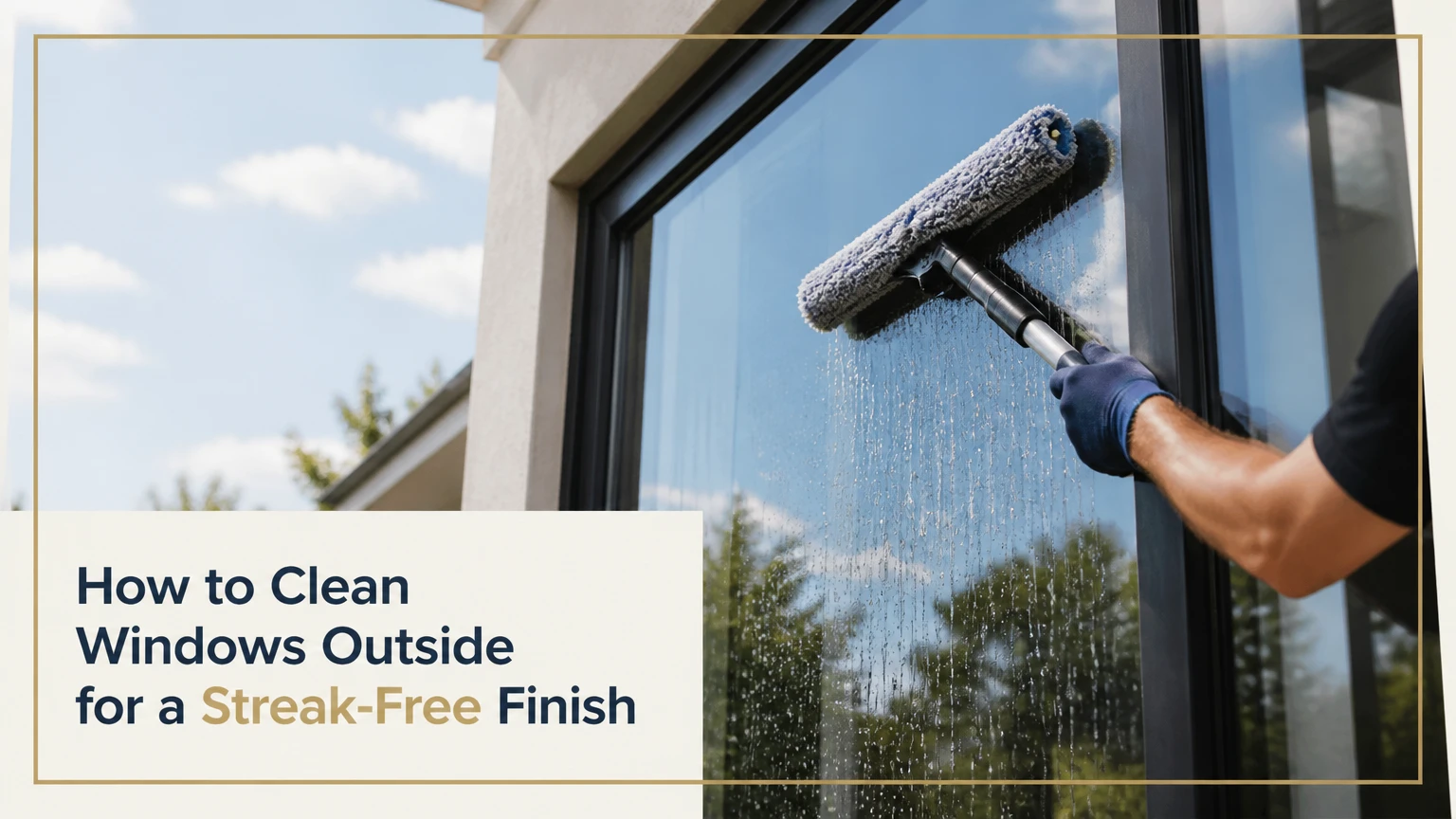
To clean windows outside, remove dry debris first, wash the glass with a lightly soapy solution, and remove the liquid with a clean squeegee before it dries. A typical ground-floor window takes 5-10 minutes, while a standard home takes 2-4 hours; shade, a clean rubber blade, and safe access determine the final result.
Key Facts at a Glance
- Exterior window cleaning works best between 50°F and 70°F, in shade and with low wind.
- Use approximately 1 teaspoon of liquid dish soap per 2 gallons of warm water.
- A squeegee removes the wet film mechanically, so clean rubber matters more than extra detergent.
- Tap water above roughly 10 ppm total dissolved solids can leave mineral spots as it dries.
- Never lean a ladder sideways or reach beyond a secure position to clean exterior glass.
- Clean frames, tracks, and sills before finishing the glass because dirty runoff can create new spots.
What Exterior Window Cleaning Removes
Exterior window cleaning removes surface contaminants from glass, frames, screens, and sills. Common deposits include airborne dust, pollen, insect residue, bird droppings, tree sap, soot, sea salt, and hard-water minerals left by sprinklers or rain.
The method cannot reverse every cloudy appearance. Mineral deposits can etch glass after prolonged exposure, and failed insulated-glass seals can create fog between panes that no surface cleaner will remove. A scratch, coating failure, or internal condensation requires repair or replacement rather than more scrubbing.
Why Squeegees Prevent Streaks
Dish soap contains surfactants that reduce water surface tension and help suspend oily soil. A scrubber loosens the contamination, while a squeegee’s flexible rubber edge pushes the liquid film off the glass before evaporation leaves detergent or minerals behind.
Professional window cleaners usually keep the blade moving in continuous contact with wet glass. The rubber should sit at roughly a 10- to 20-degree angle, with enough pressure to maintain contact but not enough to flex excessively. Extra soap does not improve cleaning after a small lubricating amount; it creates more residue.
How to Clean Windows Outside Safely
The safest basic method uses a dry brush, bucket, microfiber washer, 12- to 14-inch squeegee, and two clean towels. Work from the top down, keep the glass wet during scrubbing, and clean only panes that can be reached without unstable ladders or dangerous leaning.
Before You Start
| Requirement | Typical specification | Why it matters |
|---|---|---|
| Working temperature | 50°F-70°F | Slows evaporation without freezing the solution |
| Soap solution | 1 teaspoon per 2 gallons | Provides lubrication without a heavy film |
| Squeegee width | 12-14 inches | Fits most residential panes and remains controllable |
| Cleaning time | 5-10 minutes per accessible window | Covers preparation, washing, squeegeeing, and detailing |
| DIY equipment cost | $30-$100 | Covers basic hand tools and replacement towels |
| Minimum towel supply | 4-6 microfiber cloths | Prevents spreading dirty water around frames |
Before mixing water, check the window manufacturer’s care instructions, especially for low-emissivity coatings, wood frames, painted finishes, and older leaded glass. Remove furniture, rugs, and electrical items beneath interior access points because exterior water may run over the sill.
Do not clean during lightning, strong wind, freezing temperatures, or rain that prevents the glass from drying evenly. Do not use a ladder on soft soil, wet decking, icy ground, or a sloped surface.
Step 1: Remove Screens and Dry Debris
Remove the screen if the design allows it, label its position with painter’s tape, and place it on a clean, flat surface. Use a soft brush or vacuum attachment to remove cobwebs, insects, loose grit, nests, and leaves from the frame, sill, corners, and nearby trim.
Dry removal prevents gritty particles from becoming abrasive mud during washing. Brush bird droppings gently rather than scraping them dry, because hardened droppings can contain grit that scratches glass under pressure.
You will know the step worked when no loose dirt falls from the frame as you pass a dry microfiber cloth over it. The common mistake is spraying first, which turns dust into a paste that migrates across the pane.
Step 2: Mix a Light Cleaning Solution
Fill a clean bucket with 2 gallons of warm water, then add about 1 teaspoon of liquid dish soap. Stir slowly to avoid producing a bucket of foam. A commercial window-cleaning concentrate is suitable when its label specifies dilution for exterior glass.
Hard water changes the process. If your tap water leaves spots on shower doors or faucets, use deionized water, distilled water for small jobs, or a final rinse with purified water. Do not combine ammonia, bleach, vinegar, or other cleaners because incompatible products can create irritating or dangerous vapors.
You will know the mixture is suitable when the washer sleeve feels slippery but the glass does not retain a thick bubbly film. The common mistake is adding several tablespoons of soap, which increases residue and makes squeegee chatter more likely.
Step 3: Wet and Scrub the Glass
Dip the microfiber washer into the solution, wring it until it is wet but not dripping, and scrub the pane from the top down. Use overlapping strokes, concentrating on edges, corners, bird droppings, insect marks, and sprinkler spray zones.
Allow stubborn deposits to soften for 2-5 minutes while keeping the area wet. A soft nylon pad can help with compatible glass, but test an inconspicuous area first and never use steel wool, abrasive powder, or a dry razor. Paint, tape, and silicone require a lubricated scraper and a careful assessment of whether scraping is appropriate.
You will know the step worked when water sheets across the surface without isolated greasy patches. The common mistake is scrubbing a dry pane, which increases friction and can drag grit across the coating.
Step 4: Prepare a Dry Starting Edge
Use a clean, dry microfiber towel to wipe a narrow strip across the top of the glass or top frame. The strip gives the squeegee a dry starting point and prevents a wave of solution from bleeding over the upper edge during the first pull.
Keep the remaining pane wet. If the glass begins drying before you squeegee, re-wet it rather than chasing half-dried streaks with a towel. Direct sun, hot glass, low humidity, and wind shorten the working time.
You will know the step worked when the first squeegee pass starts without slipping into the frame. The common mistake is drying too much of the pane, which causes the rubber to drag over partially dried detergent.
Step 5: Squeegee the Pane
Place the squeegee in the dry upper strip and pull straight down with steady, moderate pressure. Overlap each pass by about 1 inch, and wipe the rubber with a clean towel after every pass. For wide panes, experienced users can apply an S-shaped motion, but straight vertical pulls are easier to control.
Keep the blade edge continuous against the glass. If it skips, check for a nick, grit, inadequate lubrication, or a frame obstruction. Finish with a short horizontal pull along the bottom edge if water remains there, then avoid pushing dirty runoff back onto the cleaned pane.
You will know the step worked when the glass looks uniformly clear from several viewing angles while still wet. The common mistake is stopping pressure at the bottom, which leaves a crescent of water along the sill.
Step 6: Detail Frames, Sills, and Corners
Use a dry microfiber cloth to wipe the perimeter, lower corners, frame joints, sill, and any drops left by the blade. Rinse or replace the cloth when it becomes damp or gray. Dirty water on a sill can wick back onto the glass after the window appears finished.
Inspect the pane from inside and outside if possible. View it at an angle rather than straight on, because streaks and residue often disappear in direct reflection but remain visible from the side.
You will know the job is complete when the glass, frame, and sill are dry, with no visible trails after 10 minutes. The common mistake is using one wet towel for every window, which transfers soil from the first frame to the last pane.
Which Method Fits Your Windows?
The best exterior window-cleaning method depends mainly on height, access, water hardness, soil severity, and safety. A hand squeegee gives the most control for accessible panes, while a water-fed pole reduces ladder exposure and cleans frames during the same pass.
| Method | Reach and setup | Typical cost | Best use | Main limitation |
|---|---|---|---|---|
| Hand washer and squeegee | Ground floor, balcony, 12-14-inch tool | $30-$100 | Heavy soil and detailed cleaning | Unsafe when access requires unstable height |
| Water-fed pole | Ground operation, commonly 2-4 stories | $400-$2,500+ | High exterior panes and frames | Requires purified water and technique |
| Hose-end cleaner | Garden hose, 20-50-foot reach | $15-$40 | Quick maintenance rinses | Hard water can dry into spots |
| Telescoping scrubber | Commonly 10-20 feet | $30-$150 | Moderate reach from stable ground | Limited pressure and drying control |
| Robotic cleaner | Indoor placement with safety tether | $150-$800+ | Certain large apartment panes | Slow, corner-limited, and glass-dependent |
When Is a Water-Fed Pole Better?
A water-fed pole is better than a ladder when exterior panes can be reached from stable ground and the operator can control the pole without overhead hazards. The brush agitates the glass and frames, while deionized or reverse-osmosis water dries with little mineral residue.
Pure-water systems commonly target 0 ppm TDS at the brush. A handheld TDS meter can verify output, and many operators treat readings above approximately 10 ppm as a warning that spotting may occur. Pure water does not dissolve thick paint, cured silicone, construction debris, or heavy grease as effectively as a lubricated hand-cleaning method.
Are Hose Attachments Good Enough?
Hose attachments are suitable for light pollen, loose dust, and maintenance between deeper cleanings. They are less reliable for hard-water areas because ordinary tap water leaves dissolved calcium and magnesium behind when the rinse evaporates.
Use a hose-end product only when runoff will not damage siding, plants, electrical fixtures, or unsealed wood. Do not assume a spot-free result simply because the bottle says outdoor glass; local water chemistry determines the drying residue.
Do Robotic Window Cleaners Work Outside?
Robotic window cleaners can work on compatible, mostly flat glass when the manufacturer permits exterior use and the safety tether is anchored indoors. Vacuum models may lose grip on wet, dusty, textured, framed, or irregular surfaces, while magnetic models require compatible pane thickness.
Robots are maintenance devices, not substitutes for restoration cleaning. They may miss corners, frames, bird droppings, and mineral deposits, and a tether must remain secured throughout operation. Never use one above people, open walkways, or property that cannot tolerate a falling device.
How Do You Avoid Water Spots?
Avoid water spots by cleaning in shade, using a small amount of detergent, removing the wet film before evaporation, and rinsing with purified water when tap water is mineral-rich. A squeegee can prevent soap streaks, but it cannot remove dissolved minerals from water that remains on the pane.
| Symptom | Most likely cause | Corrective action |
|---|---|---|
| White circular spots | Hard-water minerals | Rewash, use purified water, or use a glass-safe mineral remover |
| Long vertical streaks | Dirty or damaged blade | Clean the rubber, improve overlap, or replace the blade |
| Oily rainbow haze | Soap, wax, smoke, or sealant residue | Degrease with a compatible glass cleaner and rinse thoroughly |
| Chattering blade | Dry glass, nicked rubber, or too little lubrication | Re-wet the pane and replace damaged rubber |
| Haze between panes | Failed insulated-glass seal | Contact a glazing professional; surface cleaning will not help |
| Fine scratches | Abrasive grit or improper scraping | Stop scrubbing; obtain a glass-restoration assessment |
Vinegar can help with light alkaline mineral residue, but it is not a universal remedy. Never apply an acidic product to marble, limestone, cement-based surfaces, sensitive metal finishes, or unknown coatings without checking compatibility. A commercial mineral-deposit remover may be more appropriate for severe deposits, but follow its label and protect adjacent materials.
What Should You Avoid on Exterior Glass?
Avoid dry scraping, abrasive pads, excessive soap, newspaper, pressure-washer spray at seals, and improvised ladder positions. Modern insulated windows often include coatings and edge seals that can be damaged by heat, chemicals, impact, or concentrated water pressure.
- Do not scrape dry glass. Keep the surface lubricated and use only a clean, suitable scraper when the manufacturer permits it.
- Do not use a razor on coated, tinted, textured, or laminated glass without confirming compatibility.
- Do not pressure-wash directly into weatherstripping, weep holes, screens, or insulated-glass edges.
- Do not clean hot glass in direct sunlight because rapid drying leaves detergent trails.
- Do not wash around open electrical outlets, exterior lights, or damaged wiring.
- Do not mix vinegar with bleach or ammonia-based products.
- Do not let dirty solution dry on painted wood, unfinished metal, or porous masonry.
A counterintuitive practitioner rule is that cleaner glass often requires less chemical. Mechanical removal with a good washer and sharp rubber blade does most of the work; detergent mainly provides lubrication and soil suspension.
When Should You Hire a Professional?
Hire a professional window cleaner when exterior glass requires roof access, a tall ladder, suspended equipment, rope access, or work above people and vehicles. A professional is also appropriate for high-rise windows, fragile historic glass, extensive mineral etching, construction debris, and panes that do not open or tilt safely.
| Situation | DIY suitability | Typical professional pricing | Recommended decision |
|---|---|---|---|
| One-story, reachable panes | High | $8-$15 per pane | DIY with a squeegee |
| Two-story windows from stable ground | Moderate | $150-$450 for a typical home | Consider a water-fed pole or insured service |
| Roof, balcony edge, or steep slope | Low | $200-$600+ depending on access | Hire an insured professional |
| High-rise exterior glass | Very low | Building-specific quote | Use building-approved service |
| Hard-water etching or construction debris | Moderate to low | $100-$500+ for restoration work | Request a glass assessment |
Typical whole-house professional cleaning takes 1-2 hours, while a homeowner may spend 3-6 hours on a standard three-bedroom property because setup, access, and detailing take longer. Pricing varies by pane count, screens, storm windows, ladder work, region, and whether frames and tracks are included.
The Occupational Safety and Health Administration identifies falls as a major workplace hazard and requires fall-protection practices in applicable work settings. Homeowners should apply the practical version of that rule: if reaching changes your balance, stop and change the access method.
Special Situations That Need Different Care
How Should You Clean Windows With Screens?
Clean screens separately after removing them. Vacuum both sides with a soft brush, rinse with a gentle stream, and let the screen dry completely before reinstalling it. Wet screens can transfer loosened dust back onto freshly cleaned glass.
How Do You Clean Windows After Pollen or Wildfire Smoke?
For heavy pollen or smoke residue, dry-brush loose material first, then wash with fresh solution and replace the water when it becomes visibly dirty. Smoke film may require a compatible degreasing glass cleaner because ordinary dish soap can leave a thin gray residue.
How Do You Clean Salt From Coastal Windows?
Rinse coastal windows with fresh water before scrubbing to dissolve and carry away salt crystals. Salt should not be rubbed across dry glass or metal frames, because crystals can act as abrasive grit and accelerate corrosion on exposed hardware.
Can You Clean Wood or Aluminum Frames the Same Way?
Wood frames need limited water and immediate drying, especially where paint or caulk is cracked. Aluminum and vinyl tolerate more moisture, but strong acids, solvents, and prolonged wetting can discolor finishes or damage seals.
How Often Should Exterior Windows Be Cleaned?
Most homes benefit from exterior window cleaning twice a year, commonly in spring and autumn. Homes near construction, coastlines, farms, heavy traffic, wildfire smoke, or dense trees may need quarterly cleaning, while sheltered homes may remain acceptable with one substantial annual wash.
Clean after the heaviest seasonal pollen has settled, but before prolonged heat makes the glass difficult to keep wet. Coastal properties should inspect salt accumulation monthly, even if full cleaning occurs less often.
Frequently Asked Questions
Can I Use Vinegar to Clean Outside Windows?
Vinegar can loosen light mineral residue and reduce some soap film, but it is not necessary for ordinary dirt and may damage stone, sensitive metal, or certain finishes. Use a diluted solution only on compatible glass and rinse or wipe adjacent surfaces promptly.
Why Are My Windows Still Cloudy After Cleaning?
Cloudiness may come from mineral deposits, detergent residue, scratches, coating damage, or condensation between insulated panes. Rewash one small area with fresh solution and purified water; if the haze remains inside the glass or unchanged after cleaning, surface washing is not the solution.
Should I Clean Windows With a Pressure Washer?
Do not pressure-wash window glass, seals, screens, or frames directly. Concentrated water can force moisture past weatherstripping, damage screens, loosen caulk, and spread grit across the pane. A low-pressure garden rinse from a safe distance is a better preparation step.
What Is the Best Squeegee Size for Home Windows?
A 12- to 14-inch squeegee suits most residential panes because it balances coverage with control. Use a 6- to 10-inch channel for narrow divided lights, muntins, and small bathroom windows, and replace rubber when it develops nicks, hardens, or leaves repeated lines.
Is It Better to Clean Windows on a Cloudy Day?
A bright, cloudy day is usually better than direct sun because solution evaporates more slowly. Avoid heavy cloud cover with rain, strong wind, or freezing conditions, since those conditions interrupt the squeegee process and can leave diluted soil on the glass.
How Do I Clean Windows Outside Without a Ladder?
Use a water-fed pole, telescoping washer, or professional service when panes are reachable from stable ground. Do not extend a household squeegee while leaning from an upper window or balcony. The safe method is the one that keeps your center of balance inside the protected working area.
The Bottom Line
To clean windows outside successfully, remove loose debris, use about 1 teaspoon of dish soap in 2 gallons of warm water, keep the pane wet, and squeegee before evaporation. Clean frames and sills at the same time, switch to purified water when minerals cause spots, and hire a professional whenever height or access makes the work unstable. Properly planned how to clean windows outside work produces clearer glass with less chemical residue and fewer repeat passes.