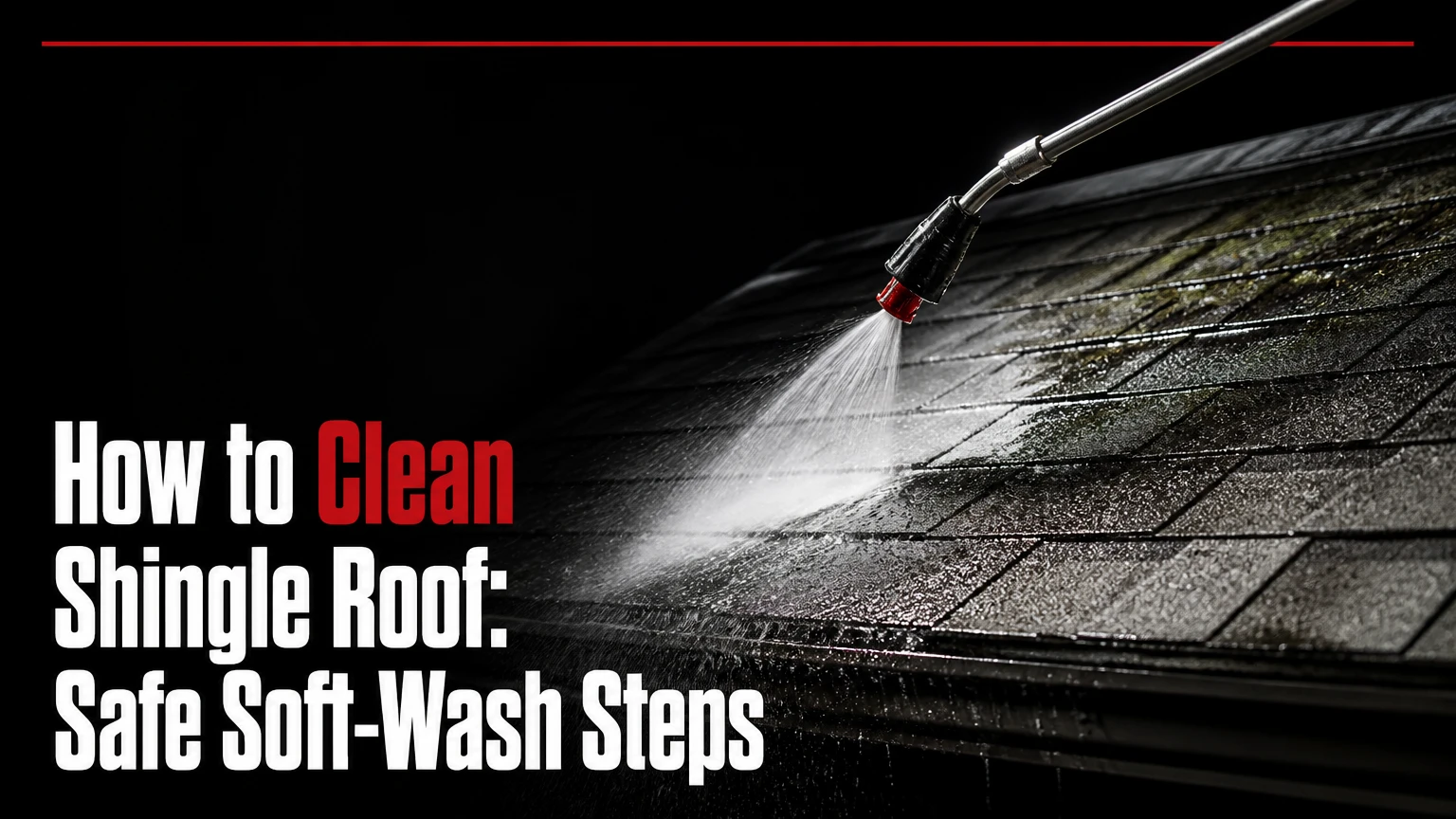
To clean a shingle roof, remove loose debris, treat algae or moss with a manufacturer-approved roof cleaner, and rinse only at low pressure when the label requires it. Protect plants and control runoff throughout the job. The safest method uses chemical treatment rather than pressure, because forceful washing can remove asphalt-shingle granules and drive water beneath laps.
Key Facts at a Glance
- Asphalt shingles should not be cleaned with a conventional pressure washer; ARMA states that “the use of a pressure washer on asphalt shingles is not recommended.”
- Black streaks usually indicate algae or cyanobacterial discoloration, while raised green growth indicates moss or lichen.
- A typical DIY treatment costs $40-$150 before roof-access equipment, while professional cleaning commonly costs $300-$900 in the United States.
- Product labels control dilution, dwell time, rinsing, and environmental precautions; a universal bleach recipe is unsafe advice.
- Wet treatment makes shingles slippery, so a steep, high, fragile, or multi-story roof is a professional job.
- Cleaning removes biological growth but cannot restore missing granules, repair leaks, or reverse aged asphalt.
How to Clean Shingle Roof Without Damage
The safest cleaning method for asphalt shingles is a low-pressure soft wash or a label-directed no-rinse treatment. Soft washing applies a cleaning agent to kill organic growth, allows controlled dwell time, and uses rainfall or a gentle downward rinse to remove residue without abrading the granule surface.
Conventional pressure washers commonly operate at 2,000-4,000 PSI, far above the force appropriate for exposed asphalt shingles. Even a lower setting can loosen granules if the nozzle is too close, the spray angle is wrong, or the operator directs water beneath shingle courses. Granules protect the asphalt coating from ultraviolet radiation, so their loss shortens service life.
The exact chemical strength cannot be prescribed safely without the product name, active ingredient, water hardness, temperature, and roof condition. Household chlorine bleach may contain about 5%-6% sodium hypochlorite, while pool-strength products can contain approximately 10%-12.5%. Never improvise a concentration from those figures. Follow the roof-cleaner label and never mix bleach with ammonia, acids, vinegar, or other cleaners.
What Do Algae, Moss, and Lichen Look Like?
Black or brown streaks are usually algae or cyanobacterial staining, whereas moss forms raised green mats and lichen appears as crusty, branching, or leaf-like growth attached to the shingle surface. The distinction matters because a light stain may respond to one treatment, while thick moss can conceal granule loss, lifted tabs, or trapped moisture.
Algae primarily creates a cosmetic discoloration, although persistent moisture and shade can support other growth. Moss holds water against shingles and can lift edges as it expands. Lichen attaches more firmly and may leave damaged or bare patches after removal.
Do not confuse dirt with biological growth. Dirt often follows drainage paths and wipes away from a test area, while algae remains bonded to the surface and changes color after treatment. If exposed fiberglass mat, curled edges, cracked tabs, or widespread bald patches appear, stop cleaning and arrange a roof inspection.
What Should You Check Before Cleaning?
Before cleaning, confirm that the shingles are structurally sound, the weather is suitable, and the roof can be treated without walking directly on a hazardous wet surface. Do not begin a DIY job on a steep or high roof simply because the growth looks minor.
Use This Stop-Work Assessment
| Condition | DIY indication | Professional or repair response |
|---|---|---|
| Roof pitch | Low-slope surface with secure ground access | Steep pitch, fragile footing, or difficult eaves |
| Roof height | One-story edge reachable from the ground | Two or more stories, dormers, or fall exposure |
| Shingle age | Sound shingles with intact granules | Roof near expected replacement age or unknown history |
| Surface condition | Flat, firm tabs without exposed mat | Curling, cracking, missing granules, soft decking, leaks |
| Weather | Overcast, calm, 45-85°F conditions | Wind, rain, freezing temperatures, intense direct sun |
| Access equipment | Properly rated ladder and ground support | No safe ladder setup, anchor, guardrail, or helper |
Roof work remains dangerous even on a low pitch. OSHA requires fall protection in many construction situations when workers face a fall of 6 feet or more, but a homeowner should treat that threshold as a minimum regulatory reference, not proof that a roof is safe to climb.
A roof anchor must be designed, installed, and rated for the roofing system. A rope tied around a plumbing vent, chimney, gutter, or tree is not equivalent protection. If you cannot establish a proper anchor and rescue plan, use a professional.
What Weather Is Best?
Choose a calm, dry, overcast period with enough time for the treatment to work without rapid evaporation. Strong wind increases drift, direct hot sun can dry a chemical before the required dwell time, and temperatures near freezing can create dangerous ice and poor cleaning performance.
Check the forecast for the entire treatment and runoff period. Avoid cleaning before heavy rain if contaminated runoff could reach a pond, storm drain, vegetable garden, rain barrel, private well, or septic area. Local regulations may restrict discharge of cleaning chemicals.
Which Roof Cleaner Works Best?
The best cleaner depends on the growth, roof condition, landscaping, and required speed. A professional low-pressure treatment is usually most effective for established algae, moss, or lichen, while oxygenated or slow-release products suit lighter growth and runoff-sensitive properties.
| Treatment | Typical active approach | Typical result time | Best fit | Main limitation |
|---|---|---|---|---|
| Professional soft wash | Label-directed sodium hypochlorite solution | Minutes to several weeks | Heavy algae and established growth | Plant and runoff risk |
| Oxygenated cleaner | Sodium percarbonate | Hours to several days | Light algae and sensitive landscaping | Slower on deep moss |
| Slow-release treatment | Enzymes, surfactants, or proprietary salts | Weeks to months | Maintenance and light staining | Rainfall-dependent |
| Manual removal plus treatment | Soft tool and approved biocide | Same day to weeks | Thick moss after chemical kill | Unsafe if force is used |
Sodium hypochlorite can produce fast visible improvement, but the risk rises with concentration, heat, overspray, and poor runoff control. Sodium percarbonate releases oxygen in water and generally has a milder odor, but “eco-friendly” does not mean harmless to every plant, aquatic organism, or roof accessory.
Household dish soap is not automatically a suitable surfactant. Some products contain fragrances, solvents, or additives that can leave residue or affect vegetation. Use the surfactant specified by the roof-cleaner manufacturer, and never combine products unless the label explicitly permits the combination.
What Tools and Materials Do You Need?
A basic low-slope treatment requires a soft broom or leaf blower, a dedicated pump sprayer, a garden hose with an adjustable nozzle, protective coverings, and label-specified cleaner. The safety system is more important than the sprayer.
Before You Start Checklist
| Item | Typical quantity or specification | Purpose |
|---|---|---|
| Roof-cleaning product | 1-5 gallons, based on roof area and label rate | Treat algae, moss, or lichen |
| Pump sprayer | 1-2 gallons for small sections | Apply without high pressure |
| Garden hose | 50-100 feet, adequate flow | Wet plants and rinse surfaces |
| Eye and skin protection | 1 pair goggles, chemical-resistant gloves | Prevent chemical exposure |
| Debris tool | 1 leaf blower or soft broom | Remove loose organic material |
| Ground support | 1 helper plus ladder stabilizer | Monitor hose, runoff, and access |
Use separate containers for roof chemicals and garden products. Label the sprayer clearly, rinse it according to the product instructions, and store chemicals away from children, pets, food, metals, and direct sunlight.
How Do You Prepare the Property?
Prepare the property by inspecting the roof from the ground, moving outdoor furniture, closing windows, covering sensitive fixtures, and thoroughly wetting nearby vegetation with clean water. Keep a helper at ground level when chemical spray, ladder access, or runoff creates additional risk.
- Identify downspout outlets, storm drains, ponds, wells, and garden beds.
- Move or cover furniture, grills, toys, electrical equipment, and vehicles.
- Close windows and doors, and turn off outdoor air intakes if possible.
- Wet shrubs, grass, and soil around the house before treatment.
- Use temporary collection or diversion only if it is secure and permitted.
- Keep pets and children away until all treated surfaces and runoff areas are safe.
Do not seal a downspout with a bag if water could back up into the gutter, fascia, soffit, or roof edge. A safer approach may be a temporary hose directed into an appropriate containment area, but local environmental rules determine what is acceptable.
Protect aluminum gutters, painted siding, wood trim, solar equipment, and unsealed masonry from prolonged chemical contact. Pre-wetting reduces absorption but does not make overspray safe.
How Do You Clean a Shingle Roof Step by Step?
A typical low-slope treatment takes 2-5 hours for a 1,500-2,000-square-foot roof, excluding setup and difficult access. The five-step sequence is debris removal, property protection, treatment application, controlled dwell time, and gentle rinsing or no-rinse completion.
Step 1: Remove Loose Debris
Clear leaves, pine needles, and small twigs with a leaf blower or soft brush while standing on a ladder or safe access point whenever possible. Work from the ridge toward the eaves without dragging equipment across shingles.
Do not rake upward against shingle edges. Do not scrape moss while it is alive and anchored. Those actions can pull out granules and lift tabs.
Success checkpoint: gutters and valleys are free of loose debris, and no shingle edges are visibly lifted.
Common mistake: using a stiff broom to scour stains that require chemical treatment.
Step 2: Protect Plants, Fixtures, and Runoff Paths
Wet all surrounding vegetation thoroughly, protect exposed fixtures, and establish a runoff plan before opening the cleaner. Keep a clean-water hose ready so a helper can rinse siding and plants immediately if spray reaches them.
Read the Safety Data Sheet for the product. The label may require additional gloves, eye protection, ventilation, dilution, or restrictions near water. A respirator is not a substitute for ventilation or correct chemical handling, and cartridge selection must match the product hazard.
Success checkpoint: every likely overspray surface has protection or an immediately available rinse path.
Common mistake: assuming a calm morning eliminates drift from a pressurized sprayer.
Step 3: Apply the Approved Cleaner
Mix only the quantity and dilution specified on the product label. Apply a controlled, low-pressure fan from the lower roof edge upward if the product instructions recommend that pattern, keeping the spray directed onto shingles rather than into laps, vents, windows, or gutters.
The bottom-up pattern can reduce streaking because the lower section receives fresh solution instead of diluted runoff. However, the product label takes priority because some treatments specify a different application order or no rinsing.
Apply enough to wet the growth without creating uncontrolled runoff. A small test patch on an inconspicuous area reveals whether the product affects color, metal, paint, or sealants.
Success checkpoint: a test area changes as the label predicts, with no visible granule movement or uncontrolled runoff.
Common mistake: increasing concentration when the real problem is rapid drying, poor coverage, cold weather, or an unsuitable product.
Step 4: Maintain the Required Dwell Time
Keep the treatment wet for the label-specified period, which is often 10-20 minutes for a fast-acting solution but may be longer for oxygenated or slow-release products. Do not allow chemical residue to dry on shingles, siding, glass, metal, or plants.
Watch the test patch rather than relying on a fixed timer. Algae may fade quickly, while moss and lichen can remain visible after they are dead. Dead moss often loosens gradually through rain, sometimes over several weeks.
Success checkpoint: the growth has changed color or texture and the surface remains wet for the required duration.
Common mistake: scraping thick moss immediately because the roof does not look clean after one application.
Step 5: Rinse or Allow Natural Weathering
Rinse only when the product label requires it, using a garden hose or low-pressure system from the ridge downward. Keep the stream below the shingle courses and never force water upward beneath the tabs.
A no-rinse product should not be rinsed simply to produce instant visual results. For a rinse product, flush gutters and downspouts with clean water, then rinse nearby plants and hard surfaces again.
Success checkpoint: no cleaner residue remains where the label requires rinsing, gutters drain normally, and no granules collect unusually in downspouts.
Common mistake: using a pressure-washer wand because a garden hose appears too slow.
How Do You Treat Black Streaks, Moss, and Lichen?
Black streaks usually need an even chemical application and adequate dwell time, while moss and lichen require patience after the organisms are killed. Cleaning cannot safely remove firmly attached growth through brute force because the roots may be interwoven with the shingle surface.
| Visible condition | Likely cause | Appropriate response | Avoid |
|---|---|---|---|
| Thin black streaks | Algae or cyanobacteria | Label-approved soft treatment | Abrasive brushing |
| Thick green cushions | Moss | Kill chemically, let loosen, remove gently if safe | Pulling live mats |
| Gray crusts or branching patches | Lichen | Longer label-directed treatment | Scraping with metal tools |
| Brown leaf piles | Organic debris | Leaf blower or soft removal | Shoving debris uphill |
| Bare dark patches | Granule loss or exposed mat | Roof inspection | Repeated chemical applications |
If a second treatment is needed, repeat only according to the label. A stronger mixture is not automatically better and can damage vegetation, metals, coatings, and the asphalt surface.
What Mistakes Damage Shingles?
The most damaging mistakes are pressure washing, abrasive scrubbing, upward water spray, uncontrolled chemical runoff, and walking on wet shingles. Each mistake can create a different failure, from immediate granule loss to hidden leaks that appear months later.
- Pressure washing: Stop immediately if granules are being displaced. A roof contractor should assess bare areas, exposed matting, and damaged flashing.
- Wire or stiff-bristle brushing: Do not continue scrubbing. Loose granules in gutters indicate abrasion, not successful cleaning.
- Water sprayed uphill: Inspect the attic and ceiling after the area dries. Persistent staining, damp insulation, or active leaks require repair.
- Chemical-damaged plants: Rinse foliage and soil with abundant clean water as soon as possible. Do not apply a homemade neutralizer unless an agronomist or product label directs it.
- Drying cleaner: Rinse according to the label, then inspect paint, glass, metal, and plants. Dried residue may require a second careful wash.
- Walking on wet shingles: Stop the roof work. Use ground-based equipment or hire a trained crew rather than accepting a fall risk.
Gypsum is not a universal bleach neutralizer. It may change soil chemistry without reversing leaf damage, so prompt dilution with clean water is the more broadly appropriate first response.
How Much Does Shingle Roof Cleaning Cost?
Typical US roof-cleaning costs range from $40-$150 for basic DIY chemicals and tools, or $300-$900 for professional service on an accessible home. Steep pitch, multiple stories, heavy moss, difficult runoff control, and regional labor rates can raise the total above those ranges.
| Job profile | Typical roof area | DIY materials | Professional price | Typical duration |
|---|---|---|---|---|
| Light algae, easy access | 1,000-1,500 sq. ft. | $40-$90 | $300-$500 | 2-3 hours |
| Moderate streaking | 1,500-2,000 sq. ft. | $60-$120 | $400-$700 | 3-5 hours |
| Heavy moss or lichen | 1,500-2,500 sq. ft. | $90-$150 | $600-$1,000 | 4-8 hours |
| Steep or multi-story roof | 1,500-2,500 sq. ft. | Not recommended | $800-$1,500+ | 3-8 hours |
Professional estimates should state the cleaning method, chemical type, runoff controls, plant protection, insurance, warranty limitations, and whether gutter flushing is included. A low quote that omits fall protection or environmental controls is not comparable to a complete service.
How Long Does a Clean Roof Stay Clean?
A cleaned roof commonly stays visibly improved for 1-5 years, depending on shade, humidity, tree cover, roof orientation, and the treatment used. Algae often returns sooner than homeowners expect when branches keep the shingles damp and block sunlight.
Copper or zinc strips near the ridge can reduce future growth as rain carries metal ions over the roof, but they do not repair existing stains and cannot protect areas below interrupted roof geometry. Trim overhanging branches, keep gutters flowing, and remove leaf buildup from valleys.
Do not apply roof coatings, sealers, or paint over asphalt shingles unless the shingle manufacturer specifically approves the system. Coatings can interfere with inspection, ventilation, warranty terms, and future replacement.
When Should You Hire a Professional?
Hire a qualified roof-cleaning contractor when the roof is steep, high, fragile, wet, heavily moss-covered, or difficult to protect from runoff. Professional service is also the safer choice when you lack a rated ladder system, fall protection, chemical-handling experience, or a second person on the ground.
Ask for proof of general liability insurance and workers’ compensation, a written description of the method, product labels or active ingredients, and references for asphalt-shingle work. Confirm that the company will not use a conventional pressure washer on the shingles.
A professional cannot guarantee that cleaning will make an old roof look new. Cleaning is a maintenance treatment, not a replacement for damaged shingles, flashing repairs, attic ventilation corrections, or deck replacement.
Frequently Asked Questions
Can I Clean Shingles With a Pressure Washer?
No. Conventional pressure washing can remove protective granules, damage the asphalt mat, lift shingle edges, and force water beneath overlaps. Use a label-directed low-pressure treatment instead. If a contractor proposes high-pressure cleaning, ask how the method complies with the shingle manufacturer’s maintenance instructions and warranty requirements.
Is Bleach Safe for an Asphalt Shingle Roof?
A properly selected and label-directed sodium hypochlorite product can treat algae on asphalt shingles, but bleach is not automatically safe at every concentration or application rate. Protect vegetation, painted surfaces, metals, pets, and waterways. Never mix bleach with ammonia, acids, vinegar, or another cleaner.
Should Moss Be Scraped Off Shingles?
Do not scrape live moss aggressively because its attachment can remove granules and damage shingle tabs. Treat the moss first with an approved product, allow it to die and loosen, then remove only what can be lifted safely without abrasion. Persistent moss may indicate excessive shade or trapped moisture.
Can Roof Cleaning Fix a Leak?
Roof cleaning cannot fix a leak caused by cracked shingles, failed flashing, damaged underlayment, or deteriorated decking. Cleaning may expose those defects, especially when moss has concealed them. Arrange a roof inspection if staining, damp insulation, missing granules, or interior water marks remain after the surface dries.
How Often Should a Shingle Roof Be Cleaned?
Inspect the roof at least twice yearly and after major storms, but clean it only when algae, moss, lichen, or debris warrants treatment. Many roofs need cleaning every 1-5 years, while shaded, humid properties may need earlier maintenance. Preventive trimming and debris removal can extend the interval.
Is Oxygen Bleach Better Than Chlorine Bleach?
Oxygen bleach is often preferable when odor, plant exposure, or runoff sensitivity is the main concern, but it usually works more slowly on established moss and lichen. Chlorine-based treatment is faster but requires stricter protection and handling. Choose the product that matches the growth, roof condition, and label requirements.
The Bottom Line
To clean a shingle roof safely, identify the growth, inspect the roof condition, protect landscaping and runoff paths, apply a manufacturer-approved low-pressure treatment, respect the dwell time, and rinse only as directed. Never pressure wash or aggressively scrub asphalt shingles. If the roof is steep, high, fragile, or leaking, professional cleaning costs less than a preventable fall or premature roof replacement.