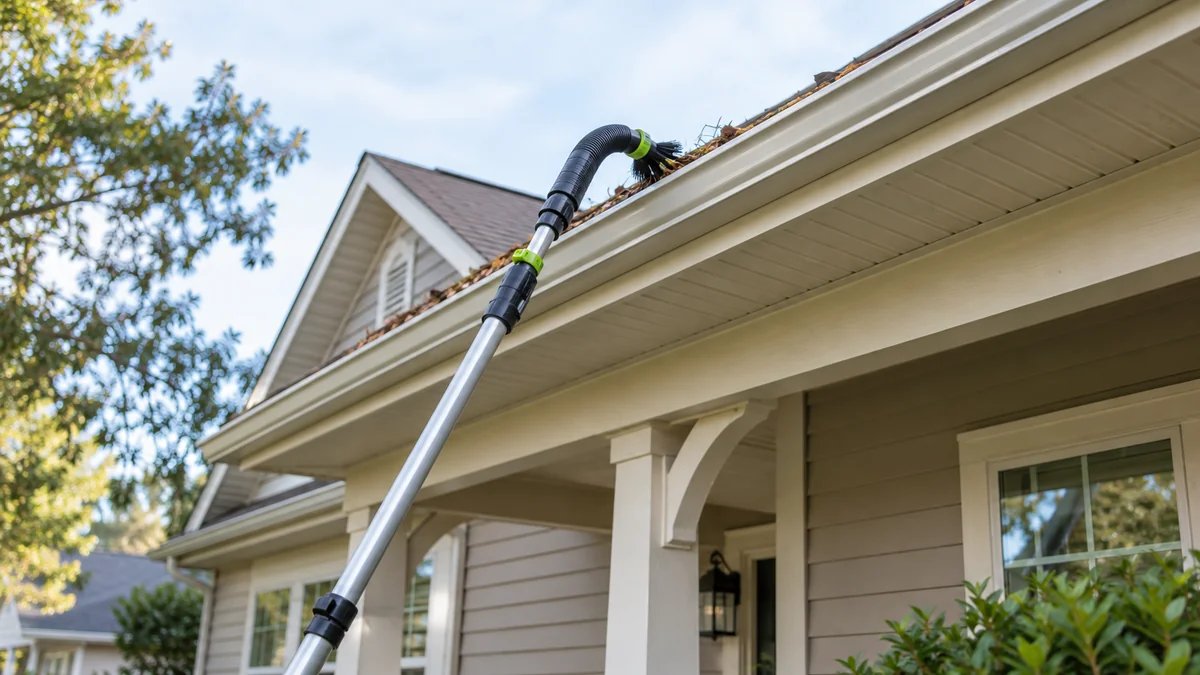
To clean rain gutters from ground level, use a telescoping gutter vacuum, water-fed pole, leaf-blower extension, or mechanical grabber, then test every downspout with water. A typical single-story home takes 30-45 minutes, while a two-story home may take 60-90 minutes. Success depends on matching the tool to the debris and keeping poles away from power lines.
Key Facts at a Glance
- A ground-based gutter vacuum is the cleanest option for dry leaves and loose pine needles.
- A hose-fed wand is better for fine silt, sticky residue, and final rinsing.
- Typical tool costs range from $25 for a basic pole attachment to $150 for a specialized system.
- Ground cleaning usually works best at heights up to 20-25 feet, but pole weight and control become limiting factors first.
- A downspout is not clear until water exits freely at the bottom without backing up.
- Do not use an aluminum or wet pole near overhead electrical wires, and never work during high winds or lightning.
Before You Start: Time, Tools, and Safety
Ground-based gutter cleaning requires a reach tool, personal protective equipment, and a way to confirm water flow. Plan 30-45 minutes for a single-story, 2,000-square-foot house and 60-90 minutes for a two-story house with multiple rooflines.
What you need
| Item | Typical quantity | Typical cost | Purpose |
|---|---|---|---|
| Telescoping pole or rigid tubes | 1 set, 12-25 feet | $25-$150 | Reaches the gutter from the ground |
| Wet/dry vacuum or leaf blower | 1 unit | Existing to $180 | Removes dry debris |
| Garden hose and spray nozzle | 1, 25-50 foot hose | $20-$60 | Rinses troughs and tests downspouts |
| Safety glasses and work gloves | 1 pair each | $10-$30 | Protects eyes and hands |
| Plastic tarp or landscape cover | 1-2 pieces | $10-$25 | Protects plants and collects debris |
| Plumbing snake | 1, 15-25 foot snake | $20-$45 | Breaks stubborn downspout blockages |
Wear wraparound safety glasses because debris falls directly from the roof edge. Use gloves, closed-toe shoes with slip-resistant soles, and a dust mask when dry leaves contain mold or bird droppings.
Walk the entire perimeter first. Identify valleys, downspout openings, heavy tree cover, gutter guards, low branches, fragile landscaping, and overhead wires. Keep conductive poles at least 10 feet from power lines; greater clearance is safer when a pole can bend or swing.
Do not work in wind strong enough to move the pole unpredictably. Wet ground also matters because mud can make you lose footing while controlling a long, top-heavy tool.
Which Ground Cleaning Method Should You Choose?
The best ground-based gutter method depends on debris moisture, roof height, cleanup tolerance, and whether you already own a vacuum, blower, or hose. Vacuum systems provide the most controlled removal, water wands rinse more effectively, and mechanical grabbers handle large objects without electricity.
| Method | Best debris | Typical reach | Typical cost | Main limitation |
|---|---|---|---|---|
| Gutter vacuum tubes | Dry leaves, pine needles, light muck | 12-25 feet | $30-$150 | Wet clumps clog bends |
| Water-fed pole | Silt, soft sludge, fine needles | 10-20 feet | $25-$60 | Heavy and messy when extended |
| Pressure-washer attachment | Packed sludge, difficult rinsing | 12-24 feet | $40-$120 | Can damage seals or spray siding |
| Leaf-blower extension | Large volumes of dry leaves | 10-20 feet | $30-$55 | Fails on wet or compacted debris |
| Rotary brush | Loose debris in straight runs | 10-18 feet | $50-$100 | Poor around corners and brackets |
| Rope-operated grabber | Twigs, pinecones, clumps | 10-20 feet | $25-$50 | Misses fine sediment |
Vacuum, blower, or water: which is cleaner?
A wet/dry vacuum creates the least airborne mess because debris travels into a canister instead of falling across the property. A leaf blower is faster for dry autumn leaves, but it scatters material onto siding, windows, mulch, and neighboring areas.
Water is the most useful finishing method because it carries fine sediment toward the downspout. Water should not be the first tool for a gutter packed with dry leaves, because saturated debris becomes heavier, sticks to the channel, and can overload a lightweight extension pole.
What is the safest option for a two-story house?
A rigid, lightweight vacuum pole is generally the most controllable option for a two-story home, but only when the operator can maintain stable footing and see the tool head. Long aluminum poles become tiring and flexible above roughly 20 feet, which reduces scraping accuracy and increases the chance of striking siding, windows, or wires.
Ground cleaning is not automatically safer at every height. If you cannot control the extended pole, cannot see the gutter, or must stand near electrical service lines, stop and hire a professional with the correct access equipment.
Step 1: Clear the Work Area and Inspect the Gutter
Move vehicles, patio furniture, toys, and delicate objects away from the drip line before opening the gutter. Cover fragile flowers and low shrubs with a breathable tarp, but do not leave plastic over plants in direct sun.
Inspect from several locations rather than staring straight upward from one point. Look for:
- Gutter sections that sag or hold standing water
- Overflow stains below valleys
- Rust holes, separated seams, and loose spikes
- Downspouts disconnected at elbows
- Dense leaf piles near roof valleys
- Gutter guards filled with sediment
- Branches touching the roof edge
- Service drops or utility lines crossing the work zone
Select the starting point based on the method. With a vacuum, begin near the downspout and work away from it so removed material does not refill a cleared outlet. With a water wand, begin at the far end of the run and rinse toward the downspout.
Success checkpoint: You can identify each gutter run, its downspout, and any section that ground tools cannot safely reach.
Common mistake: Starting without locating the downspout causes debris to be pushed into an already restricted outlet.
Step 2: Assemble and Control the Extension Tool
Connect the vacuum tubes, blower attachment, water wand, or grabber according to the manufacturer’s instructions. Lock every telescoping section before lifting the tool, and keep the pole as short as possible while still reaching the gutter.
Stand close enough to reduce the pole angle, but never step onto unstable soil, wet decking, retaining walls, or objects used as makeshift platforms. A steep diagonal angle increases leverage at your shoulders and makes the tool feel much heavier than its listed weight.
Keep both hands on the pole. One hand should guide the lower section near chest height while the other controls the upper section or trigger. Do not pull sideways against gutter brackets, fascia, or end caps.
Success checkpoint: The pole reaches the gutter with moderate extension, remains controllable, and does not flex into nearby wires or windows.
Common mistake: Fully extending a cheap aluminum pole before testing it causes excessive flex. Shorten it, move closer where safe, or use a lighter rigid system.
Step 3: Remove Loose Debris From the Gutter Trough
Start the vacuum or blower at its lowest practical setting, then move the head slowly along the channel. A useful working pace is approximately 1 foot every 3-5 seconds, although compacted debris requires shorter movements.
A vacuum head should skim the bottom rather than wedge deeply into a pile. Take small bites from heavy accumulations, especially near inside corners and downspout outlets. Stop immediately if the tube begins to whistle, lose suction, or vibrate.
A blower works best when the nozzle points along the gutter rather than directly down into the trough. Use short bursts near seams and corners to avoid dislodging end caps or forcing debris under a gutter guard.
Mechanical tongs are useful for pinecones, sticks, and wet clumps too large for a vacuum. Remove large objects first, then use suction or water to handle the remaining sediment.
Success checkpoint: The gutter bottom is visible across the cleared section, and no large clumps remain around hangers or outlets.
Common mistake: Forcing a blocked vacuum head deeper into muck packs the tube. Pull it down, clear the bend, and resume with smaller loads.
Step 4: Wash Fine Sediment Toward the Downspout
Use a telescoping water wand after loose debris is removed. Set the nozzle to a narrow stream that can move sediment without spraying directly against fascia, soffits, windows, or painted siding.
Start at the end of the gutter farthest from the downspout. Move the stream forward in 2-3 foot sections, pausing when dirty water begins to drain. Do not use a pressure washer at close range on old seams, brittle sealant, or lightweight aluminum gutters.
Water-fed poles become substantially heavier when extended because the hose pulls downward and sideways. Keep the pole close to your body and take frequent breaks on long runs.
Success checkpoint: Water travels continuously along the trough and enters the downspout without pooling behind a blockage.
Common mistake: Washing an entire gutter at once sends a large debris slug into the outlet. Clear and test short sections instead.
Step 5: Clear and Test Each Downspout
Downspouts need separate testing because a clean trough can still overflow through a blocked vertical pipe. Place a hose at the top opening and run water at a moderate flow while watching the bottom outlet.
If water exits freely, increase the flow briefly to check capacity. If water backs up, stop adding water and clear the obstruction from the bottom whenever possible. Remove the lower elbow only if its fasteners can be safely accessed from ground level, then insert a flexible hose or plumbing snake upward.
A pressure washer can break compacted organic plugs, but the nozzle must not be driven into a sealed joint or aimed toward a person. A burst of air from a vacuum may help with dry debris, but suction alone is unreliable when the obstruction is a wet, compressed mass.
Success checkpoint: Water exits the downspout immediately, reaches the splash block or drain, and does not leak from seams.
Common mistake: Continuing to flood a backed-up downspout can force water behind the fascia or into the wall assembly.
Step 6: Inspect Flow, Seams, and Gutter Slope
Run water through each completed gutter section for 30-60 seconds. Watch the roof edge, end caps, seams, downspout connections, and discharge point rather than focusing only on the gutter interior.
Standing water indicates a slope, sag, or blockage problem. A typical gutter run should direct water toward its outlet without a persistent pond between hangers. Small leaks may appear only after the trough is full, so a brief trickle test can miss them.
Use a phone mounted to a pole only if it is secured with a tether and kept away from wires. A ground-level inspection camera can reveal hidden clogs, but it does not replace a flow test.
Success checkpoint: The gutter drains continuously, the downspout carries water away, and no seam or end cap leaks during the test.
Common mistake: Treating a visually empty gutter as repaired ignores hidden leaks and poor slope.
Step 7: Clean the Ground and Protect the Property
Collect leaves and sludge from the lawn, walkways, and mulch before they dry into a difficult-to-remove layer. A tarp placed beneath the active section reduces cleanup time, but tarps should be moved often so wet debris does not smother plants.
Rinse siding from the top downward with a normal garden hose. Do not use high pressure on painted wood, mortar joints, window seals, or attic vents. Flush paved surfaces toward an appropriate drainage area, not into a storm drain if the material contains heavy sediment or animal waste.
Empty a wet/dry vacuum outdoors into a compost or yard-waste container only when local rules permit it. Moldy material and bird droppings should be bagged according to local waste requirements.
Success checkpoint: No wet debris remains on siding, windows, paths, or plant crowns, and all tool parts are rinsed and dried.
Common mistake: Leaving sludge on concrete allows organic stains to set and creates a slippery walking surface.
Cost, Time, and Reach Expectations
Typical DIY cost ranges from $30-$60 when the homeowner already owns a hose, blower, or shop vacuum. A dedicated carbon-fiber vacuum system can cost several hundred dollars, so the $30-$150 range applies mainly to attachments and basic pole kits rather than complete professional equipment.
| House condition | Typical time | Practical ground reach | Typical DIY cost |
|---|---|---|---|
| Single story, light leaves | 30-45 minutes | 10-15 feet | $25-$60 |
| Single story, wet muck | 45-75 minutes | 10-15 feet | $40-$100 |
| Two story, moderate debris | 60-90 minutes | 18-25 feet | $60-$180 |
| Two story, heavy valleys | 90-150 minutes | 18-25 feet | $100-$300 |
| Multiple rooflines or tight access | 2-3 hours | Variable | $100-$350 |
Professional gutter cleaning commonly costs about $150-$350 per visit, but regional labor rates, roof height, gutter guards, access, and debris volume change the price. Ground tools may pay for themselves quickly on a simple single-story home, while a one-time difficult job may not justify specialized equipment.
Common Problems and How to Fix Them
| Problem | Likely cause | Corrective action | Stop condition |
|---|---|---|---|
| Vacuum tube clogs | Wet compacted debris | Clear the bend and take smaller loads | Repeated clogging |
| Pole flexes excessively | Too much extension or weak tubing | Shorten the pole or move closer | Loss of directional control |
| Water backs up | Downspout plug | Snake or hose from the bottom | Water enters wall or fascia |
| Gutter overflows after cleaning | Bad slope or hidden blockage | Inspect hangers and run a flow test | Structural sag |
| Debris sprays everywhere | Blower speed too high | Lower speed and use a tarp | Windows or people are exposed |
| Gutter guard will not clear | Sediment trapped beneath mesh | Remove only accessible sections | Roof access is required |
One counterintuitive rule matters: a stronger tool is not always better. High-pressure water can clear sludge quickly, but it can also separate old seams, strip paint, and drive water behind the fascia. Controlled passes usually produce a better repair than maximum force.
Another practitioner rule is to clear the outlet area first when using suction. A blocked outlet can make the entire gutter behave like a sealed trough, causing removed debris to slide back into the channel.
Special Situations
How do you clean gutters with gutter guards?
Brush away loose material from the guard surface first, then inspect whether needles and sediment have entered through the mesh. A blower may clear surface leaves, but it cannot remove compacted material beneath most guards.
Do not pry up screwed, clipped, or integrated guards from a long pole. Damaged guard sections can expose sharp edges and create a larger repair than the original clog. If water still overflows after surface cleaning, professional removal or roof-level inspection is usually necessary.
What if the gutters are above a steep roof?
Use ground tools only when the gutter edge is visible and the pole can be controlled from level ground. A steep roof increases the chance that hidden debris, tools, and water are directed toward the operator.
Do not climb onto the roof to improve reach without fall-protection equipment and training. A professional may use a stabilizing ladder system, lift, or roof-access procedure that cannot be replicated safely with a telescoping pole.
What if the gutter contains animal waste or mold?
Wear gloves, eye protection, and a properly fitted respirator suited to the contamination. Avoid blowing dry waste because airborne particles can spread beyond the work area.
Wet the material lightly before removal, keep children and pets away, and wash tools after use. Extensive nesting material, dead animals, or suspected hazardous contamination warrants professional handling.
When should you stop and hire a professional?
Hire a professional when gutters exceed practical pole reach, sit beside power lines, require roof access, have structural sagging, or continue overflowing after the trough and downspout are clear. Professional help is also appropriate when the operator cannot maintain stable footing or safely control the extension tool.
Ground cleaning is a maintenance method, not a substitute for repairing fascia, replacing failed hangers, correcting roof drainage, or inspecting inaccessible upper roof sections. A clean gutter that still leaks or overflows needs diagnosis rather than another cleaning pass.
How Often Should You Clean Rain Gutters?
Most homes need gutter cleaning twice a year, typically in late spring and late autumn, while properties beneath pine, oak, or dense evergreen branches may need three or four inspections annually. The correct schedule follows debris load and overflow behavior rather than a universal calendar.
Check gutters after major storms, roof work, and leaf-fall peaks. Pine needles can accumulate steadily even when the gutter looks acceptable from the ground, while broad leaves often create sudden outlet blockages after rain.
A practical schedule is:
- Inspect in early spring for winter debris and roof-shingle granules.
- Clean before autumn leaf fall if trees overhang the roof.
- Clean again after most leaves have fallen.
- Recheck downspouts after any storm that produces overflow.
FAQ
Can a leaf blower clean gutters from the ground?
A leaf blower can clear dry leaves and loose pine needles when fitted with a rigid gutter extension. It performs poorly on wet sludge, compacted sediment, and debris trapped beneath gutter guards. Use a lower setting near seams and windows, and expect to collect material from the ground afterward.
Can I use a shop vacuum to clean gutters?
A wet/dry shop vacuum works well with curved gutter tubes for dry leaves, light muck, and small twigs. A high-capacity canister reduces emptying, while a narrow U-bend improves reach but increases clog risk. Clear the tube whenever suction drops or the motor sound changes.
How do I know whether a downspout is blocked?
Run water into the downspout while watching its bottom outlet. A clear downspout produces immediate, continuous flow without water rising in the gutter. Slow discharge, bubbling, or backup indicates a partial or complete blockage that needs bottom-up clearing.
Are telescoping gutter tools safe?
Telescoping gutter tools are safe only when the operator has stable footing, clear overhead space, and control over the fully extended pole. Aluminum and wet poles conduct electricity, and long poles can swing into wires. Stop if wind, height, flex, or fatigue prevents precise movement.
Should I clean gutters before or after it rains?
Clean gutters after a dry period when loose debris is light, then use a small amount of water for testing. Heavy rain turns leaves into dense sludge and can conceal a downspout obstruction. After cleaning, a controlled hose test confirms drainage more reliably than waiting for the next storm.
The Bottom Line
To clean rain gutters from ground level, remove loose debris with a controlled vacuum or blower, rinse fine sediment with a water wand, and test every downspout before finishing. The safest method keeps the operator on stable ground, protects eyes and electrical clearance, and stops when reach, wind, gutter damage, or roof access exceeds what ground equipment can safely manage.