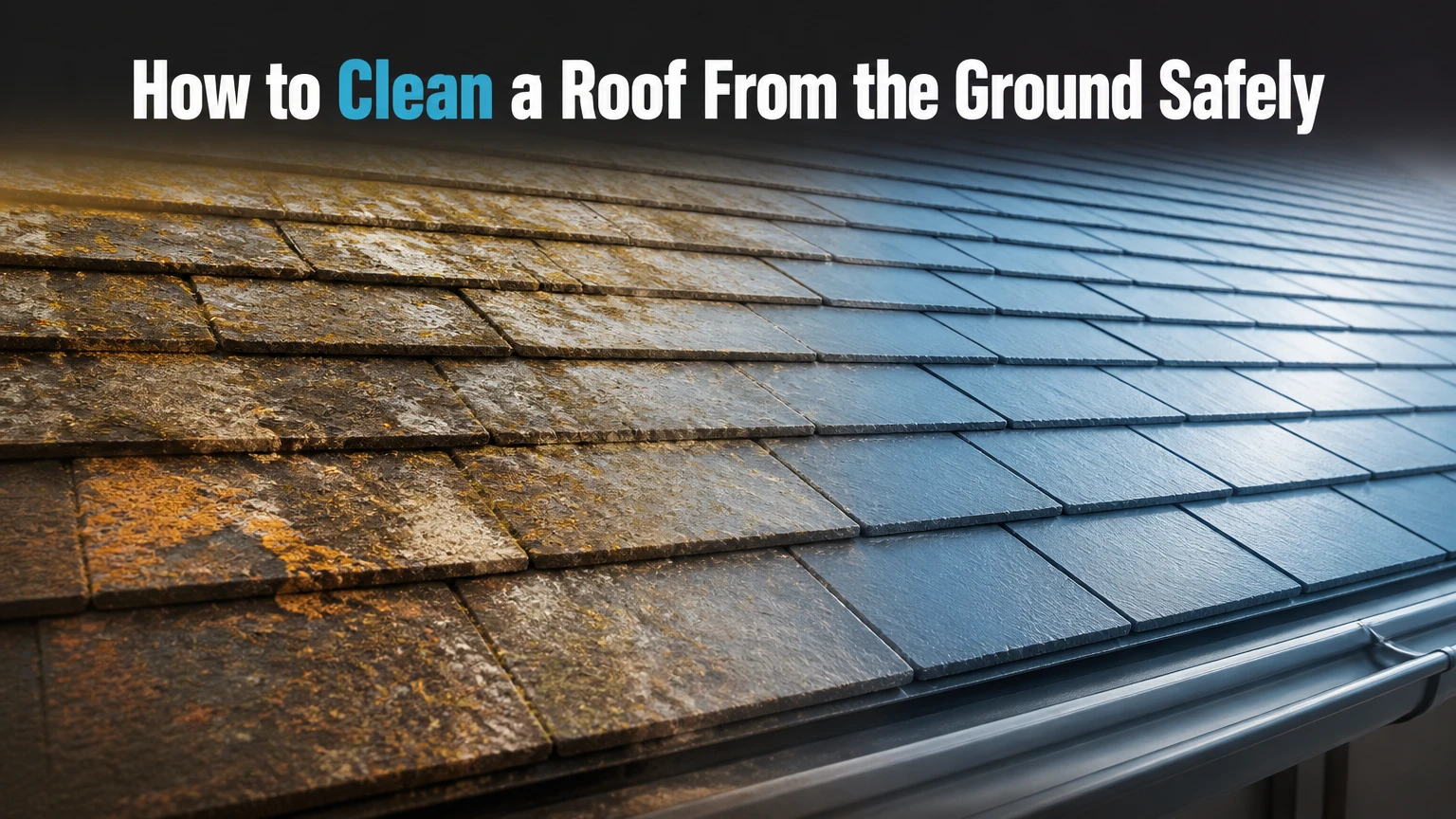
To clean a roof from the ground, apply a manufacturer-approved roof treatment with a low-pressure sprayer, long-reach nozzle, or telescoping pole, while keeping spray away from shingle laps and protecting landscaping. The chemical kills moss, algae, and lichen; rain or a controlled low-pressure rinse removes the dead growth. Never use a pressure washer on asphalt shingles.
Key Facts at a Glance
- Ground-based roof cleaning works best through chemical action, not abrasive scrubbing or high-pressure water.
- Asphalt shingles should receive a low-pressure treatment applied from the ground or by a trained professional.
- Pre-wet plants before application and rinse them again after runoff has stopped.
- A typical 2,000-square-foot home takes 1-3 hours for setup and application, excluding delayed natural shedding.
- Chlorine-based treatments can change black algae stains within hours, while no-rinse treatments may take 2-6 months.
- Stop and hire a professional when the roof is steep, fragile, damaged, inaccessible, or unsafe to reach from ground level.
What Does Ground-Based Roof Cleaning Mean?
Ground-based roof cleaning means treating roof surfaces without walking on the roof or placing a worker on a ladder. A hose-end sprayer, low-pressure pump, long-range nozzle, or telescoping application pole delivers the solution from a stable position on the ground.
The method is appropriate for many one-story asphalt-shingle roofs and some accessible two-story roofs, but “from the ground” does not automatically mean safe or effective. The operator still needs a clear line of sight, enough reach, controlled runoff, and a treatment approved for the roofing material. A missed ridge or poorly controlled stream can leave growth behind or drive liquid beneath overlapping shingles.
Ground cleaning is a treatment method, not a guarantee that every roof can be cleaned without access equipment. Steep pitches, roof valleys hidden behind parapets, brittle shingles, skylights, solar panels, and heavy moss mats often require a professional inspection before spraying.
What the Method Is Designed to Remove
| Growth or deposit | Typical appearance | Main treatment objective | Expected result |
|---|---|---|---|
| Gloeocapsa magma algae | Black or brown vertical streaks | Kill surface algae and loosen pigment | Streaks fade from hours to several weeks |
| Moss | Green, raised, cushion-like mats | Kill roots and reduce attachment | Dead moss sheds over weeks or months |
| Lichen | Pale green, gray, or orange crusts | Kill the organism without scraping shingles | Removal is slower than algae removal |
| Dirt and pollen | Tan, gray, or dusty film | Lift loose surface contamination | Visible improvement after treatment or rain |
How Does Soft Washing Work From the Ground?
Soft washing combines a low-pressure liquid stream with a roof-safe cleaning agent, surfactant, and sufficient coverage time. The solution wets the organic growth, disrupts its cells or metabolism, and loosens the material so weather can remove it without granule-stripping abrasion.
The commonly repeated pressure figure of “under 150 PSI” is not a universal safety threshold. A narrow stream at 100 PSI can damage a shingle edge, while a properly distributed spray at a lower pressure may clean more evenly. The nozzle, distance, flow rate, roof condition, and spray angle matter as much as the pump gauge. For asphalt shingles, the practical rule is to use the lowest pressure that delivers complete coverage and never use a concentrated jet to scour the surface.
The Asphalt Roofing Manufacturers Association recommends avoiding pressure washing on asphalt roofing because aggressive water can remove protective granules and force water into vulnerable areas. Roof-cleaning chemical labels remain the controlling authority because formulas differ in concentration, required dwell time, rinsing, and material compatibility.
How Much Reach Do You Need?
Choose delivery equipment by vertical roof height, horizontal setback, wind exposure, and the height of the ridge, rather than by the advertised maximum distance alone. A sprayer that reaches a ridge in still air may fail when wind bends the stream or when the operator must stand farther from the wall.
| Delivery system | Typical practical reach | Control level | Best application |
|---|---|---|---|
| Hose-end sprayer | 15-20 feet | Low to moderate | Small patches on low, one-story roofs |
| Long-range shooter nozzle | 25-30 feet | Moderate | Open sightlines and low-pitch roofs |
| Fiberglass telescoping pole | 12-24 feet | High | Precise treatment on one- and two-story walls |
| Dedicated soft-wash pump | 30-40 feet with suitable nozzle | Moderate to high | Large roofs and professional applications |
A stated reach of 30-40 feet does not mean a uniform cleaning pattern at that height. Test the system on a harmless vertical surface first. The stream should produce a controlled fan or coherent wet pattern, not a forceful needle that can cut into shingle edges.
What Equipment and Materials Are Required?
A basic ground-cleaning setup needs a roof-treatment product, compatible sprayer, garden hose or pump, clean water, protective equipment, plant-protection materials, and a way to control runoff. Product quantity depends on roof area and label dilution, so estimate the roof surface before mixing.
Before You Start
| Requirement | Typical amount or range | Practical specification |
|---|---|---|
| Application time | 1-3 hours | Includes setup, spraying, and cleanup for a typical home |
| DIY supply budget | $50-$250 | Product, sprayer, hose, protective equipment, and plant covers |
| Telescoping pole | 12-24 feet | Fiberglass is electrically safer than conductive metal near service lines |
| Protective eyewear | 1 pair | Chemical splash protection with side coverage |
| Chemical-resistant gloves | 1 pair | Use the glove material specified by the product safety data sheet |
| Clean water | Several hundred gallons for large sites | Quantity depends on plant rinsing and product instructions |
Use a dedicated chemical pump when a hose-end sprayer cannot reach the ridge or maintain an even application. Do not improvise fittings that can fail under pressure, and do not use a sprayer that previously held herbicide unless the manufacturer confirms safe decontamination.
Keep a roof plan, camera, or binoculars available. Ground-level viewing often misses back slopes and shaded valleys.
Which Roof-Cleaning Equipment Fits Your Roof?
A telescoping pole provides the greatest control, while a hose-end sprayer is the simplest option for low roofs. Long-range nozzles cover open areas quickly, but they give the operator less control over overspray and are less suitable near windows, neighboring properties, or delicate plants.
| Roof situation | Preferred equipment | Why it fits | Main limitation |
|---|---|---|---|
| One-story ranch, low pitch | Hose-end sprayer | Low cost and simple setup | Weak reach and uneven dilution |
| Two-story asphalt roof | Pump with long-range nozzle | More flow and reliable height | Requires chemical-handling skill |
| Dormers and roof obstructions | Telescoping pole | Precise placement around features | Slower coverage |
| Dense landscaping below eaves | Pole and low-output nozzle | Better overspray control | Requires more operator time |
| Steep or fragile roof | Professional system and inspection | Reduces climbing and surface contact | DIY application may remain unsafe |
A flexible pole also helps keep spray directed downward across the shingle plane. Do not lean a pole against gutters, fascia, skylights, or solar panels.
Step 1: Inspect the Roof and Prepare the Site
Inspect the roof from the ground before mixing chemicals, and postpone cleaning if you see missing shingles, exposed underlayment, sagging areas, loose flashing, damaged gutters, or active leaks. Confirm that the spray path will not cross electrical conductors, air intakes, open windows, ponds, vegetable gardens, or children’s play areas.
Walk around the house and identify where runoff will land. Close windows, move outdoor furniture, cover vulnerable fixtures, and divert downspouts if contaminated water would discharge onto sensitive planting beds. Protecting plants requires more than a plastic cover because trapped chemical spray can concentrate heat and residue beneath the sheet.
Check the weather forecast. A typical workable window is mild, overcast, and calm, with no immediate heavy rain unless the product label specifically permits rainfall soon after application. Avoid strong wind, extreme heat, freezing temperatures, and surfaces that will dry before the label dwell time ends.
Success checkpoint: The roof condition, spray path, runoff destination, and weather window are documented before chemical mixing.
Common mistake: Covering plants without first saturating their leaves and root-zone soil.
Step 2: Pre-Wet Landscaping and Exterior Surfaces
Thoroughly wet plants, grass, shrubs, soil, siding, windows, and exterior fixtures beneath the roof edge with clean water. Pre-wetting reduces absorption and dilutes incidental overspray, but it does not make concentrated runoff harmless.
Give special attention to evergreen foliage, delicate annuals, painted surfaces, unsealed stone, aluminum gutters, and nearby water features. Remove or isolate pets, bird feeders, fish ponds, and children’s equipment. Keep a hose ready for immediate spot-rinsing during application.
Do not rely on plant covers alone. Covers can protect against direct droplets but may hold residue against leaves. On hot days, remove covers after the application and rinse the plants again.
Success checkpoint: Leaves and soil are visibly saturated, windows are closed, and sensitive items are outside the runoff zone.
Common mistake: Wetting vegetation once and leaving it unattended while a slow application produces repeated chemical runoff.
Step 3: Mix the Roof Treatment According to the Label
Mix only the product and dilution specified for the roof material and sprayer. Sodium hypochlorite, oxygen bleach, quaternary ammonium compounds, surfactants, and proprietary treatments have different handling requirements, and a generic internet ratio can produce a corrosive or ineffective mixture.
Some professional asphalt-shingle treatments use diluted sodium hypochlorite, while consumer products may use oxygen bleach or quaternary ammonium compounds. The AI Overview’s 3%-4% sodium hypochlorite figure should not be treated as a universal homeowner recipe because “active strength” can refer to different points in the supply chain. Calculate from the product label and starting concentration, or use a ready-to-use product.
Never mix bleach with acids, ammonia, vinegar, or other cleaners. Chemical reactions can release toxic gases. Wear eye protection, chemical-resistant gloves, long sleeves, and footwear that remains stable on wet ground.
Add surfactant only when the label allows it. A surfactant helps liquid cling to sloped shingles, but excessive foam can hide coverage and increase runoff.
Success checkpoint: The mixture is labeled, measured, compatible with the sprayer, and prepared with fresh water.
Common mistake: Strengthening a solution because black streaks did not disappear immediately.
Step 4: Apply the Solution From the Ground
Apply the treatment in manageable sections, starting at the lower roof edge and working upward so the operator can observe runoff and maintain wet coverage. Keep the nozzle angled across the shingle surface, never upward beneath shingle laps, flashing, ridge vents, or exposed edges.
Work in sections about 5-10 feet wide, depending on roof height and wind. Saturate organic growth without creating a continuous sheet of runoff. A long-range stream should break into a controlled spray before it reaches the roof; a sharp jet can dislodge granules and damage seal strips.
Stand where falling droplets will not land on your face. Avoid looking directly overhead, and use a camera or binoculars to inspect coverage from a safer viewing angle. Treat shaded valleys and north-facing slopes carefully because they often hold the greatest moisture and growth.
Success checkpoint: The target surface is evenly wet, organic growth is coated, and runoff remains controlled at the eaves.
Common mistake: Spraying from below at a steep upward angle, which can drive water under shingle courses.
Step 5: Allow Dwell Time Without Letting the Roof Dry
Let the solution remain wet for the product’s stated dwell time, commonly 10-20 minutes for some active treatments. The correct duration depends on chemical type, temperature, roof porosity, growth thickness, and label instructions.
Watch the first section continuously. If the roof dries before the required dwell time, apply a light recoat to that section rather than flooding the entire roof. Do not extend dwell time indefinitely on a hot roof, because longer contact can increase damage to metal, paint, plants, and adjacent siding without improving the result.
Algae often changes color quickly, but moss and lichen can remain attached after they are dead. A white, tan, or brittle appearance can indicate successful treatment rather than failure.
Success checkpoint: The treated area stays wet for the label period, with no uncontrolled pooling or rapid drying.
Common mistake: Scrubbing immediately because dead moss remains physically attached.
Step 6: Rinse or Leave the Treatment as Directed
Rinse only when the product label requires rinsing, and use a broad, low-pressure flow directed down the roof plane. Sodium hypochlorite products often require thorough rinsing, while some quaternary ammonium treatments are designed to remain and let rain remove dead growth gradually.
Do not substitute a pressure washer for a rinse hose. A garden hose with a high-flow nozzle can remove residue from compatible surfaces without the concentrated force of a pressure-washing tip. Rinse gutters, siding, windows, downspouts, and nearby hardscape while preventing contaminated water from entering ponds or storm drains where local rules prohibit it.
Some roof systems, especially tile, metal, wood, and membrane roofs, require different cleaning procedures. A treatment labeled for asphalt shingles is not automatically suitable for another material.
Success checkpoint: The roof has either been rinsed according to the label or left untreated by water because the product specifies a no-rinse process.
Common mistake: Rinsing no-rinse products aggressively and washing active treatment into landscaping.
Step 7: Rinse Landscaping and Check the Result
Rinse plants, grass, soil, siding, windows, gutters, and exterior fixtures again after roof runoff has stopped. Flush downspouts toward an approved discharge area, and spot-rinse any visible residue on painted or metal surfaces.
Inspect the roof from several ground positions. Look for missed ridge sections, untreated valleys, concentrated runoff marks, damaged flashing, and areas where growth remains thick. Photograph the roof immediately and again after the next substantial rainfall so you can distinguish delayed shedding from incomplete treatment.
Do not scrape treated moss from the ground with a pole or rake. Scraping can remove shingle granules, break brittle tiles, and loosen flashing. If dead material remains after the label’s stated interval, obtain product-specific guidance or arrange a professional assessment.
Which Chemical Method Should You Use?
The best roof treatment depends on the roof material, desired speed, plant exposure, and product label, not on the strongest available chemical. Chlorine-based products act quickly but demand careful runoff control; oxygen bleach usually has a gentler environmental profile but may work slowly; quaternary ammonium treatments often provide delayed, no-rinse results.
| Treatment type | Typical visible timing | Main strength | Main risk or limitation |
|---|---|---|---|
| Diluted sodium hypochlorite | Hours to 24 hours | Fast algae and moss kill | Plant, metal, paint, and runoff damage |
| Sodium percarbonate | Hours to several days | Lower chlorine exposure | Thick moss may remain attached longer |
| Quaternary ammonium treatment | 2-6 months | Delayed no-rinse maintenance | Poor choice for immediate cosmetic results |
| Ready-to-use proprietary cleaner | Label-specific, often 1-14 days | Simplified measuring | Higher unit cost and less control |
Product claims about plant safety still require careful application. “Biodegradable” does not mean harmless at every concentration, and “no rinse” does not mean runoff can enter a pond or storm drain.
How Do Roof Materials Change the Method?
Roof materials determine chemical compatibility, acceptable pressure, and whether ground-based spraying is appropriate. Asphalt shingles tolerate low-pressure chemical treatment when the product is approved, while tile, wood, metal, and single-ply membranes require material-specific instructions.
| Roof material | Ground-cleaning suitability | Pressure rule | Main caution |
|---|---|---|---|
| Asphalt shingles | Often suitable | Low pressure only | Avoid granule loss and shingle-lap intrusion |
| Concrete or clay tile | Possible with label approval | Low pressure and broad spray | Brittle tiles can crack under impact or foot traffic |
| Painted metal | Possible with compatible cleaner | Low pressure | Chemical can dull paint or corrode exposed metals |
| Wood shakes | Specialist assessment recommended | Very low pressure | Moisture and chemicals can worsen splitting or decay |
| EPDM or TPO membrane | Label and manufacturer approval required | Avoid aggressive spray | Seams, coatings, and adhesives may react |
Solar panels, skylights, ridge vents, copper flashing, zinc-coated gutters, and painted trim also need protection. A roof may be chemically clean yet still suffer damage from incompatible runoff.
What Should You Never Do?
Avoid five actions that cause most preventable roof-cleaning failures:
- Do not pressure-wash asphalt shingles. High-pressure water can strip ceramic granules, damage seal strips, and shorten roof service life.
- Do not spray upward under laps. Water can enter beneath shingle courses and reach underlayment or roof decking.
- Do not apply in strong wind. Overspray can reach faces, neighboring yards, vehicles, ponds, and edible plants.
- Do not mix cleaning chemicals. Bleach combined with acids or ammonia can generate hazardous gas.
- Do not climb a wet or steep roof to improve coverage. A delayed cosmetic result is safer than a fall or damaged roofing system.
A counterintuitive practitioner rule is that more water does not compensate for poor coverage. Flow should be sufficient to wet the target evenly, but excessive volume increases runoff without improving chemical contact.
What If Moss, Lichen, or Black Streaks Remain?
Remaining growth does not always mean the treatment failed. Black algae pigment can persist after the organism dies, while thick moss and lichen may need repeated weather exposure before they detach.
| Symptom after treatment | Likely cause | Correct response | Avoid |
|---|---|---|---|
| Moss turns pale but stays attached | Growth is dead but rooted in surface debris | Allow rain and wind to loosen it | Scraping with a pole |
| Black streaks remain | Pigment persists or coverage was incomplete | Reinspect, then follow label reapplication rules | Increasing concentration casually |
| Brown plant tips appear | Overspray, runoff, or inadequate rinsing | Rinse foliage and soil thoroughly | Applying more roof chemical |
| Roof dries during dwell | Heat, sun, low humidity, or thin application | Rewet lightly within label limits | Flooding the roof |
| Water enters a wall or attic | Spray angle, flashing, or existing defect | Stop, inspect, and arrange roof repair | Continuing the wash |
If stains remain after the manufacturer’s reapplication interval, the issue may be embedded discoloration, shingle aging, granule loss, or a roof defect rather than living algae.
When Should You Hire a Professional?
Hire a licensed, insured roof-cleaning or roofing professional when the roof is steep, more than two stories high, visibly damaged, heavily covered with moss, difficult to view, or adjacent to electrical hazards. Professional service is also the safer choice when chemical runoff could affect a pond, extensive landscaping, neighboring property, or a shared drainage system.
Ask the contractor for the treatment product, roof-material compatibility, pressure approach, plant-protection plan, insurance certificate, and wastewater procedure. A contractor who proposes high-pressure cleaning for asphalt shingles is using a method that conflicts with ARMA’s low-impact maintenance guidance.
Professional soft-wash pricing commonly falls around $400-$900 for a standard residential roof, but regional labor rates, roof area, access, pitch, growth severity, and cleanup requirements can move the price substantially. DIY supplies commonly cost $50-$250, excluding repairs or specialized pumps.
Situations That Require Extra Caution
- Two-story homes: Confirm the ridge can be reached without standing against a wall or gutter.
- Heavy moss: Treat first; do not pull mats from shingles while they are anchored.
- Solar installations: Follow the panel manufacturer’s cleaning rules and protect electrical equipment.
- Rainy climates: Schedule treatment when the roof can remain wet for the required dwell time.
- Dry climates: Avoid hot, sunny conditions that evaporate the solution before it works.
- Older roofs: Have a roofer assess granule loss, brittleness, flashing, and remaining service life.
How Much Time and Money Does Ground Cleaning Take?
A typical ground-based application for a 2,000-square-foot home takes 1-3 hours, while visible completion ranges from the same day to several months. Immediate timing applies mainly to aggressive algae treatments; moss shedding and no-rinse formulas often require repeated rainfall.
| Project condition | DIY time | Typical DIY cost | Typical professional cost |
|---|---|---|---|
| Small algae streaks, one story | 1-2 hours | $50-$100 | $250-$500 |
| Standard 2,000-square-foot roof | 1-3 hours | $75-$250 | $400-$900 |
| Dense moss and lichen | 2-4 hours plus delayed shedding | $125-$300 | $600-$1,200 |
| Two-story or obstructed roof | 2-5 hours | $150-$400 | $700-$1,500 |
These are typical planning ranges, not fixed market prices. Repairing damaged shingles, treating extensive landscaping, removing gutter debris, or using access equipment can add substantially to the final bill.
How Can You Prevent Roof Growth From Returning?
Reduce persistent moisture and shade after cleaning because chemical treatment does not correct the conditions that support algae, moss, and lichen. Trim branches that shade the roof, keep gutters and downspouts clear, correct leaks, and improve attic ventilation when condensation contributes to dampness.
Copper or zinc strips near a roof ridge can reduce future growth as rain carries metal ions across the shingles, but installation must follow roofing and manufacturer guidance. Metal runoff can stain siding, damage plants, and affect aquatic life. Strips also cannot compensate for deep shade, blocked drainage, or a leaking roof.
Schedule a ground inspection at least annually, especially on north-facing slopes and under overhanging trees. Early treatment is safer than removing a thick moss mat because mature growth holds moisture and can lift shingle edges.
FAQ
Can I Clean a Roof Without Climbing a Ladder?
Yes, many low-pitch one-story roofs can be treated from the ground with a hose-end sprayer, long-range nozzle, or telescoping pole. Ground cleaning still requires safe chemical handling, adequate reach, a clear view, and runoff control. If the ridge cannot be covered evenly, do not compensate by climbing an unstable ladder or wet roof.
Is It Safe to Spray a Roof With a Garden Hose?
A garden hose can deliver a compatible low-pressure rinse or a labeled hose-end treatment, but hose pressure alone usually will not remove embedded moss safely. A concentrated nozzle stream can damage shingle edges or force water beneath laps. Use a broad spray directed down the roof slope and follow the product label.
How Often Should a Roof Be Cleaned?
Many roofs need inspection annually and treatment only when algae, moss, or lichen becomes established. The interval varies with shade, rainfall, roof orientation, ventilation, and nearby trees. A clean roof in a sunny, dry setting may go several years, while a damp north-facing roof can require attention much sooner.
Will Roof Cleaning Remove Black Streaks Permanently?
Roof cleaning can kill the algae that causes black streaks, but stains may remain temporarily because pigment can persist after treatment. New growth can return when moisture and shade remain. Improving drainage, trimming branches, and using a compatible preventive treatment can extend the cosmetic result.
Can I Use Vinegar to Clean Roof Shingles?
Vinegar is not a universal roof-cleaning solution and can affect nearby metals, plants, sealants, and painted surfaces. It may also fail against established moss or lichen. Use a product labeled for the specific roofing material, and never combine vinegar or other acids with bleach.
Should Dead Moss Be Removed Immediately?
Dead moss should usually remain until rain and wind loosen it, unless the product manufacturer gives different instructions. Immediate scraping can remove asphalt-shingle granules or break brittle tile. If thick material remains after the permitted treatment interval, have a roofing professional assess whether manual removal is safe.
The Bottom Line
Learning how to clean a roof from the ground safely means using a compatible low-pressure treatment, reaching the roof without forcing spray beneath shingle laps, and managing every drop of runoff. Pre-wet and post-rinse vegetation, follow the chemical label rather than a generic ratio, avoid pressure washing, and hire a professional when roof condition, height, slope, or surrounding property makes ground application uncertain.