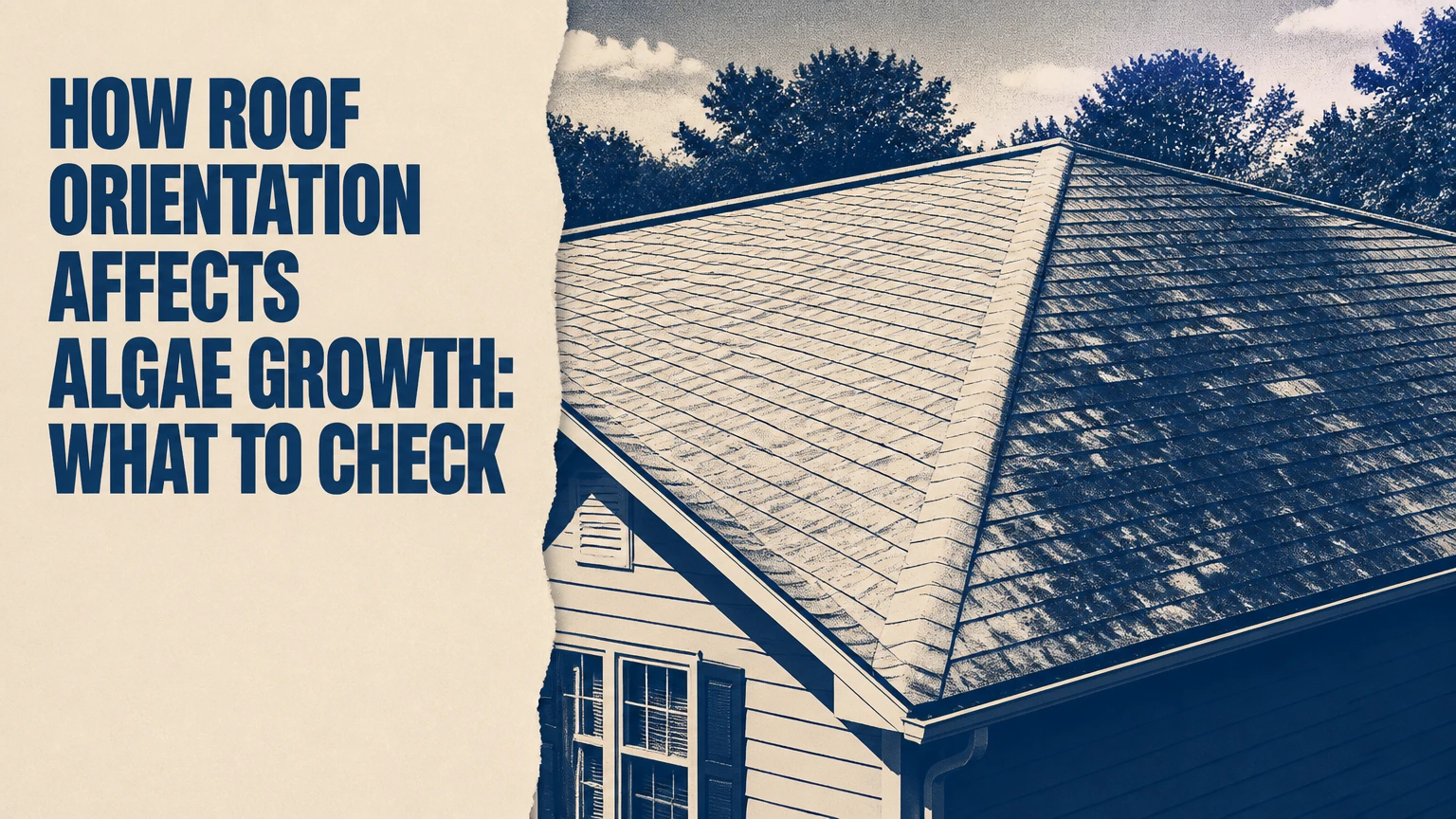
Roof orientation affects algae growth by changing how long roof surfaces remain wet and how much direct sunlight and ultraviolet radiation they receive. North-facing slopes usually have the highest risk in the Northern Hemisphere, but roof pitch, latitude, tree shade, roof material, ventilation, and nearby buildings can reverse that pattern.
Key Facts
North-facing roof slopes usually dry more slowly in the Northern Hemisphere and commonly show the earliest algae staining.
Roof orientation changes the roof’s microclimate, but shade and drainage often matter more than compass direction alone.
The black streaks commonly called roof algae are frequently associated with Gloeocapsa magma, a cyanobacterium rather than a conventional green alga.
Asphalt shingles should not be cleaned with high-pressure washing because the spray can remove ceramic granules and damage the mat.
Copper- or zinc-containing granules and correctly installed metal strips can reduce recurrence, but neither option repairs already-damaged shingles.
A typical professional soft-wash cleaning costs about $300-$800, while algae-resistant reroofing costs several thousand dollars.
What does roof orientation change?
Roof orientation changes solar exposure, surface temperature, evaporation speed, and the duration of dampness after dew or rain. A north-facing plane in the Northern Hemisphere generally receives less direct midday sun than a south-facing plane, so its shaded portions can remain cool and wet longer.
That pattern is a probability, not a guarantee. A steep west-facing roof under dense evergreen branches may stay wetter than a gently sloped north-facing roof with open sky. Dormers, parapets, chimneys, neighboring homes, roof valleys, and clogged gutters create small shaded zones that can support growth independently of the roof’s main direction.
The relevant entity is the roof-surface microclimate. Algae or cyanobacteria need a suitable combination of moisture, light, temperature, nutrients, and a surface where cells can remain attached. Orientation influences those conditions, but it does not distribute risk evenly across every roof.
How does roof orientation affect algae growth?
Airborne cells and fragments settle across roof surfaces, then moisture allows surviving organisms to remain attached and multiply. Direct sun accelerates drying and exposes colonies to ultraviolet radiation, while shaded slopes retain water longer and experience less UV exposure. Orientation therefore changes the length and frequency of the wet period rather than acting as an on-off algae switch.
The familiar black or blue-green streaking on asphalt shingles is commonly linked to Gloeocapsa magma. Roofing literature often calls it algae, although the organism is more accurately described as a cyanobacterium. A mature colony can produce dark protective pigments, making the streak visually stronger and allowing the surface community to tolerate more sunlight than newly deposited cells.
What is the growth sequence on a roof?
- Deposition: Wind, rain splash, birds, and nearby vegetation move cells or spores onto the roof.
- Wet activation: Dew, rain, fog, or high humidity wets the shingle surface.
- Attachment: Rough mineral granules and accumulated dust provide places for cells to remain.
- Colonization: Repeated wetting supports expansion across the shingle course.
- Visible staining: Pigments and the accumulated biofilm create black, green, or brown streaks.
- Material stress: Persistent moisture, heat absorption, granule displacement, and freeze-thaw exposure can increase roof deterioration.
The process is cumulative. One wet morning rarely creates a permanent colony, but repeated wetting with slow drying can produce visible streaks over a season.
Which roof orientation has the highest risk?
In the Northern Hemisphere, north-facing slopes usually carry the highest algae risk, east-facing slopes often rank second, and south-facing slopes commonly carry the lowest risk when all other conditions are similar. West-facing slopes can rank low or moderate because strong afternoon sun dries them, although late-day shade can change the result.
| Roof direction | Typical solar pattern in Northern Hemisphere | Typical drying tendency | Common algae risk |
|---|---|---|---|
| North | Limited direct sun, especially near midday | Slowest on shaded, low-pitch areas | Highest |
| East | Morning sun, afternoon shade | Moderate to slow after humid mornings | Moderate to high |
| West | Afternoon sun and higher surface heating | Moderate to fast in open locations | Low to moderate |
| South | Longest direct solar exposure | Fastest when unobstructed | Lowest to moderate |
The ranking changes in the Southern Hemisphere because the sun’s seasonal path differs. A local roof inspection should use actual shade patterns, not a generic north-south rule.
Does a north-facing roof always grow the most algae?
A north-facing roof does not always grow the most algae. Dense vegetation, a neighboring wall, a blocked valley, or a clogged gutter can make an east, west, or south slope wetter than an exposed north slope.
Roof pitch also changes the ranking. Steep slopes shed rain quickly, while low-slope asphalt roofs can retain films of water around laps, penetrations, and uneven areas. A north-facing steep roof may outperform a shallow south-facing roof beneath a tree canopy.
How do pitch and drainage change the result?
Roof pitch affects algae growth by controlling runoff speed and the amount of water that can remain against shingle surfaces. A steep asphalt roof may drain rain quickly, but dew can still persist across its shaded upper courses. Low-slope sections, valleys, and areas behind roof penetrations deserve separate inspection because they can hold moisture despite favorable orientation.
| Roof feature | Moisture effect | Algae implication | Inspection priority |
|---|---|---|---|
| 2:12 to 4:12 slope | Slower runoff than steep slopes | Higher retention near laps and valleys | High |
| 6:12 or steeper slope | Faster rain runoff | Lower rain-related retention | Moderate |
| Roof valley | Concentrates water and debris | Recurrent streaking or moss risk | High |
| Clogged gutter edge | Splashback and damp shingle courses | Localized lower-edge growth | High |
| Dormer or chimney shadow | Removes direct sun | Dense patches in shade line | High |
A roof that looks clean at the ridge can still deteriorate at eaves and valleys. Inspectors should compare upper and lower courses rather than judging only the most visible slope.
Why can shade override orientation?
Shade can override orientation because direct obstruction reduces solar drying for several hours each day. Overhanging trees also drop organic debris that holds water and supplies nutrients, while branches can abrade granules during wind events.
Tree shade explains many “wrong-way” growth patterns. A south-facing slope under an evergreen canopy may show heavier black streaks than an open north-facing slope. Buildings, solar equipment, rooftop HVAC units, and tall parapets create the same effect on a smaller scale.
A practical rule is to map shade at 9 a.m., noon, and 3 p.m. during the season when staining is most active. If a roof section remains shaded through two of those observation periods after rainfall, treat it as a high-risk microzone regardless of compass direction.
How do climate and season change orientation risk?
Climate changes the orientation ranking by changing rainfall frequency, humidity, dew formation, drying wind, and winter solar angles. In humid coastal regions and the Pacific Northwest, orientation differences are often visible because roofs experience frequent wetting. In hot, dry regions, algae may remain limited except beneath trees or on north-facing details.
| Climate or location | Dominant moisture condition | Orientation pattern | Typical maintenance implication |
|---|---|---|---|
| Pacific Northwest | Frequent rain and long damp periods | North and shaded slopes lead | Inspect annually in late spring |
| Gulf Coast | High humidity, heavy rain, warm nights | Shade and debris dominate | Clean gutters and trim canopy first |
| Northeast USA | Freeze-thaw plus seasonal shade | North slopes and valleys lead | Check granule loss after winter |
| Southwest USA | Low ambient humidity, intense sun | Shade pockets dominate | Inspect beneath trees and equipment |
| Coastal fog zone | Repeated wetting without heavy rain | East and north can remain damp | Watch for persistent film and salt debris |
Winter can temporarily alter the pattern. Low sun angles and leafless or evergreen vegetation change shadows, while snow or ice can keep a roof wet for extended periods. A spring inspection often reveals the areas that experienced the longest winter moisture exposure.
Does algae damage shingles or only stain them?
Roof algae can be cosmetic at first, but persistent biological growth can contribute to material deterioration by retaining moisture and increasing solar heat absorption. The effect depends on shingle age, granule condition, roof ventilation, climate, and whether the growth includes moss or lichen.
The often-repeated claim that algae shortens every roof’s life by 10%-20% is not a reliable universal rule. Roof manufacturers and contractors may observe faster aging on heavily stained roofs, but a defensible percentage requires controlled comparisons under the same weather, shingle batch, pitch, and maintenance history.
Algae also should not be confused with moss and lichen. Moss has a raised, fibrous appearance and can lift shingle edges. Lichen attaches more firmly and may penetrate surface irregularities. Black streaks alone usually indicate a surface biofilm rather than an immediate leak.
What does calcium carbonate have to do with asphalt shingles?
Calcium carbonate is used as mineral filler in many asphalt shingle products, and some roofing sources report that Gloeocapsa magma can use carbonate-containing material within its environment. That statement does not mean algae rapidly consumes the entire shingle or that every stained roof has structural failure.
The first measurable roof concerns are usually granule loss, exposed mat, curling, brittleness, lifted tabs, or leaks. A roof with intact granules and stable tabs may need cleaning and prevention, while a roof with widespread brittleness may need replacement regardless of staining.
Which roofing materials resist algae best?
Metal, clay tile, concrete tile, and synthetic roofing generally resist black streaks differently from mineral-granule asphalt shingles, but no material is immune in persistent shade. Surface texture, coatings, dirt retention, and drainage determine the actual result.
| Roofing material | Typical algae-stain susceptibility | Cleaning constraint | Replacement context |
|---|---|---|---|
| Asphalt shingles | Moderate to high on shaded slopes | Low-pressure treatment only | Copper-containing granules available |
| Painted steel | Low to moderate | Use coating-compatible detergent | Recoat or replace damaged panels |
| Clay tile | Low to moderate | Avoid cracking and aggressive pressure | Individual tiles often replaceable |
| Concrete tile | Moderate in damp climates | Treat without eroding surface | Repair underlayment separately |
| Wood shakes | Moderate to high with shade | Avoid forcing water beneath shakes | Condition and ventilation matter |
Algae-resistant asphalt shingles typically use copper-containing granules or another treatment integrated into the product. They reduce staining risk, but warranties may exclude unusual environmental exposure, neglect, or installation defects. Read the manufacturer’s exact warranty language.
How can homeowners clean algae without damaging shingles?
Homeowners should use a roof-compatible low-pressure cleaning method, follow the shingle manufacturer’s instructions, protect landscaping, and avoid walking on brittle or steep roofs. The objective is to kill and rinse the biological growth without stripping ceramic granules or forcing water beneath shingle laps.
The Asphalt Roofing Manufacturers Association recommends gentle cleaning methods and warns against aggressive pressure. GAF’s roof-care guidance states, “Never use a pressure washer on your roof,” because high-pressure water can dislodge granules and damage asphalt shingles.
What is the safer cleaning sequence?
- Identify the material: Confirm asphalt, metal, tile, wood, or synthetic roofing before selecting a chemical.
- Inspect the condition: Stop if shingles are brittle, severely curled, exposed at the mat, or leaking.
- Protect the site: Wet and cover sensitive plants, move outdoor furniture, and plan runoff control.
- Use a labeled roof treatment: Follow the product label and manufacturer instructions rather than copying a household bleach ratio.
- Apply from the ridge downward: Keep pressure low and avoid lifting shingle edges.
- Allow dwell time: Use the label’s contact time, commonly several minutes, without letting the solution dry.
- Rinse gently: Use low-pressure water and direct runoff away from plants and waterways.
- Inspect after drying: Look for remaining streaks, missing granules, lifted tabs, and exposed fasteners.
A 1%-2% active sodium hypochlorite solution is sometimes used by professional roof cleaners, but the correct concentration depends on the product, roof material, temperature, dwell time, and local discharge rules. Household bleach, surfactants, and acids are not interchangeable.
Do zinc or copper strips prevent recurring growth?
Zinc and copper strips can reduce algae recurrence below the strip because rain dissolves small quantities of metal and carries them down the roof surface. Strips work best when installed near the ridge, exposed to rainfall, and used on compatible roof systems with correctly sealed fasteners.
Metal strips are preventive rather than restorative. They will not replace lost granules, remove thick moss, repair leaks, or disinfect areas that rain cannot reach. Valleys, dormers, ridges with poor runoff, and complex roof geometry reduce coverage.
| Mitigation option | Typical installed cost | Useful timeframe | Best use | Main limitation |
|---|---|---|---|---|
| Professional soft wash | $300-$800 | 1-3 years on high-risk slopes | Existing staining | Does not stop new deposition |
| Zinc or copper strips | $200-$600 | About 5-10 years | Recurrence prevention | Rain coverage is incomplete |
| Algae-resistant shingles | Roof replacement, often $4,000-$12,000+ | Product warranty commonly 10-25 years | New roof installation | Requires reroofing |
| Tree and debris control | $150-$1,500 typical service range | Seasonal benefit | Shade and organic buildup | Cannot remove all moisture |
| Local shingle repair | $300-$1,200 typical minimum | Immediate defect correction | Damaged patches | Does not address whole-roof staining |
Prices vary with roof size, access, pitch, region, disposal, and whether repairs are included. A contractor should separate cleaning cost from replacement recommendations.
Which treatment fits each roof situation?
A stained but structurally sound asphalt roof usually needs cleaning first, followed by shade and moisture control. A roof nearing the end of its service life may not justify repeated treatment, especially when granule loss, curling, or leaks are already widespread.
| Roof condition | Recommended first action | Avoid | Decision threshold |
|---|---|---|---|
| Light black streaks, intact granules | Low-pressure treatment and gutter cleaning | Power washing | Reinspect after one wet season |
| Heavy staining, stable shingle tabs | Professional soft wash and shade reduction | Abrasive brushing | Add strips if recurrence is annual |
| Moss lifting edges | Professional removal and repair inspection | Pulling moss dry | Repair lifted courses promptly |
| Brittle, curled shingles | Roofing inspection before cleaning | Chemical trial on fragile roof | Replace affected sections or roof |
| Repeated growth under trees | Canopy management plus treatment | Cleaning without shade control | Trim or redesign persistent shade |
| Active leak with staining | Leak diagnosis and repair | Treating appearance first | Repair before any washing |
No cleaning method is suitable for every roof. Steep roofs, fragile shingles, asbestos-containing materials, and contaminated runoff require professional assessment.
What are the most common algae-control mistakes?
The most common mistakes are high-pressure washing, treating symptoms without removing shade and debris, using an unverified chemical mixture, and assuming all dark roof growth is algae. Each mistake can increase damage or delay a necessary repair.
- Pressure washing asphalt shingles: The spray can remove ceramic granules and expose the asphalt mat. Use a low-pressure, roof-compatible treatment instead.
- Scrubbing dry growth: Aggressive brushing can loosen granules and tear aged shingle surfaces. Let an approved treatment do the biological work.
- Using unbuffered bleach carelessly: Runoff can injure plants and corrode some metals. Protect landscaping and follow the product label.
- Installing strips where rain cannot reach: A strip behind a parapet or below a ridge cap may provide little useful coverage. Confirm runoff paths.
- Trimming branches too aggressively: Removing large limbs without an arborist plan can create safety and tree-health problems. Prioritize branches that shade or contact the roof.
- Calling moss algae: Moss lifts shingles and can create a mechanical defect that surface cleaning alone will not solve.
A practitioner rule of thumb is to fix water retention before repeating chemical treatment. Recurring growth in the same two-foot-wide strip usually points to a local moisture source, not a whole-roof algae problem.
When should a roof be replaced instead of cleaned?
Replacement becomes more appropriate when staining occurs alongside widespread granule loss, exposed fiberglass mat, curling, brittle tabs, recurring leaks, or a roof near the end of its expected service period. Cleaning a failing roof can improve appearance while leaving the primary weatherproofing problem unchanged.
Ask the inspector to document shingle condition on each orientation separately. North-side staining may be cosmetic, while a south-side slope can have hidden thermal aging from intense sun. Roof age alone should not determine the decision.
A useful inspection record includes roof age, shingle type, slope, stained area, granule condition, flashing condition, attic moisture, leak locations, and photographs. Those details produce a better decision than a sales claim based only on dark streaks.
How can you reduce algae growth after cleaning?
Reduce algae growth by shortening wet periods, increasing safe sunlight, removing organic debris, and adding a compatible preventive treatment. Begin with gutters and downspouts, then address branches, roof valleys, splashback, and blocked drainage before installing metal strips or scheduling another wash.
Use this maintenance sequence:
- Clean gutters at least twice yearly in leaf-heavy locations.
- Inspect north and shaded slopes each spring.
- Keep branches from rubbing against the roof and reduce dense canopy near roof planes.
- Check attic ventilation and interior humidity when condensation is present.
- Photograph recurring patches after rain to identify their moisture source.
- Reinspect treated roofs after one wet season, not only immediately after cleaning.
Roof ventilation does not magically remove surface algae, but it can reduce attic moisture and heat stress. It cannot compensate for a roof valley filled with leaves or a permanently shaded slope.
How much do cleaning and prevention typically cost?
Typical residential roof-algae cleaning costs $300-$800, preventive zinc or copper strips cost about $200-$600, and algae-resistant reroofing is commonly priced in the $4,000-$12,000-plus range. Actual costs depend on roof area, pitch, access, region, material, plant protection, and repairs.
A small single-story roof with easy access may cost less than the typical cleaning range, while a steep multi-story roof can cost substantially more. Contractors may also charge separately for gutter cleaning, branch removal, moss treatment, repairs, or water containment.
| Project scope | Typical time on site | Typical cost range | Output |
|---|---|---|---|
| Small one-story soft wash | 2-4 hours | $250-$500 | Streak reduction or removal |
| Average residential soft wash | 4-8 hours | $300-$800 | Full roof treatment |
| Metal-strip installation | 2-5 hours | $200-$600 | Rain-activated prevention |
| Canopy trimming near roof | 2-8 hours | $150-$1,500 | Reduced shade and debris |
| Partial shingle repair | 2-6 hours | $300-$1,200 | Localized weatherproofing |
| Full reroof with resistant shingles | 1-3 days | $4,000-$12,000+ | New roof surface |
Get written confirmation of chemical concentration, runoff protection, pressure limits, plant protection, warranty exclusions, and whether the quoted price includes repairs.
How should you evaluate a contractor?
Choose a contractor who identifies the roof material, documents existing damage, explains runoff control, and gives a cleaning method compatible with the manufacturer’s instructions. A contractor who proposes high-pressure washing for asphalt shingles is using a method that conflicts with major roofing-care guidance.
Ask five specific questions:
- What pressure will you use at the shingle surface?
- What product and active concentration will you apply?
- How will you protect plants, siding, gutters, and collected runoff?
- Which damaged areas should be repaired before cleaning?
- What recurrence period is realistic for this roof’s shade and climate?
A responsible estimate distinguishes algae removal from roof repair. It also avoids promising permanent prevention, because airborne deposition and recurring moisture remain environmental realities.
Frequently Asked Questions
Does roof color affect algae growth?
Roof color affects surface temperature and visibility more than it determines biological growth. Dark shingles can become hotter in direct sun, which may speed drying, while dark algae streaks are less noticeable on dark roofs. Shade, wetting frequency, pitch, and material texture usually matter more than color alone.
Can rain wash algae off a roof?
Rain can remove loose dirt and dead surface material, but rain rarely removes an established algae colony. Repeated rainfall may spread dissolved metals from copper or zinc strips, yet it does not substitute for a compatible cleaning treatment. Heavy rain can also move organic debris into valleys and gutters, increasing moisture retention.
Are algae-resistant shingles worth the cost?
Algae-resistant shingles are most cost-effective during a planned roof replacement in a damp or heavily shaded location. Copper-containing granules can reduce black streaking, but they do not eliminate growth under constant shade and do not justify replacing a structurally sound roof solely for cosmetic reasons.
Can roof algae grow on metal roofing?
Roof algae can grow on metal roofing when dust, pollen, and moisture accumulate, especially beneath trees or around seams. Painted or coated metal usually resists attachment better than granular asphalt, but harsh chemicals and abrasive cleaning can damage the finish. Use a coating-compatible cleaner and low-pressure rinse.
Should roof algae be removed before selling a house?
Removing visible roof algae can improve curb appeal and prevent buyers from mistaking staining for neglected maintenance, but cleaning does not conceal structural defects. Obtain a roof inspection when shingles show curling, missing granules, moss lifting, leaks, or an age near the expected replacement period.
Does attic ventilation stop roof algae?
Attic ventilation does not directly stop algae on the exterior roof surface. Proper ventilation can reduce interior condensation and heat stress, but exterior moisture from dew, rain, fog, shade, and debris remains the main driver of surface growth. Correct blocked drainage and shade before expecting ventilation changes to solve staining.
The Bottom Line
How roof orientation affects algae growth is primarily a question of drying time and sunlight, not compass direction alone. North-facing slopes usually carry the greatest risk in the Northern Hemisphere, but tree shade, roof pitch, valleys, gutters, climate, and roofing material can change the ranking.
Start with a roof-condition inspection, remove debris and excessive shade, and use a low-pressure cleaning method appropriate for the material. Add copper or zinc prevention when runoff can reach the roof, and choose algae-resistant shingles during a planned replacement rather than replacing a sound roof for staining alone.